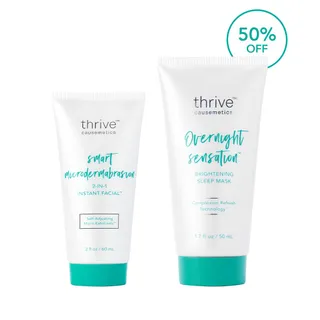
Thrive Causemetics Overnight Sensation Sleep Mask
Works for
MoisturizingPanthenol, Cetyl alcohol + 32 moreWorks well
“This potent skin-loving formula melts into skin to restore moisture + rejuvenates skin so you wake up with a smoother, brighter, more hydrated complexion.”
This product can help improve hydration of the skin with the two types of ingredients.
The first type is called “humectants”:
these ingredients help attract water.
When humectants are on the surface of the skin, they “pull in” the moisture from the outside environment, or from
within deeper layers of the skin. The following ingredients in this product do the job:
alanine, arginine.
This product also contains ingredients called “occlusives”. They help reduce the speed with which our skin loses moisture to the outside environment. These ingredients also help soften the upper layer of the skin, so it feels less tight and nicer to the touch. The following ingredients in this product do the job: arginine, dimethicone.
The following ingredients in this product are especially good for supporting the skin barrier and helping with the hydration level: panthenol
ExfoliationSide benefit · Betaine salicylate, Glycolic acid + 4 moreWorks well
This product can help exfoliate the skin. In other words, it helps break down the bonds between dead cells on the surface of the skin and speed up the skin turnover. Skin often appears softer and brighter after exfoliation, but overdoing it can result in disrupted skin barrier. The following ingredient is doing the exfoliating job in this product: betaine salicylate, glycolic acid.
Evens skin toneSide benefit · Glycolic acid, Glycyrrhiza glabra root extract + 5 moreWorks well
This product can help reduce hypepigmentation and even out the skin tone because it contains the following effective ingredients: betaine salicylate, glycolic acid
The following ingredient (ingredients) in this product might be helpful, but there is no evidence to confirm that it actually can help even out the skin tone: alanine, glycyrrhiza glabra root extract, vitis vinifera juice extract.
Keep in mind that you would need to apply any topical skincare targetted at hypigmentation consistently for a couple of months to get a result. No topical skincare product can help get rid of hyperpigmentation (including post-acne marks and age spots) instantly.
Anti-agingSide benefit · Glycolic acid, Threonine + 7 moreWorks well
This product can help reduce and prevent fine lines and wrinkles, improve skin elasticity and firmness because it contains glycolic acid.
These ingredients in the product can also be helpful, even though there is less evidence for their effectiveness: serine, threonine.
Keep in mind that it typically takes at least 6 weeks to notice any results because the changes that are needed to improve fine lines and elasticity happen in the deeper layers of the skin. No topical anti-aging product can “erase” wrinkles or fully reverse signs of aging.
Anti-blemishSide benefit · Betaine salicylate, Glycolic acid + 2 moreMay help
This product might be able to help reduce blemishes and clogged pores because it contains betaine salicylate.
The following ingredient (ingredients) in this product might be helpful, but there is no evidence to confirm that it actually works: glycolic acid
Anti-oxidationSide benefit · Melatonin, Tartaric acid + 5 moreMay help
This product contains antioxidants (melatonin, tartaric acid) that might be able to help neutralize free radicals in skin to lessen the damage it gets from the UV light (sun). There is not enough evidence to confirm their effectiveness in skin though.
Can it cause trouble?
Irritancy10 strong irritants: Citrus limon peel extract, Citrus aurantium dulcis fruit extract + 8 more — patch-test recommendedHigh risk
Comedogenic2 ingredients rated 2 or more on the 0–5 pore-clogging scale2 flagged

User reviews
Be the first — your take helps the next person decide.
Ingredients
Filter by role to see what each ingredient is doing.
Water~45–55%
Aloe barbadensis leaf juice~6.3–7.7%
- Irritation risk
- Medium
Traditionally used to treat sunburns, dermatitis and inflammation, but evidence for its effectiveness is lacking. The extract can contain humectants that help attract water into the skin
More about Aloe barbadensis leaf juiceIsopropyl palmitate~4–4.9%
- Irritation risk
- Medium
- Comedogenicity
- 3/5
Helps soften the upper layer of the skin and create a thicker product consistency
More about Isopropyl palmitatePropanediol~3–3.7%
- Irritation risk
- Low
Acts as a solvent for other ingredients. Speeds up the absorption of other ingredients into the skin
More about PropanediolCellulose~2.3–2.8%
- Irritation risk
- Low
Can be used to help absorb oil as well as add volume and imporve texture of products.
More about CelluloseCetyl alcohol~1.9–2.3%
- Irritation risk
- Low
A non-drying alcohol that works to soften the skin and stabilize product formulations helping oil and water mix together
More about Cetyl alcoholGlycereth-26~1.5–1.9%
Glyceryl stearate~1.3–1.6%
- Irritation risk
- Low
An emollient that softens the skin and forms a protective layer on its surface. Helps water and oil mix together
More about Glyceryl stearateMicrocrystalline cellulose~1.1–1.4%
Lactic acid~0.7–1%
- Irritation risk
- Medium
An exfoliating and moisturizing alpha-hydroxy acid (AHA). Typically causes less irritation than other AHAs, for example, glycolic acid. At high concentrations (about 15%), lactic acid can help reduce lines and wrinkles. Recent studies show that lactic acid can support the "good" bacteria living on skin's surface (healthy skin microbiome)
More about Lactic acidBetaine salicylate~0.55–0.8%
- Irritation risk
- Medium
Exfoliating acid, a "relative" of salicylic acid
More about Betaine salicylateNiacinamide~0.45–0.7%
- Irritation risk
- Low
Is proven to be effective in reducing blemishes, evening out skin tone and helping to improve lines and wrinkles. It helps the skin to repair sun damage, calm down inflammation and keep maintain good levels of moisture. The concentration of about 2% is effective for supporting the skin barrier and evening out the skin tone. Concentration of 4-6% is better for helping with acne and balancing the sebum production
More about NiacinamideSqualane~0.45–0.7%
- Irritation risk
- Low
An oil naturally present in skin. Works as an emollient to soften the skin and form a protective layer on its surface without a greasy feeling.
More about SqualaneGlycolic acid~0.3–0.6%
- Irritation risk
- High
An alpha-hydroxy acid (AHA) that helps to remove the dead skin cells on the surface of the skin reveling a more even, smoother complexation. It is also able to stimulate collagen production with long-term use. Could help to reduce pore congestion. It can be irritating to the skin. Apply sunscreen daily if using products with glycolic acid
More about Glycolic acidMalic acid~0.3–0.55%
Sodium hyaluronate~0.3–0.5%
- Irritation risk
- Low
One of the best moisturizing ingredients. Attracts water into the upper layer of the skin
More about Sodium hyaluronateVaccinium myrtillus fruit/leaf extract~0.25–0.45%
- Irritation risk
- Low
Saccharum officinarum extract~0.25–0.4%
- Irritation risk
- Low
Sugar extract that helps attract water to the upper layer of the skin
More about Saccharum officinarum extractSodium lactate~0.2–0.4%
- Irritation risk
- Medium
Helps attract water to the upper layer of the skin. Is often used to adjust the pH level of the product
More about Sodium lactateTartaric acid~0.2–0.35%
- Irritation risk
- Medium
An AHA (alpha-hydroxy acid). It oxidizes quickly which makes it less effective in skincare formulations. It can support skin's barrier and moisture levels
More about Tartaric acidVitis vinifera juice extract~0.2–0.35%
- Irritation risk
- Medium
Contains AHAs that exfoliate the upper layer of the skin. Can help attract water to the upper layer of the skin due to the sugar content
More about Vitis vinifera juice extractCitrus limon peel extract~0.15–0.3%
Citrus aurantium dulcis fruit extract~0.15–0.25%
- Irritation risk
- High
A plant extract that is used as a fragrance. Can be irritating and lead to photosensitivity
More about Citrus aurantium dulcis fruit extractCitrus limon fruit extract~0.15–0.25%
- Irritation risk
- High
Used as a fragrance. Can be irritating and cause photosensitivity
More about Citrus limon fruit extractSodium pca~0.15–0.25%
- Irritation risk
- Low
Naturally present in skin and helps to attract water to its upper layer
More about Sodium pcaPca~0.15–0.25%
- Irritation risk
- Low
Naturally present in skin and helps to attract water to its upper layer
More about PcaPanthenyl triacetate~0.15–0.25%
- Irritation risk
- Low
A stable oil-soluble derivative of vitamin B5. It can help support skin barrier and reduce inflammation in skin
More about Panthenyl triacetateAcer saccharum extract~0.15–0.25%
- Irritation risk
- Medium
A plant extract that contains small percentage of AHAs. Is unlikely to have any skin benefit due the small concentration of the active compounds
More about Acer saccharum extractSerine~0.15–0.25%
- Irritation risk
- Low
An amino-acid that helps to attract water to the upper layer of the skin. In combination with other amino-acids, might help to reduce fine lines and wrinkles
More about SerineAlanine~0.15–0.25%
- Irritation risk
- Low
An amino-acid that helps to attract water to the upper layer of the skin and might help to lighten the skin, but solid evidence is lacking
More about AlanineTocopheryl acetate~0.15–0.3%
- Irritation risk
- Medium
A more stable but less bio-available form of vitamin E compared to Tocopherol. Might help moisturize and protect the skin from free radicals, but mostly used in low concentrations to stabilize other ingredients.
More about Tocopheryl acetatePanthenol~0.15–0.25%
- Irritation risk
- Low
Helps attract water to the upper layer of the skin and can help improve skin barrier function
More about PanthenolGlycine~0.15–0.25%
- Irritation risk
- Low
Helps to attract water to the upper layer of the skin and can help restore the skin barrier function
More about GlycineLactobacillus/papaya fruit ferment extract~0.2–0.35%
- Irritation risk
- High
Ananas sativus fruit extract~0.15–0.25%
- Irritation risk
- Medium
A fruit extract that might help to attract water to the upper layer of the skin, but there is no evidence for any other benefits to the skin
More about Ananas sativus fruit extractCarica papaya seed oil~0.15–0.25%
- Irritation risk
- Low
Glycol distearate~0.15–0.3%
- Irritation risk
- Medium
Helps water and oil mix together
More about Glycol distearateMethyl glucose sesquistearate~0.2–0.35%
- Irritation risk
- Medium
Helps water and oil mix together
More about Methyl glucose sesquistearateAcrylates/c10-30 alkyl acrylate crosspolymer~0.2–0.35%
- Irritation risk
- Medium
Maintains the texture of skincare products. Allows the product to spread evenly. Helps oil and water mix together
More about Acrylates/c10-30 alkyl acrylate crosspolymerGlutamic acid~0.15–0.25%
- Irritation risk
- Low
An amino-acid that helps attract water to the upper layer of the skin
More about Glutamic acidLysine hcl~0.15–0.25%
Threonine~0.15–0.25%
- Irritation risk
- Low
An amino-acid that helps to attract water to the upper layer of the skin. In combination with other amino-acids, might help to reduce fine lines and wrinkles
More about ThreonineArginine~0.15–0.25%
- Irritation risk
- Low
An amino acid that is naturally present in skin and helps keep it hydrated. When used together with AHAs, it can reduce their irritating effect on the skin
More about ArginineProline~0.15–0.3%
Betaine~0.15–0.25%
- Irritation risk
- Low
Helps attract water to the upper layer of the skin and improves the product texture
More about BetainePhytosteryl/octyldodecyl lauroyl glutamate~0.2–0.35%
- Irritation risk
- Low
A mix of amino acids and plant-based lipids. Helps to soften the upper layer of the skin and reduce water loss over time
More about Phytosteryl/octyldodecyl lauroyl glutamateSodium cocoyl isethionate~0.2–0.4%
- Irritation risk
- Medium
Helps water and oil mix together. Can be used as a cleansing agent
More about Sodium cocoyl isethionateSorbitan oleate~0.15–0.3%
- Irritation risk
- Medium
- Comedogenicity
- 2/5
Helps oil and water mix together
More about Sorbitan oleateCoco-glucoside~0.2–0.35%
- Irritation risk
- High
Used as a cleansing agent (surfactant) in cleansers. Helps water and oil mix together in lotions. Can be irritating
More about Coco-glucosideCoconut alcohol~0.2–0.35%
Xanthan gum~0.15–0.3%
- Irritation risk
- Low
Used to create a thicker product consistency
More about Xanthan gumCitric acid~0.15–0.25%
- Irritation risk
- Medium
Can work as an exfoliant but is typically used to adjust the product pH
More about Citric acidHydroxypropylcellulose~0.2–0.35%
Polyacrylate crosspolymer-6~0.15–0.3%
- Irritation risk
- Low
Trisodium ethylenediamine disuccinate~0.15–0.25%
- Irritation risk
- Medium
Used to improve stability of the formulation
More about Trisodium ethylenediamine disuccinateSodium hydroxide~0.15–0.25%
Dehydroacetic acid~0.15–0.25%
Ethylhexylglycerin~0.15–0.25%
Sodium benzoate~0.15–0.25%
Water~0.15–0.3%
Glycerin~0.2–0.35%
- Irritation risk
- Low
One of the best moisturizing ingredients. Naturally present in skin. It attracts water to the upper layer of the skin working as a humectant
More about GlycerinPropanediol~0.15–0.3%
- Irritation risk
- Low
Acts as a solvent for other ingredients. Speeds up the absorption of other ingredients into the skin
More about PropanediolButylene glycol~0.15–0.3%
- Irritation risk
- Low
Used to create a nice product texture and help delivery of other ingredients. Might be somewhat helpful in attracting water to the upper layer of the skin
More about Butylene glycolSqualane~0.2–0.4%
- Irritation risk
- Low
An oil naturally present in skin. Works as an emollient to soften the skin and form a protective layer on its surface without a greasy feeling.
More about SqualaneDimethicone~0.2–0.4%
- Irritation risk
- Low
A silicone that helps to reduce water loss from the surface of the skin. Can temporarily "fill in" lines and wrinkles, absorb oil, and create a nice product finish
More about DimethiconeHydrogenated polydecene~0.15–0.3%
- Irritation risk
- Low
Helps to soften the upper layer of the skin and create a nice product texture
More about Hydrogenated polydeceneSodium acrylates copolymer~0.15–0.25%
- Irritation risk
- Medium
Used to create a thicker product consistency
More about Sodium acrylates copolymerGlyceryl stearate~0.2–0.4%
- Irritation risk
- Low
An emollient that softens the skin and forms a protective layer on its surface. Helps water and oil mix together
More about Glyceryl stearatePhenoxyethanol~0.15–0.3%
- Irritation risk
- Low
A preservative. It helps prevent bacterial growth in cosmetic products
More about PhenoxyethanolPeg-100 stearate~0.25–0.45%
- Irritation risk
- Low
Helps oil and water mix togehter and creates a nice product texture
More about Peg-100 stearateLecithin~0.2–0.4%
- Irritation risk
- Low
Used mostly for creating emulsions - helping oil and water mix together. Helps soften the upper layer of the skin
More about LecithinRosa canina seed extract~0.2–0.35%
- Irritation risk
- Low
Hydroxyacetophenone~0.2–0.35%
Panthenol~0.2–0.35%
- Irritation risk
- Low
Helps attract water to the upper layer of the skin and can help improve skin barrier function
More about PanthenolPolyacrylate crosspolymer-6~0.2–0.4%
- Irritation risk
- Low
Evodia rutaecarpa fruit extract~0.2–0.35%
- Irritation risk
- Low
Lactic acid~0.2–0.35%
- Irritation risk
- Medium
An exfoliating and moisturizing alpha-hydroxy acid (AHA). Typically causes less irritation than other AHAs, for example, glycolic acid. At high concentrations (about 15%), lactic acid can help reduce lines and wrinkles. Recent studies show that lactic acid can support the "good" bacteria living on skin's surface (healthy skin microbiome)
More about Lactic acidMenthone glycerin acetal~0.2–0.4%
- Irritation risk
- Low
Aloe barbadensis leaf extract~0.25–0.45%
- Irritation risk
- Medium
Traditionally used to treat sunburns, dermatitis and inflammation, but evidence for its effectiveness is lacking. The extract can contain humectants that help attract water into the skin
More about Aloe barbadensis leaf extractEthylhexylglycerin~0.2–0.4%
Lavandula angustifolia oil~0.2–0.4%
- Irritation risk
- High
An essential oil. Potential allergen and can be irritating. It has some anti-bacterial properties
More about Lavandula angustifolia oilMelatonin~0.2–0.4%
- Irritation risk
- Low
A compound that can regulate sleep cycles in humans and animals. When used in cosmetics, comes from plant sources. It can work as anti-oxidant in skin when applied topically in skincare
More about MelatoninSodium hyaluronate~0.2–0.4%
- Irritation risk
- Low
One of the best moisturizing ingredients. Attracts water into the upper layer of the skin
More about Sodium hyaluronateTetrahexyldecyl ascorbate~0.2–0.4%
- Irritation risk
- Medium
Being a lipid soluble form of vitamin C, it is more stable than ascorbic acid, but still degrades quickly and needs to be stabilized in a formulation with another ingredient. It is claimed to penetrate skin better than pure vitamin C and have the the similar benefits, but solid studies of its effectiveness are lacking. Is likely to require a higher concentration in a product than pure vitamin C to be effective. It might be able to help reduce pore clogging.
More about Tetrahexyldecyl ascorbateTocopheryl acetate~0.2–0.4%
- Irritation risk
- Medium
A more stable but less bio-available form of vitamin E compared to Tocopherol. Might help moisturize and protect the skin from free radicals, but mostly used in low concentrations to stabilize other ingredients.
More about Tocopheryl acetateGlycolic acid~0.2–0.4%
- Irritation risk
- High
An alpha-hydroxy acid (AHA) that helps to remove the dead skin cells on the surface of the skin reveling a more even, smoother complexation. It is also able to stimulate collagen production with long-term use. Could help to reduce pore congestion. It can be irritating to the skin. Apply sunscreen daily if using products with glycolic acid
More about Glycolic acidVaccinium myrtillus fruit extract~0.2–0.35%
- Irritation risk
- Medium
A plant extract that might help neutralize free radicals in skin, but research on its efficacy in skin is lacking
More about Vaccinium myrtillus fruit extractAcer saccharum extract~0.2–0.35%
- Irritation risk
- Medium
A plant extract that contains small percentage of AHAs. Is unlikely to have any skin benefit due the small concentration of the active compounds
More about Acer saccharum extractCitrus aurantium dulcis fruit extract~0.2–0.35%
- Irritation risk
- High
A plant extract that is used as a fragrance. Can be irritating and lead to photosensitivity
More about Citrus aurantium dulcis fruit extractCitrus limon fruit extract~0.2–0.4%
- Irritation risk
- High
Used as a fragrance. Can be irritating and cause photosensitivity
More about Citrus limon fruit extractSaccharum officinarum extract~0.2–0.35%
- Irritation risk
- Low
Sugar extract that helps attract water to the upper layer of the skin
More about Saccharum officinarum extractPeg-12 dimethicone~0.2–0.4%
- Irritation risk
- Low
Helps soften the upper layer of the skin and create a nice product texture
More about Peg-12 dimethiconeCitric acid~0.2–0.4%
- Irritation risk
- Medium
Can work as an exfoliant but is typically used to adjust the product pH
More about Citric acidCitrus aurantium dulcis peel oil~0.2–0.35%
- Irritation risk
- High
An essentil oil from orange peel. Potential allergen and can be irritating
More about Citrus aurantium dulcis peel oilGlycyrrhiza glabra root extract~0.2–0.35%
- Irritation risk
- Medium
A plant extract that can help lighten the skin and calm down inflammation. Might be helpful in neutralizing free radicals
More about Glycyrrhiza glabra root extractTartaric acid~0.2–0.35%
- Irritation risk
- Medium
An AHA (alpha-hydroxy acid). It oxidizes quickly which makes it less effective in skincare formulations. It can support skin's barrier and moisture levels
More about Tartaric acidLimonene~0.15–0.3%
- Irritation risk
- High
A common frangrance that can easily irritate skin, especially if exposed to air, light or heat
More about LimoneneLinalool~0.15–0.25%
Citronellol~0.1–0.25%
Citral~0.15–0.25%
Mica~0.1–0.2%
- Irritation risk
- Low
Creates an illusion of smoother and more radiant skin tone. Adds shimmer to the skin by reflecting light
More about MicaTitanium dioxide~0.1–0.2%
- Irritation risk
- Low
Works as a UV filter when used in high concentrations. It is photostable and is effective mostly against the UVB light, with some protection in the UVA range. In small concentrations, used for its ability to improve the color of cosmetic products. Is usually well tolerated by the skin
More about Titanium dioxideIngredient list view
Water, Aloe barbadensis leaf juice, Isopropyl palmitate, Propanediol, Cellulose, Cetyl alcohol, Glycereth-26, Glyceryl stearate, Microcrystalline cellulose, Lactic acid, Betaine salicylate, Niacinamide, Squalane, Glycolic acid, Malic acid, Sodium hyaluronate, Vaccinium myrtillus fruit/leaf extract, Saccharum officinarum extract, Sodium lactate, Tartaric acid, Vitis vinifera juice extract, Citrus limon peel extract, Citrus aurantium dulcis fruit extract, Citrus limon fruit extract, Sodium pca, Pca, Panthenyl triacetate, Acer saccharum extract, Serine, Alanine, Tocopheryl acetate, Panthenol, Glycine, Lactobacillus/papaya fruit ferment extract, Ananas sativus fruit extract, Carica papaya seed oil, Glycol distearate, Methyl glucose sesquistearate, Acrylates/c10-30 alkyl acrylate crosspolymer, Glutamic acid, Lysine hcl, Threonine, Arginine, Proline, Betaine, Phytosteryl/octyldodecyl lauroyl glutamate, Sodium cocoyl isethionate, Sorbitan oleate, Coco-glucoside, Coconut alcohol, Xanthan gum, Citric acid, Hydroxypropylcellulose, Polyacrylate crosspolymer-6, Trisodium ethylenediamine disuccinate, Sodium hydroxide, Dehydroacetic acid, Ethylhexylglycerin, Sodium benzoate, Water, Glycerin, Propanediol, Butylene glycol, Squalane, Dimethicone, Hydrogenated polydecene, Sodium acrylates copolymer, Glyceryl stearate, Phenoxyethanol, Peg-100 stearate, Lecithin, Rosa canina seed extract, Hydroxyacetophenone, Panthenol, Polyacrylate crosspolymer-6, Evodia rutaecarpa fruit extract, Lactic acid, Menthone glycerin acetal, Aloe barbadensis leaf extract, Ethylhexylglycerin, Lavandula angustifolia oil, Melatonin, Sodium hyaluronate, Tetrahexyldecyl ascorbate, Tocopheryl acetate, Glycolic acid, Vaccinium myrtillus fruit extract, Acer saccharum extract, Citrus aurantium dulcis fruit extract, Citrus limon fruit extract, Saccharum officinarum extract, Peg-12 dimethicone, Citric acid, Citrus aurantium dulcis peel oil, Glycyrrhiza glabra root extract, Tartaric acid, Limonene, Linalool, Citronellol, Citral, Mica, Titanium dioxide
Compare prices
Retailers ranked by price — lowest first.
Worth comparing, line by line.
Match % combines shared ingredients, the first five ingredients, shared actives and hero ingredients, irritancy (lower counts in the alternative's favour), texture and body area. Only products in the same routine step are compared.
| Thrive CausemeticsOvernight Sensation Sleep MaskYOUR PRODUCT | MEDIHEALD.N.A Hydrating Protein Sheet Mask | HYGGEEActive Red Flower Mask | ManyoBifida Biome Ampoule Mask | |
|---|---|---|---|---|
| Match | — | 78% | 76% | 75% |
| Price | — | — | $7.50 | $3.00 |
| Shared key ingredients | — | 14 of 25 | 11 of 25 | 10 of 25 |
| Key difference | — | Copper Tripeptide-1 | Adenosine | Madecassoside |
| Irritancy | High | Medium | Medium | Medium |
| Drying alcohol | — | — | — | — |
| View product | Shop | Shop | Shop |


More alternatives: DEARPACKER Water Beam MaskRejuran Pore Tightening Gel Mask
Product summary
"Thrive Causemetics - Overnight Sensation™ Sleep Mask" is effective for: Evens skin tone, Anti-aging and Exfoliation
This product could be helpful for: Moisturizing and Anti-blemish, but its actives are not the most effective or are not well-studied.
Ingredient callouts
- This product contains acids (glycolic acid 0.20% - 0.40%, lactic acid 0.15% - 0.30%, glycolic acid 0.30% - 0.60% and lactic acid 0.70% - 1.00%). Their concentration is low, and they will not have a strong exfoliating effect. Instead, they work to support the skin natural acid mantle and to attract water (as humectants). Lactic acid is particularly good in attracting water to the upper layer of the skin and improving the skin barrier.
- Humectants (sodium hyaluronate 0.20% - 0.40%, glycerin 0.20% - 0.35%, betaine 0.15% - 0.25%, arginine 0.15% - 0.25%, glutamic acid 0.15% - 0.25%, glycine 0.15% - 0.25%, alanine 0.15% - 0.25%, pca 0.15% - 0.25%, sodium pca 0.15% - 0.25%, sodium lactate 0.20% - 0.40% and sodium hyaluronate 0.30% - 0.50%). These ingredients help attract water to the upper layer of the skin and improve the skin hydration.
About the brand
According to Cruelty-Free Kitty "Thrive Causemetics" is cruelty free and so is its parent company.
Price
The product retails for 63.00$ in the United States.
For a detailed price comparison: click here.
Sources cited in this review
Every concentration estimate and effectiveness label is anchored to one of these 40 studies and safety reviews.
- 1Final Report on the Safety Assessment of Isopropyl Isostearatejournals.sagepub.com
- 2
- 3Epidermal and dermal effects of topical lactic acidncbi.nlm.nih.gov
- 4Dual Effects of Alpha-Hydroxy Acids on the Skinpdfs.semanticscholar.org
- 5
- 6

Affiliate links · As an Amazon Associate, WIMJ earns from qualifying purchases.