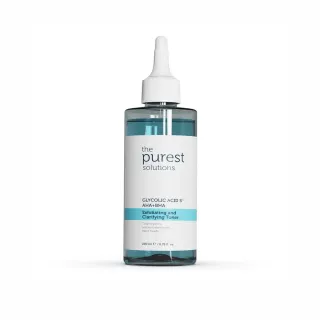
The Purest Solutions Exfoliating and Clarifying Toner Glycolic Acid 5% AHA+BHA
Works for
CleansingCoceth-7, Ppg-1-peg-9 lauryl glycol ether + 2 moreCleanses gently
“It helps to gently cleanse the skin of dead skin, oil, dirt and make-up residues, reduce the appearance of pores and balance sebum secretion.”
This product works by removing dirt and oil from the surface of the skin. It uses a combination of mild cleansing agents (coceth-7, peg-40 hydrogenated castor oil, ppg-1-peg-9 lauryl glycol ether, triethanolamine) and should be able to cleanse the skin gently. Still keep in mind that any cleansing can disrupt the skin barrier, and most people do not need to cleanse their skin more than once per day.
ExfoliationGlycolic acid, Lactic acid + 4 moreWorks well
“Exfoliating and Clarifying Toner Glycolic Acid 5% AHA+BHA”
This product can help exfoliate the skin. In other words, it helps break down the bonds between dead cells on the surface of the skin and speed up the skin turnover. Skin often appears softer and brighter after exfoliation, but overdoing it can result in disrupted skin barrier. The following ingredient is doing the exfoliating job in this product: gluconic acid, glycolic acid, lactic acid, salicylic acid.
Anti-blemishSide benefit the brand mentions · Salicylic acid, Glycolic acid + 3 moreWorks well
“Exfoliating and Clarifying Toner Glycolic Acid 5% AHA+BHA”
This product can help reduce breakouts and clogged pores because it contains the following ingredient: salicylic acid. This ingredient is used for treating acne and can have a noticeable effect.
In addition, this product contains gluconic acid. It can help in reducing blemishes, even though it is less effective.
The following ingredient (ingredients) in this product might be helpful, but there is no evidence to confirm that it actually works: glycolic acid
Can it cause trouble?
Irritancy1 strong irritant: ParfumMedium risk
ComedogenicClean of flagged comedogenic ingredientsNone flagged

User reviews
Be the first — your take helps the next person decide.
Ingredients
Filter by role to see what each ingredient is doing.
Citric acid~22–33%
- Irritation risk
- Medium
Can work as an exfoliant but is typically used to adjust the product pH
More about Citric acidLactic acid~4.6–6.9%
- Irritation risk
- Medium
An exfoliating and moisturizing alpha-hydroxy acid (AHA). Typically causes less irritation than other AHAs, for example, glycolic acid. At high concentrations (about 15%), lactic acid can help reduce lines and wrinkles. Recent studies show that lactic acid can support the "good" bacteria living on skin's surface (healthy skin microbiome)
More about Lactic acidMalic acid~4.5–6.8%
Gluconic acid~3.4–5.1%
- Irritation risk
- Medium
A polyhydroxy acid (PHA) that helps shed the dead cells from the skin surface revealing smoother skin. Is believed to be genter than AHAs. It helps attract water to the upper layer of the skin and can stimulate production of skin's own hyaluronic acid resulting in imporved hydration levels. It has been shown to be helpful against acne and clogged pores. Might help reduce fine lines and wrinkles and improve skin tone with long-term application. Can help neutralize free radicals
More about Gluconic acidGlycolic acid~2.7–4%
- Irritation risk
- High
An alpha-hydroxy acid (AHA) that helps to remove the dead skin cells on the surface of the skin reveling a more even, smoother complexation. It is also able to stimulate collagen production with long-term use. Could help to reduce pore congestion. It can be irritating to the skin. Apply sunscreen daily if using products with glycolic acid
More about Glycolic acidTartaric acid~2–3%
- Irritation risk
- Medium
An AHA (alpha-hydroxy acid). It oxidizes quickly which makes it less effective in skincare formulations. It can support skin's barrier and moisture levels
More about Tartaric acidSalicylic acid~1.2–1.8%
- Irritation risk
- High
Used for skin exfoliation. It has an anti-inflammatory and anti-bacterial effect, helps to unclog pores, prevent blemishes and speed up healing of the existing ones. Sometimes referred to as a BHA (beta-hydroxy acid)
More about Salicylic acidAscorbic acid~1.4–2.1%
- Irritation risk
- High
The most well-researched antioxidant that works in skin. Helps neutralize free radicals supporting collagen production, helping to even out the skin tone and preventing early signs of aging
More about Ascorbic acidWater~1.1–1.7%
Glycolic acid~0.95–1.4%
- Irritation risk
- High
An alpha-hydroxy acid (AHA) that helps to remove the dead skin cells on the surface of the skin reveling a more even, smoother complexation. It is also able to stimulate collagen production with long-term use. Could help to reduce pore congestion. It can be irritating to the skin. Apply sunscreen daily if using products with glycolic acid
More about Glycolic acidPhenethyl alcohol~0.6–1.35%
Propylene glycol~0.45–1.1%
- Irritation risk
- High
Helps oil and water mix together and can enhance the penetration of other ingredients into the skin. It can be irritating
More about Propylene glycolPanthenol~0.45–1%
- Irritation risk
- Low
Helps attract water to the upper layer of the skin and can help improve skin barrier function
More about PanthenolPpg-1-peg-9 lauryl glycol ether~0.4–1%
- Irritation risk
- Medium
Helps oil and water mix together
More about Ppg-1-peg-9 lauryl glycol etherCoceth-7~0.4–0.9%
Inulin~0.4–0.9%
- Irritation risk
- Low
Helps attract water to the upper layer of the skin. Is claimed to support the growth of "good" bacteria in skin (as a "prebiotic"), but the research is lacking
More about Inulin1,2-hexanediol~0.35–0.85%
Parfum~0.3–0.75%
- Irritation risk
- High
An aromatic blend of unspecified and possibly irritating ingredients
More about ParfumTriethanolamine~0.35–0.8%
- Irritation risk
- Medium
Used to adjust pH of the product and can help improve the product's smell
More about TriethanolaminePeg-40 hydrogenated castor oil~0.35–0.75%
- Irritation risk
- Medium
Helps oil and water mix together
More about Peg-40 hydrogenated castor oilFructose~0.2–0.75%
- Irritation risk
- Low
Helps attract water to the upper layer of the skin
More about FructoseTetrasodium edta~0.2–0.75%
Copper gluconate~0.2–0.7%
- Irritation risk
- Medium
Typically used to stabilize the product formulations. It is a salt of polyhydroxy acid (PHA) and in larger concentrations, can help shed the dead cells from the skin surface revealing smoother skin. It can help attract water to the upper layer of the skin. Might to be helpful against acne and clogged pores. Could be helpful in neutralizing free radicals, but solid research is missing
More about Copper gluconateCitric acid~0.15–0.65%
- Irritation risk
- Medium
Can work as an exfoliant but is typically used to adjust the product pH
More about Citric acidSodium hyaluronate~0.15–0.65%
- Irritation risk
- Low
One of the best moisturizing ingredients. Attracts water into the upper layer of the skin
More about Sodium hyaluronateLactic acid~0.15–0.65%
- Irritation risk
- Medium
An exfoliating and moisturizing alpha-hydroxy acid (AHA). Typically causes less irritation than other AHAs, for example, glycolic acid. At high concentrations (about 15%), lactic acid can help reduce lines and wrinkles. Recent studies show that lactic acid can support the "good" bacteria living on skin's surface (healthy skin microbiome)
More about Lactic acidAscorbic acid~0.15–0.6%
- Irritation risk
- High
The most well-researched antioxidant that works in skin. Helps neutralize free radicals supporting collagen production, helping to even out the skin tone and preventing early signs of aging
More about Ascorbic acidMalic acid~0.15–0.55%
Gluconic acid~0.1–0.45%
- Irritation risk
- Medium
A polyhydroxy acid (PHA) that helps shed the dead cells from the skin surface revealing smoother skin. Is believed to be genter than AHAs. It helps attract water to the upper layer of the skin and can stimulate production of skin's own hyaluronic acid resulting in imporved hydration levels. It has been shown to be helpful against acne and clogged pores. Might help reduce fine lines and wrinkles and improve skin tone with long-term application. Can help neutralize free radicals
More about Gluconic acidPhenoxyethanol~0.1–0.5%
- Irritation risk
- Low
A preservative. It helps prevent bacterial growth in cosmetic products
More about PhenoxyethanolSalicylic acid~0.1–0.45%
- Irritation risk
- High
Used for skin exfoliation. It has an anti-inflammatory and anti-bacterial effect, helps to unclog pores, prevent blemishes and speed up healing of the existing ones. Sometimes referred to as a BHA (beta-hydroxy acid)
More about Salicylic acidTartaric acid~0.1–0.4%
- Irritation risk
- Medium
An AHA (alpha-hydroxy acid). It oxidizes quickly which makes it less effective in skincare formulations. It can support skin's barrier and moisture levels
More about Tartaric acidEthylhexylglycerin~0.1–0.35%
Ingredient list view
Citric acid, Lactic acid, Malic acid, Gluconic acid, Glycolic acid, Tartaric acid, Salicylic acid, Ascorbic acid, Water, Glycolic acid, Phenethyl alcohol, Propylene glycol, Panthenol, Ppg-1-peg-9 lauryl glycol ether, Coceth-7, Inulin, 1,2-hexanediol, Parfum, Triethanolamine, Peg-40 hydrogenated castor oil, Fructose, Tetrasodium edta, Copper gluconate, Citric acid, Sodium hyaluronate, Lactic acid, Ascorbic acid, Malic acid, Gluconic acid, Phenoxyethanol, Salicylic acid, Tartaric acid, Ethylhexylglycerin
Worth comparing, line by line.
Match % combines shared ingredients, the first five ingredients, shared actives and hero ingredients, irritancy (lower counts in the alternative's favour), texture and body area. Only products in the same routine step are compared.
| The Purest SolutionsExfoliating and Clarifying Toner Glycolic Acid 5% AHA+BHAYOUR PRODUCT | BeautycounterAll Bright Triple Acid AHA Toner | CliniqueClarifying Do-Over Peel | CeraVeGel Moussant Anti-Imperfections | |
|---|---|---|---|---|
| Match | — | 63% | 60% | 59% |
| Price | — | — | $21.22 | — |
| Shared key ingredients | — | 3 of 15 | 4 of 15 | 4 of 15 |
| Key difference | — | Niacinamide | Lactobionic Acid | Niacinamide |
| Irritancy | Medium | Low | Medium | Low |
| Drying alcohol | — | — | Contains drying alcohol | — |
| View product | Shop | Shop | Shop |

More alternatives: Facetheory Glycolacsal Solution T4 with Glycolic Acid, Salicylic Acid and Lactic AcidCOSRX The AHA BHA PHA LHA 35 Peel
Sources cited in this review
Every concentration estimate and effectiveness label is anchored to one of these 25 studies and safety reviews.
- 1Epidermal and dermal effects of topical lactic acidncbi.nlm.nih.gov
- 2Dual Effects of Alpha-Hydroxy Acids on the Skinpdfs.semanticscholar.org
- 3Alpha-hydroxyacids and carboxylic acidsonlinelibrary.wiley.com
- 4
- 5Glycolic acid peel therapy – a current reviewncbi.nlm.nih.gov
- 6
