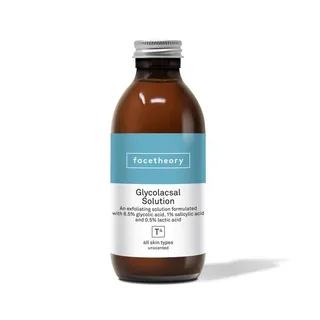
Facetheory Glycolacsal Solution T4 with Glycolic Acid, Salicylic Acid and Lactic Acid
Works for
ExfoliationGlycolic acid, Salicylic acid + 1 moreWorks well
“Our exfoliating toner is formulated with glycolic acid (8.5%), salicylic acid (1%) and lactic acid (0.5%) to clarify, brighten and even out the complexion.”
This product can help exfoliate the skin. In other words, it helps break down the bonds between dead cells on the surface of the skin and speed up the skin turnover. Skin often appears softer and brighter after exfoliation, but overdoing it can result in disrupted skin barrier. The following ingredient is doing the exfoliating job in this product: glycolic acid, salicylic acid.
CleansingNo ingredient credited for this claimNot delivered
“Salicylic acid is a beta hydroxy acid, which means that it is oil soluble and can penetrate deeper into the pores to dissolve surface oils and other impurities that would otherwise cause blockages that can lead to breakouts.”
This product does not seem to contain cleansing agents and might not be able to remove dirt and oil efficiently.
Anti-blemishSide benefit the brand mentions · Salicylic acid, Glycolic acid + 2 moreWorks well
“Brightens skin, refines pores, and evens complexion.”
This product can help reduce breakouts and clogged pores because it contains the following ingredient: salicylic acid. This ingredient is used for treating acne and can have a noticeable effect.
The following ingredient (ingredients) in this product might be helpful, but there is no evidence to confirm that it actually works: glycolic acid
Can it cause trouble?
Irritancy7 flagged ingredientsLow risk
ComedogenicClean of flagged comedogenic ingredientsNone flagged

User reviews
1 of 1 community members would buy it again.
Ingredients
Filter by role to see what each ingredient is doing.
Water~40–60%
Glycolic acid~5.8–8.7%
- Irritation risk
- High
An alpha-hydroxy acid (AHA) that helps to remove the dead skin cells on the surface of the skin reveling a more even, smoother complexation. It is also able to stimulate collagen production with long-term use. Could help to reduce pore congestion. It can be irritating to the skin. Apply sunscreen daily if using products with glycolic acid
More about Glycolic acidDimethyl isosorbide~3.7–5.5%
- Irritation risk
- Low
Used to dissolve other ingredients in a product and can enhance their ability to penetrate the skin
More about Dimethyl isosorbidePropanediol~2.7–4%
- Irritation risk
- Low
Acts as a solvent for other ingredients. Speeds up the absorption of other ingredients into the skin
More about PropanediolBetaine~2–3%
- Irritation risk
- Low
Helps attract water to the upper layer of the skin and improves the product texture
More about BetaineGlycerin~1.6–2.5%
- Irritation risk
- Low
One of the best moisturizing ingredients. Naturally present in skin. It attracts water to the upper layer of the skin working as a humectant
More about GlycerinSodium glycolate~1.1–1.7%
- Irritation risk
- Low
Panthenol~1–1.5%
- Irritation risk
- Low
Helps attract water to the upper layer of the skin and can help improve skin barrier function
More about PanthenolSalicylic acid~0.4–1%
- Irritation risk
- High
Used for skin exfoliation. It has an anti-inflammatory and anti-bacterial effect, helps to unclog pores, prevent blemishes and speed up healing of the existing ones. Sometimes referred to as a BHA (beta-hydroxy acid)
More about Salicylic acidLactic acid~0.4–1%
- Irritation risk
- Medium
An exfoliating and moisturizing alpha-hydroxy acid (AHA). Typically causes less irritation than other AHAs, for example, glycolic acid. At high concentrations (about 15%), lactic acid can help reduce lines and wrinkles. Recent studies show that lactic acid can support the "good" bacteria living on skin's surface (healthy skin microbiome)
More about Lactic acidChamomilla recutita flower extract~0.35–0.8%
- Irritation risk
- High
Plant extract that can have healing and anti-inflammatory properties. It is a potential allergen and can be irritating
More about Chamomilla recutita flower extractAloe barbadensis leaf juice~0.15–0.55%
- Irritation risk
- Medium
Traditionally used to treat sunburns, dermatitis and inflammation, but evidence for its effectiveness is lacking. The extract can contain humectants that help attract water into the skin
More about Aloe barbadensis leaf juiceCamellia sinensis leaf extract~0.1–0.4%
- Irritation risk
- Low
Can contain potent anti-oxidant compounds (abbreviated ECG, GCG, EGC, and EGCG) that might help protect the skin from free radicals. Can help calm down inflammation and has some anti-bacterial properties. Unfortunately, these antioxidants are unstable and lose their effectiveness very quickly in products. The concentration of the antioxidant compounds in the extract also tends to be low to be effective in topical formulation
More about Camellia sinensis leaf extractCitric acid~0.05–0.2%
- Irritation risk
- Medium
Can work as an exfoliant but is typically used to adjust the product pH
More about Citric acidPotassium sorbate~0.05–0.15%
Ingredient list view
Water, Glycolic acid, Dimethyl isosorbide, Propanediol, Betaine, Glycerin, Sodium glycolate, Panthenol, Salicylic acid, Lactic acid, Chamomilla recutita flower extract, Aloe barbadensis leaf juice, Camellia sinensis leaf extract, Citric acid, Potassium sorbate
Compare prices
Retailers ranked by price — lowest first.
Worth comparing, line by line.
Match % combines shared ingredients, the first five ingredients, shared actives and hero ingredients, irritancy (lower counts in the alternative's favour), texture and body area. Only products in the same routine step are compared.
| FacetheoryGlycolacsal Solution T4 with Glycolic Acid, Salicylic Acid and Lactic AcidYOUR PRODUCT | BeautycounterAll Bright Triple Acid AHA Toner | CeraVeGel Moussant Anti-Imperfections | SkinfixAcne+ 2% BHA Cleanser | |
|---|---|---|---|---|
| Match | — | 84% | 80% | 76% |
| Price | — | — | — | $10.00 |
| Shared key ingredients | — | 4 of 7 | 4 of 7 | 4 of 7 |
| Key difference | — | Niacinamide | Niacinamide | Azelaic Acid |
| Irritancy | Low | Low | Low | Low |
| Drying alcohol | — | — | — | — |
| View product | Shop | Shop | Shop |


More alternatives: 60 Pads tingl by DRMTLGYMedicube Zero Pore Pads 2.0
Product summary
"Facetheory - Glycolacsal Solution T4 with Glycolic Acid, Salicylic Acid and Lactic Acid" is effective for: Anti-inflammatory, Exfoliation, Evens skin tone, Anti-blemish, Anti-aging and Moisturizing
Ingredient callouts
- Exfoliating acids (lactic acid 0.55% - 0.80%, glycolic acid 1.20% - 1.40% and glycolic acid 4.90% - 6.00%). In this concentration, they will have a noticeable exfoliating effect. They can also have an anti-aging effect and stimulate collagen production in a long-run. Lactic Acid can also help to attract water to the upper layer (works as a humectant).
- Salicylic acid (0.60% - 0.90%). This is an oil-soluble exfoliating acid. Because of this property, it can work inside pores and help reduce the congestion. It has an anti-inflammatory effect and is used to treat acne. Because it is a quite strong exfoliator, be careful with using this product too often: it could result in over-exfoliation.
- An effective concentration of Panthenol (pro-vitamin B5) - about 0.90% - 1.10%. Panthenol helps strengthen the skin barrier, improve hydration and reduce inflammation in skin.
- Humectants (panthenol 0.90% - 1.10%, glycerin 1.70% - 2.10%, betaine 2.00% - 2.40% and sucrose 3.00% - 3.70%). These ingredients help attract water to the upper layer of the skin and improve the skin hydration.
Price
The product retails for 202.00SEK in Sweden and for 3.99£ in the United Kingdom.
For a detailed price comparison: click here.
Sources cited in this review
Every concentration estimate and effectiveness label is anchored to one of these 13 studies and safety reviews.
- 1
- 2Glycolic acid peel therapy – a current reviewncbi.nlm.nih.gov
- 3
- 4
- 5
- 6Skin moisturizing effects of panthenol-based formulationspdfs.semanticscholar.org

Affiliate links · As an Amazon Associate, WIMJ earns from qualifying purchases.