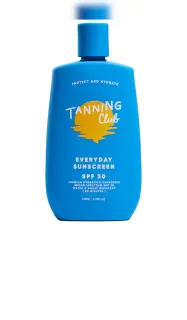
TANNING Club Everyday Sunscreen SPF 30
Works for
Sun protectionSPF 30 · 4 UV filtersBroad spectrum
This product offers a good level of protection against both UVB and UVA rays.
This sunscreen uses organic (so-called "chemical") sunscreen filters. Organic, or "chemical" filters usually provide reliable sun protection and rarely leave a white cast. Sunscreens with organic filters can sting eyes.
This product can be considered "reef safe" because it does not contain the UV filters (oxybenzone and octinoxate) that can be harmful to coral reefs when present in the water in high concentrations.
Anti-agingSide benefit · Aloe barbadensis leaf juice, Hyaluronic acid + 2 moreWorks well
This product can help prevent early signs of skin aging because it offers a good level of broad spectrum sun protection. Sun damage is the main cause of premature skin aging, and protecting your skin from the sun is the best anti-aging strategy.
Evens skin toneSide benefit · Punica granatum extractWorks well
This product offers broad spectrum sun protection. It means that it can prevent hyperpigmentation and help keep the skin tone even (sun damage is the main factor causing age spots, darkening of post-acne marks and other discolorations).
MoisturizingSide benefit the brand mentions · Caprylic/capric triglyceride, Cetearyl alcohol + 11 moreWorks
“Lightweight and hydrating broad-spectrum SPF 30 protects against harmful UVA and UVB rays.”
This product can help improve hydration of the skin with the two types of ingredients.
The first type is called “humectants”:
these ingredients help attract water.
When humectants are on the surface of the skin, they “pull in” the moisture from the outside environment, or from
within deeper layers of the skin. The following ingredients in this product do the job:
glycerin, hyaluronic acid.
This product also contains ingredients called “occlusives”. They help reduce the speed with which our skin loses moisture to the outside environment. These ingredients also help soften the upper layer of the skin, so it feels less tight and nicer to the touch. The following ingredients in this product do the job: caprylic/capric triglyceride, dimethicone.
Anti-oxidationSide benefit · Punica granatum extract, Ascorbyl palmitate + 2 moreMay help
This product contains antioxidants (punica granatum extract) that can help neutralize free radicals in skin to lessen the damage it gets from the UV light (sun). There is some human evidence for this effect in skin, though it is smaller or less consistent than the evidence for the best antioxidants.
Can it cause trouble?
Irritancy2 strong irritants: Parfum, Rosmarinus officinalis extractMedium risk
Comedogenic1 ingredient rated 2 or more on the 0–5 pore-clogging scale1 flagged
User reviews
Be the first — your take helps the next person decide.
Ingredients
Filter by role to see what each ingredient is doing.
Homosalate~23–34%
- Irritation risk
- Medium
A weak sunscreen that offers some protection against the sun rays that cause sunburn (UVB), but does not offer meaningful protection against protect against the most aging sun rays (UVA). It loses its effectiveness quickly when exposed to sunlight. It is an organic, or so called "chemical" sunscreen. When used in low concentrations, helps to stabilize the product formulation
More about HomosalateEthylhexyl salicylate~4.7–7.1%
- Irritation risk
- Low
Octisalate. A UV filter. It offers some protection against the sun rays that cause sunburn (UVB), but does not protect against the most aging sun rays (UVA). It loses its effectiveness quickly when exposed to sunlight. It is an organic, or so called "chemical" sunscreen
More about Ethylhexyl salicylateOctocrylene~4.4–6.6%
- Irritation risk
- Medium
A weak sunscreen that protects against the sun rays that cause sunburn (UVB) and is somewhat effective against the UVA rays. It is quite stable and can help stabilize other, more vulnerable, sunscreen ingredients like Avobenzone. It is an organic, or so called "chemical" sunscreen
More about OctocryleneButyl methoxydibenzoylmethane~3.6–5.4%
- Irritation risk
- Medium
Avobenzone. An organic, or so-called "chemical" UV filter. Protects against both UVA and UVB rays. Needs to be combined with other filters in a formulation to be stable.
More about Butyl methoxydibenzoylmethaneAloe barbadensis leaf juice~2.6–3.9%
- Irritation risk
- Medium
Traditionally used to treat sunburns, dermatitis and inflammation, but evidence for its effectiveness is lacking. The extract can contain humectants that help attract water into the skin
More about Aloe barbadensis leaf juiceWater~1.9–2.9%
Ascorbyl palmitate~1.4–2.1%
- Irritation risk
- Medium
Being a lipid soluble form of vitamin C, it is more stable and can penetrate the skin better than L-Ascorbic acid. It is effective in protecting the skin from free radicals, as well as evening the skin tone, but is less effective in stimulating collagen production compared to L-Ascorbic acid.
More about Ascorbyl palmitateBeta-carotene~1.3–1.9%
Butyloctyl salicylate~1.1–1.6%
- Irritation risk
- Medium
A synthetic ester of salicylic acid that is used to help disperse pigments and boost effectiveness of sunscreen ingredients. It is able to absorb UV light (working as an organic, or chemical filter), but is not approved as a sunscreen ingredient on its own
More about Butyloctyl salicylateCaprylic/capric triglyceride~0.9–1.35%
- Irritation risk
- Medium
A good mix of fatty acids that forms a protective layer on the skin. Improves the shelf life of products. Derived from coconut and glycerin
More about Caprylic/capric triglycerideCaprylyl glycol~0.5–1.2%
- Irritation risk
- Medium
Helps preserve products and creates a nice product texture
More about Caprylyl glycolCetearyl alcohol~0.5–1.15%
- Irritation risk
- Low
- Comedogenicity
- 2/5
A non-drying alcohol. Works as an emollient. Helps water and oil mix together and creates a nice product texture
More about Cetearyl alcoholCetearyl glucoside~0.2–0.75%
- Irritation risk
- Medium
Helps water and oil in the product mix well together and improves product texture
More about Cetearyl glucosideCitric acid~0.15–0.6%
- Irritation risk
- Medium
Can work as an exfoliant but is typically used to adjust the product pH
More about Citric acidCitrullus lanatus fruit extract~0.15–0.55%
- Irritation risk
- Medium
A plant extract that can contain an antioxidant compound
More about Citrullus lanatus fruit extractDimethicone~0.2–0.75%
- Irritation risk
- Low
A silicone that helps to reduce water loss from the surface of the skin. Can temporarily "fill in" lines and wrinkles, absorb oil, and create a nice product finish
More about DimethiconeDodecane~0.15–0.5%
- Irritation risk
- Low
Glycerin~0.15–0.65%
- Irritation risk
- Low
One of the best moisturizing ingredients. Naturally present in skin. It attracts water to the upper layer of the skin working as a humectant
More about GlycerinGlyceryl laurate~0.2–0.75%
- Irritation risk
- Medium
Helps water and oil mix together and has an anti-microbial effect helping to preserve product formulations
More about Glyceryl laurateGlyceryl stearate~0.15–0.65%
- Irritation risk
- Low
An emollient that softens the skin and forms a protective layer on its surface. Helps water and oil mix together
More about Glyceryl stearateGlyceryl undecylenate~0.15–0.6%
- Irritation risk
- Medium
Helps oil and water mix together and helps preserve the product formulation
More about Glyceryl undecylenateHelianthus annuus seed oil~0.15–0.55%
- Irritation risk
- Low
A great emollient due to its high linoleic acid content. One of the most effective plant oils in helping skin hydration and repairing skin barrier function
More about Helianthus annuus seed oilHyaluronic acid~0.1–0.35%
- Irritation risk
- Low
One of the best moisturizing ingredients. Attracts water into the upper layer of the skin. Naturally present in skin. Typically has large molecule size unless advertised otherwise on the product label. Helps support skin's barrier function and may help to reduce inflammation
More about Hyaluronic acidIsododecane~0.1–0.45%
- Irritation risk
- Low
An emollient that helps soften the skin and can decrease moisture loss. Helps create a nice product texture
More about IsododecaneC13-14 isoparaffin~0.15–0.5%
- Irritation risk
- Low
Helps soften the upper layer of the skin, dissolve other ingredients and create a thicker product consistency
More about C13-14 isoparaffinLaureth-7~0.1–0.4%
Magnesium aluminum silicate~0.1–0.4%
- Irritation risk
- Low
Might be helpful in restoring skin barrier function and, when combined with zinc carbonate and malonic acid, reducing fine lines and wrinkles by stimulating elastin production. Also helps stabilize the product formulation
More about Magnesium aluminum silicateParfum~0.05–0.3%
- Irritation risk
- High
An aromatic blend of unspecified and possibly irritating ingredients
More about ParfumPolyacrylamide~0.15–0.5%
- Irritation risk
- Medium
Used to improve product texture and help oil and water mix together
More about PolyacrylamidePolyhydroxystearic acid~0.1–0.4%
- Irritation risk
- Medium
Used to create a thicker product consistency and stabilize the formulation
More about Polyhydroxystearic acidPolysorbate 20~0.1–0.45%
Punica granatum extract~0.1–0.4%
- Irritation risk
- Medium
A plant extract that can help neutralize free radicals in skin and even out the skin tone, but is typically used in products in a concentration that is too low to be effective
More about Punica granatum extractRosmarinus officinalis extract~0.1–0.45%
- Irritation risk
- High
Saccharide isomerate~0.1–0.45%
- Irritation risk
- Low
Helps attract water to the upper layer of the skin
More about Saccharide isomerateSodium stearoyl glutamate~0.15–0.65%
- Irritation risk
- Medium
Helps oil and water mix together
More about Sodium stearoyl glutamateStearyl alcohol~0.15–0.65%
- Irritation risk
- Low
An emollient that helps soften the skin
More about Stearyl alcoholTetrasodium edta~0.1–0.35%
Tocopheryl acetate~0.1–0.3%
- Irritation risk
- Medium
A more stable but less bio-available form of vitamin E compared to Tocopherol. Might help moisturize and protect the skin from free radicals, but mostly used in low concentrations to stabilize other ingredients.
More about Tocopheryl acetateTrimethylsiloxysilicate~0.15–0.5%
- Irritation risk
- Low
A type of silicone that helps create a nice product consistency and support the delivery of other ingredients
More about TrimethylsiloxysilicateXanthan gum~0.05–0.25%
- Irritation risk
- Low
Used to create a thicker product consistency
More about Xanthan gumIngredient list view
Homosalate, Ethylhexyl salicylate, Octocrylene, Butyl methoxydibenzoylmethane, Aloe barbadensis leaf juice, Water, Ascorbyl palmitate, Beta-carotene, Butyloctyl salicylate, Caprylic/capric triglyceride, Caprylyl glycol, Cetearyl alcohol, Cetearyl glucoside, Citric acid, Citrullus lanatus fruit extract, Dimethicone, Dodecane, Glycerin, Glyceryl laurate, Glyceryl stearate, Glyceryl undecylenate, Helianthus annuus seed oil, Hyaluronic acid, Isododecane, C13-14 isoparaffin, Laureth-7, Magnesium aluminum silicate, Parfum, Polyacrylamide, Polyhydroxystearic acid, Polysorbate 20, Punica granatum extract, Rosmarinus officinalis extract, Saccharide isomerate, Sodium stearoyl glutamate, Stearyl alcohol, Tetrasodium edta, Tocopheryl acetate, Trimethylsiloxysilicate, Xanthan gum
Compare prices
Retailers ranked by price — lowest first.

Worth comparing, line by line.
Match % combines shared ingredients, the first five ingredients, shared actives and hero ingredients, irritancy (lower counts in the alternative's favour), texture and body area. Only products in the same routine step are compared.
| TANNING ClubEveryday Sunscreen SPF 30YOUR PRODUCT | Derma EAll Sport Performance Face Sunscreen SPF 30 | Face Reality SkincareBrilliant Defense SPF 50 | SkinCeuticalsLight Moisture UV Defense SPF 50 Oil free sunscreen for face and body | |
|---|---|---|---|---|
| Match | — | 45% | 45% | 45% |
| Price | $23.80 | — | $42.00+$18.20 | $40.00+$16.20 |
| Shared key ingredients | — | 7 of 10 | 6 of 10 | 6 of 10 |
| Key difference | — | Tea Extract | Aminopropyl Ascorbyl Phosphate | Polymethylsilsesquioxane |
| Irritancy | Medium | Low | Low | Low |
| SPF | SPF 30 | SPF 30 | SPF 50 | SPF 50 |
| Drying alcohol | — | — | — | Contains drying alcohol |
| View product | Shop | Shop | Shop |


More alternatives: Coola Exp. 7/24 - Classic Face Organic Sunscreen Lotion SPF 50 - Fragrance Free - Final SaleLa Roche-Posay Melt-In Sunscreen Milk SPF 60
Sources cited in this review
Every concentration estimate and effectiveness label is anchored to one of these 18 studies and safety reviews.
- 1
- 2
- 3Analyzing Lycopene Content in Fruitssciencedirect.com
- 4
- 5Final Report on the Safety Assessment of Dimethicone Copolyoljournals.sagepub.com
- 6

Affiliate links · As an Amazon Associate, WIMJ earns from qualifying purchases.