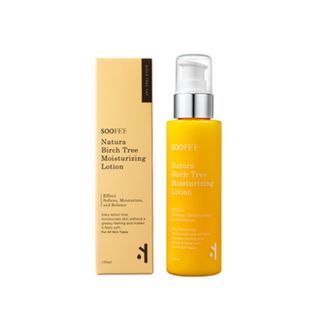
SOOFE’E Natura Birch Tree Moisturizing Lotion
Works for
1 of 1 advertised claim delivered
MoisturizingDimethicone, Glyceryl acrylate/acrylic acid copolymer + 17 moreGood evidence
“Natura Birch Tree Moisturizing Lotion”
This product can help improve hydration of the skin with the two types of ingredients.
The first type is called “humectants”:
these ingredients help attract water.
When humectants are on the surface of the skin, they “pull in” the moisture from the outside environment, or from
within deeper layers of the skin. The following ingredients in this product do the job:
arginine, glycerin.
This product also contains ingredients called “occlusives”. They help reduce the speed with which our skin loses moisture to the outside environment. These ingredients also help soften the upper layer of the skin, so it feels less tight and nicer to the touch. The following ingredients in this product do the job: arginine, caprylic/capric triglyceride.
Anti-oxidationNot advertised by the brand · Ginkgo biloba leaf extract, Coptis japonica root extract + 3 moreModerate evidence
This product contains antioxidants (ginkgo biloba leaf extract) that might be able to help neutralize free radicals in skin to lessen the damage it gets from the UV light (sun). There is not enough evidence to confirm their effectiveness in skin though.
Can it cause trouble?
Irritancy6 strong irritants: Citrus aurantifolia fruit extract, Oenothera biennis flower extract + 4 more — patch-test recommendedHigh risk
Comedogenic1 ingredient rated 2 or more on the 0–5 pore-clogging scale1 flagged
User reviews
Be the first — your take helps the next person decide.
Ingredients
Filter by role to see what each ingredient is doing.
Betula alba leaf extract~23–34%
- Irritation risk
- Low
Betula alba juice~4.6–6.9%
- Irritation risk
- Low
Glycerin~4.3–6.4%
- Irritation risk
- Low
One of the best moisturizing ingredients. Naturally present in skin. It attracts water to the upper layer of the skin working as a humectant
More about GlycerinMethylpropanediol~3.6–5.4%
Cyclopentasiloxane~2.8–4.2%
- Irritation risk
- Low
A silicone that helps improve the product texture and spreadability. Can absorb oil creating a short-term mattifying effect on the skin
More about CyclopentasiloxaneCetyl ethylhexanoate~2–3%
- Irritation risk
- Medium
An emollient that helps soften the skin and creates a thicker product texture
More about Cetyl ethylhexanoate1,2-hexanediol~0.5–1.2%
Polypropylsilsesquioxane~1.3–1.9%
- Irritation risk
- Low
Caprylic/capric triglyceride~1.2–1.8%
- Irritation risk
- Medium
A good mix of fatty acids that forms a protective layer on the skin. Improves the shelf life of products. Derived from coconut and glycerin
More about Caprylic/capric triglycerideCoptis japonica root extract~0.6–1.35%
- Irritation risk
- High
A plant extract that might have some anti-oxidant properties
More about Coptis japonica root extractC14-22 alcohols~0.5–1.1%
- Irritation risk
- Low
A non-drying alcohol that helps stabilize product formulations
More about C14-22 alcoholsGlyceryl stearate~0.5–1.15%
- Irritation risk
- Low
An emollient that softens the skin and forms a protective layer on its surface. Helps water and oil mix together
More about Glyceryl stearateButylene glycol~0.35–0.85%
- Irritation risk
- Low
Used to create a nice product texture and help delivery of other ingredients. Might be somewhat helpful in attracting water to the upper layer of the skin
More about Butylene glycolCitrus aurantifolia fruit extract~0.35–0.8%
Sodium hyaluronate~0.3–0.75%
- Irritation risk
- Low
One of the best moisturizing ingredients. Attracts water into the upper layer of the skin
More about Sodium hyaluronateChamomilla recutita flower extract~0.35–0.8%
- Irritation risk
- High
Plant extract that can have healing and anti-inflammatory properties. It is a potential allergen and can be irritating
More about Chamomilla recutita flower extractOenothera biennis flower extract~0.35–0.75%
Brassica napus extract~0.3–0.7%
- Irritation risk
- Low
Persea gratissima fruit extract~0.3–0.75%
Melissa officinalis extract~0.3–0.7%
- Irritation risk
- Low
Ginkgo biloba leaf extract~0.2–0.7%
- Irritation risk
- High
A plant extract that might help neutralize free radicals and reduce inflammation in skin. It can be irritating
More about Ginkgo biloba leaf extractJasminum officinale flower extract~0.15–0.65%
Glucose~0.15–0.65%
- Irritation risk
- Low
Helps attract water to the upper layer of the skin. Could be helpful in restoring the skin barrier function
More about GlucoseCalendula officinalis flower extract~0.15–0.65%
- Irritation risk
- High
A plant extract that has some anti-oxidant and anti-bacterial properties. Can be irritating
More about Calendula officinalis flower extractPortulaca oleracea extract~0.15–0.7%
- Irritation risk
- Medium
A plant extract that has some anti-oxidant activity, but solid research is lacking. Can help attract water to the upper layer of the skin
More about Portulaca oleracea extractDimethicone~0.35–0.75%
- Irritation risk
- Low
A silicone that helps to reduce water loss from the surface of the skin. Can temporarily "fill in" lines and wrinkles, absorb oil, and create a nice product finish
More about DimethiconeDimethicone/vinyl dimethicone crosspolymer~0.15–0.7%
- Irritation risk
- Low
Used to stabilize product formulations and create a nice product texture
More about Dimethicone/vinyl dimethicone crosspolymerC12-20 alkyl glucoside~0.2–0.7%
- Irritation risk
- Medium
Helps water and oil mix together
More about C12-20 alkyl glucosideSorbitan sesquioleate~0.2–0.7%
- Irritation risk
- High
Used to help oil and water mix together. Can be irritating
More about Sorbitan sesquioleateStearyl alcohol~0.35–0.75%
- Irritation risk
- Low
An emollient that helps soften the skin
More about Stearyl alcoholSodium acrylates copolymer~0.3–0.75%
- Irritation risk
- Medium
Used to create a thicker product consistency
More about Sodium acrylates copolymerCetyl alcohol~0.35–0.75%
- Irritation risk
- Low
A non-drying alcohol that works to soften the skin and stabilize product formulations helping oil and water mix together
More about Cetyl alcoholArginine~0.15–0.65%
- Irritation risk
- Low
An amino acid that is naturally present in skin and helps keep it hydrated. When used together with AHAs, it can reduce their irritating effect on the skin
More about ArginineCarbomer~0.15–0.7%
- Irritation risk
- Low
Helps create a thicker or gel-like product texture. It is not a surfactant but can be used in gentle cleansing formulations
More about CarbomerGlyceryl acrylate/acrylic acid copolymer~0.15–0.65%
- Irritation risk
- Medium
Helps attract water to the upper layer of the skin and provide a longer-lasting hydration. Can create a thicker product consistency
More about Glyceryl acrylate/acrylic acid copolymerStearic acid~0.4–0.9%
- Irritation risk
- Low
Helps oil and water mix together and works as an emollient
More about Stearic acidLavandula angustifolia oil~0.15–0.65%
- Irritation risk
- High
An essential oil. Potential allergen and can be irritating. It has some anti-bacterial properties
More about Lavandula angustifolia oilLecithin~0.35–0.8%
- Irritation risk
- Low
Used mostly for creating emulsions - helping oil and water mix together. Helps soften the upper layer of the skin
More about LecithinAllantoin~0.15–0.65%
- Irritation risk
- Low
Helps calm down inflammation in skin and can help reduce itching. Helps to repair the skin barrier and keep skin hydrated
More about AllantoinTocopheryl acetate~0.2–0.75%
- Irritation risk
- Medium
A more stable but less bio-available form of vitamin E compared to Tocopherol. Might help moisturize and protect the skin from free radicals, but mostly used in low concentrations to stabilize other ingredients.
More about Tocopheryl acetatePvm/ma copolymer~0.3–0.7%
- Irritation risk
- Low
Disodium edta~0.15–0.65%
Xanthan gum~0.15–0.65%
- Irritation risk
- Low
Used to create a thicker product consistency
More about Xanthan gumPalmitic acid~0.3–0.7%
- Irritation risk
- Low
An emollient that is naturally present in skin and helps soften it
More about Palmitic acidPropanediol~0.15–0.6%
- Irritation risk
- Low
Acts as a solvent for other ingredients. Speeds up the absorption of other ingredients into the skin
More about PropanediolArachidic acid~0.35–0.8%
Myristic acid~0.15–0.65%
- Irritation risk
- Medium
- Comedogenicity
- 3/5
Helps oil and water mix together. Could be comedogenic
More about Myristic acidOleic acid~0.2–0.7%
- Irritation risk
- Medium
Helps soften the upper layer of the skin. At the same time, it can weaken the skin's barrier enhancing penetration of other ingredients and increasing the risk of skin dryness
More about Oleic acidEthylhexylglycerin~0.1–0.45%
Ingredient list view
Betula alba leaf extract, Betula alba juice, Glycerin, Methylpropanediol, Cyclopentasiloxane, Cetyl ethylhexanoate, 1,2-hexanediol, Polypropylsilsesquioxane, Caprylic/capric triglyceride, Coptis japonica root extract, C14-22 alcohols, Glyceryl stearate, Butylene glycol, Citrus aurantifolia fruit extract, Sodium hyaluronate, Chamomilla recutita flower extract, Oenothera biennis flower extract, Brassica napus extract, Persea gratissima fruit extract, Melissa officinalis extract, Ginkgo biloba leaf extract, Jasminum officinale flower extract, Glucose, Calendula officinalis flower extract, Portulaca oleracea extract, Dimethicone, Dimethicone/vinyl dimethicone crosspolymer, C12-20 alkyl glucoside, Sorbitan sesquioleate, Stearyl alcohol, Sodium acrylates copolymer, Cetyl alcohol, Arginine, Carbomer, Glyceryl acrylate/acrylic acid copolymer, Stearic acid, Lavandula angustifolia oil, Lecithin, Allantoin, Tocopheryl acetate, Pvm/ma copolymer, Disodium edta, Xanthan gum, Palmitic acid, Propanediol, Arachidic acid, Myristic acid, Oleic acid, Ethylhexylglycerin
Compare prices
Retailers ranked by price — lowest first.

Affiliate links · prices updated regularly
Sources cited in this review
Every concentration estimate and effectiveness label is anchored to one of these 22 studies and safety reviews.
- 1
- 2
- 3Hyaluronic acid: A key molecule in skin agingncbi.nlm.nih.gov
- 4
- 5
- 6Cosmeceutical Critique: Ginkgo Bilobamdedge.com

Affiliate links · As an Amazon Associate, WIMJ earns from qualifying purchases.