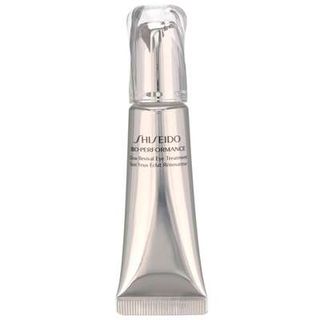
Shiseido Eye & Lip Care Bio-Performance: Glow Revival Eye Treatment
Works for
1 of 2 advertised claims delivered
Moisturizing18 ingredients credited for this claimGood support
“Shiseido, Eye & Lip Care This moisturising eye cream fights against puffiness, wrinkles, dark circles and uneven, dull skin tones by boosting the skin’s capillary system.”
This product can help improve hydration of the skin with the two types of ingredients.
The first type is called “humectants”:
these ingredients help attract water.
When humectants are on the surface of the skin, they “pull in” the moisture from the outside environment, or from
within deeper layers of the skin. The following ingredients in this product do the job:
glycerin, sodium acetylated hyaluronate.
This product also contains ingredients called “occlusives”. They help reduce the speed with which our skin loses moisture to the outside environment. These ingredients also help soften the upper layer of the skin, so it feels less tight and nicer to the touch. The following ingredients in this product do the job: dimethicone, myristyl myristate.
Anti-aging3 ingredients credited for this claimWeak support
“Shiseido, Eye & Lip Care This moisturising eye cream fights against puffiness, wrinkles, dark circles and uneven, dull skin tones by boosting the skin’s capillary system.”
Effective ingredients missing or their concentration is too low.
Can it cause trouble?
Irritancy13 strong irritants: Sd alcohol 40-b, Alcohol denat. + 11 more — patch-test recommendedHigh risk
Comedogenic3 ingredients rated 2 or more on the 0–5 pore-clogging scale3 flagged


User reviews
Be the first — your take helps the next person decide.
Ingredients
Filter by role to see what each ingredient is doing.
Water~45–55%
Glycerin~4.8–5.9%
- Irritation risk
- Low
One of the best moisturizing ingredients. Naturally present in skin. It attracts water to the upper layer of the skin working as a humectant
More about GlycerinDipropylene glycol~4–4.9%
- Irritation risk
- Low
Helps to dissolve other ingredients in a formulation. Slows down the rate of product drying
More about Dipropylene glycolDimethicone~3.1–3.7%
- Irritation risk
- Low
A silicone that helps to reduce water loss from the surface of the skin. Can temporarily "fill in" lines and wrinkles, absorb oil, and create a nice product finish
More about DimethiconeButylene glycol~2.2–2.7%
- Irritation risk
- Low
Used to create a nice product texture and help delivery of other ingredients. Might be somewhat helpful in attracting water to the upper layer of the skin
More about Butylene glycolSd alcohol 40-b~1.8–2.2%
- Irritation risk
- High
Can be drying and contribute to skin irritation. Used in formulars to dissolve other ingredients, create a thinner product consistency or for its antibacterial properties
More about Sd alcohol 40-bAlcohol denat.~1.5–1.8%
- Irritation risk
- High
Produces temporary toning effect. Can help dissolve other ingredients or preserve products
More about Alcohol denat.Methyl gluceth-10~1.3–1.6%
Myristyl myristate~1.2–1.5%
- Irritation risk
- Medium
- Comedogenicity
- 3/5
An emollient. Is not recommended for acne-prone skin as it can be comedogenic
More about Myristyl myristatePetrolatum~0.8–1.2%
- Irritation risk
- Low
One of the most effective and the most studied occlusive ingredients that creates a protective layer on top of the skin preventing moisture loss
More about PetrolatumHydrogenated polydecene~0.55–0.85%
- Irritation risk
- Low
Helps to soften the upper layer of the skin and create a nice product texture
More about Hydrogenated polydeceneBehenyl alcohol~0.5–0.75%
- Irritation risk
- Low
Non-drying alcohol that helps water and oil mix together. Also serves as an emollient
More about Behenyl alcoholStearyl alcohol~0.5–0.7%
- Irritation risk
- Low
An emollient that helps soften the skin
More about Stearyl alcoholGlyceryl stearate se~0.35–0.6%
- Irritation risk
- Low
- Comedogenicity
- 2/5
Used to stabilize the product formulations and works as an emollient
More about Glyceryl stearate seCetyl ethylhexanoate~0.35–0.6%
- Irritation risk
- Medium
An emollient that helps soften the skin and creates a thicker product texture
More about Cetyl ethylhexanoatePeg/ppg-14/7 dimethyl ether~0.35–0.6%
- Irritation risk
- Low
An emollient that helps soften the skin. It also forms a protective on its surface to reduce water loss
More about Peg/ppg-14/7 dimethyl etherDimethicone crosspolymer~0.3–0.5%
- Irritation risk
- Low
Used to create a thicker product texture. Helps soften the upper layer of the skin and might be able to prevent moisture loss from its surface
More about Dimethicone crosspolymerPolysorbate 60~0.25–0.5%
Peg-40 stearate~0.25–0.45%
Sodium acrylate/sodium acryloyldimethyl taurate copolymer~0.2–0.35%
- Irritation risk
- Low
Used to create a thicker product consistency
More about Sodium acrylate/sodium acryloyldimethyl taurate copolymerPhenoxyethanol~0.2–0.35%
- Irritation risk
- Low
A preservative. It helps prevent bacterial growth in cosmetic products
More about PhenoxyethanolMica~0.2–0.35%
- Irritation risk
- Low
Creates an illusion of smoother and more radiant skin tone. Adds shimmer to the skin by reflecting light
More about MicaIsohexadecane~0.25–0.4%
- Irritation risk
- Low
Improves the texture of the product and helps soften the skin. Helps oil and water mix together and can be used as a cleansing agent
More about IsohexadecaneTitanium dioxide~0.2–0.4%
- Irritation risk
- Low
Works as a UV filter when used in high concentrations. It is photostable and is effective mostly against the UVB light, with some protection in the UVA range. In small concentrations, used for its ability to improve the color of cosmetic products. Is usually well tolerated by the skin
More about Titanium dioxideCi 77891~0.1–0.25%
- Irritation risk
- Low
Polyvinyl alcohol~0.15–0.3%
Polysorbate 80~0.15–0.3%
Sorbitan tristearate~0.15–0.3%
- Irritation risk
- Medium
Helps oil and water mix together
More about Sorbitan tristearateTocopheryl acetate~0.15–0.3%
- Irritation risk
- Medium
A more stable but less bio-available form of vitamin E compared to Tocopherol. Might help moisturize and protect the skin from free radicals, but mostly used in low concentrations to stabilize other ingredients.
More about Tocopheryl acetateCaffeine~0.15–0.25%
- Irritation risk
- Medium
Might be helpful in neutralizing free radicals. Can have a dehydration effect that might somewhat decrease the look of puffy eyes
More about CaffeineSodium citrate~0.15–0.25%
- Irritation risk
- Medium
Helps to control the skin's pH level. Maintains the skin's natural film of amino-lactic acids and oils. Helps to preserve products
More about Sodium citrateParfum~0.15–0.25%
- Irritation risk
- High
An aromatic blend of unspecified and possibly irritating ingredients
More about Parfum2-o-ethyl ascorbic acid~0.15–0.25%
- Irritation risk
- Low
Sorbitan oleate~0.15–0.3%
- Irritation risk
- Medium
- Comedogenicity
- 2/5
Helps oil and water mix together
More about Sorbitan oleateDisodium edta~0.15–0.3%
Xanthan gum~0.15–0.3%
- Irritation risk
- Low
Used to create a thicker product consistency
More about Xanthan gumAlcohol~0.15–0.3%
- Irritation risk
- High
Can be drying and contribute to skin irritation. Used in formulars to dissolve other ingredients, create a thinner product consistency or for its antibacterial properties
More about AlcoholLimonene~0.15–0.25%
- Irritation risk
- High
A common frangrance that can easily irritate skin, especially if exposed to air, light or heat
More about LimoneneCitric acid~0.15–0.3%
- Irritation risk
- Medium
Can work as an exfoliant but is typically used to adjust the product pH
More about Citric acidSodium metaphosphate~0.15–0.3%
Xylitol~0.15–0.25%
- Irritation risk
- Low
Helps attract water to the upper layer of the skin and repair the skin barrier function
More about XylitolOryzanol~0.15–0.25%
- Irritation risk
- Low
An anti-oxidant that helps stabilize product formulations. Might help neutralise free radicals in skin
More about OryzanolMagnesium ascorbyl phosphate~0.15–0.3%
- Irritation risk
- Medium
A derivative of vitamin C that is more stable, but less bioavailable than the pure form of vitamin C. It does not penetrate the skin well, but has been shown to convert to pure vitamin C once in skin. It can be helpful in stimulating collagen production and lightening the skin tone, but the required concentration is likely to be very high
More about Magnesium ascorbyl phosphateHexyl cinnamal~0.15–0.25%
Benzyl benzoate~0.15–0.25%
- Irritation risk
- High
Fragrance with sweet balsamic smell. Help to preserve products and dissolve other ingredients. Could trigger allergic reactions and be irritating
More about Benzyl benzoateButylphenyl methylpropional~0.15–0.25%
- Irritation risk
- High
A fragrance. Can trigger allergic reactions and be irritating
More about Butylphenyl methylpropionalLinalool~0.15–0.25%
Sodium metabisulfite~0.1–0.2%
Sodium acetylated hyaluronate~0.15–0.3%
- Irritation risk
- Low
A type of hyaluronic acid that works as an excellent moisturizer by attracting water into the upper layer of the skin. Is typically feels less sticky on the skin compared to the usual hyaluronic acid
More about Sodium acetylated hyaluronateIron oxides~0.15–0.3%
- Irritation risk
- Low
An umbrella term for the following three colorants: CI 77491, CI 77492, CI 77499. They might be able to offer some protection against visible light, but the degree of the protection is not clear
More about Iron oxidesCi 77491~0.2–0.35%
- Irritation risk
- Low
A red colorant made of iron oxide. Typically is not irritating
More about Ci 77491Alpha-isomethyl ionone~0.15–0.25%
- Irritation risk
- High
A fragrance. Potential allergen and can be irritating
More about Alpha-isomethyl iononeSaccharomyces ferment lysate filtrate~0.15–0.3%
- Irritation risk
- Low
Helps attract water to the upper layer of the skin
More about Saccharomyces ferment lysate filtrateCrataegus monogyna flower extract~0.15–0.3%
- Irritation risk
- Low
Citronellol~0.15–0.25%
Geraniol~0.15–0.25%
Dipotassium glycyrrhizate~0.15–0.3%
- Irritation risk
- Low
A salt derived from licorice. Works as an emollient to soften the upper layer of the skin and can help calm down inflammation. Might be helpful for skin lightening
More about Dipotassium glycyrrhizatePaeonia suffruticosa root extract~0.15–0.3%
Tocopherol~0.15–0.3%
- Irritation risk
- Low
Pure form of vitamin E. Can help moisturise and protect the skin from free radicals. Often used to help stabilise other ingredients or the formula itself
More about TocopherolRehmannia chinensis root extract~0.15–0.25%
- Irritation risk
- Low
Cinnamomum cassia bark extract~0.2–0.35%
Bupleurum falcatum root extract~0.15–0.25%
- Irritation risk
- High
A plant extract that might help to attract water to the upper layer of the skin, but it is not well studied. It can be irritating
More about Bupleurum falcatum root extractCoix lacryma-jobi ma-yuen seed extract~0.1–0.15%
- Irritation risk
- Low
Camellia sinensis leaf extract~0.1–0.15%
- Irritation risk
- Low
Can contain potent anti-oxidant compounds (abbreviated ECG, GCG, EGC, and EGCG) that might help protect the skin from free radicals. Can help calm down inflammation and has some anti-bacterial properties. Unfortunately, these antioxidants are unstable and lose their effectiveness very quickly in products. The concentration of the antioxidant compounds in the extract also tends to be low to be effective in topical formulation
More about Camellia sinensis leaf extractIngredient list view
Water, Glycerin, Dipropylene glycol, Dimethicone, Butylene glycol, Sd alcohol 40-b, Alcohol denat., Methyl gluceth-10, Myristyl myristate, Petrolatum, Hydrogenated polydecene, Behenyl alcohol, Stearyl alcohol, Glyceryl stearate se, Cetyl ethylhexanoate, Peg/ppg-14/7 dimethyl ether, Dimethicone crosspolymer, Polysorbate 60, Peg-40 stearate, Sodium acrylate/sodium acryloyldimethyl taurate copolymer, Phenoxyethanol, Mica, Isohexadecane, Titanium dioxide, Ci 77891, Polyvinyl alcohol, Polysorbate 80, Sorbitan tristearate, Tocopheryl acetate, Caffeine, Sodium citrate, Parfum, 2-o-ethyl ascorbic acid, Sorbitan oleate, Disodium edta, Xanthan gum, Alcohol, Limonene, Citric acid, Sodium metaphosphate, Xylitol, Oryzanol, Magnesium ascorbyl phosphate, Hexyl cinnamal, Benzyl benzoate, Butylphenyl methylpropional, Linalool, Sodium metabisulfite, Sodium acetylated hyaluronate, Iron oxides, Ci 77491, Alpha-isomethyl ionone, Saccharomyces ferment lysate filtrate, Crataegus monogyna flower extract, Citronellol, Geraniol, Dipotassium glycyrrhizate, Paeonia suffruticosa root extract, Tocopherol, Rehmannia chinensis root extract, Cinnamomum cassia bark extract, Bupleurum falcatum root extract, Coix lacryma-jobi ma-yuen seed extract, Camellia sinensis leaf extract
Compare prices
Retailers ranked by price — lowest first.
Worth comparing, line by line.
Match % combines shared ingredients, the first five ingredients, shared actives and hero ingredients, irritancy (lower counts in the alternative's favour), texture and body area. Only products in the same routine step are compared.
| ShiseidoEye & Lip Care Bio-Performance: Glow Revival Eye TreatmentYOUR PRODUCT | Estée LauderResilience Multi-Effect Tri-Peptide Eye Creme | OlayTransforming Eye Cream | CitrixAntioxidant Eye Cream | |
|---|---|---|---|---|
| Match | — | 52% | 51% | 50% |
| Price | $52.82 | $73.64+$20.82 | $26.99−$25.83 | $38.40−$14.42 |
| Shared key ingredients | — | 5 of 10 | 5 of 10 | 3 of 10 |
| Key difference | — | Linoleic Acid | Niacinamide | Retinyl Palmitate |
| Irritancy | High | Medium | Medium | Medium |
| Drying alcohol | Contains drying alcohol | — | — | — |
| View product | Shop | Shop | Shop |


Sources cited in this review
Every concentration estimate and effectiveness label is anchored to one of these 18 studies and safety reviews.
- 1
- 2
- 3Final Report on the Safety Assessment of Dimethicone Copolyoljournals.sagepub.com
- 4Safety Assessment of Polyene Group as Used in Cosmeticscir-safety.org
- 5
- 6Surfactants and experimental irritant contact dermatitisncbi.nlm.nih.gov

Affiliate links · As an Amazon Associate, WIMJ earns from qualifying purchases.