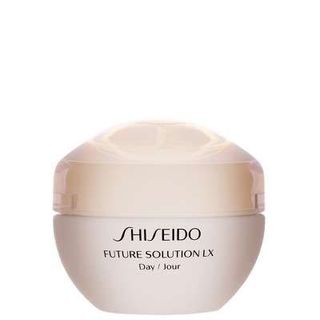
Shiseido Day And Night Creams Future Solution LX: Day Total Protective Cream SPF20
Works for
1 of 3 advertised claims delivered
Sun protectionSPF 20 · 8 UV filters · Broad spectrumWeak protectionSPF under 30
This product offers broad spectrum sun protection, but it is weak. We recommend to use a broad spectrum sunscreen with at least SPF 30.
Moisturizing13 ingredients credited for this claimGood support
“Day And Night Creams Future Solution LX Day Total Protective Cream SPF20”
This product can help improve hydration of the skin with the two types of ingredients.
The first type is called “humectants”:
these ingredients help attract water.
When humectants are on the surface of the skin, they “pull in” the moisture from the outside environment, or from
within deeper layers of the skin. The following ingredients in this product do the job:
glycerin, butylene glycol.
This product also contains ingredients called “occlusives”. They help reduce the speed with which our skin loses moisture to the outside environment. These ingredients also help soften the upper layer of the skin, so it feels less tight and nicer to the touch. The following ingredients in this product do the job: dimethicone, phytosteryl macadamiate.
Anti-aging2 ingredients credited for this claimLimited support
“The Skingenecell Enmei reduces the visible signs of ageing whilst the Premium Sansho Extract reinforces the skin's natural defences.”
This product does not contain ingredients that are able to reduce fine lines and wrinkles or help with skin elasticity, but it can improve the look of the skin temporarily through moisturization. Well-moisturized skin might also be able to repair the sun damage better.
The biggest anti-aging effect in this product comes from sun protection. Sun damage is the main factor causing early signs of skin aging. We, however, do not recommend using this product as a sunscreen because the protection it offers is not strong enough).
Can it cause trouble?
Irritancy9 strong irritants: Benzophenone-3, Alcohol + 7 more — patch-test recommendedHigh risk
Comedogenic1 ingredient rated 2 or more on the 0–5 pore-clogging scale1 flagged
User reviews
Be the first — your take helps the next person decide.
Ingredients
Filter by role to see what each ingredient is doing.
Butyl methoxydibenzoylmethane2%
- Irritation risk
- Medium
Avobenzone. An organic, or so-called "chemical" UV filter. Protects against both UVA and UVB rays. Needs to be combined with other filters in a formulation to be stable.
More about Butyl methoxydibenzoylmethaneEthylhexyl methoxycinnamate7.4%
- Irritation risk
- High
Octinoxate. When used in higher concentrations, works as a sunscreen protecting the skin from UVB rays. When used in lower concentration, helps to preserve the product formulation. Is shown to be harmful to coral reefs - consider avoiding bathing in coral reef areas when wearing a product with this ingredient. It can be irritating
More about Ethylhexyl methoxycinnamateOctocrylene3%
- Irritation risk
- Medium
A weak sunscreen that protects against the sun rays that cause sunburn (UVB) and is somewhat effective against the UVA rays. It is quite stable and can help stabilize other, more vulnerable, sunscreen ingredients like Avobenzone. It is an organic, or so called "chemical" sunscreen
More about OctocryleneBenzophenone-31.5%
- Irritation risk
- High
Same as oxybenzone. Protects in the UVB and short UVA range. In small concentrations, used to stabilize product formulation. Can be irritating. Is shown to be harmful to coral reefs - consider avoiding bathing in coral reef areas when wearing a product with this ingredient. It can penetrate the skin and get absorbed into bloodstream faster than other popular filters available in the US. The study that produced this finding did not address any potential health effects of the absorption
More about Benzophenone-3Water~45–55%
Diisopropyl sebacate~6.3–7.7%
- Irritation risk
- Low
Helps soften the upper layer of the skin without creatng a greasy finish
More about Diisopropyl sebacateGlycerin~5.3–6.4%
- Irritation risk
- Low
One of the best moisturizing ingredients. Naturally present in skin. It attracts water to the upper layer of the skin working as a humectant
More about GlycerinDipropylene glycol~3.9–4.7%
- Irritation risk
- Low
Helps to dissolve other ingredients in a formulation. Slows down the rate of product drying
More about Dipropylene glycolBehenyl alcohol~3.5–4.2%
- Irritation risk
- Low
Non-drying alcohol that helps water and oil mix together. Also serves as an emollient
More about Behenyl alcoholSilica~2.5–3%
Butylene glycol~1.7–2.1%
- Irritation risk
- Low
Used to create a nice product texture and help delivery of other ingredients. Might be somewhat helpful in attracting water to the upper layer of the skin
More about Butylene glycolAlcohol~1.4–1.7%
- Irritation risk
- High
Can be drying and contribute to skin irritation. Used in formulars to dissolve other ingredients, create a thinner product consistency or for its antibacterial properties
More about AlcoholBis-ethylhexyloxyphenol methoxyphenyl triazine~1.6–2%
- Irritation risk
- Medium
Tinosorb S. One of the most effective broad spectrum sunscreen ingredients. Protects from both UVA and UVB rays. It is photostable. Unfortunately, not approved by FDA (US) yet.
More about Bis-ethylhexyloxyphenol methoxyphenyl triazineIsododecane~1.1–1.3%
- Irritation risk
- Low
An emollient that helps soften the skin and can decrease moisture loss. Helps create a nice product texture
More about IsododecaneDimethicone~0.95–1.15%
- Irritation risk
- Low
A silicone that helps to reduce water loss from the surface of the skin. Can temporarily "fill in" lines and wrinkles, absorb oil, and create a nice product finish
More about DimethiconeMyristyl myristate~0.75–1.15%
- Irritation risk
- Medium
- Comedogenicity
- 3/5
An emollient. Is not recommended for acne-prone skin as it can be comedogenic
More about Myristyl myristatePhenylbenzimidazole sulfonic acid~0.7–1.1%
- Irritation risk
- Medium
Ensulizole. A UV filter that is effective against UVB rays. Does not protect against UVA light. It is photostable and can be used to help stabilize other sunscreen ingredients. It is water-soluble meaning that it can help create lighter sunscreen formulations
More about Phenylbenzimidazole sulfonic acidTriethanolamine~0.5–0.75%
- Irritation risk
- Medium
Used to adjust pH of the product and can help improve the product's smell
More about TriethanolamineStearyl alcohol~0.55–0.85%
- Irritation risk
- Low
An emollient that helps soften the skin
More about Stearyl alcoholDiethylamino hydroxybenzoyl hexyl benzoate~0.55–0.85%
- Irritation risk
- Medium
Uvinul A Plus. A new generation broad spectrum sunscreen that offers an effective protection especially in the UVA range. It is stable in formulations. Unfortunately, is not approved by the FDA (US) yet
More about Diethylamino hydroxybenzoyl hexyl benzoateBeheneth-20~0.45–0.7%
Phytosteryl macadamiate~0.5–0.75%
- Irritation risk
- Low
Helps soften the upper layer of the skin
More about Phytosteryl macadamiateEthylhexyl triazone~0.5–0.75%
- Irritation risk
- Medium
Uvinul T. A UV filter. Effective against UVB rays. It is photostable. Can increase water resistance properties of the sunscreen. Unfortunately, not approved by the FDA (US) yet
More about Ethylhexyl triazonePeg-6~0.3–0.6%
- Irritation risk
- Low
Helps to dissolve other ingredients and attract water to the upper layer of the skin
More about Peg-6Peg-32~0.3–0.55%
- Irritation risk
- Low
Helps dissolve other ingredients and attract water to the upper layer of the skin
More about Peg-32Phenoxyethanol~0.3–0.55%
- Irritation risk
- Low
A preservative. It helps prevent bacterial growth in cosmetic products
More about PhenoxyethanolParfum~0.25–0.5%
- Irritation risk
- High
An aromatic blend of unspecified and possibly irritating ingredients
More about ParfumTrisodium edta~0.3–0.5%
Succinoglycan~0.3–0.5%
Tocopheryl acetate~0.3–0.55%
- Irritation risk
- Medium
A more stable but less bio-available form of vitamin E compared to Tocopherol. Might help moisturize and protect the skin from free radicals, but mostly used in low concentrations to stabilize other ingredients.
More about Tocopheryl acetatePeg/ppg-17/4 dimethyl ether~0.3–0.55%
Piperidinepropionic acid~0.3–0.55%
- Irritation risk
- Low
Sodium citrate~0.3–0.5%
- Irritation risk
- Medium
Helps to control the skin's pH level. Maintains the skin's natural film of amino-lactic acids and oils. Helps to preserve products
More about Sodium citrateBht~0.25–0.5%
Sodium metaphosphate~0.3–0.55%
2-o-ethyl ascorbic acid~0.3–0.5%
- Irritation risk
- Low
Xanthan gum~0.3–0.55%
- Irritation risk
- Low
Used to create a thicker product consistency
More about Xanthan gumTocopherol~0.3–0.55%
- Irritation risk
- Low
Pure form of vitamin E. Can help moisturise and protect the skin from free radicals. Often used to help stabilise other ingredients or the formula itself
More about TocopherolCitric acid~0.3–0.5%
- Irritation risk
- Medium
Can work as an exfoliant but is typically used to adjust the product pH
More about Citric acidLinalool~0.25–0.45%
Limonene~0.25–0.45%
- Irritation risk
- High
A common frangrance that can easily irritate skin, especially if exposed to air, light or heat
More about LimoneneCitronellol~0.3–0.5%
Geraniol~0.3–0.5%
Alpha-isomethyl ionone~0.25–0.5%
- Irritation risk
- High
A fragrance. Potential allergen and can be irritating
More about Alpha-isomethyl iononeBenzyl benzoate~0.25–0.5%
- Irritation risk
- High
Fragrance with sweet balsamic smell. Help to preserve products and dissolve other ingredients. Could trigger allergic reactions and be irritating
More about Benzyl benzoateSodium metabisulfite~0.1–0.2%
Prunus speciosa leaf extract~0.3–0.6%
- Irritation risk
- Low
Angelica acutiloba root extract~0.3–0.55%
- Irritation risk
- Low
Talc~0.5–0.75%
Iron oxides~0.25–0.5%
- Irritation risk
- Low
An umbrella term for the following three colorants: CI 77491, CI 77492, CI 77499. They might be able to offer some protection against visible light, but the degree of the protection is not clear
More about Iron oxidesCi 77491~0.25–0.45%
- Irritation risk
- Low
A red colorant made of iron oxide. Typically is not irritating
More about Ci 77491Iron oxides~0.25–0.45%
- Irritation risk
- Low
An umbrella term for the following three colorants: CI 77491, CI 77492, CI 77499. They might be able to offer some protection against visible light, but the degree of the protection is not clear
More about Iron oxidesCi 77492~0.25–0.45%
Isodonis japonicus leaf/stalk extract~0.25–0.45%
- Irritation risk
- Low
Camellia sinensis leaf extract~0.2–0.4%
- Irritation risk
- Low
Can contain potent anti-oxidant compounds (abbreviated ECG, GCG, EGC, and EGCG) that might help protect the skin from free radicals. Can help calm down inflammation and has some anti-bacterial properties. Unfortunately, these antioxidants are unstable and lose their effectiveness very quickly in products. The concentration of the antioxidant compounds in the extract also tends to be low to be effective in topical formulation
More about Camellia sinensis leaf extractZanthoxylum piperitum peel extract~0.2–0.4%
- Irritation risk
- Low
Ingredient list view
Butyl methoxydibenzoylmethane, Ethylhexyl methoxycinnamate, Octocrylene, Benzophenone-3, Water, Diisopropyl sebacate, Glycerin, Dipropylene glycol, Behenyl alcohol, Silica, Butylene glycol, Alcohol, Bis-ethylhexyloxyphenol methoxyphenyl triazine, Isododecane, Dimethicone, Myristyl myristate, Phenylbenzimidazole sulfonic acid, Triethanolamine, Stearyl alcohol, Diethylamino hydroxybenzoyl hexyl benzoate, Beheneth-20, Phytosteryl macadamiate, Ethylhexyl triazone, Peg-6, Peg-32, Phenoxyethanol, Parfum, Trisodium edta, Succinoglycan, Tocopheryl acetate, Peg/ppg-17/4 dimethyl ether, Piperidinepropionic acid, Sodium citrate, Bht, Sodium metaphosphate, 2-o-ethyl ascorbic acid, Xanthan gum, Tocopherol, Citric acid, Linalool, Limonene, Citronellol, Geraniol, Alpha-isomethyl ionone, Benzyl benzoate, Sodium metabisulfite, Prunus speciosa leaf extract, Angelica acutiloba root extract, Talc, Iron oxides, Ci 77491, Iron oxides, Ci 77492, Isodonis japonicus leaf/stalk extract, Camellia sinensis leaf extract, Zanthoxylum piperitum peel extract
Compare prices
Retailers ranked by price — lowest first.
Affiliate links · prices updated regularly · As an Amazon Associate, WIMJ earns from qualifying purchases.
Product summary
"Shiseido - Day And Night Creams Future Solution LX: Day Total Protective Cream SPF20" offers broad spectrum protection. It means that it protects from both UVA and UVB rays (you can remember UVB as "burning" sunlight - they cause sunburn. You can remember UVA rays as "aging" - they do not lead to sunburn, but they cause photodamage and contribute to early signs of skin aging and hyperpigmentation). On the negative side, the SPF of this moisturizer is not high enough. We recommend to use a sunscreen with at least SPF 30 daily.
It also works as a moisturizer, so you do not have to use an additional hydrating product.
Sunscreen filters
This is a so-called "chemical" sunscreen. It means that it uses organic UV filters. They typically offer good sun protection and rarely leave a white cast, but they can be irritating for some people with sensitive skin. Here are the exact UV filters in this sunscreen: oxybenzone 1.50% (declared), tinosorb s 1.60% - 2.00%, avobenzone 2.00% (declared), uvinul a plus 0.55% - 0.85%, octinoxate 7.40% (declared), uvinul t 0.50% - 0.75% and octocrylene 3.00% (declared).
Irritation risk
This moisturizer contains a bunch of common irritants, including ingredients that do not provide any known benefit for the skin. It might not be the best choice if your skin is sensitive. We assess the overall irritancy of this moisturizer to be high. For a detailed overview of all potential irritants: click here
You can see the detailed formula review with the breakdown of all actives in the product and the full ingredient list with estimated concentrations in the tables below.
Price
The product retails from 161.60£ up to 2048.00£ in the United Kingdom and for 363.00A$ in Australia.
For a detailed price comparison: click here.
Sources cited in this review
Every concentration estimate and effectiveness label is anchored to one of these 14 studies and safety reviews.
- 1
- 2
- 3On Photostability of Oxybenzonecore.ac.uk
- 4
- 5
- 6Final Report on the Safety Assessment of Dimethicone Copolyoljournals.sagepub.com

Affiliate links · As an Amazon Associate, WIMJ earns from qualifying purchases.