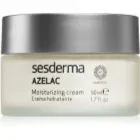
Works for
3 of 3 advertised claims delivered
Moisturizing18 ingredients credited for this claimStrong support
“Зволожувальний крем для боротьби з недоліками Sesderma Azelac стане вашим улюбленим помічником.”
This product can help improve hydration of the skin with the two types of ingredients.
The first type is called “humectants”:
these ingredients help attract water.
When humectants are on the surface of the skin, they “pull in” the moisture from the outside environment, or from
within deeper layers of the skin. The following ingredients in this product do the job:
pantolactone, sodium hyaluronate.
This product also contains ingredients called “occlusives”. They help reduce the speed with which our skin loses moisture to the outside environment. These ingredients also help soften the upper layer of the skin, so it feels less tight and nicer to the touch. The following ingredients in this product do the job: caprylic/capric triglyceride, helianthus annuus seed oil.
The following ingredients in this product are especially good for supporting the skin barrier and helping with the hydration level: panthenol
Evens skin tone5 ingredients credited for this claimStrong support
“вирівнює тон шкіри”
This product can help reduce hypepigmentation and even out the skin tone because it contains the following effective ingredients: azelaic acid, potassium azeloyl diglycinate
The following ingredient (ingredients) in this product might be helpful, but there is no evidence to confirm that it actually can help even out the skin tone: retinyl palmitate, retinyl propionate.
Keep in mind that you would need to apply any topical skincare targetted at hypigmentation consistently for a couple of months to get a result. No topical skincare product can help get rid of hyperpigmentation (including post-acne marks and age spots) instantly.
Anti-aging5 ingredients credited for this claimModerate support
“Крем навіть протидіє ознакам старіння та може наноситися на шкіру, уражену розацеєю або куперозом.”
This product contains retinyl palmitate, retinyl propionate. These ingredients might be able to help reduce and prevent fine lines and wrinkles, improve skin elasticity and firmness, but there is not enough evidence that it actually works.
Anti-oxidationNot advertised by the brand · 5 ingredients credited for this claimStrong support
This product contains antioxidants (azelaic acid) that can help neutralize free radicals in skin. By doing so, they can lessen the damage the skin gets from the UV light (sun).
Anti-blemishNot advertised by the brand · 5 ingredients credited for this claimStrong support
This product can help reduce breakouts and clogged pores because it contains the following ingredient: azelaic acid. This ingredient is used for treating acne and can have a noticeable effect.
In addition, this product contains potassium azeloyl diglycinate. It can help in reducing blemishes, even though it is less effective.
The following ingredient (ingredients) in this product might be helpful, but there is no evidence to confirm that it actually works: retinyl palmitate, retinyl propionate
Can it cause trouble?
Irritancy7 strong irritants: Alcohol, Retinyl propionate + 5 more — patch-test recommendedHigh risk
ComedogenicClean of flagged comedogenic ingredientsNone flagged


User reviews
Be the first — your take helps the next person decide.
Ingredients
Filter by role to see what each ingredient is doing.
Water~45–55%
Potassium azeloyl diglycinate~3.9–4.8%
- Irritation risk
- Low
A derivative of azelaic acid. It is obtained by reacting the chloride of azelaic acid with two molecules of glycine (an amino acid) and potassium hydroxide. It is less studied than azelaic acid, but the available research suggests that it also can be effective in reducing skin redness, hyperpigmentation and blemishes. There are claims that it is more bio-available and more effective than azelaic acid, but no comparison study is available. Potassium azeloyl diglycinate is better soluble in water compared with azelaic acid. Because of this property, products with potassium azeloyl digclycinate can have a nicer texture
More about Potassium azeloyl diglycinatePropylene glycol~3.9–4.7%
- Irritation risk
- High
Helps oil and water mix together and can enhance the penetration of other ingredients into the skin. It can be irritating
More about Propylene glycolLecithin~2.8–3.4%
- Irritation risk
- Low
Used mostly for creating emulsions - helping oil and water mix together. Helps soften the upper layer of the skin
More about LecithinSodium polyacrylate~2.4–2.9%
- Irritation risk
- Low
Used to create a gel-like product texture, as well as to stabilize emulsions
More about Sodium polyacrylateAlcohol~1.9–2.3%
- Irritation risk
- High
Can be drying and contribute to skin irritation. Used in formulars to dissolve other ingredients, create a thinner product consistency or for its antibacterial properties
More about AlcoholCetearyl ethylhexanoate~1.6–2%
- Irritation risk
- Low
An emollient that helps soften the skin
More about Cetearyl ethylhexanoateCyclopentasiloxane~1.4–1.8%
- Irritation risk
- Low
A silicone that helps improve the product texture and spreadability. Can absorb oil creating a short-term mattifying effect on the skin
More about CyclopentasiloxaneEthylhexyl cocoate~1.2–1.5%
- Irritation risk
- Low
Helps soften the upper layer of the skin
More about Ethylhexyl cocoateAmmonium acryloyldimethyltaurate/vp copolymer~0.95–1.15%
- Irritation risk
- Low
Increases thickness of a product. Texture enhancer for oil-in-water emulsions
More about Ammonium acryloyldimethyltaurate/vp copolymerHydrogenated jojoba oil~0.8–1.2%
- Irritation risk
- Low
Helps soften the upper layer of the skin
More about Hydrogenated jojoba oilCaprylic/capric triglyceride~0.65–1%
- Irritation risk
- Medium
A good mix of fatty acids that forms a protective layer on the skin. Improves the shelf life of products. Derived from coconut and glycerin
More about Caprylic/capric triglycerideNiacinamide~0.55–0.85%
- Irritation risk
- Low
Is proven to be effective in reducing blemishes, evening out skin tone and helping to improve lines and wrinkles. It helps the skin to repair sun damage, calm down inflammation and keep maintain good levels of moisture. The concentration of about 2% is effective for supporting the skin barrier and evening out the skin tone. Concentration of 4-6% is better for helping with acne and balancing the sebum production
More about NiacinamideTriclosan~0.15–0.3%
- Irritation risk
- Low
Azelaic acid~0.5–0.75%
- Irritation risk
- Low
Is produced by a yeast that lives on normal human skin. It is used in medicine as a topical treatment for mild to moderate acne. It has a mild exfoliating effect. It can also help reduce hyperpigmentation, helps calm down inflammation and can help neutralize free radicals
More about Azelaic acidSilybum marianum extract~0.5–0.75%
- Irritation risk
- High
Might be able to help neutralize free radical, calm down inflammation in skin, and even skin tone
More about Silybum marianum extractRetinyl propionate~0.45–0.7%
- Irritation risk
- High
Three steps removed from the active form of vitamin A - retinoic acid. To have an effect in the skin, it first needs to be converted twice to become the retinoic acid. This means it is less potent than retinol, but could also be less irritating. Once converted to the retinoic acid in the skin, it helps against all signs of aging, improves skin cell turnover and helps fight blemishes and clogged pores, even thought its potency is not as well established as in case of retinol or retinaldehyde
More about Retinyl propionatePanthenol~0.45–0.65%
- Irritation risk
- Low
Helps attract water to the upper layer of the skin and can help improve skin barrier function
More about PanthenolSodium hyaluronate~0.4–0.6%
- Irritation risk
- Low
One of the best moisturizing ingredients. Attracts water into the upper layer of the skin
More about Sodium hyaluronatePhytosphingosine hcl~0.35–0.65%
- Irritation risk
- Low
Titanium dioxide~0.5–0.7%
- Irritation risk
- Low
Works as a UV filter when used in high concentrations. It is photostable and is effective mostly against the UVB light, with some protection in the UVA range. In small concentrations, used for its ability to improve the color of cosmetic products. Is usually well tolerated by the skin
More about Titanium dioxideMica~0.4–0.6%
- Irritation risk
- Low
Creates an illusion of smoother and more radiant skin tone. Adds shimmer to the skin by reflecting light
More about MicaPrunus amygdalus dulcis oil~0.35–0.65%
- Irritation risk
- Low
An emollient that softens the skin
More about Prunus amygdalus dulcis oilTocopheryl acetate~0.3–0.6%
- Irritation risk
- Medium
A more stable but less bio-available form of vitamin E compared to Tocopherol. Might help moisturize and protect the skin from free radicals, but mostly used in low concentrations to stabilize other ingredients.
More about Tocopheryl acetateSodium cholate~0.3–0.55%
- Irritation risk
- Low
Acrylamide/sodium acryloyldimethyltaurate copolymer~0.3–0.55%
- Irritation risk
- Low
Helps water and oil mix together and create gel-like textures
More about Acrylamide/sodium acryloyldimethyltaurate copolymerC13-14 isoparaffin~0.35–0.65%
- Irritation risk
- Low
Helps soften the upper layer of the skin, dissolve other ingredients and create a thicker product consistency
More about C13-14 isoparaffinPpg-3 benzyl ether myristate~0.4–0.6%
- Irritation risk
- Low
Polysorbate 20~0.35–0.6%
Sodium hydroxide~0.3–0.55%
Polysilicone-11~0.35–0.6%
- Irritation risk
- Low
A silicone that forms a light film on the skin surface helping to bind water and temporarily absorb oils creating a matt and powdery feel
More about Polysilicone-11Laureth-7~0.3–0.6%
Dimethicone/vinyl dimethicone crosspolymer~0.3–0.55%
- Irritation risk
- Low
Used to stabilize product formulations and create a nice product texture
More about Dimethicone/vinyl dimethicone crosspolymerSodium chloride~0.3–0.6%
- Irritation risk
- Low
Used to stabilize mixtures of oil and water, and create thicker, gel-like product textures
More about Sodium chlorideTin oxide~0.45–0.65%
- Irritation risk
- Low
A colorant that can add a pearl-like appearance to the formulation
More about Tin oxideHelianthus annuus seed oil~0.35–0.6%
- Irritation risk
- Low
A great emollient due to its high linoleic acid content. One of the most effective plant oils in helping skin hydration and repairing skin barrier function
More about Helianthus annuus seed oilRetinyl palmitate~0.25–0.5%
- Irritation risk
- High
Three steps removed from the active form of vitamin A - retinoic acid. To have an effect in the skin, it first needs to be converted twice to become the retinoic acid. This means it is less potent than retinol, but could also be less irritating. Once converted to the retinoic acid in the skin, it helps against all signs of aging, improves skin cell turnover and helps fight blemishes and clogged pores. However, in many cosmetic formulations, it is used in a concentration that is too low to have the full effect
More about Retinyl palmitateBht~0.25–0.5%
Pantolactone~0.25–0.5%
- Irritation risk
- Low
Helps attract water to the upper layer of the skin
More about PantolactoneTocopherol~0.25–0.5%
- Irritation risk
- Low
Pure form of vitamin E. Can help moisturise and protect the skin from free radicals. Often used to help stabilise other ingredients or the formula itself
More about TocopherolPhenoxyethanol~0.25–0.5%
- Irritation risk
- Low
A preservative. It helps prevent bacterial growth in cosmetic products
More about PhenoxyethanolMethylparaben~0.15–0.3%
Ethylparaben~0.2–0.35%
Propylparaben~0.15–0.25%
Butylparaben~0.1–0.2%
Isobutylparaben~0.15–0.25%
Parfum~0.1–0.2%
- Irritation risk
- High
An aromatic blend of unspecified and possibly irritating ingredients
More about ParfumLinalool~0.1–0.2%
Citronellol~0.05–0.1%
Benzyl salicylate~0.05–0.1%
Ingredient list view
Water, Potassium azeloyl diglycinate, Propylene glycol, Lecithin, Sodium polyacrylate, Alcohol, Cetearyl ethylhexanoate, Cyclopentasiloxane, Ethylhexyl cocoate, Ammonium acryloyldimethyltaurate/vp copolymer, Hydrogenated jojoba oil, Caprylic/capric triglyceride, Niacinamide, Triclosan, Azelaic acid, Silybum marianum extract, Retinyl propionate, Panthenol, Sodium hyaluronate, Phytosphingosine hcl, Titanium dioxide, Mica, Prunus amygdalus dulcis oil, Tocopheryl acetate, Sodium cholate, Acrylamide/sodium acryloyldimethyltaurate copolymer, C13-14 isoparaffin, Ppg-3 benzyl ether myristate, Polysorbate 20, Sodium hydroxide, Polysilicone-11, Laureth-7, Dimethicone/vinyl dimethicone crosspolymer, Sodium chloride, Tin oxide, Helianthus annuus seed oil, Retinyl palmitate, Bht, Pantolactone, Tocopherol, Phenoxyethanol, Methylparaben, Ethylparaben, Propylparaben, Butylparaben, Isobutylparaben, Parfum, Linalool, Citronellol, Benzyl salicylate
Compare prices
Retailers ranked by price — lowest first.
Affiliate links · prices updated regularly · As an Amazon Associate, WIMJ earns from qualifying purchases.
Worth comparing, line by line.
Match % combines shared ingredients, the first five ingredients, shared actives and hero ingredients, irritancy (lower counts in the alternative's favour), texture and body area. Only products in the same routine step are compared.
| SesdermaAzelacYOUR PRODUCT | BootsDermacare Hyperpigmentation Cream | Skincare by Dr VTrio Blemish AM Gel Moisturiser | FaceFactsBright + Clear Cream | |
|---|---|---|---|---|
| Match | — | 69% | 65% | 62% |
| Price | $31.73 | $19.76−$11.97 | $50.17+$18.44 | — |
| Shared key ingredients | — | 5 of 17 | 4 of 17 | 3 of 17 |
| Key difference | — | Dimethicone | Sodium Ascorbyl Phosphate | Mineral Oil |
| Irritancy | High | Medium | Medium | Medium |
| Drying alcohol | Contains drying alcohol | — | — | — |
| View product | Shop | Shop | Shop |

Product summary
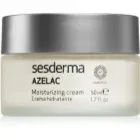
"Sesderma - Azelac" is effective for: Moisturizing, Evens skin tone and Anti-blemish
This product could be helpful for: Anti-aging, but its actives are not the most effective or are not well-studied.
Ingredient callouts
- this product includes a form of Retinoids (vitamin A) - retinyl palmitate 0.25% - 0.50% and retinyl propionate 0.45% - 0.70%, but this type of vitamin A is not very effective. It could in theory help with fine lines and wrinkles, but the effect is most likely minimal.
- Potassium Azeloyl Diglycinate (3.90% - 4.80%). It is a derivative of Azelaic Acid. It is less studied than Azelaic Acid, but the available research suggests that it also can be effective in reducing skin redness, hyperpigmentation and blemishes. There are claims that it is more bio-available and more effective than azelaic acid, but no comparison study is available. Potassium Azeloyl Diglycinate is better soluble in water compared with Azelaic Acid. Because of this property, products with Potassium Azeloyl Digclycinate can have a nicer texture.
- Humectants (pantolactone 0.25% - 0.50%, sodium hyaluronate 0.40% - 0.60% and panthenol 0.45% - 0.65%). These ingredients help attract water to the upper layer of the skin and improve the skin hydration.
Price
The product retails for 60.00$ in the United States and for 36.95£ in the United Kingdom.
For a detailed price comparison: click here.
Sources cited in this review
Every concentration estimate and effectiveness label is anchored to one of these 27 studies and safety reviews.
- 1
- 2
- 3Azeloyl-Glycine: A new active in skin disequilibriumresearchgate.net
- 4
- 5Surfactants and experimental irritant contact dermatitisncbi.nlm.nih.gov
- 6Propylene Glycolpubmed.ncbi.nlm.nih.gov

Affiliate links · As an Amazon Associate, WIMJ earns from qualifying purchases.