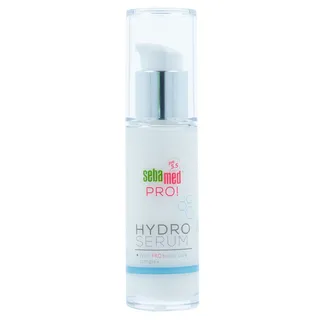
Works for
Anti-agingNiacinamide, Lactococcus ferment lysate + 2 moreWorks well
“The PRObiotic care agent in SEBAMED PRO! RENEW LINE helps to visibly improve pronounced signs of skin aging.”
This product can help reduce and prevent fine lines and wrinkles, improve skin elasticity and firmness because it contains niacinamide.
Keep in mind that it typically takes at least 6 weeks to notice any results because the changes that are needed to improve fine lines and elasticity happen in the deeper layers of the skin. No topical anti-aging product can “erase” wrinkles or fully reverse signs of aging.
MoisturizingNiacinamide, Glycerin + 10 moreWorks well
“Galangal root extract is also a hyaluronic acid booster, which enables skin to retain moisture.”
This product can help improve hydration of the skin with the two types of ingredients.
The first type is called “humectants”:
these ingredients help attract water.
When humectants are on the surface of the skin, they “pull in” the moisture from the outside environment, or from
within deeper layers of the skin. The following ingredients in this product do the job:
glycerin.
This product also contains ingredients called “occlusives”. They help reduce the speed with which our skin loses moisture to the outside environment. These ingredients also help soften the upper layer of the skin, so it feels less tight and nicer to the touch. The following ingredients in this product do the job: caprylic/capric triglyceride, helianthus annuus seed oil.
The following ingredients in this product are especially good for supporting the skin barrier and helping with the hydration level: niacinamide
Evens skin toneSide benefit the brand mentions · Niacinamide, Lactic acidWorks well
“It also contains niacinamide which is known to aid the skin in regulating its oil production and hyperpigmentation.”
This product can help reduce hypepigmentation and even out the skin tone because it contains the following effective ingredients: niacinamide
Keep in mind that you would need to apply any topical skincare targetted at hypigmentation consistently for a couple of months to get a result. No topical skincare product can help get rid of hyperpigmentation (including post-acne marks and age spots) instantly.
Anti-blemishSide benefit · NiacinamideWorks well
This product can help reduce breakouts and clogged pores because it contains the following ingredient: niacinamide. This ingredient is used for treating acne and can have a noticeable effect.
Can it cause trouble?
Irritancy1 strong irritant: ParfumMedium risk
ComedogenicClean of flagged comedogenic ingredientsNone flagged

User reviews
Be the first — your take helps the next person decide.
Ingredients
Filter by role to see what each ingredient is doing.
Water~40–60%
Glycerin~4.1–6.2%
- Irritation risk
- Low
One of the best moisturizing ingredients. Naturally present in skin. It attracts water to the upper layer of the skin working as a humectant
More about GlycerinCoco-caprylate~3.7–5.5%
- Irritation risk
- Medium
An emollient that softens skin and creates a nice product texture
More about Coco-caprylateCaprylic/capric triglyceride~2.8–4.2%
- Irritation risk
- Medium
A good mix of fatty acids that forms a protective layer on the skin. Improves the shelf life of products. Derived from coconut and glycerin
More about Caprylic/capric triglycerideNiacinamide~2–3%
- Irritation risk
- Low
Is proven to be effective in reducing blemishes, evening out skin tone and helping to improve lines and wrinkles. It helps the skin to repair sun damage, calm down inflammation and keep maintain good levels of moisture. The concentration of about 2% is effective for supporting the skin barrier and evening out the skin tone. Concentration of 4-6% is better for helping with acne and balancing the sebum production
More about NiacinamideLactococcus ferment lysate~1.7–2.5%
- Irritation risk
- Low
Consists of remains of dead bacteria cells. Is likely helpful in attracting water to the upper layer of the skin. Might be helpful in reducing inflammation and neutralizing free radicals in skin
More about Lactococcus ferment lysateDicaprylyl carbonate~1.4–2.2%
- Irritation risk
- Low
Helps products spread more easily and works as an emollient to soften skin
More about Dicaprylyl carbonateDiethylamino hydroxybenzoyl hexyl benzoate~1.7–2.6%
- Irritation risk
- Medium
Uvinul A Plus. A new generation broad spectrum sunscreen that offers an effective protection especially in the UVA range. It is stable in formulations. Unfortunately, is not approved by the FDA (US) yet
More about Diethylamino hydroxybenzoyl hexyl benzoatePolyglyceryl-6 stearate~1.1–1.6%
- Irritation risk
- Low
Helps soften the upper layer of the skin
More about Polyglyceryl-6 stearateVitis vinifera seed oil~0.85–1.3%
- Irritation risk
- Medium
A great emollient that can also have anti-oxidant properties
More about Vitis vinifera seed oilTocopherol~0.5–1.15%
- Irritation risk
- Low
Pure form of vitamin E. Can help moisturise and protect the skin from free radicals. Often used to help stabilise other ingredients or the formula itself
More about TocopherolTocopheryl acetate~0.4–0.95%
- Irritation risk
- Medium
A more stable but less bio-available form of vitamin E compared to Tocopherol. Might help moisturize and protect the skin from free radicals, but mostly used in low concentrations to stabilize other ingredients.
More about Tocopheryl acetateBupleurum falcatum root extract~0.35–0.8%
- Irritation risk
- High
A plant extract that might help to attract water to the upper layer of the skin, but it is not well studied. It can be irritating
More about Bupleurum falcatum root extractAtractylodes macrocephala root extract~0.35–0.75%
- Irritation risk
- Low
Astragalus membranaceus root extract~0.3–0.75%
- Irritation risk
- Low
Helianthus annuus seed oil~0.3–0.75%
- Irritation risk
- Low
A great emollient due to its high linoleic acid content. One of the most effective plant oils in helping skin hydration and repairing skin barrier function
More about Helianthus annuus seed oilPolyglyceryl-6 behenate~0.2–0.8%
C18-22 hydroxyalkyl hydroxypropyl guar~0.15–0.6%
- Irritation risk
- Low
Lactic acid~0.15–0.5%
- Irritation risk
- Medium
An exfoliating and moisturizing alpha-hydroxy acid (AHA). Typically causes less irritation than other AHAs, for example, glycolic acid. At high concentrations (about 15%), lactic acid can help reduce lines and wrinkles. Recent studies show that lactic acid can support the "good" bacteria living on skin's surface (healthy skin microbiome)
More about Lactic acidSodium stearoyl glutamate~0.15–0.65%
- Irritation risk
- Medium
Helps oil and water mix together
More about Sodium stearoyl glutamateHydroxypropyl starch phosphate~0.15–0.55%
- Irritation risk
- Medium
Helps oil and water mix together and used to stabilize product formulations
More about Hydroxypropyl starch phosphateSodium chloride~0.1–0.45%
- Irritation risk
- Low
Used to stabilize mixtures of oil and water, and create thicker, gel-like product textures
More about Sodium chlorideXanthan gum~0.1–0.35%
- Irritation risk
- Low
Used to create a thicker product consistency
More about Xanthan gumCitric acid~0.05–0.3%
- Irritation risk
- Medium
Can work as an exfoliant but is typically used to adjust the product pH
More about Citric acidParfum~0.05–0.2%
- Irritation risk
- High
An aromatic blend of unspecified and possibly irritating ingredients
More about ParfumPhenoxyethanol~0.05–0.25%
- Irritation risk
- Low
A preservative. It helps prevent bacterial growth in cosmetic products
More about PhenoxyethanolSodium benzoate~0.05–0.2%
Ingredient list view
Water, Glycerin, Coco-caprylate, Caprylic/capric triglyceride, Niacinamide, Lactococcus ferment lysate, Dicaprylyl carbonate, Diethylamino hydroxybenzoyl hexyl benzoate, Polyglyceryl-6 stearate, Vitis vinifera seed oil, Tocopherol, Tocopheryl acetate, Bupleurum falcatum root extract, Atractylodes macrocephala root extract, Astragalus membranaceus root extract, Helianthus annuus seed oil, Polyglyceryl-6 behenate, C18-22 hydroxyalkyl hydroxypropyl guar, Lactic acid, Sodium stearoyl glutamate, Hydroxypropyl starch phosphate, Sodium chloride, Xanthan gum, Citric acid, Parfum, Phenoxyethanol, Sodium benzoate
Compare prices
Retailers ranked by price — lowest first.
Affiliate links · As an Amazon Associate, WIMJ earns from qualifying purchases.
Worth comparing, line by line.
Match % combines shared ingredients, the first five ingredients, shared actives and hero ingredients, irritancy (lower counts in the alternative's favour), texture and body area. Only products in the same routine step are compared.
| SebamedPRO! Hydro SerumYOUR PRODUCT | SimpleBooster Serum 10% Niacinamide | Boost LabVitamin C Brightening Serum | Purito SEOULTXA 6 Niacinamide 10 Retinal Serum | |
|---|---|---|---|---|
| Match | — | 94% | 92% | 91% |
| Price | $55.00 | $6.55−$48.45 | $22.99−$32.01 | $16.07−$38.93 |
| Shared key ingredients | — | 4 of 8 | 4 of 8 | 6 of 8 |
| Key difference | — | Panthenol | Sodium Ascorbyl Phosphate | Retinal |
| Irritancy | Medium | Low | Low | Medium |
| Drying alcohol | — | — | — | — |
| View product | Shop | Shop | Shop |

More alternatives: Dr. Idriss Major Fade Hyper SerumADVANCED CLINICALS 5% Niacinamide Serum
Sources cited in this review
Every concentration estimate and effectiveness label is anchored to one of these 11 studies and safety reviews.
- 1
- 2
- 3
- 4Vitamin E in dermatologyncbi.nlm.nih.gov
- 5Vitamin E and Skin Healthlpi.oregonstate.edu
- 6

Affiliate links · As an Amazon Associate, WIMJ earns from qualifying purchases.