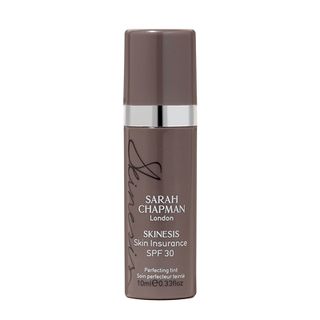
Sarah Chapman Skin Insurance SPF30
Works for
3 of 3 advertised claims delivered
Sun protectionSPF 30 · 6 UV filtersBroad spectrum
This product offers a good level of protection against both UVB and UVA rays.
This sunscreen uses organic (so-called "chemical") sunscreen filters. Organic, or "chemical" filters usually provide reliable sun protection and rarely leave a white cast. Sunscreens with organic filters can sting eyes.
Evens skin toneEthyl linoleate, NiacinamideStrong evidence
“Reduces pigmentation, brightens skin, and improves the skin’s health and quality”
This product offers broad spectrum sun protection. It means that it can prevent hyperpigmentation and help keep the skin tone even (sun damage is the main factor causing age spots, darkening of post-acne marks and other discolorations).
Anti-agingNonapeptide-1, Cyclotetrapeptide-24 aminocyclohexane carboxylate + 5 moreStrong evidence
“As well as these skin-boosting benefits, the cream features optical blurring technology, adaptive tints and light-scattering powder, so your complexion will be left looking bright, youthful and even – as well as protected.”
This product can help prevent early signs of skin aging because it offers a good level of broad spectrum sun protection. Sun damage is the main cause of premature skin aging, and protecting your skin from the sun is the best anti-aging strategy.
These ingredients in the product might also be helpful for reducing and preventing fine lines, wrinkles, and skin elasticity, even though there is no conclusive evidence for their effectiveness: cyclotetrapeptide-24 aminocyclohexane carboxylate, nonapeptide-1.
Anti-oxidationNot advertised by the brand · Polygonum aviculare extract, Pyridoxine hcl + 6 moreStrong evidence
This product contains antioxidants (polygonum aviculare extract) that can help neutralize free radicals in skin. By doing so, they can lessen the damage the skin gets from the UV light (sun).
MoisturizingNot advertised by the brand · Nonapeptide-1, Cyclotetrapeptide-24 aminocyclohexane carboxylate + 22 moreStrong evidence
This product can help improve hydration of the skin with the two types of ingredients.
The first type is called “humectants”:
these ingredients help attract water.
When humectants are on the surface of the skin, they “pull in” the moisture from the outside environment, or from
within deeper layers of the skin. The following ingredients in this product do the job:
dextran, glycerin.
This product also contains ingredients called “occlusives”. They help reduce the speed with which our skin loses moisture to the outside environment. These ingredients also help soften the upper layer of the skin, so it feels less tight and nicer to the touch. The following ingredients in this product do the job: dimethicone, dimethiconol.
The following ingredients in this product are especially good for supporting the skin barrier and helping with the hydration level: cyclotetrapeptide-24 aminocyclohexane carboxylate, nonapeptide-1
Anti-blemishNot advertised by the brand · Ethyl linoleate, Octadecenedioic acid + 4 moreGood evidence
This product might be able to help reduce blemishes and clogged pores because it contains ethyl linoleate.
Can it cause trouble?
Irritancy15 strong irritants: Jasminum officinale flower extract, Pelargonium graveolens flower oil + 13 more — patch-test recommendedHigh risk
Comedogenic2 ingredients rated 2 or more on the 0–5 pore-clogging scale2 flagged


User reviews
Be the first — your take helps the next person decide.
Ingredients
Filter by role to see what each ingredient is doing.
Water~45–55%
Homosalate~5.2–6.4%
- Irritation risk
- Medium
A weak sunscreen that offers some protection against the sun rays that cause sunburn (UVB), but does not offer meaningful protection against protect against the most aging sun rays (UVA). It loses its effectiveness quickly when exposed to sunlight. It is an organic, or so called "chemical" sunscreen. When used in low concentrations, helps to stabilize the product formulation
More about HomosalateEthylhexyl salicylate~4.5–5.5%
- Irritation risk
- Low
Octisalate. A UV filter. It offers some protection against the sun rays that cause sunburn (UVB), but does not protect against the most aging sun rays (UVA). It loses its effectiveness quickly when exposed to sunlight. It is an organic, or so called "chemical" sunscreen
More about Ethylhexyl salicylateOctocrylene~3.6–4.4%
- Irritation risk
- Medium
A weak sunscreen that protects against the sun rays that cause sunburn (UVB) and is somewhat effective against the UVA rays. It is quite stable and can help stabilize other, more vulnerable, sunscreen ingredients like Avobenzone. It is an organic, or so called "chemical" sunscreen
More about OctocryleneEthylhexyl methoxycinnamate~3.2–3.9%
- Irritation risk
- High
Octinoxate. When used in higher concentrations, works as a sunscreen protecting the skin from UVB rays. When used in lower concentration, helps to preserve the product formulation. Is shown to be harmful to coral reefs - consider avoiding bathing in coral reef areas when wearing a product with this ingredient. It can be irritating
More about Ethylhexyl methoxycinnamateGlycerin~2–2.5%
- Irritation risk
- Low
One of the best moisturizing ingredients. Naturally present in skin. It attracts water to the upper layer of the skin working as a humectant
More about GlycerinButyl methoxydibenzoylmethane~2.1–2.6%
- Irritation risk
- Medium
Avobenzone. An organic, or so-called "chemical" UV filter. Protects against both UVA and UVB rays. Needs to be combined with other filters in a formulation to be stable.
More about Butyl methoxydibenzoylmethanePotassium cetyl phosphate~1.4–1.7%
- Irritation risk
- Medium
Helps oil and water mix together
More about Potassium cetyl phosphateC12-15 alkyl benzoate~1.2–1.4%
- Irritation risk
- Low
Enhances the product texture and makes it more spreadable. Helps reduce water loss from the outer layer of skin. Extands the shelf life by preventing bacteria growth
More about C12-15 alkyl benzoateDimethicone~1–1.2%
- Irritation risk
- Low
A silicone that helps to reduce water loss from the surface of the skin. Can temporarily "fill in" lines and wrinkles, absorb oil, and create a nice product finish
More about DimethiconeNylon-12 fluorescent brightener 230 salt~0.75–1.1%
- Irritation risk
- Low
Isomalt~0.55–0.85%
- Irritation risk
- Low
Helps attract water to the upper layer of the skin
More about IsomaltHelianthus annuus seed oil~0.55–0.8%
- Irritation risk
- Low
A great emollient due to its high linoleic acid content. One of the most effective plant oils in helping skin hydration and repairing skin barrier function
More about Helianthus annuus seed oilSilica~0.7–1.05%
Ammonium acryloyldimethyltaurate/vp copolymer~0.45–0.65%
- Irritation risk
- Low
Increases thickness of a product. Texture enhancer for oil-in-water emulsions
More about Ammonium acryloyldimethyltaurate/vp copolymerOctadecenedioic acid~0.45–0.65%
- Irritation risk
- Low
Helps oil and water mix together. Might help suppress growth of acne-triggering bacteria in skin
More about Octadecenedioic acidSaccharide isomerate~0.4–0.6%
- Irritation risk
- Low
Helps attract water to the upper layer of the skin
More about Saccharide isomeratePanthenyl triacetate~0.35–0.6%
- Irritation risk
- Low
A stable oil-soluble derivative of vitamin B5. It can help support skin barrier and reduce inflammation in skin
More about Panthenyl triacetateXanthan gum~0.3–0.6%
- Irritation risk
- Low
Used to create a thicker product consistency
More about Xanthan gumSqualane~0.35–0.6%
- Irritation risk
- Low
An oil naturally present in skin. Works as an emollient to soften the skin and form a protective layer on its surface without a greasy feeling.
More about SqualaneDimethiconol~0.3–0.55%
- Irritation risk
- Low
A silicone that makes products more spreadable and keeps skin smooth. Helps to add gloss to skin and may visually fill in fine lines/wrinkles for short time
More about DimethiconolEthyl linoleate~0.25–0.5%
- Irritation risk
- Medium
Helps reduce acne and blemishes. Helps to soften the upper layer of the skin and reduce inflammation. Might be helpful in reducing hyperpigmentation and evening out the skin tone, but evidence of effectiveness in skin are lacking
More about Ethyl linoleateTocopheryl acetate~0.25–0.45%
- Irritation risk
- Medium
A more stable but less bio-available form of vitamin E compared to Tocopherol. Might help moisturize and protect the skin from free radicals, but mostly used in low concentrations to stabilize other ingredients.
More about Tocopheryl acetateLimnanthes alba seed oil~0.3–0.5%
- Irritation risk
- Low
This oil's cmposition is closest to rapeseed oil. It is a very stable oil and serves as an emoillient
More about Limnanthes alba seed oilDehydroacetic acid~0.25–0.45%
Lepidium meyenii root extract~0.25–0.45%
- Irritation risk
- Low
Cedrus atlantica bark oil~0.2–0.4%
- Irritation risk
- Low
Lecithin~0.3–0.5%
- Irritation risk
- Low
Used mostly for creating emulsions - helping oil and water mix together. Helps soften the upper layer of the skin
More about LecithinCichorium intybus root extract~0.25–0.45%
- Irritation risk
- Low
Ectoin~0.25–0.45%
- Irritation risk
- Low
Softens the upper layer of the skin and can support skin barrier function
More about EctoinPolyvinylalcohol crosspolymer~0.3–0.5%
- Irritation risk
- Low
Stearyl triethoxysilane~0.25–0.45%
- Irritation risk
- Low
Niacinamide~0.25–0.45%
- Irritation risk
- Low
Is proven to be effective in reducing blemishes, evening out skin tone and helping to improve lines and wrinkles. It helps the skin to repair sun damage, calm down inflammation and keep maintain good levels of moisture. The concentration of about 2% is effective for supporting the skin barrier and evening out the skin tone. Concentration of 4-6% is better for helping with acne and balancing the sebum production
More about NiacinamidePolygonum aviculare extract~0.3–0.55%
- Irritation risk
- Medium
A plant extract that contains a flavanol Juglanin. It can help neutralize free radicals in skin and reduce inflammation
More about Polygonum aviculare extractSodium starch octenylsuccinate~0.25–0.45%
- Irritation risk
- Low
Calcium pantothenate~0.25–0.45%
- Irritation risk
- Low
Helps support skin barrier function improving skin hydration and reducing sensitivity
More about Calcium pantothenateMaltodextrin~0.25–0.45%
- Irritation risk
- Low
Used to stabilize the product formulation and can help absorb oil
More about MaltodextrinTocopherol~0.25–0.45%
- Irritation risk
- Low
Pure form of vitamin E. Can help moisturise and protect the skin from free radicals. Often used to help stabilise other ingredients or the formula itself
More about TocopherolBuddleja davidii extract~0.25–0.45%
- Irritation risk
- Low
Ethyl ferulate~0.25–0.45%
- Irritation risk
- Low
Jasminum officinale flower extract~0.2–0.4%
Pelargonium graveolens flower oil~0.25–0.45%
- Irritation risk
- High
An essential oil. Can be irritating. Can become an allergen with oxidation
More about Pelargonium graveolens flower oilPolyglyceryl-5 trioleate~0.3–0.55%
Santalum spicata wood oil~0.2–0.4%
- Irritation risk
- High
Allantoin~0.2–0.4%
- Irritation risk
- Low
Helps calm down inflammation in skin and can help reduce itching. Helps to repair the skin barrier and keep skin hydrated
More about AllantoinAloe barbadensis leaf juice powder~0.25–0.45%
- Irritation risk
- Medium
Traditionally used to treat sunburns, dermatitis and inflammation, but evidence for its effectiveness is lacking. The extract can contain humectants that help attract water into the skin
More about Aloe barbadensis leaf juice powderPlankton extract~0.25–0.45%
- Irritation risk
- Medium
- Comedogenicity
- 3/5
Can help attract water to the upper layer of the skin
More about Plankton extractVitis vinifera fruit cell extract~0.25–0.45%
- Irritation risk
- Low
Sodium ascorbyl phosphate~0.25–0.45%
- Irritation risk
- Medium
A stable derivative of vitamin C. It is oil-soluble which means it is more likely to penetrate the skin compared to the pure form of vitamin C (which is water-soluble), but it is less bio-available and is way less effective in stimulating collagen and reducing wrinkles compared to the pure form of vitamin C (L-ascorbic acid) and its other derivatives (for example, magnesium ascorbyl phosphate). At the same time, this vitamin C derivative has been shown in studies to be effective in reducing acne, blemishes and clogged pores. It is less irritating then the pure form of vitamin C
More about Sodium ascorbyl phosphateRosa damascena flower oil~0.25–0.45%
- Irritation risk
- High
Used as a fragrance. Can be irritating
More about Rosa damascena flower oilPyridoxine hcl~0.25–0.45%
- Irritation risk
- Medium
Might help neutralize free radicals in skin
More about Pyridoxine hclRosmarinus officinalis leaf extract~0.2–0.4%
- Irritation risk
- High
Can be helpful in reducing inflammation in skin, including inflamed acne. It can be irritating
More about Rosmarinus officinalis leaf extractEthylhexylglycerin~0.25–0.45%
Disodium uridine phosphate~0.25–0.45%
- Irritation risk
- Low
Dextran~0.25–0.45%
- Irritation risk
- Low
Helps attract water to the most upper layer of the skin. Derived from sugar
More about DextranNonapeptide-1~0.25–0.45%
- Irritation risk
- Low
A type of peptide. Peptides are excellent moisturizers and might be able support collagen production reducing fine lines and wrinkles
More about Nonapeptide-1Cyclotetrapeptide-24 aminocyclohexane carboxylate~0.25–0.45%
- Irritation risk
- Low
A type of peptide. Peptides are excellent moisturizers and might be able support collagen production reducing fine lines and wrinkles
More about Cyclotetrapeptide-24 aminocyclohexane carboxylateButylene glycol~0.25–0.45%
- Irritation risk
- Low
Used to create a nice product texture and help delivery of other ingredients. Might be somewhat helpful in attracting water to the upper layer of the skin
More about Butylene glycolAlcohol~0.25–0.45%
- Irritation risk
- High
Can be drying and contribute to skin irritation. Used in formulars to dissolve other ingredients, create a thinner product consistency or for its antibacterial properties
More about AlcoholOleyl alcohol~0.25–0.45%
Parfum~0.2–0.4%
- Irritation risk
- High
An aromatic blend of unspecified and possibly irritating ingredients
More about ParfumPhenoxyethanol~0.25–0.45%
- Irritation risk
- Low
A preservative. It helps prevent bacterial growth in cosmetic products
More about PhenoxyethanolBenzoic acid~0.25–0.5%
Sodium hydroxide~0.25–0.45%
Sodium benzoate~0.25–0.45%
Citric acid~0.25–0.45%
- Irritation risk
- Medium
Can work as an exfoliant but is typically used to adjust the product pH
More about Citric acidPotassium sorbate~0.25–0.45%
Bht~0.25–0.45%
Sodium citrate~0.25–0.45%
- Irritation risk
- Medium
Helps to control the skin's pH level. Maintains the skin's natural film of amino-lactic acids and oils. Helps to preserve products
More about Sodium citrateSorbic acid~0.25–0.45%
Benzyl alcohol~0.2–0.4%
- Irritation risk
- High
A preservative. Can be used to mask unpleasant smell. Can be irritating
More about Benzyl alcoholBenzyl benzoate~0.2–0.4%
- Irritation risk
- High
Fragrance with sweet balsamic smell. Help to preserve products and dissolve other ingredients. Could trigger allergic reactions and be irritating
More about Benzyl benzoateBenzyl cinnamate~0.2–0.4%
Citral~0.2–0.4%
Citronellol~0.2–0.35%
Eugenol~0.2–0.35%
Farnesol~0.2–0.35%
Geraniol~0.15–0.3%
Hydroxycitronellal~0.15–0.3%
- Irritation risk
- High
A fragrance. A likely allergen and can be irritating
More about HydroxycitronellalLinalool~0.15–0.25%
Titanium dioxide~0.25–0.45%
- Irritation risk
- Low
Works as a UV filter when used in high concentrations. It is photostable and is effective mostly against the UVB light, with some protection in the UVA range. In small concentrations, used for its ability to improve the color of cosmetic products. Is usually well tolerated by the skin
More about Titanium dioxideIron oxides~0.15–0.25%
- Irritation risk
- Low
An umbrella term for the following three colorants: CI 77491, CI 77492, CI 77499. They might be able to offer some protection against visible light, but the degree of the protection is not clear
More about Iron oxidesIron oxides~0.1–0.15%
- Irritation risk
- Low
An umbrella term for the following three colorants: CI 77491, CI 77492, CI 77499. They might be able to offer some protection against visible light, but the degree of the protection is not clear
More about Iron oxidesIron oxides~0.1–0.15%
- Irritation risk
- Low
An umbrella term for the following three colorants: CI 77491, CI 77492, CI 77499. They might be able to offer some protection against visible light, but the degree of the protection is not clear
More about Iron oxidesIngredient list view
Water, Homosalate, Ethylhexyl salicylate, Octocrylene, Ethylhexyl methoxycinnamate, Glycerin, Butyl methoxydibenzoylmethane, Potassium cetyl phosphate, C12-15 alkyl benzoate, Dimethicone, Nylon-12 fluorescent brightener 230 salt, Isomalt, Helianthus annuus seed oil, Silica, Ammonium acryloyldimethyltaurate/vp copolymer, Octadecenedioic acid, Saccharide isomerate, Panthenyl triacetate, Xanthan gum, Squalane, Dimethiconol, Ethyl linoleate, Tocopheryl acetate, Limnanthes alba seed oil, Dehydroacetic acid, Lepidium meyenii root extract, Cedrus atlantica bark oil, Lecithin, Cichorium intybus root extract, Ectoin, Polyvinylalcohol crosspolymer, Stearyl triethoxysilane, Niacinamide, Polygonum aviculare extract, Sodium starch octenylsuccinate, Calcium pantothenate, Maltodextrin, Tocopherol, Buddleja davidii extract, Ethyl ferulate, Jasminum officinale flower extract, Pelargonium graveolens flower oil, Polyglyceryl-5 trioleate, Santalum spicata wood oil, Allantoin, Aloe barbadensis leaf juice powder, Plankton extract, Vitis vinifera fruit cell extract, Sodium ascorbyl phosphate, Rosa damascena flower oil, Pyridoxine hcl, Rosmarinus officinalis leaf extract, Ethylhexylglycerin, Disodium uridine phosphate, Dextran, Nonapeptide-1, Cyclotetrapeptide-24 aminocyclohexane carboxylate, Butylene glycol, Alcohol, Oleyl alcohol, Parfum, Phenoxyethanol, Benzoic acid, Sodium hydroxide, Sodium benzoate, Citric acid, Potassium sorbate, Bht, Sodium citrate, Sorbic acid, Benzyl alcohol, Benzyl benzoate, Benzyl cinnamate, Citral, Citronellol, Eugenol, Farnesol, Geraniol, Hydroxycitronellal, Linalool, Titanium dioxide, Iron oxides, Iron oxides, Iron oxides
Compare prices
Retailers ranked by price — lowest first.

Worth comparing, line by line.
Match % combines shared ingredients, the first five ingredients, shared actives and hero ingredients, irritancy (lower counts in the alternative's favour), texture and body area. Only products in the same routine step are compared.
| Sarah ChapmanSkin Insurance SPF30YOUR PRODUCT | SkinMedicaTotal Defense and Repair SPF 50 | OlayTotal Effects Whip Face Moisturizer with Sunscreen SPF 40 | The SaemEco Earth Light Sun Cream | |
|---|---|---|---|---|
| Match | — | 75% | 75% | 74% |
| Price | $98.93 | — | $16.99−$81.94 | $15.30−$83.63 |
| Shared key ingredients | — | 8 of 25 | 8 of 25 | 7 of 25 |
| Key difference | — | Panthenol | Sodium Ascorbyl Phosphate | Adenosine |
| Irritancy | High | Low | Medium | Medium |
| SPF | SPF 30 | SPF 50 | SPF 40 | SPF 50 |
| Drying alcohol | Contains drying alcohol | — | — | — |
| View product | Shop | Shop | Shop |


Product summary
Based on the ingredient list, we assess that "Sarah Chapman - Skin Insurance SPF30" can provide reliable sun protection. It can protect from both UVA and UVB rays. This is great news because not all sunscreens with SPF ratings give UVA protection. (UVA rays do not cause sunburn, but still damage our skin and lead to early aging).
Its formula is also hydrating, so you might not need an additional moistruizer during the day. This product prevents early signs of aging by protecting against sun damage (all broad spectrum sunscreens do that).
Sunscreen filters
This sunscreen uses a mixture of both mineral and organic (so-called "chemical") UV filters. The organic filters in the product are: avobenzone, octinoxate, octisalate, homosalate and octocrylene. As for the mineral filters, this sunscreen uses titanium dioxide.
Irritation risk
It contains a bunch of common irritants, including ingredients that do not provide any known benefit for the skin. It might not be the best choice if your skin is sensitive. We assess the overall irritancy of this product to be high. For a detailed overview of all potential irritants: click here
You can see the detailed formula review with the breakdown of all actives in the product and the full ingredient list with estimated concentrations in the tables below.
Price
The product retails from 76.50$ up to 119.92$ in the United States and from 23.50£ up to 69.00£ in the United Kingdom.
For a detailed price comparison: click here.
Sources cited in this review
Every concentration estimate and effectiveness label is anchored to one of these 33 studies and safety reviews.
- 1
- 2
- 3
- 4Final Report on the Safety Assessment of Dimethicone Copolyoljournals.sagepub.com
- 5
- 6

Affiliate links · As an Amazon Associate, WIMJ earns from qualifying purchases.