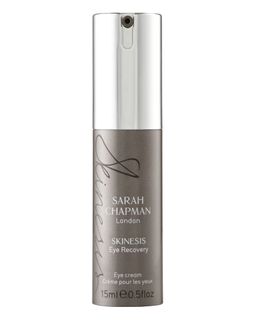
Sarah Chapman Eye Recovery
Works for
1 of 1 advertised claim delivered
Anti-agingAdenosine triphosphate, Carnosine + 14 moreModerate evidence
“The advanced peptides – Syn-Ake, Matrixyl, Syn-Coll, Haloxyl, and Eyeliss – help to stimulate collagen and cell activity to plump fine lines and smooth the eye contour, while advanced age-defying Renovage increases the life span of cells.”
This product contains adenosine triphosphate, carnosine, dipeptide diaminobutyroyl benzylamide diacetate, dipeptide-2, palmitoyl pentapeptide-4, palmitoyl tetrapeptide-7, palmitoyl tripeptide-1, palmitoyl tripeptide-5. These ingredients might be able to help reduce and prevent fine lines and wrinkles, improve skin elasticity and firmness, but there is not enough evidence that it actually works.
Anti-oxidationNot advertised by the brand · Carnosine, Thioctic acid + 11 moreStrong evidence
This product contains antioxidants (carnosine, thioctic acid, ubiquinone) that can help neutralize free radicals in skin. By doing so, they can lessen the damage the skin gets from the UV light (sun).
The following ingredients - chrysin, hexylresorcinol also can have an antioxidant effect, but there is less evidence to confirm their effectiveness in skin.
MoisturizingNot advertised by the brand · Palmitoyl pentapeptide-4, Dipeptide diaminobutyroyl benzylamide diacetate + 29 moreStrong evidence
This product can help improve hydration of the skin with the two types of ingredients.
The first type is called “humectants”:
these ingredients help attract water.
When humectants are on the surface of the skin, they “pull in” the moisture from the outside environment, or from
within deeper layers of the skin. The following ingredients in this product do the job:
carnosine, glycerin.
This product also contains ingredients called “occlusives”. They help reduce the speed with which our skin loses moisture to the outside environment. These ingredients also help soften the upper layer of the skin, so it feels less tight and nicer to the touch. The following ingredients in this product do the job: caprylic/capric triglyceride, dimethicone.
The following ingredients in this product are especially good for supporting the skin barrier and helping with the hydration level: dipeptide diaminobutyroyl benzylamide diacetate, dipeptide-2, palmitoyl pentapeptide-4, palmitoyl tetrapeptide-7, palmitoyl tripeptide-1, palmitoyl tripeptide-5
Evens skin toneNot advertised by the brand · Chrysin, Stearyl glycyrrhetinate + 6 moreModerate evidence
The following ingredient (ingredients) in this product might be helpful, but there is no evidence to confirm that it actually works: chrysin, hexylresorcinol, stearyl glycyrrhetinate.
Can it cause trouble?
Irritancy3 strong irritants: Retinyl palmitate, Santalum album extract + 1 more — patch-test recommendedHigh risk
Comedogenic4 ingredients rated 2 or more on the 0–5 pore-clogging scale4 flagged

User reviews
Be the first — your take helps the next person decide.
Ingredients
Filter by role to see what each ingredient is doing.
Water~45–55%
Glycerin~4.3–5.2%
- Irritation risk
- Low
One of the best moisturizing ingredients. Naturally present in skin. It attracts water to the upper layer of the skin working as a humectant
More about GlycerinCetearyl olivate~3.5–4.3%
Isopropyl palmitate~3–3.6%
- Irritation risk
- Medium
- Comedogenicity
- 3/5
Helps soften the upper layer of the skin and create a thicker product consistency
More about Isopropyl palmitatePhenyl trimethicone~2.3–2.8%
- Irritation risk
- Low
A type of silicone that can decrease loss of moisture from the skin surface. It helps create a nice product texture
More about Phenyl trimethiconeSorbitan olivate~1.8–2.2%
Butylene glycol~1.5–1.8%
- Irritation risk
- Low
Used to create a nice product texture and help delivery of other ingredients. Might be somewhat helpful in attracting water to the upper layer of the skin
More about Butylene glycolCaprylic/capric triglyceride~1.4–1.7%
- Irritation risk
- Medium
A good mix of fatty acids that forms a protective layer on the skin. Improves the shelf life of products. Derived from coconut and glycerin
More about Caprylic/capric triglycerideCetearyl alcohol~1.2–1.4%
- Irritation risk
- Low
- Comedogenicity
- 2/5
A non-drying alcohol. Works as an emollient. Helps water and oil mix together and creates a nice product texture
More about Cetearyl alcoholDimethicone~0.95–1.15%
- Irritation risk
- Low
A silicone that helps to reduce water loss from the surface of the skin. Can temporarily "fill in" lines and wrinkles, absorb oil, and create a nice product finish
More about DimethiconeCetyl alcohol~0.7–1.05%
- Irritation risk
- Low
A non-drying alcohol that works to soften the skin and stabilize product formulations helping oil and water mix together
More about Cetyl alcoholGlyceryl stearate~0.55–0.85%
- Irritation risk
- Low
An emollient that softens the skin and forms a protective layer on its surface. Helps water and oil mix together
More about Glyceryl stearatePeg-100 stearate~0.55–0.8%
- Irritation risk
- Low
Helps oil and water mix togehter and creates a nice product texture
More about Peg-100 stearateSodium hyaluronate crosspolymer~0.35–0.65%
- Irritation risk
- Medium
Attracts water into the upper layer of the skin
More about Sodium hyaluronate crosspolymerTetrahexyldecyl ascorbate~0.35–0.6%
- Irritation risk
- Medium
Being a lipid soluble form of vitamin C, it is more stable than ascorbic acid, but still degrades quickly and needs to be stabilized in a formulation with another ingredient. It is claimed to penetrate skin better than pure vitamin C and have the the similar benefits, but solid studies of its effectiveness are lacking. Is likely to require a higher concentration in a product than pure vitamin C to be effective. It might be able to help reduce pore clogging.
More about Tetrahexyldecyl ascorbatePlantago lanceolata leaf extract~0.35–0.6%
- Irritation risk
- Medium
A plant extract that might have anti-oxidant properties
More about Plantago lanceolata leaf extractCrithmum maritimum extract~0.3–0.55%
- Irritation risk
- Low
- Comedogenicity
- 3/5
An algae extract that might have anti-oxidant properties
More about Crithmum maritimum extractHesperidin methyl chalcone~0.3–0.5%
- Irritation risk
- High
Might help neutralize free radicals in skin. Is claimed to be able to improve the appearance of undereye darkness but evidence is missing. Can be an allergen and cause irritation
More about Hesperidin methyl chalconeTeprenone~0.25–0.45%
- Irritation risk
- Low
Dipeptide diaminobutyroyl benzylamide diacetate~0.2–0.4%
- Irritation risk
- Low
A type of peptide. Peptides are excellent moisturizers and might be able support collagen production reducing fine lines and wrinkles
More about Dipeptide diaminobutyroyl benzylamide diacetatePalmitoyl tripeptide-5~0.2–0.4%
- Irritation risk
- Low
A type of peptide. Peptides are excellent moisturizers and might be able support collagen production reducing fine lines and wrinkles
More about Palmitoyl tripeptide-5N-hydroxysuccinimide~0.2–0.35%
- Irritation risk
- High
Is claimed to be able to brighten skin tone by removing some blood-related pigmented compounds in skin (hemoglobin and related elements) but solid research is missing. Can be irritating
More about N-hydroxysuccinimideDipeptide-2~0.2–0.35%
- Irritation risk
- Low
A type of peptide. Peptides are excellent moisturizers and might be able support collagen production reducing fine lines and wrinkles
More about Dipeptide-2Palmitoyl tetrapeptide-7~0.25–0.45%
- Irritation risk
- Low
A type of peptide. Peptides are excellent moisturizers and might be able support collagen production reducing fine lines and wrinkles
More about Palmitoyl tetrapeptide-7Palmitoyl pentapeptide-4~0.2–0.35%
- Irritation risk
- Low
A type of peptide. Peptides are excellent moisturizers and might be able support collagen production reducing fine lines and wrinkles
More about Palmitoyl pentapeptide-4Chrysin~0.2–0.35%
- Irritation risk
- Medium
Might be helpful in reducing fine lines and wrinkles, as well as lightening the skin, but solid evidence is missing. Could somewhat help in reducing the darkness of the under-eye area. Helps to neutralise free radicals in skin
More about ChrysinPalmitoyl tripeptide-1~0.25–0.4%
- Irritation risk
- Low
A type of peptide. Peptides are excellent moisturizers and might be able support collagen production reducing fine lines and wrinkles
More about Palmitoyl tripeptide-1Dicetyl phosphate~0.2–0.4%
Ceteth-10 phosphate~0.25–0.5%
Steareth-20~0.25–0.5%
Acetyl tyrosine~0.2–0.35%
- Irritation risk
- Low
Proline~0.2–0.4%
Hydrolyzed vegetable protein~0.2–0.35%
Adenosine triphosphate~0.2–0.35%
Ethylhexyl palmitate~0.25–0.4%
- Irritation risk
- Low
- Comedogenicity
- 3/5
An emollient that helps soften the skin and create a nice product texture
More about Ethylhexyl palmitateSilica dimethyl silylate~0.25–0.4%
Sodium hyaluronate~0.2–0.35%
- Irritation risk
- Low
One of the best moisturizing ingredients. Attracts water into the upper layer of the skin
More about Sodium hyaluronateHexylresorcinol~0.2–0.35%
- Irritation risk
- Medium
Might be helpful in reducing hyperpigmentation and neutralizing free radicals in skin
More about HexylresorcinolCyclopentasiloxane~0.25–0.4%
- Irritation risk
- Low
A silicone that helps improve the product texture and spreadability. Can absorb oil creating a short-term mattifying effect on the skin
More about CyclopentasiloxanePpg-12/smdi copolymer~0.25–0.45%
Triethanolamine~0.2–0.4%
- Irritation risk
- Medium
Used to adjust pH of the product and can help improve the product's smell
More about TriethanolaminePhenoxyethanol~0.2–0.4%
- Irritation risk
- Low
A preservative. It helps prevent bacterial growth in cosmetic products
More about PhenoxyethanolCaprylyl glycol~0.2–0.4%
- Irritation risk
- Medium
Helps preserve products and creates a nice product texture
More about Caprylyl glycolEthylhexylglycerin~0.2–0.35%
Hexylene glycol~0.2–0.35%
- Irritation risk
- Medium
Helps create a more spreadable product texture
More about Hexylene glycolSaccharide isomerate~0.2–0.35%
- Irritation risk
- Low
Helps attract water to the upper layer of the skin
More about Saccharide isomerateXanthan gum~0.2–0.4%
- Irritation risk
- Low
Used to create a thicker product consistency
More about Xanthan gumDimethylaminoethanol tartrate~0.2–0.4%
- Irritation risk
- Low
Stearyl glycyrrhetinate~0.2–0.35%
- Irritation risk
- Medium
A fatty acid derived from licorice. Works as an emollient and can help calm down inflammation
More about Stearyl glycyrrhetinateRetinyl palmitate~0.15–0.3%
- Irritation risk
- High
Three steps removed from the active form of vitamin A - retinoic acid. To have an effect in the skin, it first needs to be converted twice to become the retinoic acid. This means it is less potent than retinol, but could also be less irritating. Once converted to the retinoic acid in the skin, it helps against all signs of aging, improves skin cell turnover and helps fight blemishes and clogged pores. However, in many cosmetic formulations, it is used in a concentration that is too low to have the full effect
More about Retinyl palmitateThioctic acid~0.2–0.35%
Carnosine~0.2–0.35%
- Irritation risk
- Low
A type of peptide. It attracts water to the upper layer of the skin. It can help neutralize free radicals in skin combatting the sun damage
More about CarnosineUbiquinone~0.2–0.35%
- Irritation risk
- Low
Coenzyme Q10. It helps neutralize free radicals in skin, improves skin hydration and might be helpful agains fine lines and wrinkles. It can be an allergen
More about UbiquinoneTocopheryl acetate~0.2–0.4%
- Irritation risk
- Medium
A more stable but less bio-available form of vitamin E compared to Tocopherol. Might help moisturize and protect the skin from free radicals, but mostly used in low concentrations to stabilize other ingredients.
More about Tocopheryl acetateTricholoma matsutake extract~0.2–0.35%
- Irritation risk
- Low
Santalum album extract~0.25–0.4%
Phellodendron amurense bark extract~0.2–0.35%
- Irritation risk
- Medium
A plant extract that might have an anti-inflammatory effect
More about Phellodendron amurense bark extractHordeum distichon extract~0.2–0.35%
- Irritation risk
- Low
Mica~0.2–0.4%
- Irritation risk
- Low
Creates an illusion of smoother and more radiant skin tone. Adds shimmer to the skin by reflecting light
More about MicaIris florentina root extract~0.2–0.35%
- Irritation risk
- Low
Jasminum officinale flower extract~0.15–0.3%
Lilium candidum bulb extract~0.2–0.35%
- Irritation risk
- Low
Dipotassium glycyrrhizate~0.15–0.3%
- Irritation risk
- Low
A salt derived from licorice. Works as an emollient to soften the upper layer of the skin and can help calm down inflammation. Might be helpful for skin lightening
More about Dipotassium glycyrrhizateAloe barbadensis leaf juice powder~0.2–0.35%
- Irritation risk
- Medium
Traditionally used to treat sunburns, dermatitis and inflammation, but evidence for its effectiveness is lacking. The extract can contain humectants that help attract water into the skin
More about Aloe barbadensis leaf juice powderPolysorbate 20~0.2–0.4%
Peg-8~0.2–0.35%
- Irritation risk
- Medium
Used to create a nice product consistency
More about Peg-8Tocopherol~0.2–0.35%
- Irritation risk
- Low
Pure form of vitamin E. Can help moisturise and protect the skin from free radicals. Often used to help stabilise other ingredients or the formula itself
More about TocopherolAscorbyl palmitate~0.15–0.3%
- Irritation risk
- Medium
Being a lipid soluble form of vitamin C, it is more stable and can penetrate the skin better than L-Ascorbic acid. It is effective in protecting the skin from free radicals, as well as evening the skin tone, but is less effective in stimulating collagen production compared to L-Ascorbic acid.
More about Ascorbyl palmitateAscorbic acid~0.15–0.3%
- Irritation risk
- High
The most well-researched antioxidant that works in skin. Helps neutralize free radicals supporting collagen production, helping to even out the skin tone and preventing early signs of aging
More about Ascorbic acidCitric acid~0.1–0.25%
- Irritation risk
- Medium
Can work as an exfoliant but is typically used to adjust the product pH
More about Citric acidSilica~0.25–0.45%
Carbomer~0.1–0.2%
- Irritation risk
- Low
Helps create a thicker or gel-like product texture. It is not a surfactant but can be used in gentle cleansing formulations
More about CarbomerDisodium edta~0.1–0.2%
Ci 77163~0.05–0.1%
Ci 77891~0.05–0.1%
- Irritation risk
- Low
Ingredient list view
Water, Glycerin, Cetearyl olivate, Isopropyl palmitate, Phenyl trimethicone, Sorbitan olivate, Butylene glycol, Caprylic/capric triglyceride, Cetearyl alcohol, Dimethicone, Cetyl alcohol, Glyceryl stearate, Peg-100 stearate, Sodium hyaluronate crosspolymer, Tetrahexyldecyl ascorbate, Plantago lanceolata leaf extract, Crithmum maritimum extract, Hesperidin methyl chalcone, Teprenone, Dipeptide diaminobutyroyl benzylamide diacetate, Palmitoyl tripeptide-5, N-hydroxysuccinimide, Dipeptide-2, Palmitoyl tetrapeptide-7, Palmitoyl pentapeptide-4, Chrysin, Palmitoyl tripeptide-1, Dicetyl phosphate, Ceteth-10 phosphate, Steareth-20, Acetyl tyrosine, Proline, Hydrolyzed vegetable protein, Adenosine triphosphate, Ethylhexyl palmitate, Silica dimethyl silylate, Sodium hyaluronate, Hexylresorcinol, Cyclopentasiloxane, Ppg-12/smdi copolymer, Triethanolamine, Phenoxyethanol, Caprylyl glycol, Ethylhexylglycerin, Hexylene glycol, Saccharide isomerate, Xanthan gum, Dimethylaminoethanol tartrate, Stearyl glycyrrhetinate, Retinyl palmitate, Thioctic acid, Carnosine, Ubiquinone, Tocopheryl acetate, Tricholoma matsutake extract, Santalum album extract, Phellodendron amurense bark extract, Hordeum distichon extract, Mica, Iris florentina root extract, Jasminum officinale flower extract, Lilium candidum bulb extract, Dipotassium glycyrrhizate, Aloe barbadensis leaf juice powder, Polysorbate 20, Peg-8, Tocopherol, Ascorbyl palmitate, Ascorbic acid, Citric acid, Silica, Carbomer, Disodium edta, Ci 77163, Ci 77891
Compare prices
Retailers ranked by price — lowest first.

Worth comparing, line by line.
Match % combines shared ingredients, the first five ingredients, shared actives and hero ingredients, irritancy (lower counts in the alternative's favour), texture and body area. Only products in the same routine step are compared.
| Sarah ChapmanEye RecoveryYOUR PRODUCT | SWANICOCOPeptine Biome Eye Cream | |
|---|---|---|
| Match | — | 52% |
| Price | $30.75 | $18.00−$12.75 |
| Shared key ingredients | — | 9 of 24 |
| Key difference | — | Acetyl Dipeptide-1 Cetyl Ester |
| Irritancy | High | Medium |
| Drying alcohol | — | — |
| View product | Shop |
Product summary
Judging from the ingredient list, "Sarah Chapman - Eye Recovery" works well for improving skin hydration As we expect from a proper moisturizer, the formula includes a combo of effective humectants and emollients. These are the two different types of ingredients that are essential for improving the skin hydration and supporting a healthy skin barrier. Humectants in this product (carnosine, glycerin, saccharide isomerate, sodium hyaluronate and sodium hyaluronate crosspolymer) help to increase the water content in the upper layer of the skin. (These ingredients do so by "capturing" water molecules from the outside air or from within the deeper layers of the skin). Palmitoyl tetrapeptide-7, palmitoyl tripeptide-1, caprylic/capric triglyceride, dimethicone and phenyl trimethicone in this product help decrease the water evoporation from the skin, so that it stays hydrated for longer. These ingredients also soften the skin and take away the feeling of tightness and dryness.
Ingredient callouts
- This product also contains Vitamin C (Ascorbic Acid). It can be an effective active for anti-aging and evening out the skin tone, but in this moisturizer it is used for stabilizing other ingredients in the formulation. In this concentration (0.15% - 0.30%) it cannot have a noticeable benefit for the skin.
- This moisturizer includes a form of Retinoids (vitamin A) - retinyl palmitate 0.15% - 0.30%, but this type of vitamin A is not very effective. It could in theory help with fine lines and wrinkles, but the effect is most likely minimal.
- This moisturizer also contains Peptides (palmitoyl pentapeptide-4 0.20% - 0.35%, dipeptide-2 0.20% - 0.35%, dipeptide diaminobutyroyl benzylamide diacetate 0.20% - 0.40%, palmitoyl tetrapeptide-7 0.25% - 0.45%, palmitoyl tripeptide-5 0.20% - 0.40% and palmitoyl tripeptide-1 0.25% - 0.40%). Peptides are a very big group of ingredients. They all consist of a different combination of aminoacids. Our skin produces Peptides naturally. Some of them work as natural antibiotics, promote wound-healing and production of collagen. The scientists are still studying how effective the topical application of Peptides is, but it is very likely that they are helpful. Peptides might be able to support skin barrier restoration and even have an anti-aging benefit. At the very least, they certainly help attract water to the skin and support the hydration in this way.
Irritation risk
This formulation includes some common irritants, including ingredients that do not provide a benefit for the skin. We assess the overall irritancy of this moisturizer to be high. For a detailed overview of all potential irritants: click here
You can see the detailed formula review with the breakdown of all actives in the product and the full ingredient list with estimated concentrations in the tables below.
Price
The product retails for 23.00£ in the United Kingdom.
For a detailed price comparison: click here.
Sources cited in this review
Every concentration estimate and effectiveness label is anchored to one of these 20 studies and safety reviews.
- 1
- 2Final Report on the Safety Assessment of Isopropyl Isostearatejournals.sagepub.com
- 3
- 4Final Report on the Safety Assessment of Dimethicone Copolyoljournals.sagepub.com
- 5
- 6

Affiliate links · As an Amazon Associate, WIMJ earns from qualifying purchases.