Works for
Anti-agingAdenosine, Tocopherol + 1 moreWorks well
“to reduce wrinkles and fine lines,”
This product can help reduce and prevent fine lines and wrinkles, improve skin elasticity and firmness because it contains adenosine.
Keep in mind that it typically takes at least 6 weeks to notice any results because the changes that are needed to improve fine lines and elasticity happen in the deeper layers of the skin. No topical anti-aging product can “erase” wrinkles or fully reverse signs of aging.
MoisturizingSimmondsia chinensis seed oil, Caprylic/capric triglyceride + 13 moreWorks
“to moisturize the skin,”
This product can help improve hydration of the skin with the two types of ingredients.
The first type is called “humectants”:
these ingredients help attract water.
When humectants are on the surface of the skin, they “pull in” the moisture from the outside environment, or from
within deeper layers of the skin. The following ingredients in this product do the job:
arginine, calcium pca.
This product also contains ingredients called “occlusives”. They help reduce the speed with which our skin loses moisture to the outside environment. These ingredients also help soften the upper layer of the skin, so it feels less tight and nicer to the touch. The following ingredients in this product do the job: arginine, caprylic/capric triglyceride.
ExfoliationSide benefit · Salicylic acidWorks well
This product can help exfoliate the skin. In other words, it helps break down the bonds between dead cells on the surface of the skin and speed up the skin turnover. Skin often appears softer and brighter after exfoliation, but overdoing it can result in disrupted skin barrier. The following ingredient is doing the exfoliating job in this product: salicylic acid.
Anti-blemishSide benefit · Salicylic acidWorks well
This product can help reduce breakouts and clogged pores because it contains the following ingredient: salicylic acid. This ingredient is used for treating acne and can have a noticeable effect.
Can it cause trouble?
Irritancy12 strong irritants: Thymus vulgaris flower/leaf/stem water, Rosa damascena flower water + 10 more — patch-test recommendedHigh risk
Comedogenic2 ingredients rated 2 or more on the 0–5 pore-clogging scale2 flagged


User reviews
Be the first — your take helps the next person decide.
Ingredients
Filter by role to see what each ingredient is doing.
Water~45–55%
Thymus vulgaris flower/leaf/stem water~8.1–9.9%
- Irritation risk
- High
Dicaprylyl ether~4.9–6%
- Irritation risk
- Low
Helps soften the upper layer of the skin while creating a non-greasy feel on the skin. Helps to dissolve other ingredients
More about Dicaprylyl etherSimmondsia chinensis seed oil~3.5–4.3%
- Irritation risk
- Medium
Softens the upper layer of skin and helps restore the healthy skin barrier. Has shown to help calm down inflammation in skin. It is a stable oil, meaning that it retains its properties even when exposed to air.
More about Simmondsia chinensis seed oilCaprylic/capric triglyceride~2.7–3.3%
- Irritation risk
- Medium
A good mix of fatty acids that forms a protective layer on the skin. Improves the shelf life of products. Derived from coconut and glycerin
More about Caprylic/capric triglycerideRosa damascena flower water~2.2–2.7%
- Irritation risk
- High
Used to add a nice rose smell to the product. Might help attract water to the upper layer of the skin and have some anti-oxidant effect. Can be irritating
More about Rosa damascena flower waterCetearyl alcohol~2–2.4%
- Irritation risk
- Low
- Comedogenicity
- 2/5
A non-drying alcohol. Works as an emollient. Helps water and oil mix together and creates a nice product texture
More about Cetearyl alcoholGlycerin~1.7–2.1%
- Irritation risk
- Low
One of the best moisturizing ingredients. Naturally present in skin. It attracts water to the upper layer of the skin working as a humectant
More about GlycerinPropanediol~1.4–1.7%
- Irritation risk
- Low
Acts as a solvent for other ingredients. Speeds up the absorption of other ingredients into the skin
More about PropanediolGlyceryl stearate citrate~1.2–1.4%
- Irritation risk
- Low
Helps oil and water mix together while softening the upper layer of the skin
More about Glyceryl stearate citrateGlyceryl stearate~1–1.2%
- Irritation risk
- Low
An emollient that softens the skin and forms a protective layer on its surface. Helps water and oil mix together
More about Glyceryl stearatePentylene glycol~0.75–1.15%
- Irritation risk
- Medium
Used to preserve products, dissolve other ingredients and create a nice product texture
More about Pentylene glycolBenzyl alcohol~0.6–0.9%
- Irritation risk
- High
A preservative. Can be used to mask unpleasant smell. Can be irritating
More about Benzyl alcoholArginine~0.6–0.9%
- Irritation risk
- Low
An amino acid that is naturally present in skin and helps keep it hydrated. When used together with AHAs, it can reduce their irritating effect on the skin
More about ArginineGlyceryl stearate se~0.6–0.9%
- Irritation risk
- Low
- Comedogenicity
- 2/5
Used to stabilize the product formulations and works as an emollient
More about Glyceryl stearate seMica~0.65–0.95%
- Irritation risk
- Low
Creates an illusion of smoother and more radiant skin tone. Adds shimmer to the skin by reflecting light
More about MicaCitric acid~0.55–0.85%
- Irritation risk
- Medium
Can work as an exfoliant but is typically used to adjust the product pH
More about Citric acidTitanium dioxide~0.65–0.95%
- Irritation risk
- Low
Works as a UV filter when used in high concentrations. It is photostable and is effective mostly against the UVB light, with some protection in the UVA range. In small concentrations, used for its ability to improve the color of cosmetic products. Is usually well tolerated by the skin
More about Titanium dioxideTocopherol~0.5–0.8%
- Irritation risk
- Low
Pure form of vitamin E. Can help moisturise and protect the skin from free radicals. Often used to help stabilise other ingredients or the formula itself
More about TocopherolParfum~0.45–0.65%
- Irritation risk
- High
An aromatic blend of unspecified and possibly irritating ingredients
More about ParfumXanthan gum~0.5–0.7%
- Irritation risk
- Low
Used to create a thicker product consistency
More about Xanthan gumSalicylic acid~0.45–0.7%
- Irritation risk
- High
Used for skin exfoliation. It has an anti-inflammatory and anti-bacterial effect, helps to unclog pores, prevent blemishes and speed up healing of the existing ones. Sometimes referred to as a BHA (beta-hydroxy acid)
More about Salicylic acidIron oxides~0.4–0.6%
- Irritation risk
- Low
An umbrella term for the following three colorants: CI 77491, CI 77492, CI 77499. They might be able to offer some protection against visible light, but the degree of the protection is not clear
More about Iron oxidesAdenosine~0.4–0.65%
- Irritation risk
- Low
Might help improve cell turnover and reduce inflammation in skin. One study shows that the ingredients might be able to help reduce dynamic wrinkles (for example, in the corners of the eyes or on the forehead)
More about AdenosineAscorbyl glucoside~0.45–0.65%
- Irritation risk
- Medium
A vitamin C derivative that is more stable but less potent than pure form of vitamin C. Has a potential to boost collagen production, nutralise free radicals and reduce hyperpigmentation, but the required concentration is likely to be much higher than for the pure form of vitamin C, limiting the ingredient's effectiveness in products
More about Ascorbyl glucosideLinalool~0.35–0.65%
Sodium phytate~0.45–0.65%
Silica~0.55–0.8%
Helianthus annuus seed oil~0.45–0.7%
- Irritation risk
- Low
A great emollient due to its high linoleic acid content. One of the most effective plant oils in helping skin hydration and repairing skin barrier function
More about Helianthus annuus seed oilLimonene~0.35–0.65%
- Irritation risk
- High
A common frangrance that can easily irritate skin, especially if exposed to air, light or heat
More about LimoneneFagus sylvatica bud extract~0.45–0.65%
- Irritation risk
- Low
Calcium pca~0.45–0.65%
- Irritation risk
- Low
Helps attract water to the upper layer of the skin
More about Calcium pcaCitronellol~0.35–0.6%
Thymus vulgaris flower/leaf oil~0.4–0.6%
- Irritation risk
- High
Benzoic acid~0.25–0.5%
Geraniol~0.3–0.55%
Citral~0.3–0.5%
Sorbic acid~0.3–0.55%
Eugenol~0.25–0.45%
Alcohol~0.25–0.45%
- Irritation risk
- High
Can be drying and contribute to skin irritation. Used in formulars to dissolve other ingredients, create a thinner product consistency or for its antibacterial properties
More about AlcoholBenzyl benzoate~0.2–0.35%
- Irritation risk
- High
Fragrance with sweet balsamic smell. Help to preserve products and dissolve other ingredients. Could trigger allergic reactions and be irritating
More about Benzyl benzoateLeontopodium alpinum flower/leaf extract~0.2–0.35%
- Irritation risk
- Low
Sodium benzoate~0.2–0.35%
Potassium sorbate~0.2–0.35%
Ingredient list view
Water, Thymus vulgaris flower/leaf/stem water, Dicaprylyl ether, Simmondsia chinensis seed oil, Caprylic/capric triglyceride, Rosa damascena flower water, Cetearyl alcohol, Glycerin, Propanediol, Glyceryl stearate citrate, Glyceryl stearate, Pentylene glycol, Benzyl alcohol, Arginine, Glyceryl stearate se, Mica, Citric acid, Titanium dioxide, Tocopherol, Parfum, Xanthan gum, Salicylic acid, Iron oxides, Adenosine, Ascorbyl glucoside, Linalool, Sodium phytate, Silica, Helianthus annuus seed oil, Limonene, Fagus sylvatica bud extract, Calcium pca, Citronellol, Thymus vulgaris flower/leaf oil, Benzoic acid, Geraniol, Citral, Sorbic acid, Eugenol, Alcohol, Benzyl benzoate, Leontopodium alpinum flower/leaf extract, Sodium benzoate, Potassium sorbate
Compare prices
Retailers ranked by price — lowest first.

Worth comparing, line by line.
Match % combines shared ingredients, the first five ingredients, shared actives and hero ingredients, irritancy (lower counts in the alternative's favour), texture and body area. Only products in the same routine step are compared.
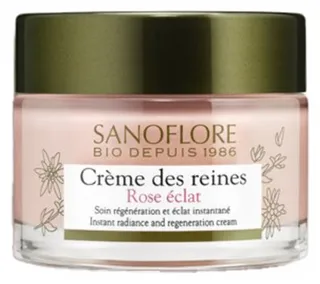
| SanofloreCrème des Reines Rose Éclat BioYOUR PRODUCT | DECLEORWhite Magnolia Anti-Ageing Rosy Cream | J.OneHana Cream | Paula's choiceProbiotic Nutrient Moisturizer | |
|---|---|---|---|---|
| Match | — | 90% | 85% | 84% |
| Price | — | — | $36.32 | $42.00 |
| Shared key ingredients | — | 7 of 11 | 5 of 11 | 4 of 11 |
| Key difference | — | Isocetyl Stearate | Acetyl Dipeptide-1 Cetyl Ester | Niacinamide |
| Irritancy | High | High | Medium | Medium |
| Drying alcohol | Contains drying alcohol | Contains drying alcohol | Contains drying alcohol | — |
| View product | Shop | Shop | Shop |


More alternatives: Institut Esthederm Intensive Propolis+ Skin Perfecting Cream TubeGarnier Organic Rosy Glow 3-in-1 Youth Cream
Product summary
"Sanoflore - Crème des Reines Rose Éclat Bio" is effective for: Anti-aging
This product could be helpful for: Moisturizing, but its actives are not the most effective or are not well-studied.
Ingredient callouts
- Adenosine 0.40% - 0.65%. It is a chemical present inside our skin cells. A clinical trial confirmed that topical application of Adenosine in a low concentration can reduce dynamic wrinkles (these are the wrinkles that appear with age in a places where our mimic is the most active, for example, in the corners of the eyes or on the forehead).
- Humectants (calcium pca 0.40% - 0.60%, arginine 0.60% - 0.90% and glycerin 1.70% - 2.10%). These ingredients help attract water to the upper layer of the skin and improve the skin hydration.
Price
The product retails from 39.10£ up to 46.31£ in the United Kingdom.
For a detailed price comparison: click here.
Sources cited in this review
Every concentration estimate and effectiveness label is anchored to one of these 15 studies and safety reviews.
- 1
- 2
- 3Vitamin E in dermatologyncbi.nlm.nih.gov
- 4Vitamin E and Skin Healthlpi.oregonstate.edu
- 5Salicylic acid as a peeling agent: a comprehensive reviewncbi.nlm.nih.gov
- 6Beta Hydroxy Acidsfda.gov

Affiliate links · As an Amazon Associate, WIMJ earns from qualifying purchases.