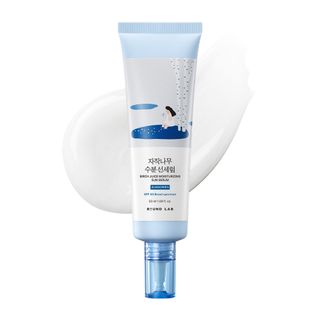
ROUND LAB Birch Juice Moisturizing Sun Serum
Works for
1 of 2 advertised claims delivered
Sun protectionSPF 50 · 5 UV filters · Partial spectrumWeak protection
This product does not offer good protection against UVA rays.
This product can be considered "reef safe" because it does not contain the UV filters (oxybenzone and octinoxate) that can be harmful to coral reefs when present in the water in high concentrations.
Moisturizing27 ingredients credited for this claimStrong support
“Birch Juice Moisturizing Sun Serum”
This product can help improve hydration of the skin with the two types of ingredients.
The first type is called “humectants”:
these ingredients help attract water.
When humectants are on the surface of the skin, they “pull in” the moisture from the outside environment, or from
within deeper layers of the skin. The following ingredients in this product do the job:
arginine, diglycerin.
This product also contains ingredients called “occlusives”. They help reduce the speed with which our skin loses moisture to the outside environment. These ingredients also help soften the upper layer of the skin, so it feels less tight and nicer to the touch. The following ingredients in this product do the job: arginine, dimethiconol.
The following ingredients in this product are especially good for supporting the skin barrier and helping with the hydration level: panthenol
Can it cause trouble?
Irritancy1 strong irritant: Pinus sylvestris leaf oilMedium risk
Comedogenic2 ingredients rated 2 or more on the 0–5 pore-clogging scale2 flagged

User reviews
Be the first — your take helps the next person decide.
Ingredients
Filter by role to see what each ingredient is doing.
Phenylbenzimidazole sulfonic acid2.5%
- Irritation risk
- Medium
Ensulizole. A UV filter that is effective against UVB rays. Does not protect against UVA light. It is photostable and can be used to help stabilize other sunscreen ingredients. It is water-soluble meaning that it can help create lighter sunscreen formulations
More about Phenylbenzimidazole sulfonic acidHomosalate5%
- Irritation risk
- Medium
A weak sunscreen that offers some protection against the sun rays that cause sunburn (UVB), but does not offer meaningful protection against protect against the most aging sun rays (UVA). It loses its effectiveness quickly when exposed to sunlight. It is an organic, or so called "chemical" sunscreen. When used in low concentrations, helps to stabilize the product formulation
More about HomosalateEthylhexyl salicylate4.5%
- Irritation risk
- Low
Octisalate. A UV filter. It offers some protection against the sun rays that cause sunburn (UVB), but does not protect against the most aging sun rays (UVA). It loses its effectiveness quickly when exposed to sunlight. It is an organic, or so called "chemical" sunscreen
More about Ethylhexyl salicylateOctocrylene6%
- Irritation risk
- Medium
A weak sunscreen that protects against the sun rays that cause sunburn (UVB) and is somewhat effective against the UVA rays. It is quite stable and can help stabilize other, more vulnerable, sunscreen ingredients like Avobenzone. It is an organic, or so called "chemical" sunscreen
More about OctocryleneWater~45–55%
Butyloctyl salicylate~6.6–8.1%
- Irritation risk
- Medium
A synthetic ester of salicylic acid that is used to help disperse pigments and boost effectiveness of sunscreen ingredients. It is able to absorb UV light (working as an organic, or chemical filter), but is not approved as a sunscreen ingredient on its own
More about Butyloctyl salicylateDipropylene glycol~5.8–7.1%
- Irritation risk
- Low
Helps to dissolve other ingredients in a formulation. Slows down the rate of product drying
More about Dipropylene glycolBenzotriazolyl dodecyl p-cresol~4.4–5.3%
- Irritation risk
- Medium
Used to stabilize the product formulation protecting it from sun light
More about Benzotriazolyl dodecyl p-cresolEthylhexyl methoxycrylene~3.2–3.9%
- Irritation risk
- Medium
Helps improve stability of sunscreen filters and boost their effectiveness
More about Ethylhexyl methoxycryleneVinyl dimethicone~2.4–3%
- Irritation risk
- Low
A type of silicone that helps to create a nice product texture and soften the upper layer of the skin
More about Vinyl dimethiconeTripropylene glycol~1.7–2%
- Irritation risk
- Low
Sorbitol~1.5–1.8%
- Irritation risk
- Low
Helps attract water to the upper layer of the skin and improves the product texture
More about Sorbitol1,2-hexanediol~0.75–1.15%
Silica~1.3–1.5%
Diethylhexyl 2,6-naphthalate~0.95–1.15%
- Irritation risk
- Low
Aminomethyl propanol~0.55–0.8%
Betula platyphylla japonica juice~0.5–0.7%
- Irritation risk
- Low
Diglycerin~0.45–0.65%
- Irritation risk
- Low
Helps attract water to the upper layer of the skin
More about DiglycerinBehenyl alcohol~0.5–0.75%
- Irritation risk
- Low
Non-drying alcohol that helps water and oil mix together. Also serves as an emollient
More about Behenyl alcoholPentylene glycol~0.5–0.75%
- Irritation risk
- Medium
Used to preserve products, dissolve other ingredients and create a nice product texture
More about Pentylene glycolPolyglyceryl-3 methylglucose distearate~0.4–0.6%
- Irritation risk
- Medium
Helps water and oil mix together
More about Polyglyceryl-3 methylglucose distearatePanthenol~0.3–0.55%
- Irritation risk
- Low
Helps attract water to the upper layer of the skin and can help improve skin barrier function
More about PanthenolButylene glycol~0.3–0.5%
- Irritation risk
- Low
Used to create a nice product texture and help delivery of other ingredients. Might be somewhat helpful in attracting water to the upper layer of the skin
More about Butylene glycolPoly c10-30 alkyl acrylate~0.3–0.5%
- Irritation risk
- Low
Dimethiconol~0.3–0.6%
- Irritation risk
- Low
A silicone that makes products more spreadable and keeps skin smooth. Helps to add gloss to skin and may visually fill in fine lines/wrinkles for short time
More about DimethiconolPolyphenylsilsesquioxane~0.45–0.65%
- Irritation risk
- Low
Dimethicone/vinyl dimethicone crosspolymer~0.25–0.4%
- Irritation risk
- Low
Used to stabilize product formulations and create a nice product texture
More about Dimethicone/vinyl dimethicone crosspolymerTromethamine~0.25–0.4%
Hydroxyacetophenone~0.25–0.4%
Polyacrylic acid~0.4–0.6%
- Irritation risk
- Low
Palmitic acid~0.3–0.55%
- Irritation risk
- Low
An emollient that is naturally present in skin and helps soften it
More about Palmitic acidStearic acid~0.4–0.6%
- Irritation risk
- Low
Helps oil and water mix together and works as an emollient
More about Stearic acidArtemisia annua extract~0.25–0.4%
- Irritation risk
- Low
Methylpropanediol~0.25–0.4%
Polyether-1~0.25–0.45%
- Irritation risk
- Low
Sphingomonas ferment extract~0.2–0.4%
- Irritation risk
- Low
Sodium stearoyl glutamate~0.3–0.55%
- Irritation risk
- Medium
Helps oil and water mix together
More about Sodium stearoyl glutamatePolyacrylate crosspolymer-6~0.25–0.45%
- Irritation risk
- Low
Bacillus ferment~0.2–0.4%
- Irritation risk
- Low
A product of bacterial fermentation. Can help attract water to the upper layer of the skin
More about Bacillus fermentSodium hyaluronate~0.2–0.4%
- Irritation risk
- Low
One of the best moisturizing ingredients. Attracts water into the upper layer of the skin
More about Sodium hyaluronateGlycerin~0.25–0.5%
- Irritation risk
- Low
One of the best moisturizing ingredients. Naturally present in skin. It attracts water to the upper layer of the skin working as a humectant
More about GlycerinAnthemis nobilis flower oil~0.2–0.35%
- Irritation risk
- High
An essential oil that is used as a fragrance and can be irritating. It might have some anti-oxidant effect in skin
More about Anthemis nobilis flower oilPinus sylvestris leaf oil~0.25–0.45%
- Irritation risk
- High
An essential oil from pine tree. Can be irritating
More about Pinus sylvestris leaf oilAloe barbadensis leaf extract~0.3–0.6%
- Irritation risk
- Medium
Traditionally used to treat sunburns, dermatitis and inflammation, but evidence for its effectiveness is lacking. The extract can contain humectants that help attract water into the skin
More about Aloe barbadensis leaf extractDioscorea japonica root extract~0.2–0.4%
- Irritation risk
- Low
Ethylhexylglycerin~0.25–0.4%
Laminaria japonica extract~0.25–0.4%
- Irritation risk
- Low
- Comedogenicity
- 3/5
Seaweed extract that might help to attract water to the upper layer of the skin and have some anti-oxidant properties
More about Laminaria japonica extractUlmus davidiana root extract~0.2–0.4%
- Irritation risk
- High
A plant root extract that helps attract water to the upper layer of the skin. It might have an anti-inflammatory effect and could help neturalize free radicals in skin
More about Ulmus davidiana root extractViola mandshurica flower extract~0.25–0.4%
- Irritation risk
- Low
Glyceryl glucoside~0.2–0.4%
- Irritation risk
- Low
Can help to restore skin barrier function and soften its upper layer
More about Glyceryl glucosideArginine~0.2–0.4%
- Irritation risk
- Low
An amino acid that is naturally present in skin and helps keep it hydrated. When used together with AHAs, it can reduce their irritating effect on the skin
More about ArginineCaprylic/capric triglyceride~0.3–0.55%
- Irritation risk
- Medium
A good mix of fatty acids that forms a protective layer on the skin. Improves the shelf life of products. Derived from coconut and glycerin
More about Caprylic/capric triglycerideCetearyl alcohol~0.3–0.55%
- Irritation risk
- Low
- Comedogenicity
- 2/5
A non-drying alcohol. Works as an emollient. Helps water and oil mix together and creates a nice product texture
More about Cetearyl alcoholCetearyl olivate~0.25–0.45%
Sorbitan olivate~0.25–0.45%
Hydrogenated lecithin~0.25–0.45%
- Irritation risk
- Low
Helps to retain moisture by creating a protective barrier on the skin. Rich in fatty acids. Improves product texture and helps with the penetration of other ingredients.
More about Hydrogenated lecithinBetulin~0.25–0.45%
- Irritation risk
- Low
Carbomer~0.2–0.4%
- Irritation risk
- Low
Helps create a thicker or gel-like product texture. It is not a surfactant but can be used in gentle cleansing formulations
More about CarbomerHydroxypropyltrimonium hyaluronate~0.4–0.6%
- Irritation risk
- Low
Hydrolyzed hyaluronic acid~0.2–0.4%
- Irritation risk
- Low
One of the best moisturizing ingredients. Attracts water into the upper layer of the skin. A version of it is naturally present in skin
More about Hydrolyzed hyaluronic acidSodium acetylated hyaluronate~0.2–0.4%
- Irritation risk
- Low
A type of hyaluronic acid that works as an excellent moisturizer by attracting water into the upper layer of the skin. Is typically feels less sticky on the skin compared to the usual hyaluronic acid
More about Sodium acetylated hyaluronateSodium dna~0.25–0.4%
- Irritation risk
- Low
Hyaluronic acid~0.15–0.3%
- Irritation risk
- Low
One of the best moisturizing ingredients. Attracts water into the upper layer of the skin. Naturally present in skin. Typically has large molecule size unless advertised otherwise on the product label. Helps support skin's barrier function and may help to reduce inflammation
More about Hyaluronic acidGlycine~0.15–0.3%
- Irritation risk
- Low
Helps to attract water to the upper layer of the skin and can help restore the skin barrier function
More about GlycineGlutamic acid~0.15–0.3%
- Irritation risk
- Low
An amino-acid that helps attract water to the upper layer of the skin
More about Glutamic acidHydrolyzed sodium hyaluronate~0.15–0.3%
- Irritation risk
- Low
Attracts water into the upper layer of the skin
More about Hydrolyzed sodium hyaluronateSodium hyaluronate crosspolymer~0.1–0.2%
- Irritation risk
- Medium
Attracts water into the upper layer of the skin
More about Sodium hyaluronate crosspolymerPotassium hyaluronate~0.15–0.25%
- Irritation risk
- Low
Ingredient list view
Phenylbenzimidazole sulfonic acid, Homosalate, Ethylhexyl salicylate, Octocrylene, Water, Butyloctyl salicylate, Dipropylene glycol, Benzotriazolyl dodecyl p-cresol, Ethylhexyl methoxycrylene, Vinyl dimethicone, Tripropylene glycol, Sorbitol, 1,2-hexanediol, Silica, Diethylhexyl 2,6-naphthalate, Aminomethyl propanol, Betula platyphylla japonica juice, Diglycerin, Behenyl alcohol, Pentylene glycol, Polyglyceryl-3 methylglucose distearate, Panthenol, Butylene glycol, Poly c10-30 alkyl acrylate, Dimethiconol, Polyphenylsilsesquioxane, Dimethicone/vinyl dimethicone crosspolymer, Tromethamine, Hydroxyacetophenone, Polyacrylic acid, Palmitic acid, Stearic acid, Artemisia annua extract, Methylpropanediol, Polyether-1, Sphingomonas ferment extract, Sodium stearoyl glutamate, Polyacrylate crosspolymer-6, Bacillus ferment, Sodium hyaluronate, Glycerin, Anthemis nobilis flower oil, Pinus sylvestris leaf oil, Aloe barbadensis leaf extract, Dioscorea japonica root extract, Ethylhexylglycerin, Laminaria japonica extract, Ulmus davidiana root extract, Viola mandshurica flower extract, Glyceryl glucoside, Arginine, Caprylic/capric triglyceride, Cetearyl alcohol, Cetearyl olivate, Sorbitan olivate, Hydrogenated lecithin, Betulin, Carbomer, Hydroxypropyltrimonium hyaluronate, Hydrolyzed hyaluronic acid, Sodium acetylated hyaluronate, Sodium dna, Hyaluronic acid, Glycine, Glutamic acid, Hydrolyzed sodium hyaluronate, Sodium hyaluronate crosspolymer, Potassium hyaluronate
Compare prices
Retailers ranked by price — lowest first.
Affiliate links · prices updated regularly · As an Amazon Associate, WIMJ earns from qualifying purchases.
Worth comparing, line by line.
Match % combines shared ingredients, the first five ingredients, shared actives and hero ingredients, irritancy (lower counts in the alternative's favour), texture and body area. Only products in the same routine step are compared.
| ROUND LABBirch Juice Moisturizing Sun SerumYOUR PRODUCT | the Torriden StoreDive-In Low Molecular Hyaluronic Watery Sun Serum PA++++ SPF50+ | Peter Thomas RothMax Vitamin D-Fense Sunscreen Serum Broad Spectrum SPF 50 | innisfreeGreen Tea Sunscreen Serum Duo | |
|---|---|---|---|---|
| Match | — | 57% | 57% | 56% |
| Price | $23.28 | — | $42.00+$18.72 | $34.00+$10.72 |
| Shared key ingredients | — | 10 of 22 | 4 of 22 | 5 of 22 |
| Key difference | — | Niacinamide | Fructooligosaccharides | Madecassoside |
| Irritancy | Medium | Low | Low | Low |
| SPF | SPF 50 | SPF 50 | SPF 50 | SPF 47 |
| Drying alcohol | — | — | — | — |
| View product | Shop | Shop | Shop |


Sources cited in this review
Every concentration estimate and effectiveness label is anchored to one of these 21 studies and safety reviews.
- 1
- 2
- 3
- 4Skin moisturizing effects of panthenol-based formulationspdfs.semanticscholar.org
- 5
- 6Safety Assessment of Tromethamine as Used in Cosmeticscir-safety.org

Affiliate links · As an Amazon Associate, WIMJ earns from qualifying purchases.