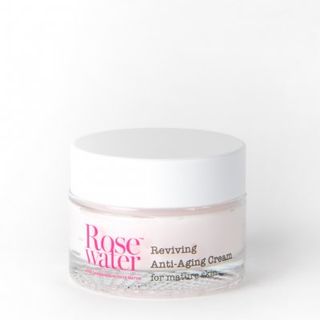
Rose Water Reviving Anti Aging Cream For Mature Skin
Works for
1 of 2 advertised claims delivered
Moisturizing28 ingredients credited for this claimStrong support
“Reviving Anti Aging Cream For Mature Skin”
This product can help improve hydration of the skin with the two types of ingredients.
The first type is called “humectants”:
these ingredients help attract water.
When humectants are on the surface of the skin, they “pull in” the moisture from the outside environment, or from
within deeper layers of the skin. The following ingredients in this product do the job:
allantoin, glycerin.
This product also contains ingredients called “occlusives”. They help reduce the speed with which our skin loses moisture to the outside environment. These ingredients also help soften the upper layer of the skin, so it feels less tight and nicer to the touch. The following ingredients in this product do the job: dimethicone, squalane.
The following ingredients in this product are especially good for supporting the skin barrier and helping with the hydration level: linoleic acid
Anti-aging4 ingredients credited for this claimLimited support
“Reviving Anti Aging Cream For Mature Skin”
This product does not contain ingredients that are able to reduce fine lines and wrinkles or help with skin elasticity, but it can improve the look of the skin temporarily through moisturization. Well-moisturized skin might also be able to repair the sun damage better.This ingredient - hyaluronic acid - could be helpful for preventing or repairing signs of aging in theory, but there is no evidence that it actually works.
Can it cause trouble?
Irritancy6 strong irritants: Rosa damascena flower water, Parfum + 4 more — patch-test recommendedHigh risk
Comedogenic2 ingredients rated 2 or more on the 0–5 pore-clogging scale2 flagged


User reviews
Be the first — your take helps the next person decide.
Ingredients
Filter by role to see what each ingredient is doing.
Water~45–55%
Isopropyl myristate~4.6–5.6%
- Irritation risk
- Low
- Comedogenicity
- 3/5
An emollient that helps soften the skin. Could be comedogenic
More about Isopropyl myristateRosa damascena flower water~4.2–5.1%
- Irritation risk
- High
Used to add a nice rose smell to the product. Might help attract water to the upper layer of the skin and have some anti-oxidant effect. Can be irritating
More about Rosa damascena flower waterDicaprylyl ether~3.1–3.7%
- Irritation risk
- Low
Helps soften the upper layer of the skin while creating a non-greasy feel on the skin. Helps to dissolve other ingredients
More about Dicaprylyl etherSqualane~2.3–2.9%
- Irritation risk
- Low
An oil naturally present in skin. Works as an emollient to soften the skin and form a protective layer on its surface without a greasy feeling.
More about SqualaneGlycerin~1.9–2.3%
- Irritation risk
- Low
One of the best moisturizing ingredients. Naturally present in skin. It attracts water to the upper layer of the skin working as a humectant
More about GlycerinPropylene glycol~1.5–1.9%
- Irritation risk
- High
Helps oil and water mix together and can enhance the penetration of other ingredients into the skin. It can be irritating
More about Propylene glycolGlyceryl stearate se~1.3–1.6%
- Irritation risk
- Low
- Comedogenicity
- 2/5
Used to stabilize the product formulations and works as an emollient
More about Glyceryl stearate seC12-15 alkyl benzoate~1.1–1.4%
- Irritation risk
- Low
Enhances the product texture and makes it more spreadable. Helps reduce water loss from the outer layer of skin. Extands the shelf life by preventing bacteria growth
More about C12-15 alkyl benzoateDimethicone crosspolymer~0.8–1.2%
- Irritation risk
- Low
Used to create a thicker product texture. Helps soften the upper layer of the skin and might be able to prevent moisture loss from its surface
More about Dimethicone crosspolymerNiacinamide~0.65–0.95%
- Irritation risk
- Low
Is proven to be effective in reducing blemishes, evening out skin tone and helping to improve lines and wrinkles. It helps the skin to repair sun damage, calm down inflammation and keep maintain good levels of moisture. The concentration of about 2% is effective for supporting the skin barrier and evening out the skin tone. Concentration of 4-6% is better for helping with acne and balancing the sebum production
More about NiacinamideCetyl alcohol~0.65–0.95%
- Irritation risk
- Low
A non-drying alcohol that works to soften the skin and stabilize product formulations helping oil and water mix together
More about Cetyl alcoholMyristyl alcohol~0.5–0.75%
- Irritation risk
- High
Helps to stabilize the product formulation while softening the upper layer of the skin. Can be irritating
More about Myristyl alcoholSimmondsia chinensis seed oil~0.5–0.75%
- Irritation risk
- Medium
Softens the upper layer of skin and helps restore the healthy skin barrier. Has shown to help calm down inflammation in skin. It is a stable oil, meaning that it retains its properties even when exposed to air.
More about Simmondsia chinensis seed oilCetyl esters~0.4–0.65%
- Irritation risk
- Low
Helps soften upper layer of the skin and can enhance penetration of other ingredients into the upper layer of the skin
More about Cetyl estersSilica~0.6–0.9%
Hdi/trimethylol hexyllactone crosspolymer~0.35–0.6%
- Irritation risk
- Low
Used to create a silky product texture and add volume to products
More about Hdi/trimethylol hexyllactone crosspolymerMyristyl glucoside~0.4–0.65%
- Irritation risk
- Low
Hydrolyzed yeast extract~0.25–0.5%
- Irritation risk
- Low
Helps attract water to the upper layer of the skin and might have some anti-oxidant and skin lightening properties
More about Hydrolyzed yeast extractCetyl hydroxyethylcellulose~0.3–0.5%
- Irritation risk
- Low
Used to create a thicker product consistency and stabilize formulations
More about Cetyl hydroxyethylcellulosePolyglucuronic acid~0.25–0.45%
- Irritation risk
- Low
Often used to support the moisturization effect of polysaccharides (contained, for example, in yeast extract)
More about Polyglucuronic acidLecithin~0.25–0.5%
- Irritation risk
- Low
Used mostly for creating emulsions - helping oil and water mix together. Helps soften the upper layer of the skin
More about LecithinPhenoxyethanol~0.25–0.45%
- Irritation risk
- Low
A preservative. It helps prevent bacterial growth in cosmetic products
More about PhenoxyethanolChlorphenesin~0.16–0.32%
Hyaluronic acid~0.2–0.4%
- Irritation risk
- Low
One of the best moisturizing ingredients. Attracts water into the upper layer of the skin. Naturally present in skin. Typically has large molecule size unless advertised otherwise on the product label. Helps support skin's barrier function and may help to reduce inflammation
More about Hyaluronic acidEthylhexylglycerin~0.2–0.4%
Hydrolyzed collagen~0.25–0.45%
- Irritation risk
- Low
A typically plant-derived compound that is supposed mimic human collagen. Cannot penetrate the skin barrier so is not particularly useful in skincare products beyond attracting water to the upper layer of the skin
More about Hydrolyzed collagenDimethicone~0.25–0.5%
- Irritation risk
- Low
A silicone that helps to reduce water loss from the surface of the skin. Can temporarily "fill in" lines and wrinkles, absorb oil, and create a nice product finish
More about DimethiconeParfum~0.2–0.35%
- Irritation risk
- High
An aromatic blend of unspecified and possibly irritating ingredients
More about ParfumMaris sal~0.2–0.4%
- Irritation risk
- Medium
Used to thicken the product formulation and might help to add minerals to the surface of the skin. It is used in scrubs as a physical exfoliant. Can increase sensitivity to other ingredients if left on the skin or used in high concentration
More about Maris salDmdm hydantoin~0.2–0.4%
- Irritation risk
- High
A preservative that releases formaldehyde and can be irritating
More about Dmdm hydantoinLinoleic acid~0.3–0.6%
- Irritation risk
- Low
An excellent emollient. Helps soften the skin, restore its barrier function, and can help to calm down inflammation. It can be helpful to prevent blemishes and clogged pores
More about Linoleic acidLinolenic acid~0.3–0.55%
- Irritation risk
- Medium
An emollient that helps soften the skin and calm down inflammation
More about Linolenic acidOlea europaea fruit oil~0.25–0.45%
- Irritation risk
- Medium
An emollient that helps soften the skin but is not effective for restoring its barrier function. Might be helpful to calm down inflammation
More about Olea europaea fruit oilHoney extract~0.25–0.45%
- Irritation risk
- Medium
Helps attract water to the upper layer of the skin
More about Honey extractPersea gratissima oil~0.25–0.5%
- Irritation risk
- Medium
An emollient that helps soften the skin and could be helpful in repairing its barrier function
More about Persea gratissima oilAloe barbadensis leaf juice powder~0.2–0.4%
- Irritation risk
- Medium
Traditionally used to treat sunburns, dermatitis and inflammation, but evidence for its effectiveness is lacking. The extract can contain humectants that help attract water into the skin
More about Aloe barbadensis leaf juice powderAllantoin~0.2–0.35%
- Irritation risk
- Low
Helps calm down inflammation in skin and can help reduce itching. Helps to repair the skin barrier and keep skin hydrated
More about AllantoinDisodium edta~0.2–0.4%
Ascorbyl tetraisopalmitate~0.25–0.4%
- Irritation risk
- Medium
A vitamin C derivative. Studies show that is might be effective in reducing hyperpigmentation, but there are no studies confirming that it is effectively converted into the bioavailable form of Vitamin C in skin. It is not clear how this derivative compares in effectiveness to the topical application of bioavailable form of vitamin C (L-ascorbic acid)
More about Ascorbyl tetraisopalmitateAnthemis nobilis flower extract~0.15–0.3%
- Irritation risk
- High
A plant extract that one one hand, can contain compounds that can help calm down skin irritation, but, on the other hand, its other compounds (especially fragrant ones) can themselves be irritating
More about Anthemis nobilis flower extractCamellia sinensis leaf extract~0.2–0.35%
- Irritation risk
- Low
Can contain potent anti-oxidant compounds (abbreviated ECG, GCG, EGC, and EGCG) that might help protect the skin from free radicals. Can help calm down inflammation and has some anti-bacterial properties. Unfortunately, these antioxidants are unstable and lose their effectiveness very quickly in products. The concentration of the antioxidant compounds in the extract also tends to be low to be effective in topical formulation
More about Camellia sinensis leaf extractTocopheryl acetate~0.15–0.3%
- Irritation risk
- Medium
A more stable but less bio-available form of vitamin E compared to Tocopherol. Might help moisturize and protect the skin from free radicals, but mostly used in low concentrations to stabilize other ingredients.
More about Tocopheryl acetateArgania spinosa kernel oil~0.15–0.3%
- Irritation risk
- Medium
An emollient that helps soften the upper layer of the skin. Might have some weak anti-oxidant properties
More about Argania spinosa kernel oilDisodium edta~0.15–0.25%
Citronellol~0.1–0.2%
Geraniol~0.05–0.1%
Linalool~0.05–0.1%
Ingredient list view
Water, Isopropyl myristate, Rosa damascena flower water, Dicaprylyl ether, Squalane, Glycerin, Propylene glycol, Glyceryl stearate se, C12-15 alkyl benzoate, Dimethicone crosspolymer, Niacinamide, Cetyl alcohol, Myristyl alcohol, Simmondsia chinensis seed oil, Cetyl esters, Silica, Hdi/trimethylol hexyllactone crosspolymer, Myristyl glucoside, Hydrolyzed yeast extract, Cetyl hydroxyethylcellulose, Polyglucuronic acid, Lecithin, Phenoxyethanol, Chlorphenesin, Hyaluronic acid, Ethylhexylglycerin, Hydrolyzed collagen, Dimethicone, Parfum, Maris sal, Dmdm hydantoin, Linoleic acid, Linolenic acid, Olea europaea fruit oil, Honey extract, Persea gratissima oil, Aloe barbadensis leaf juice powder, Allantoin, Disodium edta, Ascorbyl tetraisopalmitate, Anthemis nobilis flower extract, Camellia sinensis leaf extract, Tocopheryl acetate, Argania spinosa kernel oil, Disodium edta, Citronellol, Geraniol, Linalool
Compare prices
Retailers ranked by price — lowest first.
Worth comparing, line by line.
Match % combines shared ingredients, the first five ingredients, shared actives and hero ingredients, irritancy (lower counts in the alternative's favour), texture and body area. Only products in the same routine step are compared.
| Rose WaterReviving Anti Aging Cream For Mature SkinYOUR PRODUCT | Urban Skin RxEven Tone Barrier Repair Ceramide Cream | Glowbiotics MDGlowbiotics Probiotic Ultra Rich Brightening Cream | UltraceuticalsEven skin tone smoothing moisturiser | |
|---|---|---|---|---|
| Match | — | 86% | 84% | 84% |
| Price | $38.34 | $23.99−$14.35 | $66.00+$27.66 | $95.00+$56.66 |
| Shared key ingredients | — | 5 of 15 | 6 of 15 | 5 of 15 |
| Key difference | — | Ceramide Ng | Myristoyl Nonapeptide-3 | 3-O-Ethyl Ascorbic Acid |
| Irritancy | High | Medium | Medium | Medium |
| Drying alcohol | — | — | Contains drying alcohol | — |
| View product | Shop | Shop | Shop |


Sources cited in this review
Every concentration estimate and effectiveness label is anchored to one of these 29 studies and safety reviews.
- 1
- 2
- 3Surfactants and experimental irritant contact dermatitisncbi.nlm.nih.gov
- 4Propylene Glycolpubmed.ncbi.nlm.nih.gov
- 5Skin-sensitizing and irritant properties of propylene glycolonlinelibrary.wiley.com
- 6

Affiliate links · As an Amazon Associate, WIMJ earns from qualifying purchases.