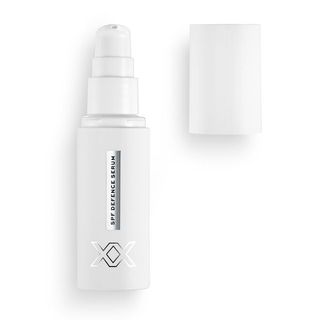
Revolution XX XX Revolution Defence XX Pollution & Blue Light Protecting Serum SPF30
Works for
1 of 2 advertised claims delivered
Sun protectionSPF 30 · 3 UV filters · Broad spectrumWeak protectionLow filter dose
MoisturizingPanthenol, Sodium hyaluronate + 10 moreStrong evidence
“Pollution defence + SPF protection Texture?”
This product can help improve hydration of the skin with the two types of ingredients.
The first type is called “humectants”:
these ingredients help attract water.
When humectants are on the surface of the skin, they “pull in” the moisture from the outside environment, or from
within deeper layers of the skin. The following ingredients in this product do the job:
glycerin, sodium hyaluronate.
This product also contains ingredients called “occlusives”. They help reduce the speed with which our skin loses moisture to the outside environment. These ingredients also help soften the upper layer of the skin, so it feels less tight and nicer to the touch. The following ingredients in this product do the job: dimethicone, squalane.
The following ingredients in this product are especially good for supporting the skin barrier and helping with the hydration level: panthenol
Can it cause trouble?
Irritancy9 flagged ingredientsLow risk
Comedogenic1 ingredient rated 2 or more on the 0–5 pore-clogging scale1 flagged


User reviews
Be the first — your take helps the next person decide.
Ingredients
Filter by role to see what each ingredient is doing.
Water~40–60%
Glycerin~3.8–5.7%
- Irritation risk
- Low
One of the best moisturizing ingredients. Naturally present in skin. It attracts water to the upper layer of the skin working as a humectant
More about GlycerinSorbitan stearate~3.2–4.8%
Dimethicone~2.7–4%
- Irritation risk
- Low
A silicone that helps to reduce water loss from the surface of the skin. Can temporarily "fill in" lines and wrinkles, absorb oil, and create a nice product finish
More about DimethiconeArachidyl alcohol~2.1–3.1%
- Irritation risk
- Low
Used to soften the upper layer of the skin and create a thicker product consistency
More about Arachidyl alcoholButyl methoxydibenzoylmethane~2.2–3.3%
- Irritation risk
- Medium
Avobenzone. An organic, or so-called "chemical" UV filter. Protects against both UVA and UVB rays. Needs to be combined with other filters in a formulation to be stable.
More about Butyl methoxydibenzoylmethaneEthylhexyl methoxycinnamate~1.8–2.8%
- Irritation risk
- High
Octinoxate. When used in higher concentrations, works as a sunscreen protecting the skin from UVB rays. When used in lower concentration, helps to preserve the product formulation. Is shown to be harmful to coral reefs - consider avoiding bathing in coral reef areas when wearing a product with this ingredient. It can be irritating
More about Ethylhexyl methoxycinnamateBehenyl alcohol~1.3–2%
- Irritation risk
- Low
Non-drying alcohol that helps water and oil mix together. Also serves as an emollient
More about Behenyl alcoholPhenoxyethanol~0.5–1%
- Irritation risk
- Low
A preservative. It helps prevent bacterial growth in cosmetic products
More about PhenoxyethanolButylene glycol~0.8–1.25%
- Irritation risk
- Low
Used to create a nice product texture and help delivery of other ingredients. Might be somewhat helpful in attracting water to the upper layer of the skin
More about Butylene glycolOctocrylene~1–1.45%
- Irritation risk
- Medium
A weak sunscreen that protects against the sun rays that cause sunburn (UVB) and is somewhat effective against the UVA rays. It is quite stable and can help stabilize other, more vulnerable, sunscreen ingredients like Avobenzone. It is an organic, or so called "chemical" sunscreen
More about OctocryleneCarbomer~0.4–0.95%
- Irritation risk
- Low
Helps create a thicker or gel-like product texture. It is not a surfactant but can be used in gentle cleansing formulations
More about CarbomerArachidyl glucoside~0.35–0.85%
Panthenol~0.3–0.7%
- Irritation risk
- Low
Helps attract water to the upper layer of the skin and can help improve skin barrier function
More about PanthenolCaprylyl glycol~0.3–0.7%
- Irritation risk
- Medium
Helps preserve products and creates a nice product texture
More about Caprylyl glycolGlyceryl stearate~0.35–0.8%
- Irritation risk
- Low
An emollient that softens the skin and forms a protective layer on its surface. Helps water and oil mix together
More about Glyceryl stearateButyrospermum parkii butter~0.3–0.75%
- Irritation risk
- Low
- Comedogenicity
- 3/5
A great moisturising ingredient that softens the skin and reduces water loss from its upper layer. It also can be helpful in protecting skin from free radicals
More about Butyrospermum parkii butterPeg-100 stearate~0.3–0.75%
- Irritation risk
- Low
Helps oil and water mix togehter and creates a nice product texture
More about Peg-100 stearateTocopheryl acetate~0.15–0.6%
- Irritation risk
- Medium
A more stable but less bio-available form of vitamin E compared to Tocopherol. Might help moisturize and protect the skin from free radicals, but mostly used in low concentrations to stabilize other ingredients.
More about Tocopheryl acetateHydroxyethyl acrylate/sodium acryloyldimethyl taurate copolymer~0.15–0.55%
- Irritation risk
- Medium
A gelling agent that thickens the product consistency and leaves the skin with a velvety finish
More about Hydroxyethyl acrylate/sodium acryloyldimethyl taurate copolymerSqualane~0.15–0.6%
- Irritation risk
- Low
An oil naturally present in skin. Works as an emollient to soften the skin and form a protective layer on its surface without a greasy feeling.
More about Squalane1,2-hexanediol~0.1–0.4%
Disodium edta~0.1–0.35%
Sodium hyaluronate~0.1–0.4%
- Irritation risk
- Low
One of the best moisturizing ingredients. Attracts water into the upper layer of the skin
More about Sodium hyaluronateMaltodextrin~0.1–0.4%
- Irritation risk
- Low
Used to stabilize the product formulation and can help absorb oil
More about MaltodextrinLecithin~0.1–0.45%
- Irritation risk
- Low
Used mostly for creating emulsions - helping oil and water mix together. Helps soften the upper layer of the skin
More about LecithinSodium hydroxide~0.05–0.3%
Biosaccharide gum-4~0.05–0.25%
Polysorbate 60~0.05–0.25%
Cistus monspeliensis extract~0.05–0.1%
- Irritation risk
- Low
Ingredient list view
Water, Glycerin, Sorbitan stearate, Dimethicone, Arachidyl alcohol, Butyl methoxydibenzoylmethane, Ethylhexyl methoxycinnamate, Behenyl alcohol, Phenoxyethanol, Butylene glycol, Octocrylene, Carbomer, Arachidyl glucoside, Panthenol, Caprylyl glycol, Glyceryl stearate, Butyrospermum parkii butter, Peg-100 stearate, Tocopheryl acetate, Hydroxyethyl acrylate/sodium acryloyldimethyl taurate copolymer, Squalane, 1,2-hexanediol, Disodium edta, Sodium hyaluronate, Maltodextrin, Lecithin, Sodium hydroxide, Biosaccharide gum-4, Polysorbate 60, Cistus monspeliensis extract
Compare prices
Retailers ranked by price — lowest first.
Worth comparing, line by line.
Match % combines shared ingredients, the first five ingredients, shared actives and hero ingredients, irritancy (lower counts in the alternative's favour), texture and body area. Only products in the same routine step are compared.
| Revolution XXXX Revolution Defence XX Pollution & Blue Light Protecting Serum SPF30YOUR PRODUCT | DCLSkincare Super Sheer SPF50 Broad Spectrum Protection Sunscreen | ELEMISDaily Defence Shield SPF30 | Face Reality SkincareBrilliant Defense SPF 50 | |
|---|---|---|---|---|
| Match | — | 54% | 52% | 51% |
| Price | — | $61.49 | $51.36 | $42.00 |
| Shared key ingredients | — | 6 of 9 | 5 of 9 | 6 of 9 |
| Key difference | — | Tetrahexyldecyl Ascorbate | Carnosine | Aminopropyl Ascorbyl Phosphate |
| Irritancy | Low | Low | Low | Low |
| SPF | SPF 30 | SPF 50 | SPF 30 | SPF 50 |
| Drying alcohol | — | — | — | — |
| View product | Shop | Shop | Shop |

Product summary
"Revolution XX - XX Revolution Defence XX Pollution & Blue Light Protecting Serum SPF30" is using UV filters in a relatively low concentration. Because of this, it might not be able to provide reliable sun protection.
This product should also be hydrating enough to use without an additional moisturizer during the day.
Sunscreen filters
This is a so-called "chemical" sunscreen. It means that it uses organic UV filters. They typically offer good sun protection and rarely leave a white cast, but they can be irritating for some people with sensitive skin. These are the sun protection ingredients in this sunscreen: avobenzone 2.20% - 3.30%, octinoxate 1.80% - 2.80% and octocrylene 1.00% - 1.45%.
Irritation risk
This product contains actives that can be irritating. We assess the overall irritancy of it to be low. For a detailed overview of all potential irritants: click here
You can see the detailed formula review with the breakdown of all actives in the product and the full ingredient list with estimated concentrations in the tables below.
Price
The product retails for 7.00£ in the United Kingdom.
For a detailed price comparison: click here.
Sources cited in this review
Every concentration estimate and effectiveness label is anchored to one of these 8 studies and safety reviews.
- 1
- 2
- 3Final Report on the Safety Assessment of Dimethicone Copolyoljournals.sagepub.com
- 4Skin moisturizing effects of panthenol-based formulationspdfs.semanticscholar.org
- 5
- 6

Affiliate links · As an Amazon Associate, WIMJ earns from qualifying purchases.