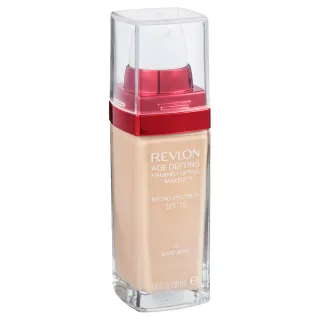
Revlon Age Defying Firming & Lifting Makeup, SPF 15, Bare Buff
Works for
1 of 1 advertised claim delivered
Sun protectionSPF 15 · 2 UV filtersNot rated
This formula relies on 2 UV filters for its sun protection. Their UV coverage is shown below, with amounts where the ingredient list lets us estimate them.
Cleansing9 ingredients credited for this claimStrong support
“Age Defying Firming & Lifting Makeup, SPF 15, Bare Buff”
This product works by removing dirt and oil from the surface of the skin. It uses a combination of mild cleansing agents (laureth-7, oleic acid, palmitic acid, peg-9 polydimethylsiloxyethyl dimethicone, polyglyceryl-3 diisostearate, xanthan gum) and should be able to cleanse the skin gently. Still keep in mind that any cleansing can disrupt the skin barrier, and most people do not need to cleanse their skin more than once per day.
Can it cause trouble?
Irritancy14 flagged ingredientsMedium risk
Comedogenic1 ingredient rated 2 or more on the 0–5 pore-clogging scale1 flagged
User reviews
Be the first — your take helps the next person decide.
Ingredients
Filter by role to see what each ingredient is doing.
Ethylhexyl methoxycinnamate~25–30%
- Irritation risk
- High
Octinoxate. When used in higher concentrations, works as a sunscreen protecting the skin from UVB rays. When used in lower concentration, helps to preserve the product formulation. Is shown to be harmful to coral reefs - consider avoiding bathing in coral reef areas when wearing a product with this ingredient. It can be irritating
More about Ethylhexyl methoxycinnamateWater~13–16%
Cyclopentasiloxane~5.6–6.8%
- Irritation risk
- Low
A silicone that helps improve the product texture and spreadability. Can absorb oil creating a short-term mattifying effect on the skin
More about CyclopentasiloxanePhenyl trimethicone~4–4.9%
- Irritation risk
- Low
A type of silicone that can decrease loss of moisture from the skin surface. It helps create a nice product texture
More about Phenyl trimethiconeGlycerin~2.8–3.4%
- Irritation risk
- Low
One of the best moisturizing ingredients. Naturally present in skin. It attracts water to the upper layer of the skin working as a humectant
More about GlycerinPeg-9 polydimethylsiloxyethyl dimethicone~2–2.4%
- Irritation risk
- Medium
A type of silicone that helps water and oil mix together
More about Peg-9 polydimethylsiloxyethyl dimethiconeBoron nitride~1.6–2%
- Irritation risk
- Low
Helps to absord oil and evenly disperse other ingredients (for example, pigment) in product formulation
More about Boron nitrideTrimethylsiloxysilicate~1.4–1.7%
- Irritation risk
- Low
A type of silicone that helps create a nice product consistency and support the delivery of other ingredients
More about TrimethylsiloxysilicateDisteardimonium hectorite~1.2–1.5%
- Irritation risk
- Low
A type of clay that is used to thicken the product consistency
More about Disteardimonium hectoritePeg-10~1–1.2%
- Irritation risk
- Low
Dimethicone~0.8–1.2%
- Irritation risk
- Low
A silicone that helps to reduce water loss from the surface of the skin. Can temporarily "fill in" lines and wrinkles, absorb oil, and create a nice product finish
More about DimethiconePeg-10~0.6–0.9%
- Irritation risk
- Low
Palmitoyl tripeptide-5~0.55–0.8%
- Irritation risk
- Low
A type of peptide. Peptides are excellent moisturizers and might be able support collagen production reducing fine lines and wrinkles
More about Palmitoyl tripeptide-5Acetyl hexapeptide-8~0.5–0.75%
- Irritation risk
- Low
A type of peptide. Peptides are excellent moisturizers and might be able support collagen production reducing fine lines and wrinkles
More about Acetyl hexapeptide-8Niacinamide~0.5–0.75%
- Irritation risk
- Low
Is proven to be effective in reducing blemishes, evening out skin tone and helping to improve lines and wrinkles. It helps the skin to repair sun damage, calm down inflammation and keep maintain good levels of moisture. The concentration of about 2% is effective for supporting the skin barrier and evening out the skin tone. Concentration of 4-6% is better for helping with acne and balancing the sebum production
More about NiacinamideTriolein~0.45–0.7%
Sodium hyaluronate~0.45–0.7%
- Irritation risk
- Low
One of the best moisturizing ingredients. Attracts water into the upper layer of the skin
More about Sodium hyaluronateLecithin~0.5–0.75%
- Irritation risk
- Low
Used mostly for creating emulsions - helping oil and water mix together. Helps soften the upper layer of the skin
More about LecithinMethyl acetylglycyrrhetinoyl hydroxyprolinate~0.4–0.6%
- Irritation risk
- Low
Phytosteryl canola glycerides~0.35–0.65%
- Irritation risk
- Low
Helps soften the upper layer of the skin
More about Phytosteryl canola glyceridesHydrolyzed glycosaminoglycans~0.3–0.55%
- Irritation risk
- Low
Long sugars that help attract water to the upper layer of the skin
More about Hydrolyzed glycosaminoglycansAcetyl hydroxyproline~0.35–0.6%
- Irritation risk
- Low
An amino-acid that can support ceramides production in skin and reduce water-loss
More about Acetyl hydroxyprolineGlycyrrhetinic acid~0.3–0.55%
- Irritation risk
- Medium
Active compound of licorice root. Works to calm down inflammation, as an anti-oxidant, and might be helpful in lightening the skin and reducing hyperpigmentation
More about Glycyrrhetinic acidTocopherol~0.3–0.6%
- Irritation risk
- Low
Pure form of vitamin E. Can help moisturise and protect the skin from free radicals. Often used to help stabilise other ingredients or the formula itself
More about TocopherolSodium ascorbyl phosphate~0.3–0.6%
- Irritation risk
- Medium
A stable derivative of vitamin C. It is oil-soluble which means it is more likely to penetrate the skin compared to the pure form of vitamin C (which is water-soluble), but it is less bio-available and is way less effective in stimulating collagen and reducing wrinkles compared to the pure form of vitamin C (L-ascorbic acid) and its other derivatives (for example, magnesium ascorbyl phosphate). At the same time, this vitamin C derivative has been shown in studies to be effective in reducing acne, blemishes and clogged pores. It is less irritating then the pure form of vitamin C
More about Sodium ascorbyl phosphateTocopheryl acetate~0.3–0.6%
- Irritation risk
- Medium
A more stable but less bio-available form of vitamin E compared to Tocopherol. Might help moisturize and protect the skin from free radicals, but mostly used in low concentrations to stabilize other ingredients.
More about Tocopheryl acetateLinoleic acid~0.45–0.65%
- Irritation risk
- Low
An excellent emollient. Helps soften the skin, restore its barrier function, and can help to calm down inflammation. It can be helpful to prevent blemishes and clogged pores
More about Linoleic acidPullulan~0.35–0.65%
- Irritation risk
- High
Creates a thin drying film on the skin resulting in a short-term tightening effect
More about PullulanSorbitol~0.3–0.55%
- Irritation risk
- Low
Helps attract water to the upper layer of the skin and improves the product texture
More about SorbitolTrehalose~0.3–0.55%
- Irritation risk
- Low
A sugar that attracts water to the upper layer of the skin
More about TrehaloseAlumina~0.55–0.8%
- Irritation risk
- Low
The same compound that is used safely in dental implants and bone cements. In cosmetics, it is used to improve the consistency of products
More about AluminaSilica~0.5–0.8%
Laureth-7~0.3–0.6%
Acacia senegal gum~0.45–0.65%
- Irritation risk
- Medium
Helps mask the small of other ingredients and improve the product texture
More about Acacia senegal gumSodium chloride~0.35–0.65%
- Irritation risk
- Low
Used to stabilize mixtures of oil and water, and create thicker, gel-like product textures
More about Sodium chloridePolyglyceryl-3 diisostearate~0.3–0.6%
- Irritation risk
- Medium
- Comedogenicity
- 3/5
Helps oil and water mix together
More about Polyglyceryl-3 diisostearateDimethicone crosspolymer~0.3–0.55%
- Irritation risk
- Low
Used to create a thicker product texture. Helps soften the upper layer of the skin and might be able to prevent moisture loss from its surface
More about Dimethicone crosspolymerMethicone~0.3–0.6%
- Irritation risk
- Low
A type of silicone that helps soften the upper layer of the skin and reduces the water loss from the skin surface
More about MethiconeXanthan gum~0.3–0.55%
- Irritation risk
- Low
Used to create a thicker product consistency
More about Xanthan gumTriethoxycaprylylsilane~0.3–0.5%
- Irritation risk
- Low
A type of silicone that helps oil and water mix well together. Helps to disperse other ingredients, e.g. pigments, evenly in a formulation
More about TriethoxycaprylylsilaneCalcium aluminum borosilicate~0.3–0.55%
C12-15 alkyl benzoate~0.3–0.55%
- Irritation risk
- Low
Enhances the product texture and makes it more spreadable. Helps reduce water loss from the outer layer of skin. Extands the shelf life by preventing bacteria growth
More about C12-15 alkyl benzoateSodium citrate~0.25–0.5%
- Irritation risk
- Medium
Helps to control the skin's pH level. Maintains the skin's natural film of amino-lactic acids and oils. Helps to preserve products
More about Sodium citrateDipropylene glycol~0.25–0.45%
- Irritation risk
- Low
Helps to dissolve other ingredients in a formulation. Slows down the rate of product drying
More about Dipropylene glycolStearic acid~0.45–0.65%
- Irritation risk
- Low
Helps oil and water mix together and works as an emollient
More about Stearic acidPalmitic acid~0.35–0.65%
- Irritation risk
- Low
An emollient that is naturally present in skin and helps soften it
More about Palmitic acidOleic acid~0.35–0.65%
- Irritation risk
- Medium
Helps soften the upper layer of the skin. At the same time, it can weaken the skin's barrier enhancing penetration of other ingredients and increasing the risk of skin dryness
More about Oleic acidTetrasodium edta~0.25–0.5%
Potassium sorbate~0.25–0.45%
Phenoxyethanol~0.2–0.4%
- Irritation risk
- Low
A preservative. It helps prevent bacterial growth in cosmetic products
More about PhenoxyethanolCaprylyl glycol~0.25–0.4%
- Irritation risk
- Medium
Helps preserve products and creates a nice product texture
More about Caprylyl glycolMica~0.25–0.4%
- Irritation risk
- Low
Creates an illusion of smoother and more radiant skin tone. Adds shimmer to the skin by reflecting light
More about MicaTitanium dioxide4.3%
- Irritation risk
- Low
Works as a UV filter when used in high concentrations. It is photostable and is effective mostly against the UVB light, with some protection in the UVA range. In small concentrations, used for its ability to improve the color of cosmetic products. Is usually well tolerated by the skin
More about Titanium dioxideIron oxides~0.1–0.2%
- Irritation risk
- Low
An umbrella term for the following three colorants: CI 77491, CI 77492, CI 77499. They might be able to offer some protection against visible light, but the degree of the protection is not clear
More about Iron oxidesIngredient list view
Ethylhexyl methoxycinnamate, Water, Cyclopentasiloxane, Phenyl trimethicone, Glycerin, Peg-9 polydimethylsiloxyethyl dimethicone, Boron nitride, Trimethylsiloxysilicate, Disteardimonium hectorite, Peg-10, Unknown, Dimethicone, Peg-10, Palmitoyl tripeptide-5, Acetyl hexapeptide-8, Niacinamide, Triolein, Sodium hyaluronate, Lecithin, Methyl acetylglycyrrhetinoyl hydroxyprolinate, Phytosteryl canola glycerides, Hydrolyzed glycosaminoglycans, Acetyl hydroxyproline, Glycyrrhetinic acid, Tocopherol, Sodium ascorbyl phosphate, Tocopheryl acetate, Linoleic acid, Pullulan, Sorbitol, Trehalose, Alumina, Silica, Laureth-7, Acacia senegal gum, Sodium chloride, Polyglyceryl-3 diisostearate, Dimethicone crosspolymer, Methicone, Xanthan gum, Triethoxycaprylylsilane, Calcium aluminum borosilicate, C12-15 alkyl benzoate, Sodium citrate, Dipropylene glycol, Stearic acid, Palmitic acid, Oleic acid, Tetrasodium edta, Potassium sorbate, Phenoxyethanol, Caprylyl glycol, Mica, Titanium dioxide, Iron oxides
Compare prices
Retailers ranked by price — lowest first.

Affiliate links · prices updated regularly
Sources cited in this review
Every concentration estimate and effectiveness label is anchored to one of these 27 studies and safety reviews.
- 1
- 2Safety Assessment of Boron Nitride as Used in Cosmetics cir-safety.org
- 3
- 4Final Report on the Safety Assessment of Dimethicone Copolyoljournals.sagepub.com
- 5
- 6

Affiliate links · As an Amazon Associate, WIMJ earns from qualifying purchases.