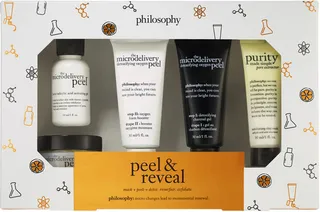
Philosophy Peel & Reveal

Philosophy Peel & Reveal

Efficacy100/100IrritancyHigh

Works for

Evens skin tone
Lactic acid, Salicylic acid + 2 more
Works well
What the product description says
“retexturize, even tone and reveal healthier-, younger-looking skin”
Source: Ulta

This product can help reduce hypepigmentation and even out the skin tone because it contains the following effective ingredients: lactic acid, salicylic acid

Keep in mind that you would need to apply any topical skincare targetted at hypigmentation consistently for a couple of months to get a result. No topical skincare product can help get rid of hyperpigmentation (including post-acne marks and age spots) instantly.

Lactic acidKey activeEffect: HighAn exfoliating and moisturizing alpha-hydroxy acid (AHA). Typically causes less irritation than other AHAs, for example, glycolic acid. At high concentrations (about 15%), lactic acid can help reduce lines and wrinkles. Recent studies show that lactic acid can support the "good" bacteria living on skin's surface (healthy skin microbiome)~4.3–5.2%
Salicylic acidEffect: LowUsed for skin exfoliation. It has an anti-inflammatory and anti-bacterial effect, helps to unclog pores, prevent blemishes and speed up healing of the existing ones. Sometimes referred to as a BHA (beta-hydroxy acid)~1.25–2.5%
Magnesium ascorbyl phosphateEffect: Low, below effective doseA derivative of vitamin C that is more stable, but less bioavailable than the pure form of vitamin C. It does not penetrate the skin well, but has been shown to convert to pure vitamin C once in skin. It can be helpful in stimulating collagen production and lightening the skin tone, but the required concentration is likely to be very high~0.25–0.5%
Retinyl palmitateUnder-dosedThree steps removed from the active form of vitamin A - retinoic acid. To have an effect in the skin, it first needs to be converted twice to become the retinoic acid. This means it is less potent than retinol, but could also be less irritating. Once converted to the retinoic acid in the skin, it helps against all signs of aging, improves skin cell turnover and helps fight blemishes and clogged pores. However, in many cosmetic formulations, it is used in a concentration that is too low to have the full effect~0.25–0.45%
Exfoliation
Lactic acid, Salicylic acid + 1 more
Works well
What the product description says
“iconic at-home resurfacing peel.”
Source: Ulta

This product can help exfoliate the skin. In other words, it helps break down the bonds between dead cells on the surface of the skin and speed up the skin turnover. Skin often appears softer and brighter after exfoliation, but overdoing it can result in disrupted skin barrier. The following ingredient is doing the exfoliating job in this product: lactic acid, salicylic acid.

Lactic acidKey activeEffect: HighAn exfoliating and moisturizing alpha-hydroxy acid (AHA). Typically causes less irritation than other AHAs, for example, glycolic acid. At high concentrations (about 15%), lactic acid can help reduce lines and wrinkles. Recent studies show that lactic acid can support the "good" bacteria living on skin's surface (healthy skin microbiome)~4.3–5.2%
Salicylic acidKey activeEffect: HighUsed for skin exfoliation. It has an anti-inflammatory and anti-bacterial effect, helps to unclog pores, prevent blemishes and speed up healing of the existing ones. Sometimes referred to as a BHA (beta-hydroxy acid)~1.25–2.5%
Retinyl palmitateEffect: Low, below effective doseThree steps removed from the active form of vitamin A - retinoic acid. To have an effect in the skin, it first needs to be converted twice to become the retinoic acid. This means it is less potent than retinol, but could also be less irritating. Once converted to the retinoic acid in the skin, it helps against all signs of aging, improves skin cell turnover and helps fight blemishes and clogged pores. However, in many cosmetic formulations, it is used in a concentration that is too low to have the full effect~0.25–0.45%
Moisturizing
Side benefit · Palmitoyl oligopeptide, Lactic acid + 12 more
Works well

This product can help improve hydration of the skin with the two types of ingredients.

The first type is called “humectants”:
these ingredients help attract water. When humectants are on the surface of the skin, they “pull in” the moisture from the outside environment, or from within deeper layers of the skin. The following ingredients in this product do the job: glycerin, lactic acid.

This product also contains ingredients called “occlusives”. They help reduce the speed with which our skin loses moisture to the outside environment. These ingredients also help soften the upper layer of the skin, so it feels less tight and nicer to the touch. The following ingredients in this product do the job: helianthus annuus seed oil, ethylhexyl palmitate.

The following ingredients in this product are especially good for supporting the skin barrier and helping with the hydration level: palmitoyl oligopeptide

Palmitoyl oligopeptideHeroEffect: HighA type of peptide. Peptides are excellent moisturizers and might be able support collagen production reducing fine lines and wrinkles~0.35–0.65%
Lactic acidKey active· HumectantEffect: HighAn exfoliating and moisturizing alpha-hydroxy acid (AHA). Typically causes less irritation than other AHAs, for example, glycolic acid. At high concentrations (about 15%), lactic acid can help reduce lines and wrinkles. Recent studies show that lactic acid can support the "good" bacteria living on skin's surface (healthy skin microbiome)~4.3–5.2%
GlycerinKey active· HumectantEffect: HighOne of the best moisturizing ingredients. Naturally present in skin. It attracts water to the upper layer of the skin working as a humectant~1–1.2%
Helianthus annuus seed oilKey active· Emollient, OcclusiveEffect: HighA great emollient due to its high linoleic acid content. One of the most effective plant oils in helping skin hydration and repairing skin barrier function~0.3–0.55%
Glyceryl stearate seKey activeEffect: MediumUsed to stabilize the product formulations and works as an emollient~0.3–0.5%
Ethylhexyl palmitateKey active· EmollientEffect: MediumAn emollient that helps soften the skin and create a nice product texture~0.3–0.55%
Sodium pcaKey active· HumectantEffect: HighNaturally present in skin and helps to attract water to its upper layer~0.25–0.45%
Caprylyl glycol· Humectant, EmollientEffect: LowHelps preserve products and creates a nice product texture~0.3–0.55%
Polysilicone-11Effect: LowA silicone that forms a light film on the skin surface helping to bind water and temporarily absorb oils creating a matt and powdery feel~0.3–0.55%
Tribehenin· EmollientEffect: LowUsed to create a thicker product consistency and soften the upper layer of the skin~0.3–0.55%
Peg-6· HumectantEffect: LowHelps to dissolve other ingredients and attract water to the upper layer of the skin~0.25–0.5%
Propylene glycol· HumectantEffect: LowHelps oil and water mix together and can enhance the penetration of other ingredients into the skin. It can be irritating~0.25–0.45%
TocopherolEffect: Low, below effective dosePure form of vitamin E. Can help moisturise and protect the skin from free radicals. Often used to help stabilise other ingredients or the formula itself~0.25–0.5%
Caprylic/capric triglycerideUnder-dosedA good mix of fatty acids that forms a protective layer on the skin. Improves the shelf life of products. Derived from coconut and glycerin~0.5–0.75%
Anti-blemish
Side benefit · Salicylic acid, Kaolin + 3 more
Works well

This product can help reduce breakouts and clogged pores because it contains the following ingredient: salicylic acid. This ingredient is used for treating acne and can have a noticeable effect.

Salicylic acidHeroEffect: HighUsed for skin exfoliation. It has an anti-inflammatory and anti-bacterial effect, helps to unclog pores, prevent blemishes and speed up healing of the existing ones. Sometimes referred to as a BHA (beta-hydroxy acid)~1.25–2.5%
KaolinEffect: LowA type of clay that consists mainly of aluminum silicate. Helps absorb oil and creates a thicker product consistency. Can be used to add a white color~0.4–0.65%
BentoniteEffect: LowHelps stabilize the product formulation~0.3–0.5%
Retinyl palmitateUnder-dosedThree steps removed from the active form of vitamin A - retinoic acid. To have an effect in the skin, it first needs to be converted twice to become the retinoic acid. This means it is less potent than retinol, but could also be less irritating. Once converted to the retinoic acid in the skin, it helps against all signs of aging, improves skin cell turnover and helps fight blemishes and clogged pores. However, in many cosmetic formulations, it is used in a concentration that is too low to have the full effect~0.25–0.45%
Rosmarinus officinalis leaf extractUnder-dosedCan be helpful in reducing inflammation in skin, including inflamed acne. It can be irritating~0.25–0.45%
Anti-aging
Side benefit · Lactic acid, Palmitoyl oligopeptide + 3 more
May help

This product contains lactic acid, palmitoyl oligopeptide. There is some human evidence that these ingredients help reduce and prevent fine lines and wrinkles and improve skin elasticity and firmness, though it is smaller or less consistent than the evidence for the best anti-aging ingredients.

Lactic acidKey activeEffect: MediumAn exfoliating and moisturizing alpha-hydroxy acid (AHA). Typically causes less irritation than other AHAs, for example, glycolic acid. At high concentrations (about 15%), lactic acid can help reduce lines and wrinkles. Recent studies show that lactic acid can support the "good" bacteria living on skin's surface (healthy skin microbiome)~4.3–5.2%
Palmitoyl oligopeptideKey activeEffect: MediumA type of peptide. Peptides are excellent moisturizers and might be able support collagen production reducing fine lines and wrinkles~0.35–0.65%
TocopherolEffect: Low, below effective dosePure form of vitamin E. Can help moisturise and protect the skin from free radicals. Often used to help stabilise other ingredients or the formula itself~0.25–0.5%
Magnesium ascorbyl phosphateEffect: Low, below effective doseA derivative of vitamin C that is more stable, but less bioavailable than the pure form of vitamin C. It does not penetrate the skin well, but has been shown to convert to pure vitamin C once in skin. It can be helpful in stimulating collagen production and lightening the skin tone, but the required concentration is likely to be very high~0.25–0.5%
Retinyl palmitateUnder-dosedThree steps removed from the active form of vitamin A - retinoic acid. To have an effect in the skin, it first needs to be converted twice to become the retinoic acid. This means it is less potent than retinol, but could also be less irritating. Once converted to the retinoic acid in the skin, it helps against all signs of aging, improves skin cell turnover and helps fight blemishes and clogged pores. However, in many cosmetic formulations, it is used in a concentration that is too low to have the full effect~0.25–0.45%

Can it cause trouble?

Irritancy
5 strong irritants: Rosmarinus officinalis leaf extract, Retinyl palmitate + 3 more — patch-test recommended
High risk
We flagged 27 ingredients with irritancy potential. Severity depends on your sensitivity threshold; the table lists the worst offenders first.
IngredientFunctionIrritationEst. amount
Salicylic acidUsed for skin exfoliation. It has an anti-inflammatory and anti-bacterial effect, helps to unclog pores, prevent blemishes and speed up healing of the existing ones. Sometimes referred to as a BHA (beta-hydroxy acid)High~1.25–2.5%est.
Cocamidopropyl betaineHelps water and oil mix together. Used as a cleansing ingredient. Could be an allergenHigh~1.1–1.3%est.
Rosmarinus officinalis leaf extractCan be helpful in reducing inflammation in skin, including inflamed acne. It can be irritatingHigh~0.25–0.45%est.
Retinyl palmitateThree steps removed from the active form of vitamin A - retinoic acid. To have an effect in the skin, it first needs to be converted twice to become the retinoic acid. This means it is less potent than retinol, but could also be less irritating. Once converted to the retinoic acid in the skin, it helps against all signs of aging, improves skin cell turnover and helps fight blemishes and clogged pores. However, in many cosmetic formulations, it is used in a concentration that is too low to have the full effectHigh~0.25–0.45%est.
ParfumAn aromatic blend of unspecified and possibly irritating ingredientsHigh~0.25–0.45%est.
LimoneneA common frangrance that can easily irritate skin, especially if exposed to air, light or heatHigh~0.25–0.45%est.
Decyl glucosideHelps oil and water mix together. Can be irritatingHigh~0.35–0.65%est.
Alcohol denat.Produces temporary toning effect. Can help dissolve other ingredients or preserve productsHigh~0.25–0.5%est.
Propylene glycolHelps oil and water mix together and can enhance the penetration of other ingredients into the skin. It can be irritatingHigh~0.25–0.45%est.
Lactic acidAn exfoliating and moisturizing alpha-hydroxy acid (AHA). Typically causes less irritation than other AHAs, for example, glycolic acid. At high concentrations (about 15%), lactic acid can help reduce lines and wrinkles. Recent studies show that lactic acid can support the "good" bacteria living on skin's surface (healthy skin microbiome)Medium~4.3–5.2%est.
1,2-hexanediolA preservativeMedium~0.7–1.05%est.
Caprylyl glycolHelps preserve products and creates a nice product textureMedium~1.7–2%est.
Acrylates/c10-30 alkyl acrylate crosspolymerMaintains the texture of skincare products. Allows the product to spread evenly. Helps oil and water mix togetherMedium~0.55–0.8%est.
Caprylic/capric triglycerideA good mix of fatty acids that forms a protective layer on the skin. Improves the shelf life of products. Derived from coconut and glycerinMedium~0.5–0.75%est.
Disodium edtaStabilizes the product formulationMedium~0.3–0.55%est.
Hordeum vulgare extractA plant extract that might have some anti-oxidant properties. Avoid if you are sensitive to glutenMedium~0.3–0.55%est.
Oleth-20Helps oil and water mix togetherMedium~0.35–0.65%est.
Tocopheryl acetateA more stable but less bio-available form of vitamin E compared to Tocopherol. Might help moisturize and protect the skin from free radicals, but mostly used in low concentrations to stabilize other ingredients.Medium~0.3–0.5%est.
Magnesium ascorbyl phosphateA derivative of vitamin C that is more stable, but less bioavailable than the pure form of vitamin C. It does not penetrate the skin well, but has been shown to convert to pure vitamin C once in skin. It can be helpful in stimulating collagen production and lightening the skin tone, but the required concentration is likely to be very highMedium~0.25–0.5%est.
BhtA preservativeMedium~0.25–0.5%est.
Lauryl glucosideHelps oil and water mix togetherMedium~0.35–0.65%est.
PvpHelps evenly disperse other ingredients in a formulation and create an even layer on the surface of the skinMedium~0.25–0.5%est.
Sodium citrateHelps to control the skin's pH level. Maintains the skin's natural film of amino-lactic acids and oils. Helps to preserve productsMedium~0.25–0.45%est.
Citric acidCan work as an exfoliant but is typically used to adjust the product pHMedium~0.25–0.4%est.
ChlorphenesinA preservativeMedium~0.16–0.32%est.
Laureth-12Helps water and oil mix togetherMedium~0.2–0.35%est.
EthylhexylglycerinA preservativeMedium~0.15–0.25%est.
Comedogenic
2 ingredients rated 2 or more on the 0–5 pore-clogging scale
2 flagged
These ingredients have a comedogenic rating of 2 or more on a 0–5 scale; the table shows each one's rating. In leave-on products they can clog pores in acne-prone skin.
IngredientFunctionRatingEst. amount
Ethylhexyl palmitateAn emollient that helps soften the skin and create a nice product texture3/5~0.3–0.55%est.
Glyceryl stearate seUsed to stabilize the product formulations and works as an emollient2/5~0.3–0.5%est.
Did this help you decide?

User reviews

Would you recommend?
No community reviews yet.

Be the first — your take helps the next person decide.

Ingredients

Filter by role to see what each ingredient is doing.

Water~45–55%
Formula
Irritation risk
Low

Plain old water

More about Water
Lactic acid~4.3–5.2%
Key activeIrritant · medium
Irritation risk
Medium
Works for
Evens skin toneMoisturizingExfoliationAnti-aging

An exfoliating and moisturizing alpha-hydroxy acid (AHA). Typically causes less irritation than other AHAs, for example, glycolic acid. At high concentrations (about 15%), lactic acid can help reduce lines and wrinkles. Recent studies show that lactic acid can support the "good" bacteria living on skin's surface (healthy skin microbiome)

More about Lactic acid
Hydroxyethylcellulose~4.3–5.2%
Formula
Irritation risk
Low

Used to thicken product formulations and create gel-like textures

More about Hydroxyethylcellulose
Salicylic acid~1.25–2.5%
Hero · Anti-blemishIrritant · high
Irritation risk
High
Works for
Anti-inflammatoryExfoliationAnti-blemishAntibacterialEvens skin tone

Used for skin exfoliation. It has an anti-inflammatory and anti-bacterial effect, helps to unclog pores, prevent blemishes and speed up healing of the existing ones. Sometimes referred to as a BHA (beta-hydroxy acid)

More about Salicylic acid
Linoleamidopropyl pg-dimonium chloride phosphate~2.3–2.9%
Formula
1,2-hexanediol~0.7–1.05%
Irritant · medium
Irritation risk
Medium

A preservative

More about 1,2-hexanediol
Caprylyl glycol~1.7–2%
Irritant · medium
Irritation risk
Medium
Works for
Moisturizing

Helps preserve products and creates a nice product texture

More about Caprylyl glycol
Polyquaternium-10~1.5–1.8%
Formula
Irritation risk
Low

Helps soften the upper layer of the skin and create a nice product finish

More about Polyquaternium-10
Water~1.2–1.4%
Formula
Irritation risk
Low

Plain old water

More about Water
Glycerin~1–1.2%
Key active
Irritation risk
Low
Works for
Moisturizing

One of the best moisturizing ingredients. Naturally present in skin. It attracts water to the upper layer of the skin working as a humectant

More about Glycerin
Manganese dioxide~0.7–1%
Formula
Sodium bicarbonate~0.7–1.05%
Formula
Irritation risk
Low

Helps regulate the product pH

More about Sodium bicarbonate
Acrylates/c10-30 alkyl acrylate crosspolymer~0.55–0.8%
Irritant · medium
Irritation risk
Medium

Maintains the texture of skincare products. Allows the product to spread evenly. Helps oil and water mix together

More about Acrylates/c10-30 alkyl acrylate crosspolymer
Phenoxyethanol~0.45–0.7%
Formula
Irritation risk
Low

A preservative. It helps prevent bacterial growth in cosmetic products

More about Phenoxyethanol
Caprylic/capric triglyceride~0.5–0.75%
Under-dosedIrritant · medium
Irritation risk
Medium
Works for
Moisturizing

A good mix of fatty acids that forms a protective layer on the skin. Improves the shelf life of products. Derived from coconut and glycerin

More about Caprylic/capric triglyceride
Cocamidopropyl betaine~1.1–1.3%
Irritant · high
Irritation risk
High
Works for
Cleansing

Helps water and oil mix together. Used as a cleansing ingredient. Could be an allergen

More about Cocamidopropyl betaine
Sodium hydroxide~0.4–0.6%
Formula
Irritation risk
Low

Used to adjust the product's pH

More about Sodium hydroxide
Charcoal powder~0.5–0.7%
Formula
Irritation risk
Low

Benefits for the skin are not clear

More about Charcoal powder
Xanthan gum~0.3–0.6%
Formula
Irritation risk
Low
Works for
Cleansing

Used to create a thicker product consistency

More about Xanthan gum
Disodium edta~0.3–0.55%
Irritant · medium
Irritation risk
Medium

Stabilizes the product formulation

More about Disodium edta
Sodium chloride~0.3–0.6%
Formula
Irritation risk
Low

Used to stabilize mixtures of oil and water, and create thicker, gel-like product textures

More about Sodium chloride
Hordeum vulgare extract~0.3–0.55%
Irritant · medium
Irritation risk
Medium
Works for
Anti-oxidation

A plant extract that might have some anti-oxidant properties. Avoid if you are sensitive to gluten

More about Hordeum vulgare extract
Rosmarinus officinalis leaf extract~0.25–0.45%
Under-dosedIrritant · high
Irritation risk
High
Works for
Anti-blemishAntibacterialAnti-oxidation

Can be helpful in reducing inflammation in skin, including inflamed acne. It can be irritating

More about Rosmarinus officinalis leaf extract
Peg-6~0.25–0.5%
Formula
Irritation risk
Low
Works for
Moisturizing

Helps to dissolve other ingredients and attract water to the upper layer of the skin

More about Peg-6
Sodium bicarbonate~0.35–0.65%
Formula
Irritation risk
Low

Helps regulate the product pH

More about Sodium bicarbonate
Oleth-20~0.35–0.65%
Irritant · medium
Irritation risk
Medium
Works for
Cleansing

Helps oil and water mix together

More about Oleth-20
Glyceryl stearate se~0.3–0.5%
Key activeComedogenic 2/5
Irritation risk
Low
Comedogenicity
2/5
Works for
CleansingMoisturizing

Used to stabilize the product formulations and works as an emollient

More about Glyceryl stearate se
Silica~0.4–0.65%
Formula
Irritation risk
Low

Used to absorb oil and can temporarily mattify skin

More about Silica
Tocopheryl acetate~0.3–0.5%
Irritant · medium
Irritation risk
Medium
Works for
Anti-oxidation

A more stable but less bio-available form of vitamin E compared to Tocopherol. Might help moisturize and protect the skin from free radicals, but mostly used in low concentrations to stabilize other ingredients.

More about Tocopheryl acetate
1,2-hexanediol~0.25–0.5%
Irritant · medium
Irritation risk
Medium

A preservative

More about 1,2-hexanediol
Caprylyl glycol~0.3–0.55%
Irritant · medium
Irritation risk
Medium
Works for
Moisturizing

Helps preserve products and creates a nice product texture

More about Caprylyl glycol
Magnesium ascorbyl phosphate~0.25–0.5%
Irritant · medium
Irritation risk
Medium
Works for
Evens skin toneAnti-agingAnti-oxidation

A derivative of vitamin C that is more stable, but less bioavailable than the pure form of vitamin C. It does not penetrate the skin well, but has been shown to convert to pure vitamin C once in skin. It can be helpful in stimulating collagen production and lightening the skin tone, but the required concentration is likely to be very high

More about Magnesium ascorbyl phosphate
Helianthus annuus seed oil~0.3–0.55%
Key active
Irritation risk
Low
Works for
Moisturizing

A great emollient due to its high linoleic acid content. One of the most effective plant oils in helping skin hydration and repairing skin barrier function

More about Helianthus annuus seed oil
Tocopherol~0.25–0.5%
Formula
Irritation risk
Low
Works for
Anti-oxidationAnti-agingMoisturizingAnti-inflammatory

Pure form of vitamin E. Can help moisturise and protect the skin from free radicals. Often used to help stabilise other ingredients or the formula itself

More about Tocopherol
Beta-carotene~0.25–0.45%
Formula
Irritation risk
Low

A colorant adding orange or bright yellow color

More about Beta-carotene
Retinyl palmitate~0.25–0.45%
Under-dosedIrritant · high
Irritation risk
High
Works for
Anti-agingAnti-blemishEvens skin toneExfoliation

Three steps removed from the active form of vitamin A - retinoic acid. To have an effect in the skin, it first needs to be converted twice to become the retinoic acid. This means it is less potent than retinol, but could also be less irritating. Once converted to the retinoic acid in the skin, it helps against all signs of aging, improves skin cell turnover and helps fight blemishes and clogged pores. However, in many cosmetic formulations, it is used in a concentration that is too low to have the full effect

More about Retinyl palmitate
Ethylhexyl palmitate~0.3–0.55%
Key activeComedogenic 3/5
Irritation risk
Low
Comedogenicity
3/5
Works for
Moisturizing

An emollient that helps soften the skin and create a nice product texture

More about Ethylhexyl palmitate
Parfum~0.25–0.45%
Irritant · high
Irritation risk
High

An aromatic blend of unspecified and possibly irritating ingredients

More about Parfum
Palmitoyl oligopeptide~0.35–0.65%
Hero · Moisturizing
Irritation risk
Low
Works for
MoisturizingCleansingAnti-aging

A type of peptide. Peptides are excellent moisturizers and might be able support collagen production reducing fine lines and wrinkles

More about Palmitoyl oligopeptide
Tribehenin~0.3–0.55%
Formula
Irritation risk
Low
Works for
Moisturizing

Used to create a thicker product consistency and soften the upper layer of the skin

More about Tribehenin
Sorbitan isostearate~0.3–0.5%
Formula
Irritation risk
Low
Works for
Cleansing

Helps oil and water mix together

More about Sorbitan isostearate
Limonene~0.25–0.45%
Irritant · high
Irritation risk
High

A common frangrance that can easily irritate skin, especially if exposed to air, light or heat

More about Limonene
Bht~0.25–0.5%
Irritant · medium
Irritation risk
Medium

A preservative

More about Bht
Water~0.25–0.5%
Formula
Irritation risk
Low

Plain old water

More about Water
Kaolin~0.4–0.65%
Formula
Irritation risk
Low
Works for
MattifyingAnti-blemish

A type of clay that consists mainly of aluminum silicate. Helps absorb oil and creates a thicker product consistency. Can be used to add a white color

More about Kaolin
Diatomaceous earth~0.45–0.65%
Formula
Irritation risk
Low

Used to create a thicker product consistency

More about Diatomaceous earth
Propanediol~0.3–0.5%
Formula
Irritation risk
Low

Acts as a solvent for other ingredients. Speeds up the absorption of other ingredients into the skin

More about Propanediol
Bentonite~0.3–0.5%
Formula
Irritation risk
Low
Works for
Anti-blemish

Helps stabilize the product formulation

More about Bentonite
Decyl glucoside~0.35–0.65%
Irritant · high
Irritation risk
High
Works for
Cleansing

Helps oil and water mix together. Can be irritating

More about Decyl glucoside
Alcohol denat.~0.25–0.5%
Irritant · high
Irritation risk
High

Produces temporary toning effect. Can help dissolve other ingredients or preserve products

More about Alcohol denat.
Lauryl glucoside~0.35–0.65%
Irritant · medium
Irritation risk
Medium
Works for
Cleansing

Helps oil and water mix together

More about Lauryl glucoside
Propylene glycol~0.25–0.45%
Irritant · high
Irritation risk
High
Works for
Moisturizing

Helps oil and water mix together and can enhance the penetration of other ingredients into the skin. It can be irritating

More about Propylene glycol
Polysilicone-11~0.3–0.55%
Formula
Irritation risk
Low
Works for
MattifyingMoisturizing

A silicone that forms a light film on the skin surface helping to bind water and temporarily absorb oils creating a matt and powdery feel

More about Polysilicone-11
Pvp~0.25–0.5%
Irritant · medium
Irritation risk
Medium

Helps evenly disperse other ingredients in a formulation and create an even layer on the surface of the skin

More about Pvp
Xanthan gum~0.25–0.5%
Formula
Irritation risk
Low
Works for
Cleansing

Used to create a thicker product consistency

More about Xanthan gum
Sodium pca~0.25–0.45%
Key active
Irritation risk
Low
Works for
Moisturizing

Naturally present in skin and helps to attract water to its upper layer

More about Sodium pca
Sodium citrate~0.25–0.45%
Irritant · medium
Irritation risk
Medium

Helps to control the skin's pH level. Maintains the skin's natural film of amino-lactic acids and oils. Helps to preserve products

More about Sodium citrate
Citric acid~0.25–0.4%
Irritant · medium
Irritation risk
Medium

Can work as an exfoliant but is typically used to adjust the product pH

More about Citric acid
Parfum~0.2–0.4%
Irritant · high
Irritation risk
High

An aromatic blend of unspecified and possibly irritating ingredients

More about Parfum
Chlorphenesin~0.16–0.32%
Irritant · medium
Irritation risk
Medium

A preservative

More about Chlorphenesin
Disodium edta~0.2–0.4%
Irritant · medium
Irritation risk
Medium

Stabilizes the product formulation

More about Disodium edta
Laureth-12~0.2–0.35%
Irritant · medium
Irritation risk
Medium
Works for
Cleansing

Helps water and oil mix together

More about Laureth-12
Phenoxyethanol~0.15–0.25%
Formula
Irritation risk
Low

A preservative. It helps prevent bacterial growth in cosmetic products

More about Phenoxyethanol
Vanillyl butyl ether~0.15–0.3%
Formula
Ethylhexylglycerin~0.15–0.25%
Irritant · medium
Irritation risk
Medium

A preservative

More about Ethylhexylglycerin
Titanium dioxide~0.15–0.25%
Formula
Irritation risk
Low
Works for
Sun protection

Works as a UV filter when used in high concentrations. It is photostable and is effective mostly against the UVB light, with some protection in the UVA range. In small concentrations, used for its ability to improve the color of cosmetic products. Is usually well tolerated by the skin

More about Titanium dioxide
Ci 77891~0.1–0.15%
Formula
Irritation risk
Low
More about Ci 77891
Ingredient list view

Water, Lactic acid, Hydroxyethylcellulose, Salicylic acid, Linoleamidopropyl pg-dimonium chloride phosphate, 1,2-hexanediol, Caprylyl glycol, Polyquaternium-10, Water, Glycerin, Manganese dioxide, Sodium bicarbonate, Acrylates/c10-30 alkyl acrylate crosspolymer, Phenoxyethanol, Caprylic/capric triglyceride, Cocamidopropyl betaine, Sodium hydroxide, Charcoal powder, Xanthan gum, Disodium edta, Sodium chloride, Hordeum vulgare extract, Rosmarinus officinalis leaf extract, Peg-6, Sodium bicarbonate, Oleth-20, Glyceryl stearate se, Silica, Tocopheryl acetate, 1,2-hexanediol, Caprylyl glycol, Magnesium ascorbyl phosphate, Helianthus annuus seed oil, Tocopherol, Beta-carotene, Retinyl palmitate, Ethylhexyl palmitate, Parfum, Palmitoyl oligopeptide, Tribehenin, Sorbitan isostearate, Limonene, Bht, Water, Kaolin, Diatomaceous earth, Propanediol, Bentonite, Decyl glucoside, Alcohol denat., Lauryl glucoside, Propylene glycol, Polysilicone-11, Pvp, Xanthan gum, Sodium pca, Sodium citrate, Citric acid, Parfum, Chlorphenesin, Disodium edta, Laureth-12, Phenoxyethanol, Vanillyl butyl ether, Ethylhexylglycerin, Titanium dioxide, Ci 77891

Compare prices

Retailers ranked by price — lowest first.

Amazon US0.45 Kilograms
Price unavailable Out of stock
Check

Affiliate links · As an Amazon Associate, WIMJ earns from qualifying purchases.

Worth comparing, line by line.

Match % combines shared ingredients, the first five ingredients, shared actives and hero ingredients, irritancy (lower counts in the alternative's favour), texture and body area. Only products in the same routine step are compared.

Side-by-side comparison of this product against its closest alternatives
PhilosophyPeel & RevealYOUR PRODUCTDermalogicabreakout clearing liquid peelPelican SoapPeeling SoapPaula's choice25% AHA + 2% BHA Exfoliant Peel
Match—78%78%78%
Price—$37.50$12.86$33.60
Shared key ingredients—4 of 133 of 135 of 13
Key difference—Azelaic AcidCamellia Sinensis Leaf ExtractGlycolic Acid
Irritancy High Low Medium Medium
Drying alcohol Contains drying alcohol ———
View product Shop Shop Shop

More alternatives: StackedSkincare TCA Lactic & Glycolic Face PeelBeautyStat Universal Triple Action Daily Peel with Glucosamine & AHAs/BHAs

Cheaper alternatives? Browse formulas in the same category.
We compare ingredient profiles across our catalog — pick the closest match for your budget.
Open dupe finder

Sources cited in this review

Every concentration estimate and effectiveness label is anchored to one of these 27 studies and safety reviews.

  1. 1
  2. 2
  3. 3
  4. 4
  5. 5
  6. 6
Philosophy Peel & Reveal
PhilosophyPeel & Reveal

Affiliate links · As an Amazon Associate, WIMJ earns from qualifying purchases.

As an Amazon Associate, WIMJ earns from qualifying purchases.