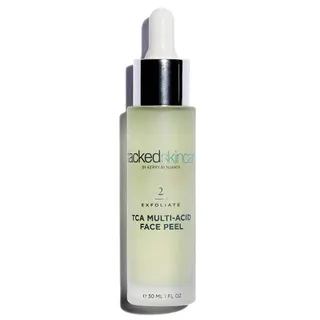
StackedSkincare TCA Lactic & Glycolic Face Peel
Works for
Anti-agingGlycolic acid, Lactic acidWorks well
“Promotes radiance and softens fine lines.”
This product can help reduce and prevent fine lines and wrinkles, improve skin elasticity and firmness because it contains glycolic acid.
These ingredients in the product can also be helpful, even though there is less evidence for their effectiveness: lactic acid.
Keep in mind that it typically takes at least 6 weeks to notice any results because the changes that are needed to improve fine lines and elasticity happen in the deeper layers of the skin. No topical anti-aging product can “erase” wrinkles or fully reverse signs of aging.
ExfoliationGlycolic acid, Lactic acid + 1 moreWorks well
“TCA Lactic & Glycolic Face Peel”
This product can help exfoliate the skin. In other words, it helps break down the bonds between dead cells on the surface of the skin and speed up the skin turnover. Skin often appears softer and brighter after exfoliation, but overdoing it can result in disrupted skin barrier. The following ingredient is doing the exfoliating job in this product: glycolic acid, lactic acid.
Evens skin toneGlycolic acid, Lactic acid + 1 moreWorks well
“Lactic Acid – Gently exfoliates while helping maintain hydration Glycolic Acid – Dissolves dead skin buildup and helps brighten tone Trichloroacetic Acid (TCA) – Resurfaces skin for smoother texture Phytic Acid – Helps brighten and defend against environmental stressors Salicylic Acid – Clears pore congestion and supports breakout-prone skin”
This product can help reduce hypepigmentation and even out the skin tone because it contains the following effective ingredients: glycolic acid, lactic acid
Keep in mind that you would need to apply any topical skincare targetted at hypigmentation consistently for a couple of months to get a result. No topical skincare product can help get rid of hyperpigmentation (including post-acne marks and age spots) instantly.
Anti-blemishGlycolic acid, Salicylic acidNot delivered
“Lactic Acid – Gently exfoliates while helping maintain hydration Glycolic Acid – Dissolves dead skin buildup and helps brighten tone Trichloroacetic Acid (TCA) – Resurfaces skin for smoother texture Phytic Acid – Helps brighten and defend against environmental stressors Salicylic Acid – Clears pore congestion and supports breakout-prone skin”
This product contains ingredients (glycolic acid) that could help reduce blemishes and clogged pores in theory, but there is not enough evidence that they actually work.
MoisturizingSide benefit · Lactic acid, GlycerinWorks
This product contains good ingredients to attract water to the upper layer of the skin. These ingredients are called "humectants": glycerin, lactic acid.
When humectants are on the surface of the skin, they “pull in” the moisture from the outside environment, or from within deeper layers of the skin. If the air is dry, humectants can speed up the moisture loss from the skin. This is why it is a good idea to use another product on top of this one to help "seal in" the moisture (look for ingredients like dimethicone, squalane, oils and butters).
Can it cause trouble?
Irritancy8 flagged ingredientsMedium risk
ComedogenicClean of flagged comedogenic ingredientsNone flagged


User reviews
Be the first — your take helps the next person decide.
Ingredients
Filter by role to see what each ingredient is doing.
Water~40–60%
Glycolic acid~5.5–8.2%
- Irritation risk
- High
An alpha-hydroxy acid (AHA) that helps to remove the dead skin cells on the surface of the skin reveling a more even, smoother complexation. It is also able to stimulate collagen production with long-term use. Could help to reduce pore congestion. It can be irritating to the skin. Apply sunscreen daily if using products with glycolic acid
More about Glycolic acidLactic acid~3.5–5.2%
- Irritation risk
- Medium
An exfoliating and moisturizing alpha-hydroxy acid (AHA). Typically causes less irritation than other AHAs, for example, glycolic acid. At high concentrations (about 15%), lactic acid can help reduce lines and wrinkles. Recent studies show that lactic acid can support the "good" bacteria living on skin's surface (healthy skin microbiome)
More about Lactic acidSd alcohol 40-b~2.7–4%
- Irritation risk
- High
Can be drying and contribute to skin irritation. Used in formulars to dissolve other ingredients, create a thinner product consistency or for its antibacterial properties
More about Sd alcohol 40-bPropanediol~2–3%
- Irritation risk
- Low
Acts as a solvent for other ingredients. Speeds up the absorption of other ingredients into the skin
More about PropanediolSodium hydroxide~1.6–2.3%
Glycerin~1.3–1.9%
- Irritation risk
- Low
One of the best moisturizing ingredients. Naturally present in skin. It attracts water to the upper layer of the skin working as a humectant
More about GlycerinChloroacetic acid~0.9–1.3%
- Irritation risk
- Low
Salicylic acid~0.4–0.95%
- Irritation risk
- High
Used for skin exfoliation. It has an anti-inflammatory and anti-bacterial effect, helps to unclog pores, prevent blemishes and speed up healing of the existing ones. Sometimes referred to as a BHA (beta-hydroxy acid)
More about Salicylic acidCurcuma longa root extract~0.4–0.9%
- Irritation risk
- High
A plant extract that can contain an active compound curcumin, that may have some anti-inflammatory properties when applied to the skin, but solid research is lacking and the typical concentration used in skincare products is too low. Can be an irritant
More about Curcuma longa root extractPhytic acid~0.2–0.75%
- Irritation risk
- Medium
An alpha-hydroxy acid (AHA), but is mostly used to stabilize product formulations in cosmetics
More about Phytic acidXanthan gum~0.1–0.45%
- Irritation risk
- Low
Used to create a thicker product consistency
More about Xanthan gumPhenoxyethanol~0.1–0.35%
- Irritation risk
- Low
A preservative. It helps prevent bacterial growth in cosmetic products
More about PhenoxyethanolBenzoic acid~0.05–0.25%
Dehydroacetic acid~0.05–0.15%
Ingredient list view
Water, Glycolic acid, Lactic acid, Sd alcohol 40-b, Propanediol, Sodium hydroxide, Glycerin, Unknown, Chloroacetic acid, Salicylic acid, Curcuma longa root extract, Phytic acid, Xanthan gum, Phenoxyethanol, Benzoic acid, Dehydroacetic acid
Compare prices
Retailers ranked by price — lowest first.

Worth comparing, line by line.
Match % combines shared ingredients, the first five ingredients, shared actives and hero ingredients, irritancy (lower counts in the alternative's favour), texture and body area. Only products in the same routine step are compared.
| StackedSkincareTCA Lactic & Glycolic Face PeelYOUR PRODUCT | Paula's choice25% AHA + 2% BHA Exfoliant Peel | Deviant SkincareGentle Resurfacing Liquid | Jan MariniMarini Multi-Acid Exfoliating Pads | |
|---|---|---|---|---|
| Match | — | 96% | 96% | 96% |
| Price | $122.00 | $44.78−$77.22 | $52.00−$70.00 | — |
| Shared key ingredients | — | 4 of 4 | 4 of 4 | 4 of 4 |
| Key difference | — | Mandelic Acid | Gluconolactone | Sodium Hyaluronate |
| Irritancy | Medium | Medium | Low | Low |
| Drying alcohol | Contains drying alcohol | — | — | — |
| View product | Shop | Shop | Shop |


More alternatives: CeraVe Blemish Control Gel Moisturiser with 2% Salicylic Acid & Niacinamide for Blemish-Prone SkinBliss Pro Liquid Exfoliant
Product summary
"StackedSkincare - TCA Lactic & Glycolic Face Peel" is effective for: Anti-inflammatory, Anti-aging, Exfoliation and Evens skin tone
This product could be helpful for: Moisturizing, but its actives are not the most effective or are not well-studied.
Ingredient callouts
- Exfoliating acids (lactic acid 3.50% - 5.20% and glycolic acid 5.50% - 8.20%). In this concentration, they will have a noticeable exfoliating effect. They can also have an anti-aging effect and stimulate collagen production in a long-run. Lactic Acid can also help to attract water to the upper layer (works as a humectant).
- Salicylic acid (0.40% - 0.95%). This is an oil-soluble exfoliating acid. Because of this property, it can work inside pores and help reduce the congestion. It has an anti-inflammatory effect and is used to treat acne. Because it is a quite strong exfoliator, be careful with using this product too often: it could result in over-exfoliation.
- Humectants (lactic acid 3.50% - 5.20% and glycerin 1.30% - 1.90%). These ingredients help attract water to the upper layer of the skin and improve the skin hydration.
Price
The product retails for 122.00$ in the United States.
For a detailed price comparison: click here.
Sources cited in this review
Every concentration estimate and effectiveness label is anchored to one of these 14 studies and safety reviews.
- 1
- 2Glycolic acid peel therapy – a current reviewncbi.nlm.nih.gov
- 3
- 4Epidermal and dermal effects of topical lactic acidncbi.nlm.nih.gov
- 5Dual Effects of Alpha-Hydroxy Acids on the Skinpdfs.semanticscholar.org
- 6

Affiliate links · As an Amazon Associate, WIMJ earns from qualifying purchases.