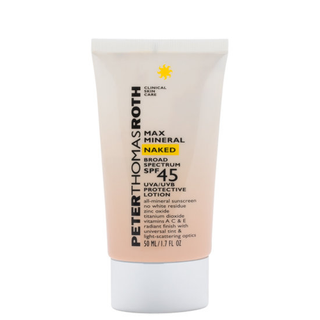
Peter Thomas Roth Max Mineral Naked Broad Spectrum SPF 45
Works for
2 of 2 advertised claims delivered
Sun protectionSPF 45 · 3 UV filtersBroad spectrum
This product offers a good level of protection against both UVB and UVA rays.
This sunscreen uses organic (so-called "chemical") sunscreen filters. Organic, or "chemical" filters usually provide reliable sun protection and rarely leave a white cast. Sunscreens with organic filters can sting eyes.
This product can be considered "reef safe" because it does not contain the UV filters (oxybenzone and octinoxate) that can be harmful to coral reefs when present in the water in high concentrations.
Anti-aging3 ingredients credited for this claimStrong support
“Vitamin A boosts the production of collagen to alleviate skin damage that aging has caused, while vitamin C enhances your natural beauty by brightening dark spots to even your skin tone.”
This product can help prevent early signs of skin aging because it offers a good level of broad spectrum sun protection. Sun damage is the main cause of premature skin aging, and protecting your skin from the sun is the best anti-aging strategy.
Evens skin toneNot advertised by the brand · 3 ingredients credited for this claimStrong support
This product offers broad spectrum sun protection. It means that it can prevent hyperpigmentation and help keep the skin tone even (sun damage is the main factor causing age spots, darkening of post-acne marks and other discolorations).
MoisturizingNot advertised by the brand · 12 ingredients credited for this claimGood support
This product can help soften the skin and reduce its moisture loss with emollients and occlusives: squalane, carthamus tinctorius seed oil.
Keep in mind that this product does not contain effective ingredients to attract water to the upper layer of the skin. This is why an additional product with humectants like glycerin or hyaluronic acid can be helpful (apply it before this product for the best results).
Can it cause trouble?
Irritancy1 strong irritant: Retinyl palmitateMedium risk
Comedogenic1 ingredient rated 2 or more on the 0–5 pore-clogging scale1 flagged


User reviews
Be the first — your take helps the next person decide.
Ingredients
Filter by role to see what each ingredient is doing.
Titanium dioxide1.93%
- Irritation risk
- Low
Works as a UV filter when used in high concentrations. It is photostable and is effective mostly against the UVB light, with some protection in the UVA range. In small concentrations, used for its ability to improve the color of cosmetic products. Is usually well tolerated by the skin
More about Titanium dioxideZinc oxide19.24%
- Irritation risk
- Low
A broad spectrum sunblock (protects from both UVA and UVB rays). Is suitable for most sensitive skins. In small concentrations, can be used as a colorant
More about Zinc oxideWater~45–55%
Butyloctyl salicylate~8.7–10.6%
- Irritation risk
- Medium
A synthetic ester of salicylic acid that is used to help disperse pigments and boost effectiveness of sunscreen ingredients. It is able to absorb UV light (working as an organic, or chemical filter), but is not approved as a sunscreen ingredient on its own
More about Butyloctyl salicylateC9-12 alkane~6.5–8%
Carthamus tinctorius seed oil~4.6–5.7%
- Irritation risk
- Low
An emollient that helps soften the skin and might help calm down inflammation
More about Carthamus tinctorius seed oilDicaprylyl carbonate~3.7–4.5%
- Irritation risk
- Low
Helps products spread more easily and works as an emollient to soften skin
More about Dicaprylyl carbonateIsodecyl neopentanoate~3.3–4.1%
- Irritation risk
- Low
An emollient that helps soften the skin. It also forms a protective on its surface to reduce water loss.
More about Isodecyl neopentanoateCetyl alcohol~2.7–3.3%
- Irritation risk
- Low
A non-drying alcohol that works to soften the skin and stabilize product formulations helping oil and water mix together
More about Cetyl alcoholCoco-caprylate/caprate~2.2–2.7%
- Irritation risk
- Low
Helps to soften the upper layer of the skin without creating a greasy texture
More about Coco-caprylate/capratePropanediol~1.7–2%
- Irritation risk
- Low
Acts as a solvent for other ingredients. Speeds up the absorption of other ingredients into the skin
More about PropanediolEthylhexyl olivate~1.3–1.6%
- Irritation risk
- Low
Helps soften the upper layer of the skin
More about Ethylhexyl olivateGlyceryl stearate~1.2–1.4%
- Irritation risk
- Low
An emollient that softens the skin and forms a protective layer on its surface. Helps water and oil mix together
More about Glyceryl stearatePeg-100 stearate~1.1–1.3%
- Irritation risk
- Low
Helps oil and water mix togehter and creates a nice product texture
More about Peg-100 stearateCetearyl olivate~0.95–1.2%
Cetearyl phosphate~0.8–1.2%
- Irritation risk
- Low
Triethoxycaprylylsilane~0.9–1.1%
- Irritation risk
- Low
A type of silicone that helps oil and water mix well together. Helps to disperse other ingredients, e.g. pigments, evenly in a formulation
More about TriethoxycaprylylsilanePhenoxyethanol~0.5–1%
- Irritation risk
- Low
A preservative. It helps prevent bacterial growth in cosmetic products
More about PhenoxyethanolSorbitan olivate~0.75–1.15%
Oleth-3 phosphate~0.75–1.1%
- Irritation risk
- Medium
- Comedogenicity
- 3/5
Helps water and oil mix together
More about Oleth-3 phosphateHdi/trimethylol hexyllactone crosspolymer~0.65–1%
- Irritation risk
- Low
Used to create a silky product texture and add volume to products
More about Hdi/trimethylol hexyllactone crosspolymerPeg-8 dimethicone~0.65–0.95%
- Irritation risk
- Low
A type of silicone that can help create nice product texture and soften the upper layer of the skin
More about Peg-8 dimethiconeAlumina~0.7–1.05%
- Irritation risk
- Low
The same compound that is used safely in dental implants and bone cements. In cosmetics, it is used to improve the consistency of products
More about AluminaXanthan gum~0.65–0.95%
- Irritation risk
- Low
Used to create a thicker product consistency
More about Xanthan gumPolymethylsilsesquioxane~0.6–0.9%
- Irritation risk
- Low
A silicone that improves product texture and helps dissolve other ingredients. Can form a non-greasy film on the skin to prevent moisture loss
More about PolymethylsilsesquioxanePolyhydroxystearic acid~0.6–0.9%
- Irritation risk
- Medium
Used to create a thicker product consistency and stabilize the formulation
More about Polyhydroxystearic acidDisodium edta~0.45–0.7%
Squalane~0.55–0.85%
- Irritation risk
- Low
An oil naturally present in skin. Works as an emollient to soften the skin and form a protective layer on its surface without a greasy feeling.
More about SqualaneGluconolactone~0.45–0.65%
- Irritation risk
- Medium
A polyhydroxy acid (PHA) that helps shed the dead cells from the skin surface revealing smoother skin. Is believed to be genter than AHAs. It helps attract water to the upper layer of the skin and can stimulate production of skin's own hyaluronic acid resulting in improved hydration levels. It has been shown to be helpful against acne and clogged pores if used consistently (e.g over a period of 12 weeks) in high enough concentration. It can help reduce fine lines and wrinkles and improve skin tone with long-term application. Can help neutralize free radicals
More about GluconolactoneIsopropyl titanium triisostearate~0.55–0.8%
- Irritation risk
- Medium
Helps water and oil mix together
More about Isopropyl titanium triisostearateSodium benzoate~0.25–0.5%
Hydrogen dimethicone~0.45–0.65%
- Irritation risk
- Low
Helps the function of sunscreen and pigment ingredients in the formulation
More about Hydrogen dimethiconePotassium sorbate~0.3–0.6%
Silica~0.5–0.8%
Mica~0.35–0.65%
- Irritation risk
- Low
Creates an illusion of smoother and more radiant skin tone. Adds shimmer to the skin by reflecting light
More about MicaAscorbic acid~0.25–0.45%
- Irritation risk
- High
The most well-researched antioxidant that works in skin. Helps neutralize free radicals supporting collagen production, helping to even out the skin tone and preventing early signs of aging
More about Ascorbic acidOctyldodecanol~0.3–0.5%
- Irritation risk
- Low
An emollient that helps to soften the skin and create a pleasant product texture and stabilize the formulation
More about OctyldodecanolRetinyl palmitate~0.25–0.4%
- Irritation risk
- High
Three steps removed from the active form of vitamin A - retinoic acid. To have an effect in the skin, it first needs to be converted twice to become the retinoic acid. This means it is less potent than retinol, but could also be less irritating. Once converted to the retinoic acid in the skin, it helps against all signs of aging, improves skin cell turnover and helps fight blemishes and clogged pores. However, in many cosmetic formulations, it is used in a concentration that is too low to have the full effect
More about Retinyl palmitateSodium propoxyhydroxypropyl thiosulfate silica~0.2–0.4%
- Irritation risk
- Low
Tocopheryl acetate~0.15–0.3%
- Irritation risk
- Medium
A more stable but less bio-available form of vitamin E compared to Tocopherol. Might help moisturize and protect the skin from free radicals, but mostly used in low concentrations to stabilize other ingredients.
More about Tocopheryl acetateDiamond powder~0.2–0.35%
- Irritation risk
- Low
Does not have known skin benefits. Might help create an optical illusion of smoother skin
More about Diamond powderIron oxides~0.1–0.2%
- Irritation risk
- Low
An umbrella term for the following three colorants: CI 77491, CI 77492, CI 77499. They might be able to offer some protection against visible light, but the degree of the protection is not clear
More about Iron oxidesIngredient list view
Titanium dioxide, Zinc oxide, Water, Butyloctyl salicylate, C9-12 alkane, Carthamus tinctorius seed oil, Dicaprylyl carbonate, Isodecyl neopentanoate, Cetyl alcohol, Coco-caprylate/caprate, Propanediol, Ethylhexyl olivate, Glyceryl stearate, Peg-100 stearate, Cetearyl olivate, Cetearyl phosphate, Triethoxycaprylylsilane, Phenoxyethanol, Sorbitan olivate, Oleth-3 phosphate, Hdi/trimethylol hexyllactone crosspolymer, Peg-8 dimethicone, Alumina, Xanthan gum, Polymethylsilsesquioxane, Polyhydroxystearic acid, Disodium edta, Squalane, Gluconolactone, Isopropyl titanium triisostearate, Sodium benzoate, Hydrogen dimethicone, Potassium sorbate, Silica, Mica, Ascorbic acid, Octyldodecanol, Retinyl palmitate, Sodium propoxyhydroxypropyl thiosulfate silica, Tocopheryl acetate, Diamond powder, Iron oxides
Compare prices
Retailers ranked by price — lowest first.


Worth comparing, line by line.
Match % combines shared ingredients, the first five ingredients, shared actives and hero ingredients, irritancy (lower counts in the alternative's favour), texture and body area. Only products in the same routine step are compared.
| Peter Thomas RothMax Mineral Naked Broad Spectrum SPF 45YOUR PRODUCT | NEOSTRATASheer Physical Protection SPF 50 | DecreeDay Shield SPF 30 | ExuvianceSheer Daily Protector SPF 50 1.7 Ounce | |
|---|---|---|---|---|
| Match | — | 60% | 55% | 55% |
| Price | $38.00 | $35.75−$2.25 | $93.00+$55.00 | $33.73−$4.27 |
| Shared key ingredients | — | 4 of 9 | 5 of 9 | 4 of 9 |
| Key difference | — | Lactobionic Acid | Palmitoyl Tripeptide-1 | Lactobionic Acid |
| Irritancy | Medium | Low | Medium | Low |
| SPF | SPF 45 | SPF 50 | SPF 30 | SPF 50 |
| Drying alcohol | — | — | — | — |
| View product | Shop | Shop | Shop |


Product summary
The ingredient list suggests that "Peter Thomas Roth - Max Mineral Naked Broad Spectrum SPF 45" can provide reliable sun protection. We love that it can protect from both UVA and UVB rays (not all sunscreens with SPF ratings give UVA protection. UVA rays do not cause sunburn, but still damage our skin and lead to early aging).
This product should also be hydrating enough to use without an additional moisturizer during the day. Like all broad-spectrum sunscreens, this product has an anti-aging benefit.
Sunscreen filters
This is a "mixed" sunscreen in the sense that it uses both mineral and organic (so-called "chemical") sun filters. The organic filters in the product are: butyloctyl salicylate. As for the mineral filters, this sunscreen uses both titanium dioxide and zinc oxide.
Irritation risk
This product contains actives that can be irritating. We assess the overall irritancy of it to be medium. For a detailed overview of all potential irritants: click here
You can see the detailed formula review with the breakdown of all actives in the product and the full ingredient list with estimated concentrations in the tables below.
Price
The product retails for 27.84£ in the United Kingdom and for 38.00$ in the United States.
For a detailed price comparison: click here.
Sources cited in this review
Every concentration estimate and effectiveness label is anchored to one of these 21 studies and safety reviews.
- 1A review of inorganic UV filters zinc oxide and titanium dioxideonlinelibrary.wiley.com
- 2
- 3
- 4
- 5
- 6

Affiliate links · As an Amazon Associate, WIMJ earns from qualifying purchases.