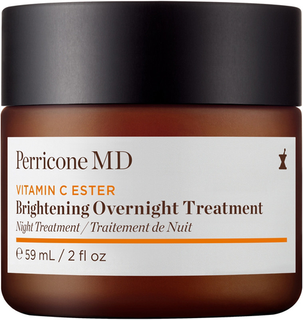
Perricone MD Vitamin C Ester Brightening Overnight Treatment

Perricone MD Vitamin C Ester Brightening Overnight Treatment

Efficacy100/100IrritancyMedium
Edit

Works for

4 of 4 advertised claims delivered

Moisturizing
16 ingredients credited for this claim
Strong support
What the product description says
“Wake up to radiant, youthful-looking skin with Perricone MD Vitamin C Ester Brightening Overnight Treatment ; a multi-beneficial formula that works to firm, hydrate and refine.”
Source: Lookfantastic US

This product can help improve hydration of the skin with the two types of ingredients.

The first type is called “humectants”:
these ingredients help attract water. When humectants are on the surface of the skin, they “pull in” the moisture from the outside environment, or from within deeper layers of the skin. The following ingredients in this product do the job: sodium hyaluronate, butylene glycol.

This product also contains ingredients called “occlusives”. They help reduce the speed with which our skin loses moisture to the outside environment. These ingredients also help soften the upper layer of the skin, so it feels less tight and nicer to the touch. The following ingredients in this product do the job: dimethicone, pantethine.

The following ingredients in this product are especially good for supporting the skin barrier and helping with the hydration level: urea

PantethineKey active· EmollientEffect: HighHelps to hydrate the skin by improving its barrier funciton~0.55–0.85%
TyrosineKey activeEffect: High~3.6–4.4%
DimethiconeKey active· Emollient, OcclusiveEffect: HighA silicone that helps to reduce water loss from the surface of the skin. Can temporarily "fill in" lines and wrinkles, absorb oil, and create a nice product finish~0.7–1.1%
Sodium hyaluronateKey active· HumectantEffect: HighOne of the best moisturizing ingredients. Attracts water into the upper layer of the skin~0.6–0.9%
UreaHero· HumectantEffect: HighNaturally present in skin (urea makes up about 7% of natural moisturizing factors in skin). Attracts water to the upper layer of the skin. Also has a positive effect on the skin barrier beyond the humectant action. Can enhance penetration of other ingredients. Is an exfoliating ingredient when used in high concentrations~2–2.4%
Elaeis guineensis oilKey active· EmollientEffect: MediumHelps soften the upper layer of the skin~0.3–0.6%
Cetearyl alcoholKey active· EmollientEffect: MediumA non-drying alcohol. Works as an emollient. Helps water and oil mix together and creates a nice product texture~2.5–3%
CyclopentasiloxaneKey active· EmollientEffect: MediumA silicone that helps improve the product texture and spreadability. Can absorb oil creating a short-term mattifying effect on the skin~0.8–1.2%
Butylene glycol· HumectantEffect: LowUsed to create a nice product texture and help delivery of other ingredients. Might be somewhat helpful in attracting water to the upper layer of the skin~1.2–1.4%
Glyceryl stearate· EmollientEffect: LowAn emollient that softens the skin and forms a protective layer on its surface. Helps water and oil mix together~0.5–0.75%
Isopropyl palmitate· EmollientEffect: LowHelps soften the upper layer of the skin and create a thicker product consistency~4.5–5.5%
Caprylyl glycol· Humectant, EmollientEffect: LowHelps preserve products and creates a nice product texture~0.4–0.65%
Camellia sinensis leaf extractEffect: LowCan contain potent anti-oxidant compounds (abbreviated ECG, GCG, EGC, and EGCG) that might help protect the skin from free radicals. Can help calm down inflammation and has some anti-bacterial properties. Unfortunately, these antioxidants are unstable and lose their effectiveness very quickly in products. The concentration of the antioxidant compounds in the extract also tends to be low to be effective in topical formulation~0.75–1.1%
AllantoinUnder-dosedEffect: HighHelps calm down inflammation in skin and can help reduce itching. Helps to repair the skin barrier and keep skin hydrated~0.6–0.9%
TocopherolEffect: Low, below effective dosePure form of vitamin E. Can help moisturise and protect the skin from free radicals. Often used to help stabilise other ingredients or the formula itself~0.5–0.75%
CyclohexasiloxaneEffect: Low, below effective doseA silicone that serves as an emollient. Helps create a nice non-greasy feels~0.5–0.75%
Evens skin tone
3 ingredients credited for this claim
Strong support
What the product description says
“Helps to minimise the appearance of fine lines and wrinkles, whilst targeting age spots, sun damage and discolouration for a more even tone.”
Source: Lookfantastic US

This product can help reduce hypepigmentation and even out the skin tone because it contains the following effective ingredients: glycolic acid, tetrahexyldecyl ascorbate

Keep in mind that you would need to apply any topical skincare targetted at hypigmentation consistently for a couple of months to get a result. No topical skincare product can help get rid of hyperpigmentation (including post-acne marks and age spots) instantly.

Tetrahexyldecyl ascorbateKey activeEffect: HighBeing a lipid soluble form of vitamin C, it is more stable than ascorbic acid, but still degrades quickly and needs to be stabilized in a formulation with another ingredient. It is claimed to penetrate skin better than pure vitamin C and have the the similar benefits, but solid studies of its effectiveness are lacking. Is likely to require a higher concentration in a product than pure vitamin C to be effective. It might be able to help reduce pore clogging.~8.2–10%
Glycolic acidKey activeEffect: HighAn alpha-hydroxy acid (AHA) that helps to remove the dead skin cells on the surface of the skin reveling a more even, smoother complexation. It is also able to stimulate collagen production with long-term use. Could help to reduce pore congestion. It can be irritating to the skin. Apply sunscreen daily if using products with glycolic acid~2.8–3.5%
Camellia sinensis leaf extractEffect: LowCan contain potent anti-oxidant compounds (abbreviated ECG, GCG, EGC, and EGCG) that might help protect the skin from free radicals. Can help calm down inflammation and has some anti-bacterial properties. Unfortunately, these antioxidants are unstable and lose their effectiveness very quickly in products. The concentration of the antioxidant compounds in the extract also tends to be low to be effective in topical formulation~0.75–1.1%
Anti-aging
6 ingredients credited for this claim
Strong support
What the product description says
“Wake up to radiant, youthful-looking skin with Perricone MD Vitamin C Ester Brightening Overnight Treatment ; a multi-beneficial formula that works to firm, hydrate and refine.”
Source: Lookfantastic US

This product can help reduce and prevent fine lines and wrinkles, improve skin elasticity and firmness because it contains glycolic acid, tetrahexyldecyl ascorbate.

These ingredients in the product can also be helpful, even though there is less evidence for their effectiveness: tocotrienols.

Keep in mind that it typically takes at least 6 weeks to notice any results because the changes that are needed to improve fine lines and elasticity happen in the deeper layers of the skin. No topical anti-aging product can “erase” wrinkles or fully reverse signs of aging.

Glycolic acidKey activeEffect: HighAn alpha-hydroxy acid (AHA) that helps to remove the dead skin cells on the surface of the skin reveling a more even, smoother complexation. It is also able to stimulate collagen production with long-term use. Could help to reduce pore congestion. It can be irritating to the skin. Apply sunscreen daily if using products with glycolic acid~2.8–3.5%
Tetrahexyldecyl ascorbateKey activeEffect: HighBeing a lipid soluble form of vitamin C, it is more stable than ascorbic acid, but still degrades quickly and needs to be stabilized in a formulation with another ingredient. It is claimed to penetrate skin better than pure vitamin C and have the the similar benefits, but solid studies of its effectiveness are lacking. Is likely to require a higher concentration in a product than pure vitamin C to be effective. It might be able to help reduce pore clogging.~8.2–10%
TocotrienolsKey activeEffect: MediumA type of vitamin E that is more powerful in neutralizing free radicals compared to its other forms~0.55–0.8%
Camellia sinensis leaf extractEffect: LowCan contain potent anti-oxidant compounds (abbreviated ECG, GCG, EGC, and EGCG) that might help protect the skin from free radicals. Can help calm down inflammation and has some anti-bacterial properties. Unfortunately, these antioxidants are unstable and lose their effectiveness very quickly in products. The concentration of the antioxidant compounds in the extract also tends to be low to be effective in topical formulation~0.75–1.1%
TocopherolEffect: Low, below effective dosePure form of vitamin E. Can help moisturise and protect the skin from free radicals. Often used to help stabilise other ingredients or the formula itself~0.5–0.75%
Ascorbyl palmitateEffect: Low, below effective doseBeing a lipid soluble form of vitamin C, it is more stable and can penetrate the skin better than L-Ascorbic acid. It is effective in protecting the skin from free radicals, as well as evening the skin tone, but is less effective in stimulating collagen production compared to L-Ascorbic acid.~0.65–1%
Exfoliation
3 ingredients credited for this claim
Strong support
What the product description says
“Superior Exfoliation Amino Acids.”
Source: Ulta

This product can help exfoliate the skin. In other words, it helps break down the bonds between dead cells on the surface of the skin and speed up the skin turnover. Skin often appears softer and brighter after exfoliation, but overdoing it can result in disrupted skin barrier. The following ingredient is doing the exfoliating job in this product: glycolic acid.

Glycolic acidKey activeEffect: HighAn alpha-hydroxy acid (AHA) that helps to remove the dead skin cells on the surface of the skin reveling a more even, smoother complexation. It is also able to stimulate collagen production with long-term use. Could help to reduce pore congestion. It can be irritating to the skin. Apply sunscreen daily if using products with glycolic acid~2.8–3.5%
UreaKey activeEffect: MediumNaturally present in skin (urea makes up about 7% of natural moisturizing factors in skin). Attracts water to the upper layer of the skin. Also has a positive effect on the skin barrier beyond the humectant action. Can enhance penetration of other ingredients. Is an exfoliating ingredient when used in high concentrations~2–2.4%
AllantoinEffect: Low, below effective doseHelps calm down inflammation in skin and can help reduce itching. Helps to repair the skin barrier and keep skin hydrated~0.6–0.9%
Anti-oxidation
Not advertised by the brand · 8 ingredients credited for this claim
Strong support

This product contains antioxidants (tetrahexyldecyl ascorbate, tocotrienols) that can help neutralize free radicals in skin. By doing so, they can lessen the damage the skin gets from the UV light (sun).

The following ingredients - camellia sinensis leaf extract also can have an antioxidant effect, but there is less evidence to confirm their effectiveness in skin.

TocotrienolsKey activeEffect: HighA type of vitamin E that is more powerful in neutralizing free radicals compared to its other forms~0.55–0.8%
Tetrahexyldecyl ascorbateKey activeEffect: HighBeing a lipid soluble form of vitamin C, it is more stable than ascorbic acid, but still degrades quickly and needs to be stabilized in a formulation with another ingredient. It is claimed to penetrate skin better than pure vitamin C and have the the similar benefits, but solid studies of its effectiveness are lacking. Is likely to require a higher concentration in a product than pure vitamin C to be effective. It might be able to help reduce pore clogging.~8.2–10%
Camellia sinensis leaf extractKey activeEffect: MediumCan contain potent anti-oxidant compounds (abbreviated ECG, GCG, EGC, and EGCG) that might help protect the skin from free radicals. Can help calm down inflammation and has some anti-bacterial properties. Unfortunately, these antioxidants are unstable and lose their effectiveness very quickly in products. The concentration of the antioxidant compounds in the extract also tends to be low to be effective in topical formulation~0.75–1.1%
Pyridoxine hclEffect: LowMight help neutralize free radicals in skin~0.5–0.8%
Tocopheryl acetateEffect: LowA more stable but less bio-available form of vitamin E compared to Tocopherol. Might help moisturize and protect the skin from free radicals, but mostly used in low concentrations to stabilize other ingredients.~1–1.2%
TocopherolUnder-dosedEffect: HighPure form of vitamin E. Can help moisturise and protect the skin from free radicals. Often used to help stabilise other ingredients or the formula itself~0.5–0.75%
BisabololEffect: Low, below effective doseAn active component of chamomile plant that historically has been used to calm down irritated skin. A recent study shows that bisabolol indeed can have some anti-inflammatory effect on skin, even though conclusive data is lacking. Bisabolol has a sweet floral scent and can be added to products for its aromatic properties~0.5–0.8%
Ascorbyl palmitateEffect: Low, below effective doseBeing a lipid soluble form of vitamin C, it is more stable and can penetrate the skin better than L-Ascorbic acid. It is effective in protecting the skin from free radicals, as well as evening the skin tone, but is less effective in stimulating collagen production compared to L-Ascorbic acid.~0.65–1%

Can it cause trouble?

Irritancy
2 strong irritants: Parfum, Benzyl benzoate
Medium risk
We flagged 17 ingredients with irritancy potential. Severity depends on your sensitivity threshold; the table lists the worst offenders first.
IngredientFunctionIrritationEst. amount
Glycolic acidAn alpha-hydroxy acid (AHA) that helps to remove the dead skin cells on the surface of the skin reveling a more even, smoother complexation. It is also able to stimulate collagen production with long-term use. Could help to reduce pore congestion. It can be irritating to the skin. Apply sunscreen daily if using products with glycolic acidHigh~2.8–3.5%est.
Zinc sulfateA preservative. It can be irritatingHigh~0.2–0.4%est.
ParfumAn aromatic blend of unspecified and possibly irritating ingredientsHigh~0.1–0.2%est.
Benzyl benzoateFragrance with sweet balsamic smell. Help to preserve products and dissolve other ingredients. Could trigger allergic reactions and be irritatingHigh~0.1–0.2%est.
Tetrahexyldecyl ascorbateBeing a lipid soluble form of vitamin C, it is more stable than ascorbic acid, but still degrades quickly and needs to be stabilized in a formulation with another ingredient. It is claimed to penetrate skin better than pure vitamin C and have the the similar benefits, but solid studies of its effectiveness are lacking. Is likely to require a higher concentration in a product than pure vitamin C to be effective. It might be able to help reduce pore clogging.Medium~8.2–10%est.
Isopropyl palmitateHelps soften the upper layer of the skin and create a thicker product consistencyMedium~4.5–5.5%est.
TriethanolamineUsed to adjust pH of the product and can help improve the product's smellMedium~1.7–2.1%est.
Tocopheryl acetateA more stable but less bio-available form of vitamin E compared to Tocopherol. Might help moisturize and protect the skin from free radicals, but mostly used in low concentrations to stabilize other ingredients.Medium~1–1.2%est.
Ascorbyl palmitateBeing a lipid soluble form of vitamin C, it is more stable and can penetrate the skin better than L-Ascorbic acid. It is effective in protecting the skin from free radicals, as well as evening the skin tone, but is less effective in stimulating collagen production compared to L-Ascorbic acid.Medium~0.65–1%est.
Pyridoxine hclMight help neutralize free radicals in skinMedium~0.5–0.8%est.
Citric acidCan work as an exfoliant but is typically used to adjust the product pHMedium~0.5–0.75%est.
Disodium edtaStabilizes the product formulationMedium~0.5–0.75%est.
BhtA preservativeMedium~0.5–0.7%est.
Ceteareth-20Helps oil and water mix together. Has some emollient propertiesMedium~0.55–0.85%est.
EthoxydiglycolHelps to improve the product consistencyMedium~0.4–0.6%est.
Caprylyl glycolHelps preserve products and creates a nice product textureMedium~0.4–0.65%est.
Sorbic acidA preservativeMedium~0.15–0.3%est.
Comedogenic
3 ingredients rated 2 or more on the 0–5 pore-clogging scale
3 flagged
These ingredients have a comedogenic rating of 2 or more on a 0–5 scale; the table shows each one's rating. In leave-on products they can clog pores in acne-prone skin.
IngredientFunctionRatingEst. amount
Isopropyl palmitateHelps soften the upper layer of the skin and create a thicker product consistency3/5~4.5–5.5%est.
Cetearyl alcoholA non-drying alcohol. Works as an emollient. Helps water and oil mix together and creates a nice product texture2/5~2.5–3%est.
Ceteareth-20Helps oil and water mix together. Has some emollient properties2/5~0.55–0.85%est.
Edit
Cheaper Alternatives
Similar formulations, better price
No cheaper similar product found.

User reviews

Would you recommend?
No community reviews yet.

Be the first — your take helps the next person decide.

Write a review · ~30s

Ingredients

Filter by role to see what each ingredient is doing.

Water~45–55%
Formula
Irritation risk
Low

Plain old water

More about Water
Tetrahexyldecyl ascorbate~8.2–10%
Key activeIrritant · medium
Irritation risk
Medium
Works for
Evens skin toneAnti-oxidationAnti-aging

Being a lipid soluble form of vitamin C, it is more stable than ascorbic acid, but still degrades quickly and needs to be stabilized in a formulation with another ingredient. It is claimed to penetrate skin better than pure vitamin C and have the the similar benefits, but solid studies of its effectiveness are lacking. Is likely to require a higher concentration in a product than pure vitamin C to be effective. It might be able to help reduce pore clogging.

More about Tetrahexyldecyl ascorbate
Isopropyl palmitate~4.5–5.5%
Comedogenic 3/5Irritant · medium
Irritation risk
Medium
Comedogenicity
3/5
Works for
Moisturizing

Helps soften the upper layer of the skin and create a thicker product consistency

More about Isopropyl palmitate
Tyrosine~3.6–4.4%
Key active
Irritation risk
Low
Works for
Moisturizing
More about Tyrosine
Glycolic acid~2.8–3.5%
Key activeIrritant · high
Irritation risk
High
Works for
ExfoliationEvens skin toneAnti-agingAnti-blemish

An alpha-hydroxy acid (AHA) that helps to remove the dead skin cells on the surface of the skin reveling a more even, smoother complexation. It is also able to stimulate collagen production with long-term use. Could help to reduce pore congestion. It can be irritating to the skin. Apply sunscreen daily if using products with glycolic acid

More about Glycolic acid
Cetearyl alcohol~2.5–3%
Key activeComedogenic 2/5
Irritation risk
Low
Comedogenicity
2/5
Works for
CleansingMoisturizing

A non-drying alcohol. Works as an emollient. Helps water and oil mix together and creates a nice product texture

More about Cetearyl alcohol
Urea~2–2.4%
Hero · Moisturizing
Irritation risk
Low
Works for
MoisturizingExfoliation

Naturally present in skin (urea makes up about 7% of natural moisturizing factors in skin). Attracts water to the upper layer of the skin. Also has a positive effect on the skin barrier beyond the humectant action. Can enhance penetration of other ingredients. Is an exfoliating ingredient when used in high concentrations

More about Urea
Triethanolamine~1.7–2.1%
Irritant · medium
Irritation risk
Medium
Works for
Cleansing

Used to adjust pH of the product and can help improve the product's smell

More about Triethanolamine
Sodium carboxymethyl beta-glucan~1.8–2.2%
Formula
Irritation risk
Low

Helps thicken the product formulation and create a gel-like texture

More about Sodium carboxymethyl beta-glucan
Butylene glycol~1.2–1.4%
Formula
Irritation risk
Low
Works for
Moisturizing

Used to create a nice product texture and help delivery of other ingredients. Might be somewhat helpful in attracting water to the upper layer of the skin

More about Butylene glycol
Tocopheryl acetate~1–1.2%
Irritant · medium
Irritation risk
Medium
Works for
Anti-oxidation

A more stable but less bio-available form of vitamin E compared to Tocopherol. Might help moisturize and protect the skin from free radicals, but mostly used in low concentrations to stabilize other ingredients.

More about Tocopheryl acetate
Cyclopentasiloxane~0.8–1.2%
Key active
Irritation risk
Low
Works for
MattifyingMoisturizing

A silicone that helps improve the product texture and spreadability. Can absorb oil creating a short-term mattifying effect on the skin

More about Cyclopentasiloxane
Camellia sinensis leaf extract~0.75–1.1%
Key active
Irritation risk
Low
Works for
Anti-oxidationAntibacterialAnti-agingMoisturizingAnti-blemishEvens skin tone

Can contain potent anti-oxidant compounds (abbreviated ECG, GCG, EGC, and EGCG) that might help protect the skin from free radicals. Can help calm down inflammation and has some anti-bacterial properties. Unfortunately, these antioxidants are unstable and lose their effectiveness very quickly in products. The concentration of the antioxidant compounds in the extract also tends to be low to be effective in topical formulation

More about Camellia sinensis leaf extract
Dimethicone~0.7–1.1%
Key active
Irritation risk
Low
Works for
MoisturizingMattifying

A silicone that helps to reduce water loss from the surface of the skin. Can temporarily "fill in" lines and wrinkles, absorb oil, and create a nice product finish

More about Dimethicone
Dimethyl mea~0.65–0.95%
Formula
Irritation risk
Low
More about Dimethyl mea
Ascorbyl palmitate~0.65–1%
Irritant · medium
Irritation risk
Medium
Works for
Anti-oxidationAnti-aging

Being a lipid soluble form of vitamin C, it is more stable and can penetrate the skin better than L-Ascorbic acid. It is effective in protecting the skin from free radicals, as well as evening the skin tone, but is less effective in stimulating collagen production compared to L-Ascorbic acid.

More about Ascorbyl palmitate
Sodium hyaluronate~0.6–0.9%
Key active
Irritation risk
Low
Works for
Moisturizing

One of the best moisturizing ingredients. Attracts water into the upper layer of the skin

More about Sodium hyaluronate
Allantoin~0.6–0.9%
Under-dosed
Irritation risk
Low
Works for
MoisturizingAnti-inflammatoryReduces irritationAnti-blemishReduces rednessExfoliation

Helps calm down inflammation in skin and can help reduce itching. Helps to repair the skin barrier and keep skin hydrated

More about Allantoin
Bisabolol~0.5–0.8%
Formula
Irritation risk
Low
Works for
Reduces irritationAnti-inflammatoryAnti-oxidation

An active component of chamomile plant that historically has been used to calm down irritated skin. A recent study shows that bisabolol indeed can have some anti-inflammatory effect on skin, even though conclusive data is lacking. Bisabolol has a sweet floral scent and can be added to products for its aromatic properties

More about Bisabolol
Tocotrienols~0.55–0.8%
Key active
Irritation risk
Low
Works for
Anti-oxidationAnti-aging

A type of vitamin E that is more powerful in neutralizing free radicals compared to its other forms

More about Tocotrienols
Pyridoxine hcl~0.5–0.8%
Irritant · medium
Irritation risk
Medium
Works for
Anti-oxidation

Might help neutralize free radicals in skin

More about Pyridoxine hcl
Pantethine~0.55–0.85%
Key active
Irritation risk
Low
Works for
MoisturizingReduces irritationAnti-inflammatory

Helps to hydrate the skin by improving its barrier funciton

More about Pantethine
Tocopherol~0.5–0.75%
Under-dosed
Irritation risk
Low
Works for
Anti-oxidationMoisturizingAnti-agingAnti-inflammatory

Pure form of vitamin E. Can help moisturise and protect the skin from free radicals. Often used to help stabilise other ingredients or the formula itself

More about Tocopherol
Citric acid~0.5–0.75%
Irritant · medium
Irritation risk
Medium

Can work as an exfoliant but is typically used to adjust the product pH

More about Citric acid
Disodium edta~0.5–0.75%
Irritant · medium
Irritation risk
Medium

Stabilizes the product formulation

More about Disodium edta
Bht~0.5–0.7%
Irritant · medium
Irritation risk
Medium

A preservative

More about Bht
Ceteareth-20~0.55–0.85%
Comedogenic 2/5Irritant · medium
Irritation risk
Medium
Comedogenicity
2/5
Works for
Cleansing

Helps oil and water mix together. Has some emollient properties

More about Ceteareth-20
Cyclohexasiloxane~0.5–0.75%
Formula
Irritation risk
Low
Works for
Moisturizing

A silicone that serves as an emollient. Helps create a nice non-greasy feels

More about Cyclohexasiloxane
Ethoxydiglycol~0.4–0.6%
Irritant · medium
Irritation risk
Medium

Helps to improve the product consistency

More about Ethoxydiglycol
Glyceryl stearate~0.5–0.75%
Formula
Irritation risk
Low
Works for
CleansingMoisturizing

An emollient that softens the skin and forms a protective layer on its surface. Helps water and oil mix together

More about Glyceryl stearate
Peg-100 stearate~0.55–0.8%
Formula
Irritation risk
Low
Works for
Cleansing

Helps oil and water mix togehter and creates a nice product texture

More about Peg-100 stearate
Caprylyl glycol~0.4–0.65%
Irritant · medium
Irritation risk
Medium
Works for
Moisturizing

Helps preserve products and creates a nice product texture

More about Caprylyl glycol
Elaeis guineensis oil~0.3–0.6%
Key active
Irritation risk
Low
Works for
Moisturizing

Helps soften the upper layer of the skin

More about Elaeis guineensis oil
Zinc sulfate~0.2–0.4%
Irritant · high
Irritation risk
High

A preservative. It can be irritating

More about Zinc sulfate
Phenoxyethanol~0.2–0.4%
Formula
Irritation risk
Low

A preservative. It helps prevent bacterial growth in cosmetic products

More about Phenoxyethanol
Sorbic acid~0.15–0.3%
Irritant · medium
Irritation risk
Medium

A preservative

More about Sorbic acid
Parfum~0.1–0.2%
Irritant · high
Irritation risk
High

An aromatic blend of unspecified and possibly irritating ingredients

More about Parfum
Benzyl benzoate~0.1–0.2%
Irritant · high
Irritation risk
High

Fragrance with sweet balsamic smell. Help to preserve products and dissolve other ingredients. Could trigger allergic reactions and be irritating

More about Benzyl benzoate
Ingredient list view

Water, Tetrahexyldecyl ascorbate, Isopropyl palmitate, Tyrosine, Glycolic acid, Cetearyl alcohol, Urea, Triethanolamine, Sodium carboxymethyl beta-glucan, Butylene glycol, Tocopheryl acetate, Cyclopentasiloxane, Camellia sinensis leaf extract, Dimethicone, Dimethyl mea, Ascorbyl palmitate, Sodium hyaluronate, Allantoin, Bisabolol, Tocotrienols, Pyridoxine hcl, Pantethine, Tocopherol, Citric acid, Disodium edta, Bht, Ceteareth-20, Cyclohexasiloxane, Ethoxydiglycol, Glyceryl stearate, Peg-100 stearate, Caprylyl glycol, Elaeis guineensis oil, Zinc sulfate, Phenoxyethanol, Sorbic acid, Parfum, Benzyl benzoate

Compare prices

Retailers ranked by price — lowest first.

Perricone MD
$99.00
Buy
Lookfantastic US
$113.20
Buy
Amazon US
Price unavailable
Check
Perricone MD
Price unavailable
Check

Affiliate links · prices updated regularly · As an Amazon Associate, WIMJ earns from qualifying purchases.

Cheaper alternatives? See how this stacks up against similar formulas.
We compare ingredient profiles across our catalog — pick the closest match for your budget.
Open dupe finder

Product summary

"Perricone MD - Vitamin C Ester Brightening Overnight Treatment" is a well-rounded moisturizing product. The formulation is based on a combination of good humectants and emollients. Both are needed to increase the skin hydration level. Humectants in this product (urea, sodium hyaluronate, butylene glycol and caprylyl glycol) help to increase the water content in the upper layer of the skin. (These ingredients do so by "capturing" water molecules from the outside air or from within the deeper layers of the skin). Emollients in this formulation (pantethine, dimethicone, cetearyl alcohol, cyclopentasiloxane and elaeis guineensis oil) help to reduce the moisture loss from the skin. They also soften the skin surface and relieve the feeling of dryness and tightness.

Irritation risk

This moisturizer contains some common irritants, including those without a benefit for the skin. We assess the overall irritancy of this moisturizer to be medium. For a detailed overview of all potential irritants: click here

You can see the detailed formula review with the breakdown of all actives in the product and the full ingredient list with estimated concentrations in the tables below.

About the brand

According to Cruelty-Free Kitty "Perricone MD" is cruelty free and so is its parent company.

Price

The product retails from 99.00$ up to 113.20$ in the United States, from 41.00£ up to 79.00£ in the United Kingdom and for 143.50CA$ in Canada.

For a detailed price comparison: click here.

Sources cited in this review

Every concentration estimate and effectiveness label is anchored to one of these 24 studies and safety reviews.

  1. 1
  2. 2
  3. 3
  4. 4
  5. 5
  6. 6
Perricone MD Vitamin C Ester Brightening Overnight Treatment
Perricone MDVitamin C Ester Brightening Overnight Treatment

Affiliate links · As an Amazon Associate, WIMJ earns from qualifying purchases.

As an Amazon Associate, WIMJ earns from qualifying purchases.