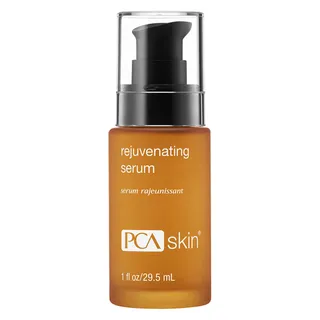
PCA SKIN Rejuvenating Serum

PCA SKIN Rejuvenating Serum

Efficacy100/100IrritancyHigh

Works for

Anti-aging
Gluconolactone, Tocotrienols + 4 more
Works well
What the product description says
“This serum contains epidermal growth factor (EGF) to diminish the appearance of fine lines and wrinkles.”
Source: Face the future

This product can help reduce and prevent fine lines and wrinkles, improve skin elasticity and firmness because it contains gluconolactone.

These ingredients in the product can also be helpful, even though there is less evidence for their effectiveness: epigallocatechin gallate, tocotrienols.

Keep in mind that it typically takes at least 6 weeks to notice any results because the changes that are needed to improve fine lines and elasticity happen in the deeper layers of the skin. No topical anti-aging product can “erase” wrinkles or fully reverse signs of aging.

GluconolactoneKey activeEffect: HighA polyhydroxy acid (PHA) that helps shed the dead cells from the skin surface revealing smoother skin. Is believed to be genter than AHAs. It helps attract water to the upper layer of the skin and can stimulate production of skin's own hyaluronic acid resulting in improved hydration levels. It has been shown to be helpful against acne and clogged pores if used consistently (e.g over a period of 12 weeks) in high enough concentration. It can help reduce fine lines and wrinkles and improve skin tone with long-term application. Can help neutralize free radicals~2.3–2.8%
TocotrienolsKey activeEffect: MediumA type of vitamin E that is more powerful in neutralizing free radicals compared to its other forms~0.3–0.5%
Epigallocatechin gallateKey activeEffect: MediumA polyphenol found in tea. This particular compound abbreviated EGCG is the most powerful antioxidant among those extracted from tea (usually green tea). Unfortunately, EGCG is unstable, requires a low pH (below 4) to prevent quick degradation, and does not penetrate the skin very well. This is why the full anti-oxidant effect of EGCG is typically not realized when it is added to topical skincare~0.3–0.55%
TocopherolEffect: Low, below effective dosePure form of vitamin E. Can help moisturise and protect the skin from free radicals. Often used to help stabilise other ingredients or the formula itself~0.5–0.75%
Aloe barbadensis leaf juiceEffect: Low, below effective doseTraditionally used to treat sunburns, dermatitis and inflammation, but evidence for its effectiveness is lacking. The extract can contain humectants that help attract water into the skin~0.25–0.4%
NiacinamideUnder-dosedIs proven to be effective in reducing blemishes, evening out skin tone and helping to improve lines and wrinkles. It helps the skin to repair sun damage, calm down inflammation and keep maintain good levels of moisture. The concentration of about 2% is effective for supporting the skin barrier and evening out the skin tone. Concentration of 4-6% is better for helping with acne and balancing the sebum production~0.2–0.35%
Anti-oxidation
Side benefit · Gluconolactone, Glutathione + 6 more
Works well

This product contains antioxidants (camellia oleifera leaf extract, glutathione, tocotrienols) that can help neutralize free radicals in skin. By doing so, they can lessen the damage the skin gets from the UV light (sun).

The following ingredients - epigallocatechin gallate, gluconolactone, squalene also can have an antioxidant effect, but there is less evidence to confirm their effectiveness in skin.

GluconolactoneKey activeEffect: MediumA polyhydroxy acid (PHA) that helps shed the dead cells from the skin surface revealing smoother skin. Is believed to be genter than AHAs. It helps attract water to the upper layer of the skin and can stimulate production of skin's own hyaluronic acid resulting in improved hydration levels. It has been shown to be helpful against acne and clogged pores if used consistently (e.g over a period of 12 weeks) in high enough concentration. It can help reduce fine lines and wrinkles and improve skin tone with long-term application. Can help neutralize free radicals~2.3–2.8%
GlutathioneKey activeEffect: HighA peptide that can help neutralize free radicals in skin and reduce melanin production resulting in skin lightening effect and reduction in hyperpigmentation. It can also help attract moisture to the upper layer of the skin~0.45–0.65%
Camellia oleifera leaf extractKey activeEffect: HighA plant extract that can help neutralize free radicals and reduce inflammation, even though it is not usually used in sufficient concentration in cosmetics~0.3–0.55%
TocotrienolsKey activeEffect: HighA type of vitamin E that is more powerful in neutralizing free radicals compared to its other forms~0.3–0.5%
SqualeneKey activeEffect: MediumAn oil that is naturally part of skin sebum that helps to soften its upper layer, reduce water loss and neutralize free radicals. It might be comedogenic. Avoid applying large concentrations (or pure oil) before sun exposure as oxidized squalene can clog pores and lead to skin irritation. Today squalene is mostly derived from vegetable oils or synthetized by yeast~0.3–0.55%
Epigallocatechin gallateKey activeEffect: MediumA polyphenol found in tea. This particular compound abbreviated EGCG is the most powerful antioxidant among those extracted from tea (usually green tea). Unfortunately, EGCG is unstable, requires a low pH (below 4) to prevent quick degradation, and does not penetrate the skin very well. This is why the full anti-oxidant effect of EGCG is typically not realized when it is added to topical skincare~0.3–0.55%
BisabololEffect: LowAn active component of chamomile plant that historically has been used to calm down irritated skin. A recent study shows that bisabolol indeed can have some anti-inflammatory effect on skin, even though conclusive data is lacking. Bisabolol has a sweet floral scent and can be added to products for its aromatic properties~1.6–2%
TocopherolUnder-dosedPure form of vitamin E. Can help moisturise and protect the skin from free radicals. Often used to help stabilise other ingredients or the formula itself~0.5–0.75%
Moisturizing
Side benefit · Urea, Glycerin + 18 more
Works well

This product can help improve hydration of the skin with the two types of ingredients.

The first type is called “humectants”:
these ingredients help attract water. When humectants are on the surface of the skin, they “pull in” the moisture from the outside environment, or from within deeper layers of the skin. The following ingredients in this product do the job: fructose, glycerin.

This product also contains ingredients called “occlusives”. They help reduce the speed with which our skin loses moisture to the outside environment. These ingredients also help soften the upper layer of the skin, so it feels less tight and nicer to the touch. The following ingredients in this product do the job: squalane, squalene.

The following ingredients in this product are especially good for supporting the skin barrier and helping with the hydration level: urea

UreaHero· HumectantEffect: HighNaturally present in skin (urea makes up about 7% of natural moisturizing factors in skin). Attracts water to the upper layer of the skin. Also has a positive effect on the skin barrier beyond the humectant action. Can enhance penetration of other ingredients. Is an exfoliating ingredient when used in high concentrations~0.2–0.4%
GlycerinKey active· HumectantEffect: HighOne of the best moisturizing ingredients. Naturally present in skin. It attracts water to the upper layer of the skin working as a humectant~3.9–4.7%
GluconolactoneKey activeEffect: HighA polyhydroxy acid (PHA) that helps shed the dead cells from the skin surface revealing smoother skin. Is believed to be genter than AHAs. It helps attract water to the upper layer of the skin and can stimulate production of skin's own hyaluronic acid resulting in improved hydration levels. It has been shown to be helpful against acne and clogged pores if used consistently (e.g over a period of 12 weeks) in high enough concentration. It can help reduce fine lines and wrinkles and improve skin tone with long-term application. Can help neutralize free radicals~2.3–2.8%
IsomaltKey active· HumectantEffect: HighHelps attract water to the upper layer of the skin~1.2–1.4%
Sodium pcaKey active· HumectantEffect: HighNaturally present in skin and helps to attract water to its upper layer~0.95–1.2%
Sodium lactateKey active· HumectantEffect: HighHelps attract water to the upper layer of the skin. Is often used to adjust the pH level of the product~0.7–1.05%
SqualaneKey active· Emollient, OcclusiveEffect: HighAn oil naturally present in skin. Works as an emollient to soften the skin and form a protective layer on its surface without a greasy feeling.~0.55–0.8%
GlutathioneKey activeEffect: HighA peptide that can help neutralize free radicals in skin and reduce melanin production resulting in skin lightening effect and reduction in hyperpigmentation. It can also help attract moisture to the upper layer of the skin~0.45–0.65%
PhytosterolsKey active· EmollientEffect: HighLipids that work as an emollient and can be helpful in repairing skin barrier function~0.4–0.6%
SqualeneKey active· Emollient, OcclusiveEffect: HighAn oil that is naturally part of skin sebum that helps to soften its upper layer, reduce water loss and neutralize free radicals. It might be comedogenic. Avoid applying large concentrations (or pure oil) before sun exposure as oxidized squalene can clog pores and lead to skin irritation. Today squalene is mostly derived from vegetable oils or synthetized by yeast~0.3–0.55%
PhospholipidsKey activeEffect: MediumEmollients that are naturaly present in skin. In addition, they help water and oil mix together in the product~0.3–0.6%
GlycineKey active· HumectantEffect: HighHelps to attract water to the upper layer of the skin and can help restore the skin barrier function~0.15–0.3%
FructoseKey active· HumectantEffect: HighHelps attract water to the upper layer of the skin~0.15–0.25%
InositolKey active· HumectantEffect: High~0.05–0.15%
Caprylyl glycol· Humectant, EmollientEffect: LowHelps preserve products and creates a nice product texture~0.6–0.9%
Epigallocatechin gallateEffect: LowA polyphenol found in tea. This particular compound abbreviated EGCG is the most powerful antioxidant among those extracted from tea (usually green tea). Unfortunately, EGCG is unstable, requires a low pH (below 4) to prevent quick degradation, and does not penetrate the skin very well. This is why the full anti-oxidant effect of EGCG is typically not realized when it is added to topical skincare~0.3–0.55%
TocopherolEffect: Low, below effective dosePure form of vitamin E. Can help moisturise and protect the skin from free radicals. Often used to help stabilise other ingredients or the formula itself~0.5–0.75%
Aloe barbadensis leaf juiceEffect: Low, below effective doseTraditionally used to treat sunburns, dermatitis and inflammation, but evidence for its effectiveness is lacking. The extract can contain humectants that help attract water into the skin~0.25–0.4%
LecithinEffect: Low, below effective doseUsed mostly for creating emulsions - helping oil and water mix together. Helps soften the upper layer of the skin~0.15–0.3%
NiacinamideUnder-dosedIs proven to be effective in reducing blemishes, evening out skin tone and helping to improve lines and wrinkles. It helps the skin to repair sun damage, calm down inflammation and keep maintain good levels of moisture. The concentration of about 2% is effective for supporting the skin barrier and evening out the skin tone. Concentration of 4-6% is better for helping with acne and balancing the sebum production~0.2–0.35%
Evens skin tone
Side benefit · Gluconolactone, Glutathione + 2 more
Works well

This product can help reduce hypepigmentation and even out the skin tone because it contains the following effective ingredients: gluconolactone, glutathione

The following ingredient (ingredients) in this product might be helpful, but there is no evidence to confirm that it actually can help even out the skin tone: epigallocatechin gallate.

Keep in mind that you would need to apply any topical skincare targetted at hypigmentation consistently for a couple of months to get a result. No topical skincare product can help get rid of hyperpigmentation (including post-acne marks and age spots) instantly.

GluconolactoneKey activeEffect: HighA polyhydroxy acid (PHA) that helps shed the dead cells from the skin surface revealing smoother skin. Is believed to be genter than AHAs. It helps attract water to the upper layer of the skin and can stimulate production of skin's own hyaluronic acid resulting in improved hydration levels. It has been shown to be helpful against acne and clogged pores if used consistently (e.g over a period of 12 weeks) in high enough concentration. It can help reduce fine lines and wrinkles and improve skin tone with long-term application. Can help neutralize free radicals~2.3–2.8%
GlutathioneKey activeEffect: HighA peptide that can help neutralize free radicals in skin and reduce melanin production resulting in skin lightening effect and reduction in hyperpigmentation. It can also help attract moisture to the upper layer of the skin~0.45–0.65%
Epigallocatechin gallateKey activeEffect: MediumA polyphenol found in tea. This particular compound abbreviated EGCG is the most powerful antioxidant among those extracted from tea (usually green tea). Unfortunately, EGCG is unstable, requires a low pH (below 4) to prevent quick degradation, and does not penetrate the skin very well. This is why the full anti-oxidant effect of EGCG is typically not realized when it is added to topical skincare~0.3–0.55%
NiacinamideUnder-dosedIs proven to be effective in reducing blemishes, evening out skin tone and helping to improve lines and wrinkles. It helps the skin to repair sun damage, calm down inflammation and keep maintain good levels of moisture. The concentration of about 2% is effective for supporting the skin barrier and evening out the skin tone. Concentration of 4-6% is better for helping with acne and balancing the sebum production~0.2–0.35%
Exfoliation
Side benefit · Gluconolactone, Urea
Works well

This product can help exfoliate the skin. In other words, it helps break down the bonds between dead cells on the surface of the skin and speed up the skin turnover. Skin often appears softer and brighter after exfoliation, but overdoing it can result in disrupted skin barrier. The following ingredient is doing the exfoliating job in this product: gluconolactone.

GluconolactoneKey activeEffect: HighA polyhydroxy acid (PHA) that helps shed the dead cells from the skin surface revealing smoother skin. Is believed to be genter than AHAs. It helps attract water to the upper layer of the skin and can stimulate production of skin's own hyaluronic acid resulting in improved hydration levels. It has been shown to be helpful against acne and clogged pores if used consistently (e.g over a period of 12 weeks) in high enough concentration. It can help reduce fine lines and wrinkles and improve skin tone with long-term application. Can help neutralize free radicals~2.3–2.8%
UreaKey activeEffect: MediumNaturally present in skin (urea makes up about 7% of natural moisturizing factors in skin). Attracts water to the upper layer of the skin. Also has a positive effect on the skin barrier beyond the humectant action. Can enhance penetration of other ingredients. Is an exfoliating ingredient when used in high concentrations~0.2–0.4%

Can it cause trouble?

Irritancy
4 strong irritants: Sd alcohol 40-b, Mentha piperita oil + 2 more — patch-test recommended
High risk
We flagged 13 ingredients with irritancy potential. Severity depends on your sensitivity threshold; the table lists the worst offenders first.
IngredientFunctionIrritationEst. amount
Sd alcohol 40-bCan be drying and contribute to skin irritation. Used in formulars to dissolve other ingredients, create a thinner product consistency or for its antibacterial propertiesHigh~8.7–10.7%est.
Mentha piperita oilUsed as a fragrance and can be irritatingHigh~0.45–0.7%est.
Citrus grandis peel oilA plant oil with high content of volatile compounds that, especially when exposed to air, can cause allergic reactions and irritate the skinHigh~0.35–0.6%est.
Citrus aurantium dulcis peel oilAn essentil oil from orange peel. Potential allergen and can be irritatingHigh~0.35–0.6%est.
Hydroxyethyl acrylate/sodium acryloyldimethyl taurate copolymerA gelling agent that thickens the product consistency and leaves the skin with a velvety finishMedium~3.1–3.8%est.
GluconolactoneA polyhydroxy acid (PHA) that helps shed the dead cells from the skin surface revealing smoother skin. Is believed to be genter than AHAs. It helps attract water to the upper layer of the skin and can stimulate production of skin's own hyaluronic acid resulting in improved hydration levels. It has been shown to be helpful against acne and clogged pores if used consistently (e.g over a period of 12 weeks) in high enough concentration. It can help reduce fine lines and wrinkles and improve skin tone with long-term application. Can help neutralize free radicalsMedium~2.3–2.8%est.
Acrylates/c10-30 alkyl acrylate crosspolymerMaintains the texture of skincare products. Allows the product to spread evenly. Helps oil and water mix togetherMedium~1.5–1.8%est.
Sodium lactateHelps attract water to the upper layer of the skin. Is often used to adjust the pH level of the productMedium~0.7–1.05%est.
Caprylyl glycolHelps preserve products and creates a nice product textureMedium~0.6–0.9%est.
1,2-hexanediolA preservativeMedium~0.5–0.75%est.
GlutathioneA peptide that can help neutralize free radicals in skin and reduce melanin production resulting in skin lightening effect and reduction in hyperpigmentation. It can also help attract moisture to the upper layer of the skinMedium~0.45–0.65%est.
PhytosterolsLipids that work as an emollient and can be helpful in repairing skin barrier functionMedium~0.4–0.6%est.
Aloe barbadensis leaf juiceTraditionally used to treat sunburns, dermatitis and inflammation, but evidence for its effectiveness is lacking. The extract can contain humectants that help attract water into the skinMedium~0.25–0.4%est.
Comedogenic
1 ingredient rated 2 or more on the 0–5 pore-clogging scale
1 flagged
These ingredients have a comedogenic rating of 2 or more on a 0–5 scale; the table shows each one's rating. In leave-on products they can clog pores in acne-prone skin.
IngredientFunctionRatingEst. amount
SqualeneAn oil that is naturally part of skin sebum that helps to soften its upper layer, reduce water loss and neutralize free radicals. It might be comedogenic. Avoid applying large concentrations (or pure oil) before sun exposure as oxidized squalene can clog pores and lead to skin irritation. Today squalene is mostly derived from vegetable oils or synthetized by yeast2/5~0.3–0.55%est.

User reviews

Would you recommend?
No community reviews yet.

Be the first — your take helps the next person decide.

Ingredients

Filter by role to see what each ingredient is doing.

Water~45–55%
Formula
Irritation risk
Low

Plain old water

More about Water
Sd alcohol 40-b~8.7–10.7%
Irritant · high
Irritation risk
High
Works for
Antibacterial

Can be drying and contribute to skin irritation. Used in formulars to dissolve other ingredients, create a thinner product consistency or for its antibacterial properties

More about Sd alcohol 40-b
Glycerin~3.9–4.7%
Key active
Irritation risk
Low
Works for
Moisturizing

One of the best moisturizing ingredients. Naturally present in skin. It attracts water to the upper layer of the skin working as a humectant

More about Glycerin
Hydroxyethyl acrylate/sodium acryloyldimethyl taurate copolymer~3.1–3.8%
Irritant · medium
Irritation risk
Medium

A gelling agent that thickens the product consistency and leaves the skin with a velvety finish

More about Hydroxyethyl acrylate/sodium acryloyldimethyl taurate copolymer
Gluconolactone~2.3–2.8%
Key activeIrritant · medium
Irritation risk
Medium
Works for
Anti-agingMoisturizingExfoliationEvens skin toneAnti-oxidationAnti-blemish

A polyhydroxy acid (PHA) that helps shed the dead cells from the skin surface revealing smoother skin. Is believed to be genter than AHAs. It helps attract water to the upper layer of the skin and can stimulate production of skin's own hyaluronic acid resulting in improved hydration levels. It has been shown to be helpful against acne and clogged pores if used consistently (e.g over a period of 12 weeks) in high enough concentration. It can help reduce fine lines and wrinkles and improve skin tone with long-term application. Can help neutralize free radicals

More about Gluconolactone
Polysorbate 20~1.9–2.4%
Formula
Irritation risk
Low
Works for
Cleansing

Helps oil and water mix together

More about Polysorbate 20
Bisabolol~1.6–2%
Formula
Irritation risk
Low
Works for
Anti-inflammatoryReduces irritationAnti-oxidation

An active component of chamomile plant that historically has been used to calm down irritated skin. A recent study shows that bisabolol indeed can have some anti-inflammatory effect on skin, even though conclusive data is lacking. Bisabolol has a sweet floral scent and can be added to products for its aromatic properties

More about Bisabolol
Acrylates/c10-30 alkyl acrylate crosspolymer~1.5–1.8%
Irritant · medium
Irritation risk
Medium

Maintains the texture of skincare products. Allows the product to spread evenly. Helps oil and water mix together

More about Acrylates/c10-30 alkyl acrylate crosspolymer
Isomalt~1.2–1.4%
Key active
Irritation risk
Low
Works for
Moisturizing

Helps attract water to the upper layer of the skin

More about Isomalt
Sodium pca~0.95–1.2%
Key active
Irritation risk
Low
Works for
Moisturizing

Naturally present in skin and helps to attract water to its upper layer

More about Sodium pca
Sodium lactate~0.7–1.05%
Key activeIrritant · medium
Irritation risk
Medium
Works for
Moisturizing

Helps attract water to the upper layer of the skin. Is often used to adjust the pH level of the product

More about Sodium lactate
Sodium benzoate~0.25–0.5%
Formula
Irritation risk
Low

A preservative

More about Sodium benzoate
Caprylyl glycol~0.6–0.9%
Irritant · medium
Irritation risk
Medium
Works for
Moisturizing

Helps preserve products and creates a nice product texture

More about Caprylyl glycol
1,2-hexanediol~0.5–0.75%
Irritant · medium
Irritation risk
Medium

A preservative

More about 1,2-hexanediol
Mentha piperita oil~0.45–0.7%
Irritant · high
Irritation risk
High

Used as a fragrance and can be irritating

More about Mentha piperita oil
Tocopherol~0.5–0.75%
Under-dosed
Irritation risk
Low
Works for
Anti-oxidationMoisturizingAnti-inflammatoryAnti-aging

Pure form of vitamin E. Can help moisturise and protect the skin from free radicals. Often used to help stabilise other ingredients or the formula itself

More about Tocopherol
Squalane~0.55–0.8%
Key active
Irritation risk
Low
Works for
Moisturizing

An oil naturally present in skin. Works as an emollient to soften the skin and form a protective layer on its surface without a greasy feeling.

More about Squalane
Glutathione~0.45–0.65%
Key activeIrritant · medium
Irritation risk
Medium
Works for
Evens skin toneMoisturizingAnti-oxidation

A peptide that can help neutralize free radicals in skin and reduce melanin production resulting in skin lightening effect and reduction in hyperpigmentation. It can also help attract moisture to the upper layer of the skin

More about Glutathione
Citrus grandis peel oil~0.35–0.6%
Irritant · high
Irritation risk
High

A plant oil with high content of volatile compounds that, especially when exposed to air, can cause allergic reactions and irritate the skin

More about Citrus grandis peel oil
Citrus aurantium dulcis peel oil~0.35–0.6%
Irritant · high
Irritation risk
High

An essentil oil from orange peel. Potential allergen and can be irritating

More about Citrus aurantium dulcis peel oil
Phospholipids~0.3–0.6%
Key active
Irritation risk
Low
Works for
Moisturizing

Emollients that are naturaly present in skin. In addition, they help water and oil mix together in the product

More about Phospholipids
Phytosterols~0.4–0.6%
Key activeIrritant · medium
Irritation risk
Medium
Works for
Moisturizing

Lipids that work as an emollient and can be helpful in repairing skin barrier function

More about Phytosterols
Tropolone~0.3–0.55%
Formula
Irritation risk
Low
More about Tropolone
Epigallocatechin gallate~0.3–0.55%
Key active
Irritation risk
Low
Works for
Anti-oxidationAnti-agingAnti-blemishEvens skin toneMoisturizing

A polyphenol found in tea. This particular compound abbreviated EGCG is the most powerful antioxidant among those extracted from tea (usually green tea). Unfortunately, EGCG is unstable, requires a low pH (below 4) to prevent quick degradation, and does not penetrate the skin very well. This is why the full anti-oxidant effect of EGCG is typically not realized when it is added to topical skincare

More about Epigallocatechin gallate
Camellia oleifera leaf extract~0.3–0.55%
Key active
Irritation risk
Low
Works for
Anti-oxidationAnti-inflammatory

A plant extract that can help neutralize free radicals and reduce inflammation, even though it is not usually used in sufficient concentration in cosmetics

More about Camellia oleifera leaf extract
Aminomethyl propanol~0.3–0.5%
Formula
Irritation risk
Low

Used to adjust the pH in formulations

More about Aminomethyl propanol
Tocotrienols~0.3–0.5%
Key active
Irritation risk
Low
Works for
Anti-oxidationAnti-aging

A type of vitamin E that is more powerful in neutralizing free radicals compared to its other forms

More about Tocotrienols
Squalene~0.3–0.55%
Key activeComedogenic 2/5
Irritation risk
Low
Comedogenicity
2/5
Works for
MoisturizingAnti-oxidation

An oil that is naturally part of skin sebum that helps to soften its upper layer, reduce water loss and neutralize free radicals. It might be comedogenic. Avoid applying large concentrations (or pure oil) before sun exposure as oxidized squalene can clog pores and lead to skin irritation. Today squalene is mostly derived from vegetable oils or synthetized by yeast

More about Squalene
Oryza sativa bran wax~0.25–0.45%
Formula
Aloe barbadensis leaf juice~0.25–0.4%
Irritant · medium
Irritation risk
Medium
Works for
MoisturizingAntibacterialReduces irritationReduces rednessAnti-inflammatoryAnti-blemishAnti-aging

Traditionally used to treat sunburns, dermatitis and inflammation, but evidence for its effectiveness is lacking. The extract can contain humectants that help attract water into the skin

More about Aloe barbadensis leaf juice
Urea~0.2–0.4%
Hero · Moisturizing
Irritation risk
Low
Works for
MoisturizingExfoliation

Naturally present in skin (urea makes up about 7% of natural moisturizing factors in skin). Attracts water to the upper layer of the skin. Also has a positive effect on the skin barrier beyond the humectant action. Can enhance penetration of other ingredients. Is an exfoliating ingredient when used in high concentrations

More about Urea
Niacinamide~0.2–0.35%
Under-dosed
Irritation risk
Low
Works for
Anti-agingEvens skin toneMoisturizingAnti-blemishReduces irritationAntibacterialReduces rednessAnti-inflammatory

Is proven to be effective in reducing blemishes, evening out skin tone and helping to improve lines and wrinkles. It helps the skin to repair sun damage, calm down inflammation and keep maintain good levels of moisture. The concentration of about 2% is effective for supporting the skin barrier and evening out the skin tone. Concentration of 4-6% is better for helping with acne and balancing the sebum production

More about Niacinamide
Glycine~0.15–0.3%
Key active
Irritation risk
Low
Works for
Moisturizing

Helps to attract water to the upper layer of the skin and can help restore the skin barrier function

More about Glycine
Fructose~0.15–0.25%
Key active
Irritation risk
Low
Works for
Moisturizing

Helps attract water to the upper layer of the skin

More about Fructose
Vitis vinifera fruit cell extract~0.15–0.25%
Formula
Lecithin~0.15–0.3%
Formula
Irritation risk
Low
Works for
CleansingMoisturizing

Used mostly for creating emulsions - helping oil and water mix together. Helps soften the upper layer of the skin

More about Lecithin
Inositol~0.05–0.15%
Key active
Irritation risk
Low
Works for
Moisturizing
More about Inositol
Rh-oligopeptide-1~0.05–0.1%
Formula
Ingredient list view

Water, Sd alcohol 40-b, Glycerin, Hydroxyethyl acrylate/sodium acryloyldimethyl taurate copolymer, Gluconolactone, Polysorbate 20, Bisabolol, Acrylates/c10-30 alkyl acrylate crosspolymer, Isomalt, Sodium pca, Sodium lactate, Sodium benzoate, Caprylyl glycol, 1,2-hexanediol, Mentha piperita oil, Tocopherol, Squalane, Glutathione, Citrus grandis peel oil, Citrus aurantium dulcis peel oil, Phospholipids, Phytosterols, Tropolone, Epigallocatechin gallate, Camellia oleifera leaf extract, Aminomethyl propanol, Tocotrienols, Squalene, Oryza sativa bran wax, Aloe barbadensis leaf juice, Urea, Niacinamide, Glycine, Fructose, Vitis vinifera fruit cell extract, Lecithin, Inositol, Rh-oligopeptide-1

Compare prices

Retailers ranked by price — lowest first.

Bluemercury
$105.00
Buy
Amazon USPrice as of 11/8 06:21 GMT
$111.00
Buy
Dermstore1 oz
$111.00
Buy

Affiliate links · As an Amazon Associate, WIMJ earns from qualifying purchases.

Worth comparing, line by line.

Match % combines shared ingredients, the first five ingredients, shared actives and hero ingredients, irritancy (lower counts in the alternative's favour), texture and body area. Only products in the same routine step are compared.

Side-by-side comparison of this product against its closest alternatives
PCA SKINRejuvenating SerumYOUR PRODUCTBABORLIFTING RX Lift SerumDr Roebuck'sTrue Blue Ultimate Hydrating SerumBloomeffectsTulip Dew Drops
Match—83%80%80%
Price$105.00—$52.95−$52.05$55.00−$50.00
Shared key ingredients—9 of 195 of 195 of 19
Key difference—Glycolic AcidRetinolAscorbyl Glucoside
Irritancy High Medium High Medium
Drying alcohol Contains drying alcohol — Contains drying alcohol Contains drying alcohol
View product Shop Shop Shop

More alternatives: OSKIA Isotonic Hydra-Serum GWPendota spa Peptide 8 Hyaluronic Serum

Cheaper alternatives? See how this stacks up against similar formulas.
We compare ingredient profiles across our catalog — pick the closest match for your budget.
Open dupe finder

Product summary

"PCA SKIN - Rejuvenating Serum" is effective for: Anti-aging, Exfoliation, Moisturizing and Evens skin tone

Ingredient callouts

  • This product contains acids (gluconolactone 2.30% - 2.80%). Their concentration is low, and they will not have a strong exfoliating effect. Instead, they work to support the skin natural acid mantle and to attract water (as humectants). PHAs (gluconolactone) especially are great for improving skin hydration. They might be even able to stimulate the production of skin's natural humectants and support the healthy skin microbiome.
  • Humectants (urea 0.20% - 0.40%, sodium pca 0.95% - 1.20%, sodium lactate 0.70% - 1.05%, isomalt 1.20% - 1.40%, inositol 0.05% - 0.15%, glycine 0.15% - 0.30%, glycerin 3.90% - 4.70% and fructose 0.15% - 0.25%). These ingredients help attract water to the upper layer of the skin and improve the skin hydration.

Price

The product retails for 105.00$ in the United States, for 105.00CA$ in Canada, for 265.38A$ in Australia and from 86.00£ up to 152.73£ in the United Kingdom.

For a detailed price comparison: click here.

Sources cited in this review

Every concentration estimate and effectiveness label is anchored to one of these 35 studies and safety reviews.

  1. 1
  2. 2
  3. 3
  4. 4
  5. 5
  6. 6

Affiliate links · As an Amazon Associate, WIMJ earns from qualifying purchases.

As an Amazon Associate, WIMJ earns from qualifying purchases.