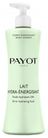
Payot Body Energy Lait Hydra-Énergisant 24-hr Hydrating Fluid
Works for
1 of 1 advertised claim delivered
MoisturizingUrea, Glycerin + 31 moreStrong evidence
“Body Energy Lait Hydra-Énergisant 24-hr Hydrating Fluid”
This product can help improve hydration of the skin with the two types of ingredients.
The first type is called “humectants”:
these ingredients help attract water.
When humectants are on the surface of the skin, they “pull in” the moisture from the outside environment, or from
within deeper layers of the skin. The following ingredients in this product do the job:
fructose, glycerin.
This product also contains ingredients called “occlusives”. They help reduce the speed with which our skin loses moisture to the outside environment. These ingredients also help soften the upper layer of the skin, so it feels less tight and nicer to the touch. The following ingredients in this product do the job: caprylic/capric triglyceride, dimethicone.
The following ingredients in this product are especially good for supporting the skin barrier and helping with the hydration level: urea
Anti-oxidationNot advertised by the brand · Tocopheryl linoleate, Castanea sativa seed extract + 7 moreModerate evidence
This product contains antioxidants (castanea sativa seed extract, imperata cylindrica root extract, tocopheryl linoleate) that might be able to help neutralize free radicals in skin to lessen the damage it gets from the UV light (sun). There is not enough evidence to confirm their effectiveness in skin though.
Can it cause trouble?
Irritancy7 strong irritants: Parfum, Coumarin + 5 more — patch-test recommendedHigh risk
Comedogenic4 ingredients rated 2 or more on the 0–5 pore-clogging scale4 flagged
User reviews
Be the first — your take helps the next person decide.
Ingredients
Filter by role to see what each ingredient is doing.
Water~45–55%
Glycerin~4.3–5.3%
- Irritation risk
- Low
One of the best moisturizing ingredients. Naturally present in skin. It attracts water to the upper layer of the skin working as a humectant
More about GlycerinCaprylic/capric triglyceride~4.2–5.1%
- Irritation risk
- Medium
A good mix of fatty acids that forms a protective layer on the skin. Improves the shelf life of products. Derived from coconut and glycerin
More about Caprylic/capric triglycerideCetearyl ethylhexanoate~3.1–3.8%
- Irritation risk
- Low
An emollient that helps soften the skin
More about Cetearyl ethylhexanoateMyristyl myristate~2.4–2.9%
- Irritation risk
- Medium
- Comedogenicity
- 3/5
An emollient. Is not recommended for acne-prone skin as it can be comedogenic
More about Myristyl myristateDimethicone~2–2.4%
- Irritation risk
- Low
A silicone that helps to reduce water loss from the surface of the skin. Can temporarily "fill in" lines and wrinkles, absorb oil, and create a nice product finish
More about DimethiconeCetearyl alcohol~1.6–2%
- Irritation risk
- Low
- Comedogenicity
- 2/5
A non-drying alcohol. Works as an emollient. Helps water and oil mix together and creates a nice product texture
More about Cetearyl alcoholButylene glycol~1.4–1.7%
- Irritation risk
- Low
Used to create a nice product texture and help delivery of other ingredients. Might be somewhat helpful in attracting water to the upper layer of the skin
More about Butylene glycolGlyceryl stearate~1.2–1.5%
- Irritation risk
- Low
An emollient that softens the skin and forms a protective layer on its surface. Helps water and oil mix together
More about Glyceryl stearatePeg-100 stearate~1–1.3%
- Irritation risk
- Low
Helps oil and water mix togehter and creates a nice product texture
More about Peg-100 stearateButyrospermum parkii butter~0.75–1.1%
- Irritation risk
- Low
- Comedogenicity
- 3/5
A great moisturising ingredient that softens the skin and reduces water loss from its upper layer. It also can be helpful in protecting skin from free radicals
More about Butyrospermum parkii butterStearyl heptanoate~0.6–0.9%
Castanea sativa seed extract~0.5–0.75%
- Irritation risk
- Medium
A plant extract that helps attract water to the upper layer of the skin and can help neutralize free radicals
More about Castanea sativa seed extractScutellaria baicalensis root extract~0.45–0.7%
- Irritation risk
- High
A plant extract that might contain a compound baicalin that could be helpful in neutralizing free radicals and reducing inflammation in skin. The baicalin concentration in skincare products is often too low for an effective action. Can be used for its fragrant properties
More about Scutellaria baicalensis root extractImperata cylindrica root extract~0.45–0.7%
- Irritation risk
- Medium
A plat extract that might help neutralize free radicals in skin and attract water to its upper layer
More about Imperata cylindrica root extractBorago officinalis seed oil~0.5–0.7%
- Irritation risk
- Low
A plant oil that is effective in reducing irritation in skin, restore the barrier function and support its hydration
More about Borago officinalis seed oilMel extract~0.45–0.65%
- Irritation risk
- Low
Smithsonite extract~0.4–0.6%
- Irritation risk
- Low
Olivine extract~0.3–0.6%
- Irritation risk
- Low
A mineral, magnesium iron silicate. It can help add minerals to the surface of the skin that might be helpful for its barrier function. It is claimed to be able to support collagen production but evidence of effectiveness in skin is lacking
More about Olivine extractFructose~0.3–0.6%
- Irritation risk
- Low
Helps attract water to the upper layer of the skin
More about FructoseGlycine~0.3–0.55%
- Irritation risk
- Low
Helps to attract water to the upper layer of the skin and can help restore the skin barrier function
More about GlycineInositol~0.3–0.55%
Tocopheryl acetate~0.3–0.5%
- Irritation risk
- Medium
A more stable but less bio-available form of vitamin E compared to Tocopherol. Might help moisturize and protect the skin from free radicals, but mostly used in low concentrations to stabilize other ingredients.
More about Tocopheryl acetateMannitol~0.25–0.5%
- Irritation risk
- Low
Helps to attract water to the upper layer of the skin
More about MannitolPanthenol~0.25–0.5%
- Irritation risk
- Low
Helps attract water to the upper layer of the skin and can help improve skin barrier function
More about PanthenolStearyl caprylate~0.3–0.55%
- Irritation risk
- Low
Cyclopentasiloxane~0.3–0.55%
- Irritation risk
- Low
A silicone that helps improve the product texture and spreadability. Can absorb oil creating a short-term mattifying effect on the skin
More about CyclopentasiloxaneEthylhexylglycerin~0.25–0.5%
Cetearyl glucoside~0.3–0.55%
- Irritation risk
- Medium
Helps water and oil in the product mix well together and improves product texture
More about Cetearyl glucosideParfum~0.25–0.45%
- Irritation risk
- High
An aromatic blend of unspecified and possibly irritating ingredients
More about ParfumCyclohexasiloxane~0.3–0.55%
- Irritation risk
- Low
A silicone that serves as an emollient. Helps create a nice non-greasy feels
More about CyclohexasiloxanePropylene glycol~0.25–0.5%
- Irritation risk
- High
Helps oil and water mix together and can enhance the penetration of other ingredients into the skin. It can be irritating
More about Propylene glycolHydroxyethyl acrylate/sodium acryloyldimethyl taurate copolymer~0.25–0.5%
- Irritation risk
- Medium
A gelling agent that thickens the product consistency and leaves the skin with a velvety finish
More about Hydroxyethyl acrylate/sodium acryloyldimethyl taurate copolymerCaprylyl glycol~0.3–0.55%
- Irritation risk
- Medium
Helps preserve products and creates a nice product texture
More about Caprylyl glycol1,2-hexanediol~0.25–0.5%
Acrylates/c10-30 alkyl acrylate crosspolymer~0.3–0.55%
- Irritation risk
- Medium
Maintains the texture of skincare products. Allows the product to spread evenly. Helps oil and water mix together
More about Acrylates/c10-30 alkyl acrylate crosspolymerTromethamine~0.25–0.5%
Isohexadecane~0.4–0.6%
- Irritation risk
- Low
Improves the texture of the product and helps soften the skin. Helps oil and water mix together and can be used as a cleansing agent
More about IsohexadecaneSodium lactate~0.25–0.5%
- Irritation risk
- Medium
Helps attract water to the upper layer of the skin. Is often used to adjust the pH level of the product
More about Sodium lactateSodium pca~0.25–0.5%
- Irritation risk
- Low
Naturally present in skin and helps to attract water to its upper layer
More about Sodium pcaUrea~0.25–0.5%
- Irritation risk
- Low
Naturally present in skin (urea makes up about 7% of natural moisturizing factors in skin). Attracts water to the upper layer of the skin. Also has a positive effect on the skin barrier beyond the humectant action. Can enhance penetration of other ingredients. Is an exfoliating ingredient when used in high concentrations
More about UreaBisabolol~0.25–0.4%
- Irritation risk
- Low
An active component of chamomile plant that historically has been used to calm down irritated skin. A recent study shows that bisabolol indeed can have some anti-inflammatory effect on skin, even though conclusive data is lacking. Bisabolol has a sweet floral scent and can be added to products for its aromatic properties
More about BisabololDisodium edta~0.25–0.5%
Tocopheryl linoleate~0.25–0.5%
- Irritation risk
- Medium
A relative of vitamin E (Tocopherol). It can have an anti-oxidant effect in skin and/or to stabilize the product fromulation. It could be irritating but most of the reported allergy and irritation cases appeared in one geographic location (Switzerland) in 1992, and might be due to the quality issues in manufacturing of a particular batch of the ingredient
More about Tocopheryl linoleatePolysorbate 60~0.3–0.55%
Sorbitan isostearate~0.3–0.55%
- Irritation risk
- Low
Helps oil and water mix together
More about Sorbitan isostearateSodium hyaluronate~0.25–0.5%
- Irritation risk
- Low
One of the best moisturizing ingredients. Attracts water into the upper layer of the skin
More about Sodium hyaluronatePhenoxyethanol~0.3–0.5%
- Irritation risk
- Low
A preservative. It helps prevent bacterial growth in cosmetic products
More about PhenoxyethanolSodium benzoate~0.25–0.5%
Niacinamide~0.25–0.5%
- Irritation risk
- Low
Is proven to be effective in reducing blemishes, evening out skin tone and helping to improve lines and wrinkles. It helps the skin to repair sun damage, calm down inflammation and keep maintain good levels of moisture. The concentration of about 2% is effective for supporting the skin barrier and evening out the skin tone. Concentration of 4-6% is better for helping with acne and balancing the sebum production
More about NiacinamideCarbomer~0.25–0.5%
- Irritation risk
- Low
Helps create a thicker or gel-like product texture. It is not a surfactant but can be used in gentle cleansing formulations
More about CarbomerLactic acid~0.25–0.45%
- Irritation risk
- Medium
An exfoliating and moisturizing alpha-hydroxy acid (AHA). Typically causes less irritation than other AHAs, for example, glycolic acid. At high concentrations (about 15%), lactic acid can help reduce lines and wrinkles. Recent studies show that lactic acid can support the "good" bacteria living on skin's surface (healthy skin microbiome)
More about Lactic acidSodium citrate~0.25–0.45%
- Irritation risk
- Medium
Helps to control the skin's pH level. Maintains the skin's natural film of amino-lactic acids and oils. Helps to preserve products
More about Sodium citrateTocopherol~0.25–0.45%
- Irritation risk
- Low
Pure form of vitamin E. Can help moisturise and protect the skin from free radicals. Often used to help stabilise other ingredients or the formula itself
More about TocopherolCitric acid~0.25–0.45%
- Irritation risk
- Medium
Can work as an exfoliant but is typically used to adjust the product pH
More about Citric acidSodium metabisulfite~0.1–0.2%
Biotin~0.2–0.4%
- Irritation risk
- Low
Might have some moisturising properties. Is not effective when applied topically beyond some moisturizing effect
More about BiotinCi 17200~0.2–0.35%
Coumarin~0.15–0.25%
Hydroxycitronellal~0.15–0.25%
- Irritation risk
- High
A fragrance. A likely allergen and can be irritating
More about HydroxycitronellalCitronellol~0.15–0.25%
Linalool~0.15–0.25%
Alpha-isomethyl ionone~0.1–0.15%
- Irritation risk
- High
A fragrance. Potential allergen and can be irritating
More about Alpha-isomethyl iononeGeraniol~0.05–0.15%
Ingredient list view
Water, Glycerin, Caprylic/capric triglyceride, Cetearyl ethylhexanoate, Myristyl myristate, Dimethicone, Cetearyl alcohol, Butylene glycol, Glyceryl stearate, Peg-100 stearate, Butyrospermum parkii butter, Stearyl heptanoate, Castanea sativa seed extract, Scutellaria baicalensis root extract, Imperata cylindrica root extract, Borago officinalis seed oil, Mel extract, Smithsonite extract, Olivine extract, Fructose, Glycine, Inositol, Tocopheryl acetate, Mannitol, Panthenol, Stearyl caprylate, Cyclopentasiloxane, Ethylhexylglycerin, Cetearyl glucoside, Parfum, Cyclohexasiloxane, Propylene glycol, Hydroxyethyl acrylate/sodium acryloyldimethyl taurate copolymer, Caprylyl glycol, 1,2-hexanediol, Acrylates/c10-30 alkyl acrylate crosspolymer, Tromethamine, Isohexadecane, Sodium lactate, Sodium pca, Urea, Bisabolol, Disodium edta, Tocopheryl linoleate, Polysorbate 60, Sorbitan isostearate, Sodium hyaluronate, Phenoxyethanol, Sodium benzoate, Niacinamide, Carbomer, Lactic acid, Sodium citrate, Tocopherol, Citric acid, Sodium metabisulfite, Biotin, Ci 17200, Coumarin, Hydroxycitronellal, Citronellol, Linalool, Alpha-isomethyl ionone, Geraniol
Compare prices
Retailers ranked by price — lowest first.

Affiliate links · prices updated regularly
Worth comparing, line by line.
Match % combines shared ingredients, the first five ingredients, shared actives and hero ingredients, irritancy (lower counts in the alternative's favour), texture and body area. Only products in the same routine step are compared.
| PayotBody Energy Lait Hydra-Énergisant 24-hr Hydrating FluidYOUR PRODUCT | MarudermHyaluronic Acid Moisturizer Face & Body Cream | MetodeSpesialpleie karbamidkrem 9,5% | NaturiumBio-Lipid Restoring Body Lotion | |
|---|---|---|---|---|
| Match | — | 81% | 74% | 74% |
| Price | $41.11 | $21.99−$19.12 | $13.89−$27.22 | $14.88−$26.23 |
| Shared key ingredients | — | 13 of 23 | 5 of 23 | 9 of 23 |
| Key difference | — | Allantoin | Linoleic Acid | Carthamus Tinctorius Seed Oil |
| Irritancy | High | Low | Low | Medium |
| Drying alcohol | — | — | — | — |
| View product | Shop | Shop | Shop |


Product summary
"Payot - Body Energy Lait Hydra-Énergisant 24-hr Hydrating Fluid" has a good moisturizing formula. As we expect from a proper moisturizer, the formula includes a combo of effective humectants and emollients. These are the two different types of ingredients that are essential for improving the skin hydration and supporting a healthy skin barrier. Humectants in this product (urea, fructose, glycerin, glycine and imperata cylindrica root extract) help to increase the water content in the upper layer of the skin. (These ingredients do so by "capturing" water molecules from the outside air or from within the deeper layers of the skin). Emollients in this formulation (borago officinalis seed oil, caprylic/capric triglyceride, dimethicone, myristyl myristate and cetearyl alcohol) help to reduce the moisture loss from the skin. They also soften the skin surface and relieve the feeling of dryness and tightness.
This product contains ingredients that could be beneficial, but their concentrations are too low in this formulation: vitamin e, lactic acid and niacinamideIrritation risk
There are quite a few common irritants in this product, including ingredients without particular skin benefits. We would not recommend it for sensitive skin. We assess the overall irritancy of this moisturizer to be high. For a detailed overview of all potential irritants: click here
You can see the detailed formula review with the breakdown of all actives in the product and the full ingredient list with estimated concentrations in the tables below.
Price
The product retails for 30.75£ in the United Kingdom.
For a detailed price comparison: click here.
Sources cited in this review
Every concentration estimate and effectiveness label is anchored to one of these 34 studies and safety reviews.
- 1
- 2
- 3Final Report on the Safety Assessment of Dimethicone Copolyoljournals.sagepub.com
- 4Chestnut extractmdedge.com
- 5
- 6Flavonoids in Treating Psoriasissciencedirect.com

Affiliate links · As an Amazon Associate, WIMJ earns from qualifying purchases.