Works for
1 of 3 advertised claims delivered
Moisturizing12 ingredients credited for this claimGood support
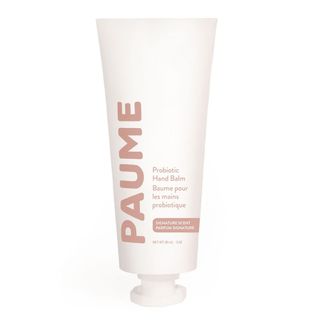
“Product Description: Paume Probiotic Hand Balm is a rich, fast absorbing hand balm enhanced with natural probiotics and plant based emollients that deliver long lasting hydration while improving skin tone, elasticity and texture.”
This product can help improve hydration of the skin with the two types of ingredients.
The first type is called “humectants”:
these ingredients help attract water.
When humectants are on the surface of the skin, they “pull in” the moisture from the outside environment, or from
within deeper layers of the skin. The following ingredients in this product do the job:
glycerin, sclerocarya birrea seed oil.
This product also contains ingredients called “occlusives”. They help reduce the speed with which our skin loses moisture to the outside environment. These ingredients also help soften the upper layer of the skin, so it feels less tight and nicer to the touch. The following ingredients in this product do the job: persea gratissima oil, vitis vinifera seed oil.
Anti-aging1 ingredient credited for this claimWeak support
“It also minimizes fine lines with continued use.”
Effective ingredients missing or their concentration is too low.
Evens skin toneNo ingredient credited for this claimNo support
“Product Description: Paume Probiotic Hand Balm is a rich, fast absorbing hand balm enhanced with natural probiotics and plant based emollients that deliver long lasting hydration while improving skin tone, elasticity and texture.”
Effective ingredients missing or their concentration is too low
Can it cause trouble?
Irritancy4 strong irritants: Lavandula angustifolia oil, Rosmarinus officinalis leaf oil + 2 more — patch-test recommendedHigh risk
ComedogenicClean of flagged comedogenic ingredientsNone flagged
User reviews
Be the first — your take helps the next person decide.
Ingredients
Filter by role to see what each ingredient is doing.
Water~45–55%
Methyl glucose sesquistearate~4.7–5.7%
- Irritation risk
- Medium
Helps water and oil mix together
More about Methyl glucose sesquistearateVitis vinifera seed oil~4.5–5.4%
- Irritation risk
- Medium
A great emollient that can also have anti-oxidant properties
More about Vitis vinifera seed oilGlyceryl stearate~3.2–3.9%
- Irritation risk
- Low
An emollient that softens the skin and forms a protective layer on its surface. Helps water and oil mix together
More about Glyceryl stearateCoco-caprylate~2.8–3.4%
- Irritation risk
- Medium
An emollient that softens skin and creates a nice product texture
More about Coco-caprylateCetyl alcohol~2.3–2.8%
- Irritation risk
- Low
A non-drying alcohol that works to soften the skin and stabilize product formulations helping oil and water mix together
More about Cetyl alcoholPropanediol~1.9–2.3%
- Irritation risk
- Low
Acts as a solvent for other ingredients. Speeds up the absorption of other ingredients into the skin
More about PropanediolCarthamus tinctorius oleosomes~1.6–2%
- Irritation risk
- Low
Helps soften the upper layer of the skin
More about Carthamus tinctorius oleosomesGlycerin~1.4–1.7%
- Irritation risk
- Low
One of the best moisturizing ingredients. Naturally present in skin. It attracts water to the upper layer of the skin working as a humectant
More about GlycerinPyrus malus fruit extract~1.1–1.3%
- Irritation risk
- Medium
Can have some moisturizing properties due to its sugar content
More about Pyrus malus fruit extractAleurites moluccanus seed oil~0.75–1.1%
- Irritation risk
- Low
Helps soften the upper layer of the skin
More about Aleurites moluccanus seed oilSclerocarya birrea seed oil~0.7–1.05%
- Irritation risk
- Medium
An emollient that helps to soften the skin. It has a high contetn of oleic acid that might weaken the skin barrier. Might have some anti-oxidant properties. It might be somewhat helpful against hyperpigmentation.
More about Sclerocarya birrea seed oilPersea gratissima oil~0.7–1.05%
- Irritation risk
- Medium
An emollient that helps soften the skin and could be helpful in repairing its barrier function
More about Persea gratissima oilCedrus atlantica bark oil~0.55–0.85%
- Irritation risk
- Low
Lavandula angustifolia oil~0.55–0.85%
- Irritation risk
- High
An essential oil. Potential allergen and can be irritating. It has some anti-bacterial properties
More about Lavandula angustifolia oilRosmarinus officinalis leaf oil~0.5–0.8%
- Irritation risk
- High
A plant oil with high content of volatile compounds that can irritate the skin. Can be used as a fragrance. Has anti-bacterial properties and might help neutralize free radicals on the surface of the skin
More about Rosmarinus officinalis leaf oilCitrus aurantium dulcis peel oil~0.4–0.6%
- Irritation risk
- High
An essentil oil from orange peel. Potential allergen and can be irritating
More about Citrus aurantium dulcis peel oilCitrus limon peel oil~0.25–0.5%
Aloe barbadensis leaf juice~0.25–0.5%
- Irritation risk
- Medium
Traditionally used to treat sunburns, dermatitis and inflammation, but evidence for its effectiveness is lacking. The extract can contain humectants that help attract water into the skin
More about Aloe barbadensis leaf juiceLactobacillus ferment lysate~0.2–0.4%
- Irritation risk
- Low
A "broth" with parts of dead cells of lactobacteria. Might be helpful supporting diverse microbiome in skin, but evidence is lacking
More about Lactobacillus ferment lysateLeuconostoc/radish root ferment filtrate~0.2–0.35%
- Irritation risk
- Medium
A preservative that comes from radishes fermented by a bacteria. New research suggests that the preservation properties in the ingredient come from an ammonium salt that is not present naturally in radish root but used in its cultivation. Is problematic because the exact amount of the preservative agents is difficult to determine
More about Leuconostoc/radish root ferment filtrateSodium stearoyl glutamate~0.25–0.45%
- Irritation risk
- Medium
Helps oil and water mix together
More about Sodium stearoyl glutamateXanthan gum~0.15–0.25%
- Irritation risk
- Low
Used to create a thicker product consistency
More about Xanthan gumCitric acid~0.1–0.15%
- Irritation risk
- Medium
Can work as an exfoliant but is typically used to adjust the product pH
More about Citric acid1,2-hexanediol~0.1–0.15%
Caprylhydroxamic acid~0.05%
Ingredient list view
Water, Methyl glucose sesquistearate, Vitis vinifera seed oil, Glyceryl stearate, Coco-caprylate, Cetyl alcohol, Propanediol, Carthamus tinctorius oleosomes, Glycerin, Pyrus malus fruit extract, Aleurites moluccanus seed oil, Sclerocarya birrea seed oil, Persea gratissima oil, Cedrus atlantica bark oil, Lavandula angustifolia oil, Rosmarinus officinalis leaf oil, Citrus aurantium dulcis peel oil, Citrus limon peel oil, Aloe barbadensis leaf juice, Lactobacillus ferment lysate, Leuconostoc/radish root ferment filtrate, Sodium stearoyl glutamate, Xanthan gum, Citric acid, 1,2-hexanediol, Caprylhydroxamic acid
Compare prices
Retailers ranked by price — lowest first.
Affiliate links · prices updated regularly · As an Amazon Associate, WIMJ earns from qualifying purchases.
Sources cited in this review
Every concentration estimate and effectiveness label is anchored to one of these 11 studies and safety reviews.
- 1
- 2
- 3
- 4
- 5
- 6

Affiliate links · As an Amazon Associate, WIMJ earns from qualifying purchases.