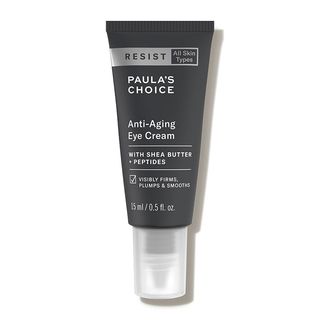
Paula's choice RESIST Anti-Aging Eye Cream
Works for
2 of 2 advertised claims delivered
Anti-aging4 ingredients credited for this claimStrong support
“RESIST Anti-Aging Eye Cream”
This product can help reduce and prevent fine lines and wrinkles, improve skin elasticity and firmness because it contains ascorbic acid.
These ingredients in the product can also be helpful, even though there is less evidence for their effectiveness: acetyl zingerone, ascorbyl glucoside.
Keep in mind that it typically takes at least 6 weeks to notice any results because the changes that are needed to improve fine lines and elasticity happen in the deeper layers of the skin. No topical anti-aging product can “erase” wrinkles or fully reverse signs of aging.
Moisturizing20 ingredients credited for this claimGood support
“RESIST Anti-Aging Eye Cream”
This product can help improve hydration of the skin with the two types of ingredients.
The first type is called “humectants”:
these ingredients help attract water.
When humectants are on the surface of the skin, they “pull in” the moisture from the outside environment, or from
within deeper layers of the skin. The following ingredients in this product do the job:
polyglutamic acid, sodium hyaluronate.
This product also contains ingredients called “occlusives”. They help reduce the speed with which our skin loses moisture to the outside environment. These ingredients also help soften the upper layer of the skin, so it feels less tight and nicer to the touch. The following ingredients in this product do the job: dimethicone, squalane.
Evens skin toneNot advertised by the brand · 2 ingredients credited for this claimStrong support
This product can help reduce hypepigmentation and even out the skin tone because it contains the following effective ingredients: ascorbic acid.
The following ingredient (ingredients) in this product might be helpful, but there is no evidence to confirm that it actually can help even out the skin tone: ascorbyl glucoside.
Keep in mind that you would need to apply any topical skincare targetted at hypigmentation consistently for a couple of months to get a result. No topical skincare product can help get rid of hyperpigmentation (including post-acne marks and age spots) instantly.
Anti-oxidationNot advertised by the brand · 7 ingredients credited for this claimStrong support
This product contains antioxidants (ascorbic acid, acetyl zingerone) that can help neutralize free radicals in skin. By doing so, they can lessen the damage the skin gets from the UV light (sun).
The following ingredients - ascorbyl glucoside, squalene also can have an antioxidant effect, but there is less evidence to confirm their effectiveness in skin.
Can it cause trouble?
Irritancy1 strong irritant: Rosmarinus officinalis leaf extractMedium risk
Comedogenic3 ingredients rated 2 or more on the 0–5 pore-clogging scale3 flagged


User reviews
Ingredients
Filter by role to see what each ingredient is doing.
Water~45–55%
Dicaprylyl carbonate~4.4–5.4%
- Irritation risk
- Low
Helps products spread more easily and works as an emollient to soften skin
More about Dicaprylyl carbonateAscorbic acid~4.4–5.4%
- Irritation risk
- High
The most well-researched antioxidant that works in skin. Helps neutralize free radicals supporting collagen production, helping to even out the skin tone and preventing early signs of aging
More about Ascorbic acidDimethicone~3.3–4%
- Irritation risk
- Low
A silicone that helps to reduce water loss from the surface of the skin. Can temporarily "fill in" lines and wrinkles, absorb oil, and create a nice product finish
More about DimethiconeButylene glycol~2.4–2.9%
- Irritation risk
- Low
Used to create a nice product texture and help delivery of other ingredients. Might be somewhat helpful in attracting water to the upper layer of the skin
More about Butylene glycolPolyglyceryl-6 distearate~2–2.4%
- Irritation risk
- Medium
Helps oil and water mix together while softening the upper layer of the skin
More about Polyglyceryl-6 distearateAscorbyl glucoside~1.7–2.1%
- Irritation risk
- Medium
A vitamin C derivative that is more stable but less potent than pure form of vitamin C. Has a potential to boost collagen production, nutralise free radicals and reduce hyperpigmentation, but the required concentration is likely to be much higher than for the pure form of vitamin C, limiting the ingredient's effectiveness in products
More about Ascorbyl glucosideSqualane~1.5–1.9%
- Irritation risk
- Low
An oil naturally present in skin. Works as an emollient to soften the skin and form a protective layer on its surface without a greasy feeling.
More about SqualaneHydroxyethyl acrylate/sodium acryloyldimethyl taurate copolymer~1.1–1.4%
- Irritation risk
- Medium
A gelling agent that thickens the product consistency and leaves the skin with a velvety finish
More about Hydroxyethyl acrylate/sodium acryloyldimethyl taurate copolymerAcetyl sh-hexapeptide-5 amide acetate~0.95–1.15%
- Irritation risk
- Low
Citrullus lanatus seed oil~0.65–1%
- Irritation risk
- Low
Hydrogenated lecithin~0.5–0.75%
- Irritation risk
- Low
Helps to retain moisture by creating a protective barrier on the skin. Rich in fatty acids. Improves product texture and helps with the penetration of other ingredients.
More about Hydrogenated lecithinTheobroma cacao seed butter~0.45–0.7%
- Irritation risk
- Low
- Comedogenicity
- 3/5
Helps soften the upper layer of the skin and can be helpful in restoring the skin barrier function. Might have some anti-oxidant effect
More about Theobroma cacao seed butterHydrogenated phosphatidylcholine~0.35–0.65%
- Irritation risk
- Medium
Helps oil and water mix together
More about Hydrogenated phosphatidylcholinePentaerythrityl tetra-di-t-butyl hydroxyhydrocinnamate~0.35–0.6%
- Irritation risk
- Low
Used to increase stability of product formulations
More about Pentaerythrityl tetra-di-t-butyl hydroxyhydrocinnamateSodium hyaluronate~0.3–0.6%
- Irritation risk
- Low
One of the best moisturizing ingredients. Attracts water into the upper layer of the skin
More about Sodium hyaluronateOryza sativa bran extract~0.3–0.55%
Propanediol~0.3–0.55%
- Irritation risk
- Low
Acts as a solvent for other ingredients. Speeds up the absorption of other ingredients into the skin
More about PropanediolJojoba esters~0.3–0.55%
- Irritation risk
- Medium
An emollient made of jojoba oil. Helps soften the skin and support its barrier function
More about Jojoba estersTocopherol~0.25–0.45%
- Irritation risk
- Low
Pure form of vitamin E. Can help moisturise and protect the skin from free radicals. Often used to help stabilise other ingredients or the formula itself
More about TocopherolAcetyl zingerone~0.2–0.4%
- Irritation risk
- Medium
An active compound sourced from ginger root. It can help neutralize free radicals in skin. It might be able to help reduce fine lines and wrinkles and improve the skin tone. In small concentrations, used as a chelating agent and helps preserve stability of product formulations.
More about Acetyl zingeroneCetyl palmitate~0.25–0.45%
- Irritation risk
- Low
An emollient that helps soften the skin and is used to improve product texture and stability
More about Cetyl palmitateCaprylyl glycol~0.2–0.35%
- Irritation risk
- Medium
Helps preserve products and creates a nice product texture
More about Caprylyl glycolCetyl alcohol~0.2–0.4%
- Irritation risk
- Low
A non-drying alcohol that works to soften the skin and stabilize product formulations helping oil and water mix together
More about Cetyl alcoholPolyglyceryl-3 beeswax~0.2–0.35%
- Irritation risk
- Medium
Helps water and oil mix together. Could be an allergen (beeswax)
More about Polyglyceryl-3 beeswaxSodium hydroxide~0.15–0.3%
Sorbitan olivate~0.2–0.35%
Sorbitan palmitate~0.2–0.35%
- Irritation risk
- Medium
Helps water and oil mix together and stabilize the product formulation
More about Sorbitan palmitateHelianthus annuus extract~0.2–0.35%
- Irritation risk
- Low
Helps soften the upper layer of the skin
More about Helianthus annuus extractEthylhexylglycerin~0.15–0.3%
Hexylene glycol~0.15–0.3%
- Irritation risk
- Medium
Helps create a more spreadable product texture
More about Hexylene glycolSodium phytate~0.15–0.3%
Polysorbate 60~0.2–0.4%
Sorbitan isostearate~0.2–0.4%
- Irritation risk
- Low
Helps oil and water mix together
More about Sorbitan isostearateLecithin~0.2–0.4%
- Irritation risk
- Low
Used mostly for creating emulsions - helping oil and water mix together. Helps soften the upper layer of the skin
More about LecithinRosmarinus officinalis leaf extract~0.15–0.3%
- Irritation risk
- High
Can be helpful in reducing inflammation in skin, including inflamed acne. It can be irritating
More about Rosmarinus officinalis leaf extractGlycine soja oil~0.2–0.35%
- Irritation risk
- Medium
- Comedogenicity
- 2/5
A good emollient that helps soften the skin and helps repair its barrier function. It can clog pores if used in high concentrations.
More about Glycine soja oilLysolecithin~0.2–0.35%
- Irritation risk
- Low
Lecithin derivative. It helps oil and water mix together and can enhance penetration of other ingredients. It helps soften the upper layer of the skin
More about LysolecithinBacillus ferment~0.2–0.35%
- Irritation risk
- Low
A product of bacterial fermentation. Can help attract water to the upper layer of the skin
More about Bacillus fermentCitric acid~0.2–0.35%
- Irritation risk
- Medium
Can work as an exfoliant but is typically used to adjust the product pH
More about Citric acidPolyglutamic acid~0.2–0.35%
- Irritation risk
- Low
Helps attract water to the upper layer of the skin.
More about Polyglutamic acidBeta-sitosterol~0.2–0.4%
- Irritation risk
- Low
A phytosterol that can support skin's barrier function and help the skin stay hydrated
More about Beta-sitosterolPhytic acid~0.15–0.3%
- Irritation risk
- Medium
An alpha-hydroxy acid (AHA), but is mostly used to stabilize product formulations in cosmetics
More about Phytic acidSqualene~0.2–0.4%
- Irritation risk
- Low
- Comedogenicity
- 2/5
An oil that is naturally part of skin sebum that helps to soften its upper layer, reduce water loss and neutralize free radicals. It might be comedogenic. Avoid applying large concentrations (or pure oil) before sun exposure as oxidized squalene can clog pores and lead to skin irritation. Today squalene is mostly derived from vegetable oils or synthetized by yeast
More about SqualenePhenoxyethanol~0.15–0.3%
- Irritation risk
- Low
A preservative. It helps prevent bacterial growth in cosmetic products
More about PhenoxyethanolSodium benzoate~0.15–0.25%
Potassium sorbate~0.15–0.25%
Ingredient list view
Water, Dicaprylyl carbonate, Ascorbic acid, Dimethicone, Butylene glycol, Polyglyceryl-6 distearate, Ascorbyl glucoside, Squalane, Hydroxyethyl acrylate/sodium acryloyldimethyl taurate copolymer, Acetyl sh-hexapeptide-5 amide acetate, Citrullus lanatus seed oil, Hydrogenated lecithin, Theobroma cacao seed butter, Hydrogenated phosphatidylcholine, Pentaerythrityl tetra-di-t-butyl hydroxyhydrocinnamate, Sodium hyaluronate, Oryza sativa bran extract, Propanediol, Jojoba esters, Tocopherol, Acetyl zingerone, Cetyl palmitate, Caprylyl glycol, Cetyl alcohol, Polyglyceryl-3 beeswax, Sodium hydroxide, Sorbitan olivate, Sorbitan palmitate, Helianthus annuus extract, Ethylhexylglycerin, Hexylene glycol, Sodium phytate, Polysorbate 60, Sorbitan isostearate, Lecithin, Rosmarinus officinalis leaf extract, Glycine soja oil, Lysolecithin, Bacillus ferment, Citric acid, Polyglutamic acid, Beta-sitosterol, Phytic acid, Squalene, Phenoxyethanol, Sodium benzoate, Potassium sorbate
Compare prices
Retailers ranked by price — lowest first.

Worth comparing, line by line.
Match % combines shared ingredients, the first five ingredients, shared actives and hero ingredients, irritancy (lower counts in the alternative's favour), texture and body area. Only products in the same routine step are compared.
| Paula's choiceRESIST Anti-Aging Eye CreamYOUR PRODUCT | NiveaQ10 Energy Fresh Look Eye Cream with Vitamin C | La Roche-Posayredermic vitamin canti-ageing eye cream | CeraVeSkin Renewing Vitamin C Eye Cream | |
|---|---|---|---|---|
| Match | — | 83% | 83% | 81% |
| Price | $27.20 | $9.92−$17.28 | $64.71+$37.51 | $17.88−$9.32 |
| Shared key ingredients | — | 3 of 16 | 2 of 16 | 4 of 16 |
| Key difference | — | Panthenol | Madecassoside | Ceramide Eop |
| Irritancy | Medium | Low | Low | Medium |
| Drying alcohol | — | — | — | — |
| View product | Shop | Shop | Shop |


Product summary
Based on the ingredients included, "Paula's choice - RESIST Anti-Aging Eye Cream" works well for moisturizing the skin. This moisturizer uses a good combo of humectants and emollients. These both types of ingredients are essentials for improving the skin hydration and keeping the skin barrier healthy. Acetyl glucosamine, dextran, glycerin, sodium pca and glucosyl hesperidin in this product (humectants) attract water molecules to the upper layer of the skin (the water comes from the outside air or from the deeper layers of the skin if the air is dry). Caprooyl tetrapeptide-3, butyrospermum parkii butter, dimethicone, cetearyl alcohol and hydrogenated polyisobutene in this product help decrease the water evoporation from the skin, so that it stays hydrated for longer. These ingredients also soften the skin and take away the feeling of tightness and dryness.
Ingredient callouts
- This moistruizer also contains peptides (palmitoyl tripeptide-38 0.35% - 0.60% and caprooyl tetrapeptide-3 0.45% - 0.65%). Peptides is a very big group of ingredients. They all consist of a different combination of amino-acids. Our skin produces peptides naturally. Some of them work as natural anti-biotics, promote wound-healing and production of collagen. The scientists are still studying how effective the topical application of peptides is, but it is very likely that peptides in skincare are helpful. They might be able to support skin barrier restoration and even have an anti-aging benefit. At the very least, they certainly help attract water to the skin and support the hydration in this way.
- Adenosine 0.20% - 0.40% in this product adds an anti-aging property to it. Adenosine is a chemical present inside our skin cells. A clinical trial confirmed that topical application of adenosine in a low concentration reduce dynamic wrinkles (these are the wrinkles that appear with age in a places where we our mimic is the most active, for example, in the corners of the eyes or on the forehead).
Irritation risk
There are some common irritants in this product, including ingredients that do not have benefits for the skin. We assess the overall irritancy of this moisturizer to be medium. For a detailed overview of all potential irritants: click here
You can see the detailed formula review with the breakdown of all actives in the product and the full ingredient list with estimated concentrations in the tables below.
Price
The product retails for 37.00$ in the United States and for 34.00£ in the United Kingdom.
For a detailed price comparison: click here.
Sources cited in this review
Every concentration estimate and effectiveness label is anchored to one of these 24 studies and safety reviews.
- 1
- 2Final Report on the Safety Assessment of Dimethicone Copolyoljournals.sagepub.com
- 3The Roles of Vitamin C in Skin Healthncbi.nlm.nih.gov
- 4
- 5
- 6

Affiliate links · As an Amazon Associate, WIMJ earns from qualifying purchases.