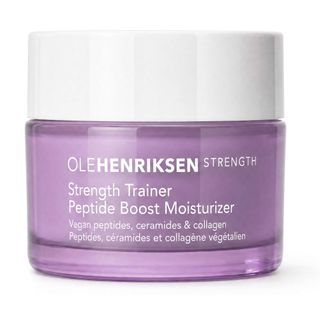
OleHenriksen Strength Trainer Peptide BoostMoisturizer Strength Trainer Peptide Boost Moisturiser
Works for
1 of 1 advertised claim delivered
Moisturizing44 ingredients credited for this claimStrong support
“Strength Trainer Peptide BoostMoisturizer Strength Trainer Peptide Boost Moisturiser”
This product can help improve hydration of the skin with the two types of ingredients.
The first type is called “humectants”:
these ingredients help attract water.
When humectants are on the surface of the skin, they “pull in” the moisture from the outside environment, or from
within deeper layers of the skin. The following ingredients in this product do the job:
alanine, anhydroxylitol.
This product also contains ingredients called “occlusives”. They help reduce the speed with which our skin loses moisture to the outside environment. These ingredients also help soften the upper layer of the skin, so it feels less tight and nicer to the touch. The following ingredients in this product do the job: arginine, dimethicone.
The following ingredients in this product are especially good for supporting the skin barrier and helping with the hydration level: acetyl dipeptide-1 cetyl ester, acetyl hexapeptide-1, acetyl hexapeptide-8, acetyl octapeptide-3, acetyl tetrapeptide-2, ceramide ap, ceramide eop, ceramide np, linoleic acid, niacinamide, palmitoyl tetrapeptide-7, palmitoyl tripeptide-1, panthenol, phytosphingosine
Anti-agingNot advertised by the brand · 13 ingredients credited for this claimStrong support
This product can help reduce and prevent fine lines and wrinkles, improve skin elasticity and firmness because it contains niacinamide.
These ingredients in the product can also be helpful, even though there is less evidence for their effectiveness: acetyl dipeptide-1 cetyl ester, acetyl hexapeptide-1, acetyl hexapeptide-8, acetyl octapeptide-3, acetyl tetrapeptide-2, carnosine, palmitoyl tetrapeptide-7, palmitoyl tripeptide-1, serine, threonine.
Keep in mind that it typically takes at least 6 weeks to notice any results because the changes that are needed to improve fine lines and elasticity happen in the deeper layers of the skin. No topical anti-aging product can “erase” wrinkles or fully reverse signs of aging.
Evens skin toneNot advertised by the brand · 2 ingredients credited for this claimStrong support
This product can help reduce hypepigmentation and even out the skin tone because it contains the following effective ingredients: niacinamide
The following ingredient (ingredients) in this product might be helpful, but there is no evidence to confirm that it actually can help even out the skin tone: alanine.
Keep in mind that you would need to apply any topical skincare targetted at hypigmentation consistently for a couple of months to get a result. No topical skincare product can help get rid of hyperpigmentation (including post-acne marks and age spots) instantly.
Anti-oxidationNot advertised by the brand · 4 ingredients credited for this claimStrong support
This product contains antioxidants (carnosine) that can help neutralize free radicals in skin. By doing so, they can lessen the damage the skin gets from the UV light (sun).
Anti-blemishNot advertised by the brand · 3 ingredients credited for this claimStrong support
This product can help reduce breakouts and clogged pores because it contains the following ingredient: niacinamide. This ingredient is used for treating acne and can have a noticeable effect.
The following ingredient (ingredients) in this product might be helpful, but there is no evidence to confirm that it actually works: linoleic acid
Can it cause trouble?
Irritancy4 strong irritants: Parfum, Citral + 2 more — patch-test recommendedHigh risk
Comedogenic2 ingredients rated 2 or more on the 0–5 pore-clogging scale2 flagged

User reviews
Be the first — your take helps the next person decide.
Ingredients
Filter by role to see what each ingredient is doing.
Water~45–55%
Propanediol~4.3–5.3%
- Irritation risk
- Low
Acts as a solvent for other ingredients. Speeds up the absorption of other ingredients into the skin
More about PropanediolDicaprylyl carbonate~4–4.9%
- Irritation risk
- Low
Helps products spread more easily and works as an emollient to soften skin
More about Dicaprylyl carbonateGlycerin~3–3.6%
- Irritation risk
- Low
One of the best moisturizing ingredients. Naturally present in skin. It attracts water to the upper layer of the skin working as a humectant
More about GlycerinMethylpropanediol~2.3–2.8%
Cetearyl alcohol~1.9–2.4%
- Irritation risk
- Low
- Comedogenicity
- 2/5
A non-drying alcohol. Works as an emollient. Helps water and oil mix together and creates a nice product texture
More about Cetearyl alcoholStearyl alcohol~1.6–2%
- Irritation risk
- Low
An emollient that helps soften the skin
More about Stearyl alcoholMangifera indica seed butter~1.4–1.7%
- Irritation risk
- Low
Helps to soften the upper layer of the skin and might have some anti-oxidant effect
More about Mangifera indica seed butterNiacinamide~1.1–1.4%
- Irritation risk
- Low
Is proven to be effective in reducing blemishes, evening out skin tone and helping to improve lines and wrinkles. It helps the skin to repair sun damage, calm down inflammation and keep maintain good levels of moisture. The concentration of about 2% is effective for supporting the skin barrier and evening out the skin tone. Concentration of 4-6% is better for helping with acne and balancing the sebum production
More about NiacinamideAcetyl hexapeptide-1~0.9–1.1%
- Irritation risk
- Low
A type of peptide. Peptides are excellent moisturizers and might be able support collagen production reducing fine lines and wrinkles
More about Acetyl hexapeptide-1Acetyl hexapeptide-8~0.65–1%
- Irritation risk
- Low
A type of peptide. Peptides are excellent moisturizers and might be able support collagen production reducing fine lines and wrinkles
More about Acetyl hexapeptide-8Acetyl octapeptide-3~0.55–0.85%
- Irritation risk
- Low
A type of peptide. Peptides are excellent moisturizers and might be able support collagen production reducing fine lines and wrinkles
More about Acetyl octapeptide-3Acetyl tetrapeptide-2~0.5–0.75%
- Irritation risk
- Low
A type of peptide. Peptides are excellent moisturizers and might be able support collagen production reducing fine lines and wrinkles
More about Acetyl tetrapeptide-2Acetyl dipeptide-1 cetyl ester~0.5–0.75%
- Irritation risk
- Low
A type of peptide. Peptides are excellent moisturizers and might be able support collagen production reducing fine lines and wrinkles
More about Acetyl dipeptide-1 cetyl esterPalmitoyl tripeptide-1~0.5–0.75%
- Irritation risk
- Low
A type of peptide. Peptides are excellent moisturizers and might be able support collagen production reducing fine lines and wrinkles
More about Palmitoyl tripeptide-1Palmitoyl tetrapeptide-7~0.5–0.75%
- Irritation risk
- Low
A type of peptide. Peptides are excellent moisturizers and might be able support collagen production reducing fine lines and wrinkles
More about Palmitoyl tetrapeptide-7Carnosine~0.4–0.65%
- Irritation risk
- Low
A type of peptide. It attracts water to the upper layer of the skin. It can help neutralize free radicals in skin combatting the sun damage
More about CarnosineCeramide np~0.45–0.65%
- Irritation risk
- Low
A type of lipid similar to ceramides naturally present in skin. Helps to soften the upper layer of the skin and supports the skin barrier function to keep it hydrated. Can help to prevent inflammation in skin
More about Ceramide npCeramide ap~0.35–0.65%
- Irritation risk
- Low
A type of lipid similar to ceramides naturally present in skin. Helps to soften the upper layer of the skin and supports the skin barrier function to keep it hydrated. Can help to prevent inflammation in skin
More about Ceramide apCeramide eop~0.35–0.6%
- Irritation risk
- Low
A type of lipid similar to ceramides naturally present in skin. Helps to soften the upper layer of the skin and supports the skin barrier function to keep it hydrated. Can help to prevent inflammation in skin
More about Ceramide eopCollagen~0.3–0.5%
- Irritation risk
- Low
Cannot penetrate the skin barrier so is not particularly useful in skincare products
More about CollagenSerine~0.3–0.55%
- Irritation risk
- Low
An amino-acid that helps to attract water to the upper layer of the skin. In combination with other amino-acids, might help to reduce fine lines and wrinkles
More about SerineAlanine~0.3–0.55%
- Irritation risk
- Low
An amino-acid that helps to attract water to the upper layer of the skin and might help to lighten the skin, but solid evidence is lacking
More about AlanineGlycine~0.3–0.55%
- Irritation risk
- Low
Helps to attract water to the upper layer of the skin and can help restore the skin barrier function
More about GlycineGlutamic acid~0.3–0.55%
- Irritation risk
- Low
An amino-acid that helps attract water to the upper layer of the skin
More about Glutamic acidLysine hcl~0.3–0.55%
Threonine~0.3–0.55%
- Irritation risk
- Low
An amino-acid that helps to attract water to the upper layer of the skin. In combination with other amino-acids, might help to reduce fine lines and wrinkles
More about ThreonineArginine~0.3–0.55%
- Irritation risk
- Low
An amino acid that is naturally present in skin and helps keep it hydrated. When used together with AHAs, it can reduce their irritating effect on the skin
More about ArginineProline~0.3–0.55%
Hyaluronic acid~0.3–0.55%
- Irritation risk
- Low
One of the best moisturizing ingredients. Attracts water into the upper layer of the skin. Naturally present in skin. Typically has large molecule size unless advertised otherwise on the product label. Helps support skin's barrier function and may help to reduce inflammation
More about Hyaluronic acidSodium hyaluronate~0.3–0.55%
- Irritation risk
- Low
One of the best moisturizing ingredients. Attracts water into the upper layer of the skin
More about Sodium hyaluronateLinoleic acid~0.45–0.7%
- Irritation risk
- Low
An excellent emollient. Helps soften the skin, restore its barrier function, and can help to calm down inflammation. It can be helpful to prevent blemishes and clogged pores
More about Linoleic acidLinolenic acid~0.4–0.65%
- Irritation risk
- Medium
An emollient that helps soften the skin and calm down inflammation
More about Linolenic acidSodium pca~0.3–0.55%
- Irritation risk
- Low
Naturally present in skin and helps to attract water to its upper layer
More about Sodium pcaSodium lactate~0.3–0.55%
- Irritation risk
- Medium
Helps attract water to the upper layer of the skin. Is often used to adjust the pH level of the product
More about Sodium lactatePanthenol~0.3–0.55%
- Irritation risk
- Low
Helps attract water to the upper layer of the skin and can help improve skin barrier function
More about PanthenolTocopherol~0.3–0.55%
- Irritation risk
- Low
Pure form of vitamin E. Can help moisturise and protect the skin from free radicals. Often used to help stabilise other ingredients or the formula itself
More about TocopherolTocopheryl acetate~0.3–0.6%
- Irritation risk
- Medium
A more stable but less bio-available form of vitamin E compared to Tocopherol. Might help moisturize and protect the skin from free radicals, but mostly used in low concentrations to stabilize other ingredients.
More about Tocopheryl acetateBetaine~0.3–0.55%
- Irritation risk
- Low
Helps attract water to the upper layer of the skin and improves the product texture
More about BetainePca~0.3–0.55%
- Irritation risk
- Low
Naturally present in skin and helps to attract water to its upper layer
More about PcaCyanocobalamin~0.3–0.55%
- Irritation risk
- Low
Can support skin barrier function and reduce inflammation in skin
More about CyanocobalaminXylitol~0.3–0.55%
- Irritation risk
- Low
Helps attract water to the upper layer of the skin and repair the skin barrier function
More about XylitolAnhydroxylitol~0.3–0.55%
- Irritation risk
- Low
Helps attract water to the upper layer of the skin and repair the skin barrir function
More about AnhydroxylitolXylitylglucoside~0.3–0.55%
- Irritation risk
- Low
Helps attract water to the upper layer of the skin and repair the skin barrier function
More about XylitylglucosideSorbitan olivate~0.3–0.6%
Carbomer~0.3–0.55%
- Irritation risk
- Low
Helps create a thicker or gel-like product texture. It is not a surfactant but can be used in gentle cleansing formulations
More about CarbomerHydroxyethylcellulose~0.3–0.6%
- Irritation risk
- Low
Used to thicken product formulations and create gel-like textures
More about HydroxyethylcelluloseXanthan gum~0.3–0.55%
- Irritation risk
- Low
Used to create a thicker product consistency
More about Xanthan gumCetearyl olivate~0.3–0.6%
Sorbitan laurate~0.3–0.6%
Phytosphingosine~0.35–0.65%
- Irritation risk
- Low
A type of lipid that is naturally present in skin. It might help in repairing skin barrier function and has anti-bacterial effect
More about PhytosphingosineCholesterol~0.35–0.65%
- Irritation risk
- Low
An emollient that is naturally found in skin
More about CholesterolPolysorbate 60~0.3–0.6%
Butylene glycol~0.3–0.55%
- Irritation risk
- Low
Used to create a nice product texture and help delivery of other ingredients. Might be somewhat helpful in attracting water to the upper layer of the skin
More about Butylene glycolHydroxyacetophenone~0.3–0.55%
Glycine soja oil~0.3–0.55%
- Irritation risk
- Medium
- Comedogenicity
- 2/5
A good emollient that helps soften the skin and helps repair its barrier function. It can clog pores if used in high concentrations.
More about Glycine soja oilAcrylates/c10-30 alkyl acrylate crosspolymer~0.3–0.6%
- Irritation risk
- Medium
Maintains the texture of skincare products. Allows the product to spread evenly. Helps oil and water mix together
More about Acrylates/c10-30 alkyl acrylate crosspolymerPolysorbate 20~0.3–0.6%
Ammonium acryloyldimethyltaurate/beheneth-25 methacrylate crosspolymer~0.3–0.55%
- Irritation risk
- Medium
Used to stabilize product formulations
More about Ammonium acryloyldimethyltaurate/beheneth-25 methacrylate crosspolymerDimethicone~0.35–0.6%
- Irritation risk
- Low
A silicone that helps to reduce water loss from the surface of the skin. Can temporarily "fill in" lines and wrinkles, absorb oil, and create a nice product finish
More about DimethiconeSodium phytate~0.3–0.5%
Sodium lauroyl lactylate~0.3–0.5%
- Irritation risk
- Medium
Helps water and oil mix together
More about Sodium lauroyl lactylatePentaerythrityl tetra-di-t-butyl hydroxyhydrocinnamate~0.25–0.5%
- Irritation risk
- Low
Used to increase stability of product formulations
More about Pentaerythrityl tetra-di-t-butyl hydroxyhydrocinnamateLeuconostoc/radish root ferment filtrate~0.25–0.45%
- Irritation risk
- Medium
A preservative that comes from radishes fermented by a bacteria. New research suggests that the preservation properties in the ingredient come from an ammonium salt that is not present naturally in radish root but used in its cultivation. Is problematic because the exact amount of the preservative agents is difficult to determine
More about Leuconostoc/radish root ferment filtrateCitric acid~0.2–0.4%
- Irritation risk
- Medium
Can work as an exfoliant but is typically used to adjust the product pH
More about Citric acidCaprylyl glycol~0.2–0.4%
- Irritation risk
- Medium
Helps preserve products and creates a nice product texture
More about Caprylyl glycolEthylhexylglycerin~0.15–0.3%
Phenoxyethanol~0.15–0.25%
- Irritation risk
- Low
A preservative. It helps prevent bacterial growth in cosmetic products
More about PhenoxyethanolParfum~0.15–0.25%
- Irritation risk
- High
An aromatic blend of unspecified and possibly irritating ingredients
More about ParfumCitral~0.15–0.25%
Limonene~0.1–0.15%
- Irritation risk
- High
A common frangrance that can easily irritate skin, especially if exposed to air, light or heat
More about LimoneneLinalool~0.1–0.15%
Ingredient list view
Water, Propanediol, Dicaprylyl carbonate, Glycerin, Methylpropanediol, Cetearyl alcohol, Stearyl alcohol, Mangifera indica seed butter, Niacinamide, Acetyl hexapeptide-1, Acetyl hexapeptide-8, Acetyl octapeptide-3, Acetyl tetrapeptide-2, Acetyl dipeptide-1 cetyl ester, Palmitoyl tripeptide-1, Palmitoyl tetrapeptide-7, Carnosine, Ceramide np, Ceramide ap, Ceramide eop, Collagen, Serine, Alanine, Glycine, Glutamic acid, Lysine hcl, Threonine, Arginine, Proline, Hyaluronic acid, Sodium hyaluronate, Linoleic acid, Linolenic acid, Sodium pca, Sodium lactate, Panthenol, Tocopherol, Tocopheryl acetate, Betaine, Pca, Cyanocobalamin, Xylitol, Anhydroxylitol, Xylitylglucoside, Sorbitan olivate, Carbomer, Hydroxyethylcellulose, Xanthan gum, Cetearyl olivate, Sorbitan laurate, Phytosphingosine, Cholesterol, Polysorbate 60, Butylene glycol, Hydroxyacetophenone, Glycine soja oil, Acrylates/c10-30 alkyl acrylate crosspolymer, Polysorbate 20, Ammonium acryloyldimethyltaurate/beheneth-25 methacrylate crosspolymer, Dimethicone, Sodium phytate, Sodium lauroyl lactylate, Pentaerythrityl tetra-di-t-butyl hydroxyhydrocinnamate, Leuconostoc/radish root ferment filtrate, Citric acid, Caprylyl glycol, Ethylhexylglycerin, Phenoxyethanol, Parfum, Citral, Limonene, Linalool
Compare prices
Retailers ranked by price — lowest first.

Affiliate links · prices updated regularly
Worth comparing, line by line.
Match % combines shared ingredients, the first five ingredients, shared actives and hero ingredients, irritancy (lower counts in the alternative's favour), texture and body area. Only products in the same routine step are compared.
| OleHenriksenStrength Trainer Peptide BoostMoisturizer Strength Trainer Peptide Boost MoisturiserYOUR PRODUCT | AHCHydrating Essential Real Eye Cream for Face | BIOHEAL BOHCeramide Water Gel Cream | TIRTIRMatcha Calming Cream 50ml | |
|---|---|---|---|---|
| Match | — | 77% | 77% | 75% |
| Price | $48.32 | $21.14−$27.18 | $22.29−$26.03 | $43.56−$4.76 |
| Shared key ingredients | — | 22 of 38 | 16 of 38 | 14 of 38 |
| Key difference | — | Copper Tripeptide-1 | Adenosine | Dipeptide-2 |
| Irritancy | High | High | Medium | Medium |
| Drying alcohol | — | Contains drying alcohol | — | — |
| View product | Shop | Shop | Shop |

Sources cited in this review
Every concentration estimate and effectiveness label is anchored to one of these 30 studies and safety reviews.
- 1
- 2Extraction and Characteristics of Seed Kernel Oil from Mangopdfs.semanticscholar.org
- 3
- 4
- 5
- 6

Affiliate links · As an Amazon Associate, WIMJ earns from qualifying purchases.