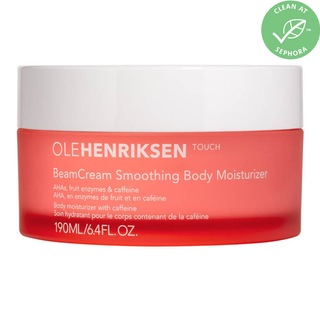
OleHenriksen BeamCream Smoothing Body Moisturizer
Works for
4 of 4 advertised claims delivered
Exfoliation2 ingredients credited for this claimStrong support
“Packed with chemical exfoliants and nourishing EFAs, it reduces the look of dark spots, fine lines and wrinkles and strengthens your skin barrier.”
This product can help exfoliate the skin. In other words, it helps break down the bonds between dead cells on the surface of the skin and speed up the skin turnover. Skin often appears softer and brighter after exfoliation, but overdoing it can result in disrupted skin barrier. The following ingredient is doing the exfoliating job in this product: glycolic acid, lactic acid.
Anti-aging4 ingredients credited for this claimStrong support
“Packed with chemical exfoliants and nourishing EFAs, it reduces the look of dark spots, fine lines and wrinkles and strengthens your skin barrier.”
This product can help reduce and prevent fine lines and wrinkles, improve skin elasticity and firmness because it contains glycolic acid.
These ingredients in the product can also be helpful, even though there is less evidence for their effectiveness: lactic acid.
Keep in mind that it typically takes at least 6 weeks to notice any results because the changes that are needed to improve fine lines and elasticity happen in the deeper layers of the skin. No topical anti-aging product can “erase” wrinkles or fully reverse signs of aging.
Evens skin tone2 ingredients credited for this claimStrong support
“Packed with chemical exfoliants and nourishing EFAs, it reduces the look of dark spots, fine lines and wrinkles and strengthens your skin barrier.”
This product can help reduce hypepigmentation and even out the skin tone because it contains the following effective ingredients: glycolic acid, lactic acid
Keep in mind that you would need to apply any topical skincare targetted at hypigmentation consistently for a couple of months to get a result. No topical skincare product can help get rid of hyperpigmentation (including post-acne marks and age spots) instantly.
Moisturizing15 ingredients credited for this claimGood support
“BeamCream Smoothing Body Moisturizer”
This product can help improve hydration of the skin with the two types of ingredients.
The first type is called “humectants”:
these ingredients help attract water.
When humectants are on the surface of the skin, they “pull in” the moisture from the outside environment, or from
within deeper layers of the skin. The following ingredients in this product do the job:
glycerin, lactic acid.
This product also contains ingredients called “occlusives”. They help reduce the speed with which our skin loses moisture to the outside environment. These ingredients also help soften the upper layer of the skin, so it feels less tight and nicer to the touch. The following ingredients in this product do the job: butyrospermum parkii butter, caprylic/capric triglyceride.
Can it cause trouble?
Irritancy10 strong irritants: Citrus grandis fruit extract, Citrus paradisi fruit extract + 8 more — patch-test recommendedHigh risk
Comedogenic3 ingredients rated 2 or more on the 0–5 pore-clogging scale3 flagged


User reviews
Be the first — your take helps the next person decide.
Ingredients
Filter by role to see what each ingredient is doing.
Water~45–55%
Caprylic/capric triglyceride~5.5–6.7%
- Irritation risk
- Medium
A good mix of fatty acids that forms a protective layer on the skin. Improves the shelf life of products. Derived from coconut and glycerin
More about Caprylic/capric triglycerideCrambe abyssinica seed oil~4.4–5.4%
- Irritation risk
- Medium
Helps soften the upper layer of the skin
More about Crambe abyssinica seed oilCetyl ethylhexanoate~3.2–4%
- Irritation risk
- Medium
An emollient that helps soften the skin and creates a thicker product texture
More about Cetyl ethylhexanoateLactic acid~2.4–2.9%
- Irritation risk
- Medium
An exfoliating and moisturizing alpha-hydroxy acid (AHA). Typically causes less irritation than other AHAs, for example, glycolic acid. At high concentrations (about 15%), lactic acid can help reduce lines and wrinkles. Recent studies show that lactic acid can support the "good" bacteria living on skin's surface (healthy skin microbiome)
More about Lactic acidCetearyl alcohol~2–2.5%
- Irritation risk
- Low
- Comedogenicity
- 2/5
A non-drying alcohol. Works as an emollient. Helps water and oil mix together and creates a nice product texture
More about Cetearyl alcoholMethylpropanediol~1.7–2.1%
Propanediol~1.5–1.8%
- Irritation risk
- Low
Acts as a solvent for other ingredients. Speeds up the absorption of other ingredients into the skin
More about PropanediolSteareth-21~1.3–1.6%
Butyrospermum parkii butter~1–1.3%
- Irritation risk
- Low
- Comedogenicity
- 3/5
A great moisturising ingredient that softens the skin and reduces water loss from its upper layer. It also can be helpful in protecting skin from free radicals
More about Butyrospermum parkii butterMangifera indica seed butter~0.7–1.05%
- Irritation risk
- Low
Helps to soften the upper layer of the skin and might have some anti-oxidant effect
More about Mangifera indica seed butterDimethicone~0.65–1%
- Irritation risk
- Low
A silicone that helps to reduce water loss from the surface of the skin. Can temporarily "fill in" lines and wrinkles, absorb oil, and create a nice product finish
More about DimethiconePotassium hydroxide~0.55–0.8%
Glycolic acid~0.5–0.75%
- Irritation risk
- High
An alpha-hydroxy acid (AHA) that helps to remove the dead skin cells on the surface of the skin reveling a more even, smoother complexation. It is also able to stimulate collagen production with long-term use. Could help to reduce pore congestion. It can be irritating to the skin. Apply sunscreen daily if using products with glycolic acid
More about Glycolic acidSambucus nigra seed oil~0.45–0.7%
- Irritation risk
- Low
Vaccinium vitis-idaea seed oil~0.5–0.7%
- Irritation risk
- Low
Caffeine~0.45–0.65%
- Irritation risk
- Medium
Might be helpful in neutralizing free radicals. Can have a dehydration effect that might somewhat decrease the look of puffy eyes
More about CaffeineCarnitine~1–1.2%
Polyglutamic acid~0.3–0.6%
- Irritation risk
- Low
Helps attract water to the upper layer of the skin.
More about Polyglutamic acidOctadecenedioic acid~0.3–0.6%
- Irritation risk
- Low
Helps oil and water mix together. Might help suppress growth of acne-triggering bacteria in skin
More about Octadecenedioic acidCitrus grandis fruit extract~0.25–0.45%
- Irritation risk
- High
Citrus paradisi fruit extract~0.25–0.5%
- Irritation risk
- High
Citrus sinensis fruit extract~0.25–0.45%
- Irritation risk
- High
Citrus limon fruit extract~0.25–0.45%
- Irritation risk
- High
Used as a fragrance. Can be irritating and cause photosensitivity
More about Citrus limon fruit extractHelianthus annuus seed oil~0.3–0.55%
- Irritation risk
- Low
A great emollient due to its high linoleic acid content. One of the most effective plant oils in helping skin hydration and repairing skin barrier function
More about Helianthus annuus seed oilGlycerin~0.3–0.55%
- Irritation risk
- Low
One of the best moisturizing ingredients. Naturally present in skin. It attracts water to the upper layer of the skin working as a humectant
More about GlycerinTocopherol~0.25–0.5%
- Irritation risk
- Low
Pure form of vitamin E. Can help moisturise and protect the skin from free radicals. Often used to help stabilise other ingredients or the formula itself
More about TocopherolCetearyl olivate~0.3–0.5%
Sorbitan olivate~0.3–0.5%
Caprylyl glycol~0.3–0.55%
- Irritation risk
- Medium
Helps preserve products and creates a nice product texture
More about Caprylyl glycolPolysorbate 60~0.3–0.55%
Acrylates/c10-30 alkyl acrylate crosspolymer~0.25–0.5%
- Irritation risk
- Medium
Maintains the texture of skincare products. Allows the product to spread evenly. Helps oil and water mix together
More about Acrylates/c10-30 alkyl acrylate crosspolymerPotassium cetyl phosphate~0.3–0.5%
- Irritation risk
- Medium
Helps oil and water mix together
More about Potassium cetyl phosphateLeuconostoc/radish root ferment filtrate~0.25–0.5%
- Irritation risk
- Medium
A preservative that comes from radishes fermented by a bacteria. New research suggests that the preservation properties in the ingredient come from an ammonium salt that is not present naturally in radish root but used in its cultivation. Is problematic because the exact amount of the preservative agents is difficult to determine
More about Leuconostoc/radish root ferment filtrateHydroxyethyl acrylate/sodium acryloyldimethyl taurate copolymer~0.25–0.45%
- Irritation risk
- Medium
A gelling agent that thickens the product consistency and leaves the skin with a velvety finish
More about Hydroxyethyl acrylate/sodium acryloyldimethyl taurate copolymerCitrus paradisi peel oil~0.2–0.4%
Citrus aurantium dulcis peel oil~0.25–0.45%
- Irritation risk
- High
An essentil oil from orange peel. Potential allergen and can be irritating
More about Citrus aurantium dulcis peel oilCitrus nobilis peel oil~0.2–0.4%
- Irritation risk
- High
A plant oil with high content of volatile compounds that, especially when exposed to air, can cause allergic reactions and irritate the skin
More about Citrus nobilis peel oilCitrus limon peel oil~0.2–0.35%
Cymbopogon citratus leaf/stem oil~0.2–0.35%
- Irritation risk
- Low
Pentaerythrityl tetra-di-t-butyl hydroxyhydrocinnamate~0.2–0.4%
- Irritation risk
- Low
Used to increase stability of product formulations
More about Pentaerythrityl tetra-di-t-butyl hydroxyhydrocinnamateEthylhexylglycerin~0.15–0.3%
Glycine soja oil~0.2–0.35%
- Irritation risk
- Medium
- Comedogenicity
- 2/5
A good emollient that helps soften the skin and helps repair its barrier function. It can clog pores if used in high concentrations.
More about Glycine soja oilHydroxyacetophenone~0.15–0.3%
Tromethamine~0.15–0.3%
Limonene~0.1–0.15%
- Irritation risk
- High
A common frangrance that can easily irritate skin, especially if exposed to air, light or heat
More about LimoneneCitral~0.1–0.15%
Ingredient list view
Water, Caprylic/capric triglyceride, Crambe abyssinica seed oil, Cetyl ethylhexanoate, Lactic acid, Cetearyl alcohol, Methylpropanediol, Propanediol, Steareth-21, Butyrospermum parkii butter, Mangifera indica seed butter, Dimethicone, Potassium hydroxide, Glycolic acid, Sambucus nigra seed oil, Vaccinium vitis-idaea seed oil, Caffeine, Carnitine, Polyglutamic acid, Octadecenedioic acid, Citrus grandis fruit extract, Citrus paradisi fruit extract, Citrus sinensis fruit extract, Citrus limon fruit extract, Helianthus annuus seed oil, Glycerin, Tocopherol, Cetearyl olivate, Sorbitan olivate, Caprylyl glycol, Polysorbate 60, Acrylates/c10-30 alkyl acrylate crosspolymer, Potassium cetyl phosphate, Leuconostoc/radish root ferment filtrate, Hydroxyethyl acrylate/sodium acryloyldimethyl taurate copolymer, Citrus paradisi peel oil, Citrus aurantium dulcis peel oil, Citrus nobilis peel oil, Citrus limon peel oil, Cymbopogon citratus leaf/stem oil, Pentaerythrityl tetra-di-t-butyl hydroxyhydrocinnamate, Ethylhexylglycerin, Glycine soja oil, Hydroxyacetophenone, Tromethamine, Limonene, Citral
Compare prices
Retailers ranked by price — lowest first.
Affiliate links · prices updated regularly · As an Amazon Associate, WIMJ earns from qualifying purchases.
Worth comparing, line by line.
Match % combines shared ingredients, the first five ingredients, shared actives and hero ingredients, irritancy (lower counts in the alternative's favour), texture and body area. Only products in the same routine step are compared.
| OleHenriksenBeamCream Smoothing Body MoisturizerYOUR PRODUCT | DermadoctorKP Duty Dermatologist Formulated Body Scrub | ADVANCED CLINICALSBody Bump Eraser | Kopari BeautyKP Body Bumps Be Gone With 10% AHA Clarifying Body Scrub | |
|---|---|---|---|---|
| Match | — | 53% | 52% | 51% |
| Price | $46.00 | $25.60−$20.40 | $10.00−$36.00 | $12.00−$34.00 |
| Shared key ingredients | — | 4 of 13 | 3 of 13 | 4 of 13 |
| Key difference | — | Lactobionic Acid | Anhydroxylitol | Oatmeal Extract |
| Irritancy | High | Low | Medium | Low |
| Drying alcohol | — | — | — | — |
| View product | Shop | Shop | Shop |


Sources cited in this review
Every concentration estimate and effectiveness label is anchored to one of these 24 studies and safety reviews.
- 1Epidermal and dermal effects of topical lactic acidncbi.nlm.nih.gov
- 2Dual Effects of Alpha-Hydroxy Acids on the Skinpdfs.semanticscholar.org
- 3Extraction and Characteristics of Seed Kernel Oil from Mangopdfs.semanticscholar.org
- 4
- 5
- 6

Affiliate links · As an Amazon Associate, WIMJ earns from qualifying purchases.