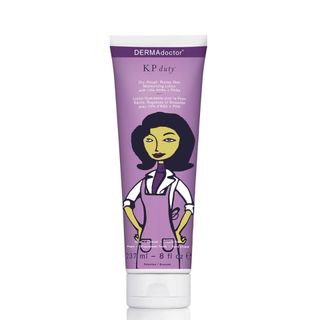
Dermadoctor KP Duty Dermatologist Formulated Therapy for Dry, Rough, Bumpy Skin
Works for
3 of 3 advertised claims delivered
Anti-aging8 ingredients credited for this claimStrong support
“Incomparable PHA chemically exfoliates, offers anti-aging antioxidant benefits and is a mega-moisturizing humectant able to hold 4x its weight in water compared to hyaluronic acid Lactobionic Acid.”
This product can help reduce and prevent fine lines and wrinkles, improve skin elasticity and firmness because it contains glycolic acid, lactobionic acid.
These ingredients in the product can also be helpful, even though there is less evidence for their effectiveness: lactic acid.
Keep in mind that it typically takes at least 6 weeks to notice any results because the changes that are needed to improve fine lines and elasticity happen in the deeper layers of the skin. No topical anti-aging product can “erase” wrinkles or fully reverse signs of aging.
Exfoliation6 ingredients credited for this claimStrong support
“KP Duty Dermatologist Formulated Therapy for Dry, Rough, Bumpy Skin”
This product can help exfoliate the skin. In other words, it helps break down the bonds between dead cells on the surface of the skin and speed up the skin turnover. Skin often appears softer and brighter after exfoliation, but overdoing it can result in disrupted skin barrier. The following ingredient is doing the exfoliating job in this product: glycolic acid, lactic acid, lactobionic acid.
Moisturizing23 ingredients credited for this claimStrong support
“KP Duty Dermatologist Formulated Therapy for Dry, Rough, Bumpy Skin”
This product can help improve hydration of the skin with the two types of ingredients.
The first type is called “humectants”:
these ingredients help attract water.
When humectants are on the surface of the skin, they “pull in” the moisture from the outside environment, or from
within deeper layers of the skin. The following ingredients in this product do the job:
glycerin, lactic acid.
This product also contains ingredients called “occlusives”. They help reduce the speed with which our skin loses moisture to the outside environment. These ingredients also help soften the upper layer of the skin, so it feels less tight and nicer to the touch. The following ingredients in this product do the job: caprylic/capric triglyceride, squalene.
The following ingredients in this product are especially good for supporting the skin barrier and helping with the hydration level: caprooyl phytosphingosine, ceramide ap, ceramide eop, ceramide eos, ceramide np, ceramide ns, lactobionic acid, urea
Anti-oxidationNot advertised by the brand · 10 ingredients credited for this claimStrong support
This product contains antioxidants (lactobionic acid, superoxide dismutase) that can help neutralize free radicals in skin. By doing so, they can lessen the damage the skin gets from the UV light (sun).
The following ingredients - squalene also can have an antioxidant effect, but there is less evidence to confirm their effectiveness in skin.
Evens skin toneNot advertised by the brand · 6 ingredients credited for this claimStrong support
This product can help reduce hypepigmentation and even out the skin tone because it contains the following effective ingredients: glycolic acid, lactic acid, lactobionic acid
The following ingredient (ingredients) in this product might be helpful, but there is no evidence to confirm that it actually can help even out the skin tone: glycyrrhiza glabra root extract.
Keep in mind that you would need to apply any topical skincare targetted at hypigmentation consistently for a couple of months to get a result. No topical skincare product can help get rid of hyperpigmentation (including post-acne marks and age spots) instantly.
Can it cause trouble?
Irritancy2 strong irritants: Boswellia carterii oil, Rosa damascena extractMedium risk
Comedogenic2 ingredients rated 2 or more on the 0–5 pore-clogging scale2 flagged
User reviews
Be the first — your take helps the next person decide.
Ingredients
Filter by role to see what each ingredient is doing.
Water~45–55%
C12-15 alkyl benzoate~5–6.1%
- Irritation risk
- Low
Enhances the product texture and makes it more spreadable. Helps reduce water loss from the outer layer of skin. Extands the shelf life by preventing bacteria growth
More about C12-15 alkyl benzoateUrea~4.4–5.4%
- Irritation risk
- Low
Naturally present in skin (urea makes up about 7% of natural moisturizing factors in skin). Attracts water to the upper layer of the skin. Also has a positive effect on the skin barrier beyond the humectant action. Can enhance penetration of other ingredients. Is an exfoliating ingredient when used in high concentrations
More about UreaCaprylic/capric triglyceride~3.5–4.3%
- Irritation risk
- Medium
A good mix of fatty acids that forms a protective layer on the skin. Improves the shelf life of products. Derived from coconut and glycerin
More about Caprylic/capric triglycerideLactic acid~2.7–3.3%
- Irritation risk
- Medium
An exfoliating and moisturizing alpha-hydroxy acid (AHA). Typically causes less irritation than other AHAs, for example, glycolic acid. At high concentrations (about 15%), lactic acid can help reduce lines and wrinkles. Recent studies show that lactic acid can support the "good" bacteria living on skin's surface (healthy skin microbiome)
More about Lactic acidSorbitol~2.2–2.7%
- Irritation risk
- Low
Helps attract water to the upper layer of the skin and improves the product texture
More about SorbitolSorbitan stearate~1.8–2.2%
Peg-100 stearate~1.6–1.9%
- Irritation risk
- Low
Helps oil and water mix togehter and creates a nice product texture
More about Peg-100 stearateGlyceryl stearate~1.4–1.7%
- Irritation risk
- Low
An emollient that softens the skin and forms a protective layer on its surface. Helps water and oil mix together
More about Glyceryl stearateGlycolic acid~1.1–1.4%
- Irritation risk
- High
An alpha-hydroxy acid (AHA) that helps to remove the dead skin cells on the surface of the skin reveling a more even, smoother complexation. It is also able to stimulate collagen production with long-term use. Could help to reduce pore congestion. It can be irritating to the skin. Apply sunscreen daily if using products with glycolic acid
More about Glycolic acidGluconolactone~0.8–1.2%
- Irritation risk
- Medium
A polyhydroxy acid (PHA) that helps shed the dead cells from the skin surface revealing smoother skin. Is believed to be genter than AHAs. It helps attract water to the upper layer of the skin and can stimulate production of skin's own hyaluronic acid resulting in improved hydration levels. It has been shown to be helpful against acne and clogged pores if used consistently (e.g over a period of 12 weeks) in high enough concentration. It can help reduce fine lines and wrinkles and improve skin tone with long-term application. Can help neutralize free radicals
More about GluconolactoneButyrospermum parkii butter~0.8–1.2%
- Irritation risk
- Low
- Comedogenicity
- 3/5
A great moisturising ingredient that softens the skin and reduces water loss from its upper layer. It also can be helpful in protecting skin from free radicals
More about Butyrospermum parkii butterSodium hydroxide~0.7–1.05%
Lactobionic acid~0.65–1%
- Irritation risk
- Medium
A polyhydroxy acid (PHA) that helps shed dead cells from the surface of the skin revealing a smoother, more even skin. PHAs tend to be gentler on the skin compared to AHAs (for example, glycolic acid). It also has hydrating properties and helps attract water to the upper layer of the skin. It can help calm down inflammation in skin and support restoration of the barrier function. It has an anti-oxidant effect as well. It can help reduce fine line, wrinkles and improve skin elasticity
More about Lactobionic acidSalix alba bark extract~0.6–0.9%
- Irritation risk
- High
A plant extract that can help neutralize free radicals in skin. It contains a compound salicin that can theoretically be converted into salicylic acid that, in turn, helps reduce inflammation in skin, but the evidence of effectiveness in skin is lacking and the extract is usually not used in a concentration that would enable an exfoliating effect
More about Salix alba bark extractCeramide np~0.65–1%
- Irritation risk
- Low
A type of lipid similar to ceramides naturally present in skin. Helps to soften the upper layer of the skin and supports the skin barrier function to keep it hydrated. Can help to prevent inflammation in skin
More about Ceramide npCeramide ns~0.6–0.9%
- Irritation risk
- Low
A type of lipid similar to ceramides naturally present in skin. Helps to soften the upper layer of the skin and supports the skin barrier function to keep it hydrated. Can help to prevent inflammation in skin
More about Ceramide nsCeramide eos~0.55–0.8%
- Irritation risk
- Low
A type of lipid similar to ceramides naturally present in skin. Helps to soften the upper layer of the skin and supports the skin barrier function to keep it hydrated. Can help to prevent inflammation in skin
More about Ceramide eosCeramide eop~0.55–0.8%
- Irritation risk
- Low
A type of lipid similar to ceramides naturally present in skin. Helps to soften the upper layer of the skin and supports the skin barrier function to keep it hydrated. Can help to prevent inflammation in skin
More about Ceramide eopCeramide ap~0.5–0.7%
- Irritation risk
- Low
A type of lipid similar to ceramides naturally present in skin. Helps to soften the upper layer of the skin and supports the skin barrier function to keep it hydrated. Can help to prevent inflammation in skin
More about Ceramide apCaprooyl phytosphingosine~0.5–0.75%
- Irritation risk
- Low
A component of ceramides. Helps to soften the upper layer of the skin and supports the skin barrier function to keep it hydrated. Can help to prevent inflammation in skin
More about Caprooyl phytosphingosineTheobroma grandiflorum seed butter~0.45–0.65%
- Irritation risk
- Medium
Helps soften the upper layer of the skin and might as well help to attract moisture to its upper layer
More about Theobroma grandiflorum seed butterCholesterol~0.5–0.75%
- Irritation risk
- Low
An emollient that is naturally found in skin
More about CholesterolSqualene~0.5–0.75%
- Irritation risk
- Low
- Comedogenicity
- 2/5
An oil that is naturally part of skin sebum that helps to soften its upper layer, reduce water loss and neutralize free radicals. It might be comedogenic. Avoid applying large concentrations (or pure oil) before sun exposure as oxidized squalene can clog pores and lead to skin irritation. Today squalene is mostly derived from vegetable oils or synthetized by yeast
More about SqualeneCamellia sinensis leaf extract~0.45–0.65%
- Irritation risk
- Low
Can contain potent anti-oxidant compounds (abbreviated ECG, GCG, EGC, and EGCG) that might help protect the skin from free radicals. Can help calm down inflammation and has some anti-bacterial properties. Unfortunately, these antioxidants are unstable and lose their effectiveness very quickly in products. The concentration of the antioxidant compounds in the extract also tends to be low to be effective in topical formulation
More about Camellia sinensis leaf extractGlycyrrhiza glabra root extract~0.4–0.6%
- Irritation risk
- Medium
A plant extract that can help lighten the skin and calm down inflammation. Might be helpful in neutralizing free radicals
More about Glycyrrhiza glabra root extractBoswellia serrata extract~0.4–0.65%
- Irritation risk
- Low
Boswellia carterii oil~0.35–0.65%
Rosa damascena extract~0.25–0.5%
- Irritation risk
- High
Oil of a very fragrant pink rose used as fragrance in cosmetics. Extensive research has shown it has mixed benefits. In the pro column, inhaling this flower’s scent seems to have relaxing properties and the plant’s petals contain skin-soothing and antioxidant compounds that can benefit skin. On the flipside, the numerous chemicals that create this rose’s distinctive fragrance pose a risk of causing skin aggravation.
More about Rosa damascena extractSuperoxide dismutase~0.25–0.5%
- Irritation risk
- Low
An antioxidant enzyme that is naturally present in skin. It can help support skin barrier function and reduce inflammation in skin. It is used in topical medications for inflammatory skin conditions including atopic dermatitis (eczema) and psoriasis. There are three types of natural Superoxide Dismutase in human skin. The compound used in topical treatments and cosmetics are mimics of typically one of these natural variants
More about Superoxide dismutaseTocopherol~0.3–0.5%
- Irritation risk
- Low
Pure form of vitamin E. Can help moisturise and protect the skin from free radicals. Often used to help stabilise other ingredients or the formula itself
More about TocopherolAscorbyl palmitate~0.25–0.5%
- Irritation risk
- Medium
Being a lipid soluble form of vitamin C, it is more stable and can penetrate the skin better than L-Ascorbic acid. It is effective in protecting the skin from free radicals, as well as evening the skin tone, but is less effective in stimulating collagen production compared to L-Ascorbic acid.
More about Ascorbyl palmitateGlycerin~0.3–0.55%
- Irritation risk
- Low
One of the best moisturizing ingredients. Naturally present in skin. It attracts water to the upper layer of the skin working as a humectant
More about GlycerinPropylene glycol~0.25–0.5%
- Irritation risk
- High
Helps oil and water mix together and can enhance the penetration of other ingredients into the skin. It can be irritating
More about Propylene glycolXanthan gum~0.25–0.45%
- Irritation risk
- Low
Used to create a thicker product consistency
More about Xanthan gumPolysorbate 60~0.25–0.45%
Hydroxyethyl acrylate/sodium acryloyldimethyl taurate copolymer~0.2–0.4%
- Irritation risk
- Medium
A gelling agent that thickens the product consistency and leaves the skin with a velvety finish
More about Hydroxyethyl acrylate/sodium acryloyldimethyl taurate copolymerEthylhexylglycerin~0.2–0.35%
Sodium chloride~0.2–0.35%
- Irritation risk
- Low
Used to stabilize mixtures of oil and water, and create thicker, gel-like product textures
More about Sodium chlorideSorbitan isostearate~0.15–0.3%
- Irritation risk
- Low
Helps oil and water mix together
More about Sorbitan isostearateCeteareth-25~0.25–0.45%
Cetyl alcohol~0.2–0.35%
- Irritation risk
- Low
A non-drying alcohol that works to soften the skin and stabilize product formulations helping oil and water mix together
More about Cetyl alcoholBehenic acid~0.2–0.35%
Phenoxyethanol~0.15–0.25%
- Irritation risk
- Low
A preservative. It helps prevent bacterial growth in cosmetic products
More about PhenoxyethanolIngredient list view
Water, C12-15 alkyl benzoate, Urea, Caprylic/capric triglyceride, Lactic acid, Sorbitol, Sorbitan stearate, Peg-100 stearate, Glyceryl stearate, Glycolic acid, Gluconolactone, Butyrospermum parkii butter, Sodium hydroxide, Lactobionic acid, Salix alba bark extract, Ceramide np, Ceramide ns, Ceramide eos, Ceramide eop, Ceramide ap, Unknown, Caprooyl phytosphingosine, Theobroma grandiflorum seed butter, Cholesterol, Squalene, Camellia sinensis leaf extract, Glycyrrhiza glabra root extract, Boswellia serrata extract, Unknown, Boswellia carterii oil, Rosa damascena extract, Superoxide dismutase, Tocopherol, Ascorbyl palmitate, Glycerin, Propylene glycol, Xanthan gum, Polysorbate 60, Hydroxyethyl acrylate/sodium acryloyldimethyl taurate copolymer, Ethylhexylglycerin, Sodium chloride, Sorbitan isostearate, Ceteareth-25, Cetyl alcohol, Behenic acid, Phenoxyethanol
Compare prices
Retailers ranked by price — lowest first.

Affiliate links · prices updated regularly
Product summary
Judging from the ingredient list, "Dermadoctor - KP Duty Dermatologist Formulated Therapy for Dry, Rough, Bumpy Skin" works well for improving skin hydration As we expect from a proper moisturizer, the formula includes a combo of effective humectants and emollients. These are the two different types of ingredients that are essential for improving the skin hydration and supporting a healthy skin barrier. Humectants in this product (urea, glycerin, lactic acid and sorbitol) help to increase the water content in the upper layer of the skin. (These ingredients do so by "capturing" water molecules from the outside air or from within the deeper layers of the skin). Caprooyl phytosphingosine, ceramide eop, ceramide np, ceramide ns and cholesterol in this product help decrease the water evoporation from the skin, so that it stays hydrated for longer. These ingredients also soften the skin and take away the feeling of tightness and dryness.
Ingredient callouts
- As a plus, this moisturizer also contains ceramides (caprooyl phytosphingosine 0.50% - 0.75%, ceramide ap 0.50% - 0.70%, ceramide eop 0.55% - 0.80%, ceramide eos 0.55% - 0.80%, ceramide ns 0.60% - 0.90% and ceramide np 0.65% - 1.00%). Ceramides are a type of lipids that our skin produces itself. They are a building block of the skin's barrier. Ceramides used in skincare are synthetic or extracted from plants. They work well for softening the skin surface and "patch holes" in the skin's barrier.
Irritation risk
This moisturizer contains some common irritants, including those without a benefit for the skin. We assess the overall irritancy of this moisturizer to be medium. For a detailed overview of all potential irritants: click here
You can see the detailed formula review with the breakdown of all actives in the product and the full ingredient list with estimated concentrations in the tables below.
About the brand
According to Cruelty-Free Kitty "Dermadoctor" is cruelty free and so is its parent company.
Price
The product retails from 31.00£ up to 43.32£ in the United Kingdom and for 38.00$ in the United States.
For a detailed price comparison: click here.
Sources cited in this review
Every concentration estimate and effectiveness label is anchored to one of these 43 studies and safety reviews.
- 1Topical urea in skincare: A reviewpubmed.ncbi.nlm.nih.gov
- 2Epidermal and dermal effects of topical lactic acidncbi.nlm.nih.gov
- 3Dual Effects of Alpha-Hydroxy Acids on the Skinpdfs.semanticscholar.org
- 4
- 5Glycolic acid peel therapy – a current reviewncbi.nlm.nih.gov
- 6

Affiliate links · As an Amazon Associate, WIMJ earns from qualifying purchases.