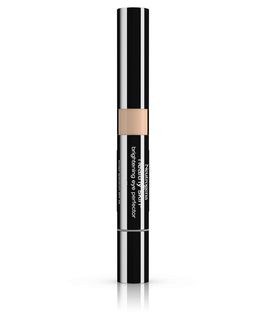
Neutrogena Healthy Skin Brightening Eye Perfector Broad Spectrum SPF 25
Works for
0 of 1 advertised claim delivered
Sun protectionSPF 25 · 1 UV filter · Partial spectrumWeak protectionSPF under 30
This product does not offer good protection against UVA rays.
This product can be considered "reef safe" because it does not contain the UV filters (oxybenzone and octinoxate) that can be harmful to coral reefs when present in the water in high concentrations.
MoisturizingNot advertised by the brand · 16 ingredients credited for this claimGood support
This product can help improve hydration of the skin with the two types of ingredients.
The first type is called “humectants”:
these ingredients help attract water.
When humectants are on the surface of the skin, they “pull in” the moisture from the outside environment, or from
within deeper layers of the skin. The following ingredients in this product do the job:
saccharomyces lysate extract, butylene glycol.
This product also contains ingredients called “occlusives”. They help reduce the speed with which our skin loses moisture to the outside environment. These ingredients also help soften the upper layer of the skin, so it feels less tight and nicer to the touch. The following ingredients in this product do the job: dimethicone, cetyl dimethicone.
Can it cause trouble?
Irritancy1 strong irritant: Dmdm hydantoinMedium risk
Comedogenic1 ingredient rated 2 or more on the 0–5 pore-clogging scale1 flagged
User reviews
Be the first — your take helps the next person decide.
Ingredients
Filter by role to see what each ingredient is doing.
Water~45–55%
Cyclopentasiloxane~6.2–7.5%
- Irritation risk
- Low
A silicone that helps improve the product texture and spreadability. Can absorb oil creating a short-term mattifying effect on the skin
More about CyclopentasiloxaneTalc~4.8–5.8%
Butylene glycol~3.4–4.2%
- Irritation risk
- Low
Used to create a nice product texture and help delivery of other ingredients. Might be somewhat helpful in attracting water to the upper layer of the skin
More about Butylene glycolCyclohexasiloxane~2.9–3.5%
- Irritation risk
- Low
A silicone that serves as an emollient. Helps create a nice non-greasy feels
More about CyclohexasiloxanePolyglyceryl-4 diisostearate/polyhydroxystearate/sebacate~2.3–2.9%
- Irritation risk
- Medium
Helps water and oil mix together
More about Polyglyceryl-4 diisostearate/polyhydroxystearate/sebacateEthylhexyl palmitate~2–2.5%
- Irritation risk
- Low
- Comedogenicity
- 3/5
An emollient that helps soften the skin and create a nice product texture
More about Ethylhexyl palmitateC12-15 alkyl benzoate~1.7–2.1%
- Irritation risk
- Low
Enhances the product texture and makes it more spreadable. Helps reduce water loss from the outer layer of skin. Extands the shelf life by preventing bacteria growth
More about C12-15 alkyl benzoateTetrahydroxypropyl ethylenediamine~1.4–1.7%
- Irritation risk
- Low
Cetyl peg/ppg-10/1 dimethicone~1.2–1.5%
- Irritation risk
- Low
A type of silicone that helps water and oil mix together. Can help to soften upper layer of the skin
More about Cetyl peg/ppg-10/1 dimethiconeBoron nitride~1.1–1.3%
- Irritation risk
- Low
Helps to absord oil and evenly disperse other ingredients (for example, pigment) in product formulation
More about Boron nitrideCetyl dimethicone~0.95–1.2%
- Irritation risk
- Low
A type of silicone. Helps soften the upper layer of the skin and creates a nice, light product texture
More about Cetyl dimethiconeMagnesium sulfate~0.9–1.1%
Ozokerite~0.8–1.2%
Polybutene~0.7–1.05%
Citric acid~0.7–1.05%
- Irritation risk
- Medium
Can work as an exfoliant but is typically used to adjust the product pH
More about Citric acidPolymethylsilsesquioxane~0.7–1.05%
- Irritation risk
- Low
A silicone that improves product texture and helps dissolve other ingredients. Can form a non-greasy film on the skin to prevent moisture loss
More about PolymethylsilsesquioxaneMyristyl alcohol~0.65–0.95%
- Irritation risk
- High
Helps to stabilize the product formulation while softening the upper layer of the skin. Can be irritating
More about Myristyl alcoholMica~0.6–0.9%
- Irritation risk
- Low
Creates an illusion of smoother and more radiant skin tone. Adds shimmer to the skin by reflecting light
More about Mica1,2-hexanediol~0.55–0.8%
Caprylyl glycol~0.55–0.85%
- Irritation risk
- Medium
Helps preserve products and creates a nice product texture
More about Caprylyl glycolCocoglycerides~0.55–0.85%
- Irritation risk
- High
Help soften the upper layer of the skin and make it easier for oil and water mix together. Recently, a rising number of allergic reactions to cocoglycerides and other coconut-derived surfactants has been reported. As there is a significant overlap between frequent irritants and allergens, we flag this ingredient for attention of those with very sensitive, reactive skin
More about CocoglyceridesSaccharomyces lysate extract~0.5–0.75%
- Irritation risk
- Low
Helps attract water to the upper layer of the skin. Can have some anti-inflammatory effect
More about Saccharomyces lysate extractAluminum starch octenylsuccinate~0.5–0.75%
- Irritation risk
- Medium
Used to thicken the product's consistency
More about Aluminum starch octenylsuccinateDmdm hydantoin~0.3–0.6%
- Irritation risk
- High
A preservative that releases formaldehyde and can be irritating
More about Dmdm hydantoinPropylparaben~0.2–0.4%
Silica silylate~0.5–0.75%
Alumina~0.6–0.9%
- Irritation risk
- Low
The same compound that is used safely in dental implants and bone cements. In cosmetics, it is used to improve the consistency of products
More about AluminaPolyhydroxystearic acid~0.5–0.75%
- Irritation risk
- Medium
Used to create a thicker product consistency and stabilize the formulation
More about Polyhydroxystearic acidSilica~0.5–0.75%
Glyceryl laurate~0.45–0.65%
- Irritation risk
- Medium
Helps water and oil mix together and has an anti-microbial effect helping to preserve product formulations
More about Glyceryl laurateStearyl alcohol~0.45–0.65%
- Irritation risk
- Low
An emollient that helps soften the skin
More about Stearyl alcoholDimethicone~0.45–0.65%
- Irritation risk
- Low
A silicone that helps to reduce water loss from the surface of the skin. Can temporarily "fill in" lines and wrinkles, absorb oil, and create a nice product finish
More about DimethiconeTriethoxycaprylylsilane~0.3–0.55%
- Irritation risk
- Low
A type of silicone that helps oil and water mix well together. Helps to disperse other ingredients, e.g. pigments, evenly in a formulation
More about TriethoxycaprylylsilaneGlycine soja seed extract~0.35–0.6%
- Irritation risk
- Medium
An emollient that helps soften the skin. Might be somewhat helpful in evening the skin tone.
More about Glycine soja seed extractPentaerythrityl tetra-di-t-butyl hydroxyhydrocinnamate~0.3–0.5%
- Irritation risk
- Low
Used to increase stability of product formulations
More about Pentaerythrityl tetra-di-t-butyl hydroxyhydrocinnamateHydrogenated vegetable glycerides~0.3–0.55%
- Irritation risk
- Low
Help soften the upper layer of the skin
More about Hydrogenated vegetable glyceridesTocopherol~0.25–0.45%
- Irritation risk
- Low
Pure form of vitamin E. Can help moisturise and protect the skin from free radicals. Often used to help stabilise other ingredients or the formula itself
More about TocopherolChrysanthemum parthenium flower/leaf/stem juice~0.2–0.4%
- Irritation risk
- Low
Distearyl ether~0.2–0.35%
- Irritation risk
- Low
Acrylates copolymer~0.15–0.3%
- Irritation risk
- Medium
Used to stabilize product formulation, help create an even product layer over skin (for example, in sunscreen) and create a thicker product consistency
More about Acrylates copolymerMagnesium carbonate~0.2–0.4%
- Irritation risk
- Low
Titanium dioxide1.88%
- Irritation risk
- Low
Works as a UV filter when used in high concentrations. It is photostable and is effective mostly against the UVB light, with some protection in the UVA range. In small concentrations, used for its ability to improve the color of cosmetic products. Is usually well tolerated by the skin
More about Titanium dioxideIron oxides~0.1–0.2%
- Irritation risk
- Low
An umbrella term for the following three colorants: CI 77491, CI 77492, CI 77499. They might be able to offer some protection against visible light, but the degree of the protection is not clear
More about Iron oxidesIngredient list view
Water, Cyclopentasiloxane, Talc, Butylene glycol, Cyclohexasiloxane, Polyglyceryl-4 diisostearate/polyhydroxystearate/sebacate, Ethylhexyl palmitate, C12-15 alkyl benzoate, Tetrahydroxypropyl ethylenediamine, Cetyl peg/ppg-10/1 dimethicone, Boron nitride, Cetyl dimethicone, Magnesium sulfate, Ozokerite, Polybutene, Citric acid, Polymethylsilsesquioxane, Myristyl alcohol, Mica, 1,2-hexanediol, Caprylyl glycol, Cocoglycerides, Saccharomyces lysate extract, Aluminum starch octenylsuccinate, Dmdm hydantoin, Propylparaben, Silica silylate, Alumina, Polyhydroxystearic acid, Silica, Glyceryl laurate, Stearyl alcohol, Dimethicone, Triethoxycaprylylsilane, Glycine soja seed extract, Pentaerythrityl tetra-di-t-butyl hydroxyhydrocinnamate, Hydrogenated vegetable glycerides, Tocopherol, Chrysanthemum parthenium flower/leaf/stem juice, Distearyl ether, Acrylates copolymer, Magnesium carbonate, Titanium dioxide, Iron oxides
Compare prices
Retailers ranked by price — lowest first.
Product summary
"Neutrogena - Healthy Skin Brightening Eye Perfector Broad Spectrum SPF 25" does not provide enough UVA protection. UVA rays do not cause sunburn, but still damage the skin, leading to early signs of aging and pigmentation issues.
Its formula is also hydrating, so you might not need an additional moistruizer during the day.
Sunscreen filters
This product is a mineral sunscreen. It uses titanium dioxide for sun protection. Titanium dioxide almost never irritates the skin or stings eyes, but it can leave a white cast.
Irritation risk
There are some common irritants in this product, including ingredients that do not have benefits for the skin. We assess the overall irritancy of this sunscreen to be medium. For a detailed overview of all potential irritants: click here
You can see the detailed formula review with the breakdown of all actives in the product and the full ingredient list with estimated concentrations in the tables below.
Price
The product retails for 67.93CA$ in Canada and from 13.99$ up to 28.65$ in the United States.
For a detailed price comparison: click here.
Sources cited in this review
Every concentration estimate and effectiveness label is anchored to one of these 16 studies and safety reviews.
- 1Safety Assessment of Boron Nitride as Used in Cosmetics cir-safety.org
- 2Safety Assessment of Magnesium Sulfate as Used in Cosmeticsncbi.nlm.nih.gov
- 3
- 4Cosmetic allergy from myristyl alcoholncbi.nlm.nih.gov
- 5
- 6Patch testing with myristyl alcoholresearchgate.net

Affiliate links · As an Amazon Associate, WIMJ earns from qualifying purchases.