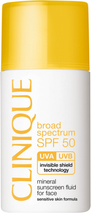
Clinique Broad Spectrum SPF 50 Mineral Sunscreen Fluid For Face
Works for
1 of 1 advertised claim delivered
Sun protectionSPF 50 · 3 UV filtersBroad spectrum
This product offers a good level of protection against both UVB and UVA rays.
This sunscreen uses organic (so-called "chemical") sunscreen filters. Organic, or "chemical" filters usually provide reliable sun protection and rarely leave a white cast. Sunscreens with organic filters can sting eyes.
This product can be considered "reef safe" because it does not contain the UV filters (oxybenzone and octinoxate) that can be harmful to coral reefs when present in the water in high concentrations.
Anti-agingNot advertised by the brand · No ingredient credited for this claimStrong evidence
This product can help prevent early signs of skin aging because it offers a good level of broad spectrum sun protection. Sun damage is the main cause of premature skin aging, and protecting your skin from the sun is the best anti-aging strategy.
Evens skin toneNot advertised by the brand · No ingredient credited for this claimStrong evidence
This product offers broad spectrum sun protection. It means that it can prevent hyperpigmentation and help keep the skin tone even (sun damage is the main factor causing age spots, darkening of post-acne marks and other discolorations).
MoisturizingNot advertised by the brand · Dimethicone, Diethylhexyl succinate + 7 moreGood evidence
This product can help soften the skin and reduce its moisture loss with emollients and occlusives: dimethicone, c12-15 alkyl benzoate.
Keep in mind that this product does not contain effective ingredients to attract water to the upper layer of the skin. This is why an additional product with humectants like glycerin or hyaluronic acid can be helpful (apply it before this product for the best results).
Can it cause trouble?
Irritancy6 flagged ingredientsLow risk
Comedogenic1 ingredient rated 2 or more on the 0–5 pore-clogging scale1 flagged
User reviews
Ingredients
Filter by role to see what each ingredient is doing.
Titanium dioxide6.3%
- Irritation risk
- Low
Works as a UV filter when used in high concentrations. It is photostable and is effective mostly against the UVB light, with some protection in the UVA range. In small concentrations, used for its ability to improve the color of cosmetic products. Is usually well tolerated by the skin
More about Titanium dioxideZinc oxide4%
- Irritation risk
- Low
A broad spectrum sunblock (protects from both UVA and UVB rays). Is suitable for most sensitive skins. In small concentrations, can be used as a colorant
More about Zinc oxideWater~45–55%
Dimethicone~6.1–7.4%
- Irritation risk
- Low
A silicone that helps to reduce water loss from the surface of the skin. Can temporarily "fill in" lines and wrinkles, absorb oil, and create a nice product finish
More about DimethiconeButyloctyl salicylate~6.5–8%
- Irritation risk
- Medium
A synthetic ester of salicylic acid that is used to help disperse pigments and boost effectiveness of sunscreen ingredients. It is able to absorb UV light (working as an organic, or chemical filter), but is not approved as a sunscreen ingredient on its own
More about Butyloctyl salicylatePolydiethylsiloxane~4.6–5.6%
- Irritation risk
- Low
C12-15 alkyl benzoate~3.7–4.5%
- Irritation risk
- Low
Enhances the product texture and makes it more spreadable. Helps reduce water loss from the outer layer of skin. Extands the shelf life by preventing bacteria growth
More about C12-15 alkyl benzoateIsononyl isononanoate~3.3–4.1%
- Irritation risk
- Low
Forms a protective film on the surface of the skin to prevent moisture loss. Gives a velvety feel to products while reducing tackiness
More about Isononyl isononanoateDiethylhexyl succinate~2.7–3.3%
- Irritation risk
- Low
Helps soften the upper layer of the skin and create a nice product texture
More about Diethylhexyl succinateNeopentyl glycol diheptanoate~2.2–2.7%
- Irritation risk
- Low
Helps soften the upper layer of the skin and create a nice product consistency
More about Neopentyl glycol diheptanoateMethyl trimethicone~1.6–1.9%
- Irritation risk
- Low
A type of silicone that helps create a silky product finish and dissolve other ingredients
More about Methyl trimethiconeButylene glycol~1.2–1.5%
- Irritation risk
- Low
Used to create a nice product texture and help delivery of other ingredients. Might be somewhat helpful in attracting water to the upper layer of the skin
More about Butylene glycolEthylhexyl methoxycrylene~1–1.3%
- Irritation risk
- Medium
Helps improve stability of sunscreen filters and boost their effectiveness
More about Ethylhexyl methoxycryleneLauryl peg-9 polydimethylsiloxyethyl dimethicone~0.95–1.15%
- Irritation risk
- Low
A type of silicone that helps to soften upper layer of the skin and create a nice product texture
More about Lauryl peg-9 polydimethylsiloxyethyl dimethiconeSilica~1.1–1.3%
Dipentaerythrityl tri-polyhydroxystearate~0.75–1.15%
- Irritation risk
- Low
Laureth-4~0.7–1.05%
- Irritation risk
- Medium
- Comedogenicity
- 2/5
Helps water and oil mix together
More about Laureth-4Cetyl peg/ppg-10/1 dimethicone~0.65–1%
- Irritation risk
- Low
A type of silicone that helps water and oil mix together. Can help to soften upper layer of the skin
More about Cetyl peg/ppg-10/1 dimethiconeDimethicone/peg-10/15 crosspolymer~0.65–0.95%
Dimethicone silylate~0.6–0.85%
- Irritation risk
- Low
Hydrolyzed wheat protein/pvp crosspolymer~0.5–0.75%
- Irritation risk
- Low
Triethoxycaprylylsilane~0.45–0.65%
- Irritation risk
- Low
A type of silicone that helps oil and water mix well together. Helps to disperse other ingredients, e.g. pigments, evenly in a formulation
More about TriethoxycaprylylsilaneDimethicone crosspolymer-3~0.35–0.65%
- Irritation risk
- Low
Isostearic acid~0.45–0.65%
- Irritation risk
- Low
Used to create a nice product texture
More about Isostearic acidCaprylyl glycol~0.3–0.55%
- Irritation risk
- Medium
Helps preserve products and creates a nice product texture
More about Caprylyl glycolPolyhydroxystearic acid~0.25–0.5%
- Irritation risk
- Medium
Used to create a thicker product consistency and stabilize the formulation
More about Polyhydroxystearic acidDipropylene glycol~0.15–0.3%
- Irritation risk
- Low
Helps to dissolve other ingredients in a formulation. Slows down the rate of product drying
More about Dipropylene glycolPhenoxyethanol~0.15–0.3%
- Irritation risk
- Low
A preservative. It helps prevent bacterial growth in cosmetic products
More about PhenoxyethanolCi 77492~0.1–0.2%
Ci 77491~0.1–0.2%
- Irritation risk
- Low
A red colorant made of iron oxide. Typically is not irritating
More about Ci 77491Ingredient list view
Titanium dioxide, Zinc oxide, Water, Dimethicone, Butyloctyl salicylate, Polydiethylsiloxane, C12-15 alkyl benzoate, Isononyl isononanoate, Diethylhexyl succinate, Neopentyl glycol diheptanoate, Methyl trimethicone, Butylene glycol, Ethylhexyl methoxycrylene, Lauryl peg-9 polydimethylsiloxyethyl dimethicone, Silica, Dipentaerythrityl tri-polyhydroxystearate, Laureth-4, Cetyl peg/ppg-10/1 dimethicone, Dimethicone/peg-10/15 crosspolymer, Dimethicone silylate, Hydrolyzed wheat protein/pvp crosspolymer, Triethoxycaprylylsilane, Dimethicone crosspolymer-3, Isostearic acid, Caprylyl glycol, Polyhydroxystearic acid, Dipropylene glycol, Phenoxyethanol, Ci 77492, Ci 77491
Compare prices
Retailers ranked by price — lowest first.

Product summary
We believe that "Clinique - Broad Spectrum SPF 50 Mineral Sunscreen Fluid For Face" can provide reliable sun protection based on the ingredients listed. We love that it can protect from both UVA and UVB rays (not all sunscreens with SPF ratings give UVA protection. UVA rays do not cause sunburn, but still damage our skin and lead to early aging).
Its formula is also hydrating, so you might not need an additional moistruizer during the day. This product prevents early signs of aging by protecting against sun damage (all broad spectrum sunscreens do that).
Sunscreen filters
This sunscreen uses a mixture of both mineral and organic (so-called "chemical") UV filters. The organic filters in the product are: butyloctyl salicylate. As for the mineral filters, this sunscreen uses both titanium dioxide and zinc oxide.
Irritation risk
This product does not contain known common irritants and is suitable for sensitive skin. We assess the overall irritancy of this sunscreen to be low. For a detailed overview of all potential irritants: click here
You can see the detailed formula review with the breakdown of all actives in the product and the full ingredient list with estimated concentrations in the tables below.
What our users say
Based on 1 review 100% recommend this product- When it comes to comedogenicity, the reviewer found that it does not clog pores.
- As for the white cast, it did not leave a noticeable white residue for the reviewer.
Price
The product retails at around 41.00CA$ in Canada, for 31.00$ in the United States and for 23.99£ in the United Kingdom.
For a detailed price comparison: click here.
Sources cited in this review
Every concentration estimate and effectiveness label is anchored to one of these 9 studies and safety reviews.
- 1A review of inorganic UV filters zinc oxide and titanium dioxideonlinelibrary.wiley.com
- 2
- 3
- 4
- 5
- 6

Affiliate links · As an Amazon Associate, WIMJ earns from qualifying purchases.