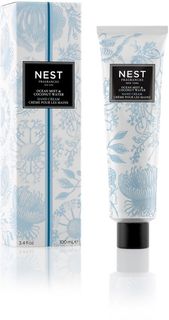
NEST Fragrances Ocean Mist & Coconut Water Hand Cream
Works for
1 of 1 advertised claim delivered
Moisturizing26 ingredients credited for this claimGood support
“Ocean Mist & Coconut Water Hand Cream”
This product can help improve hydration of the skin with the two types of ingredients.
The first type is called “humectants”:
these ingredients help attract water.
When humectants are on the surface of the skin, they “pull in” the moisture from the outside environment, or from
within deeper layers of the skin. The following ingredients in this product do the job:
glycerin, sodium hyaluronate.
This product also contains ingredients called “occlusives”. They help reduce the speed with which our skin loses moisture to the outside environment. These ingredients also help soften the upper layer of the skin, so it feels less tight and nicer to the touch. The following ingredients in this product do the job: dimethicone, squalane.
Can it cause trouble?
Irritancy7 strong irritants: Parfum, Hibiscus sabdariffa flower extract + 5 more — patch-test recommendedHigh risk
Comedogenic2 ingredients rated 2 or more on the 0–5 pore-clogging scale2 flagged


User reviews
Be the first — your take helps the next person decide.
Ingredients
Filter by role to see what each ingredient is doing.
Water~45–55%
Isodecyl neopentanoate~4.6–5.6%
- Irritation risk
- Low
An emollient that helps soften the skin. It also forms a protective on its surface to reduce water loss.
More about Isodecyl neopentanoatePropanediol~3.8–4.7%
- Irritation risk
- Low
Acts as a solvent for other ingredients. Speeds up the absorption of other ingredients into the skin
More about PropanediolDiphenylsiloxy phenyl trimethicone~3–3.7%
- Irritation risk
- Low
Help improve the product's texture
More about Diphenylsiloxy phenyl trimethiconeC12-15 alkyl benzoate~2.3–2.8%
- Irritation risk
- Low
Enhances the product texture and makes it more spreadable. Helps reduce water loss from the outer layer of skin. Extands the shelf life by preventing bacteria growth
More about C12-15 alkyl benzoateHydrogenated vegetable oil~1.9–2.3%
- Irritation risk
- Low
- Comedogenicity
- 2/5
An oil from a mixture of different vegetables. Helps soften the upper layer of the skin
More about Hydrogenated vegetable oilParfum~1.5–1.8%
- Irritation risk
- High
An aromatic blend of unspecified and possibly irritating ingredients
More about ParfumBehenyl alcohol~1.4–1.7%
- Irritation risk
- Low
Non-drying alcohol that helps water and oil mix together. Also serves as an emollient
More about Behenyl alcoholGlycerin~1.2–1.4%
- Irritation risk
- Low
One of the best moisturizing ingredients. Naturally present in skin. It attracts water to the upper layer of the skin working as a humectant
More about GlycerinSteareth-21~0.95–1.15%
Dimethicone~0.7–1%
- Irritation risk
- Low
A silicone that helps to reduce water loss from the surface of the skin. Can temporarily "fill in" lines and wrinkles, absorb oil, and create a nice product finish
More about DimethiconePpg-5-ceteth-20~0.55–0.8%
- Irritation risk
- Medium
A solvent with some emollient properties
More about Ppg-5-ceteth-20Trimyristin~0.45–0.65%
- Irritation risk
- Low
Acrylates copolymer~0.4–0.6%
- Irritation risk
- Medium
Used to stabilize product formulation, help create an even product layer over skin (for example, in sunscreen) and create a thicker product consistency
More about Acrylates copolymerAloe barbadensis leaf juice~0.3–0.6%
- Irritation risk
- Medium
Traditionally used to treat sunburns, dermatitis and inflammation, but evidence for its effectiveness is lacking. The extract can contain humectants that help attract water into the skin
More about Aloe barbadensis leaf juiceAluminum starch octenylsuccinate~0.4–0.6%
- Irritation risk
- Medium
Used to thicken the product's consistency
More about Aluminum starch octenylsuccinateAmmonium acryloyldimethyltaurate/vp copolymer~0.35–0.65%
- Irritation risk
- Low
Increases thickness of a product. Texture enhancer for oil-in-water emulsions
More about Ammonium acryloyldimethyltaurate/vp copolymerAscorbyl palmitate~0.3–0.55%
- Irritation risk
- Medium
Being a lipid soluble form of vitamin C, it is more stable and can penetrate the skin better than L-Ascorbic acid. It is effective in protecting the skin from free radicals, as well as evening the skin tone, but is less effective in stimulating collagen production compared to L-Ascorbic acid.
More about Ascorbyl palmitateBehenic acid~0.4–0.65%
Benzoic acid~0.3–0.5%
Benzyl alcohol~0.2–0.4%
- Irritation risk
- High
A preservative. Can be used to mask unpleasant smell. Can be irritating
More about Benzyl alcoholBht~0.2–0.4%
Butyrospermum parkii butter~0.25–0.45%
- Irritation risk
- Low
- Comedogenicity
- 3/5
A great moisturising ingredient that softens the skin and reduces water loss from its upper layer. It also can be helpful in protecting skin from free radicals
More about Butyrospermum parkii butterCamelina sativa seed oil~0.2–0.35%
- Irritation risk
- Low
Helps soften the upper layer of the skin
More about Camelina sativa seed oilCaprylyl glycol~0.2–0.4%
- Irritation risk
- Medium
Helps preserve products and creates a nice product texture
More about Caprylyl glycolCaryodendron orinocense seed oil~0.2–0.4%
- Irritation risk
- Low
A plant oil with a high content of linoleic acid that helps soften the upper layer of the skin and helps strengthen the skin barrier. It is an excellent moisturizer. Might have an anti-oxidant effect
More about Caryodendron orinocense seed oilCeratonia siliqua gum~0.25–0.45%
- Irritation risk
- Medium
Used to stabilize product formulations and create thicker consistency
More about Ceratonia siliqua gumChlorphenesin~0.16–0.32%
Citric acid~0.2–0.35%
- Irritation risk
- Medium
Can work as an exfoliant but is typically used to adjust the product pH
More about Citric acidCitrullus lanatus fruit extract~0.2–0.35%
- Irritation risk
- Medium
A plant extract that can contain an antioxidant compound
More about Citrullus lanatus fruit extractDisodium edta~0.2–0.35%
Glyceryl stearate~0.25–0.45%
- Irritation risk
- Low
An emollient that softens the skin and forms a protective layer on its surface. Helps water and oil mix together
More about Glyceryl stearateGlycyrrhiza glabra root extract~0.2–0.35%
- Irritation risk
- Medium
A plant extract that can help lighten the skin and calm down inflammation. Might be helpful in neutralizing free radicals
More about Glycyrrhiza glabra root extractHelichrysum angustifolium wax~0.2–0.4%
- Irritation risk
- Low
Hibiscus sabdariffa flower extract~0.2–0.35%
- Irritation risk
- High
A plant extract that can be irritating. It might contain a compound anthocyanin that could be helpful in neutralizing free radicals
More about Hibiscus sabdariffa flower extractHydrogenated starch hydrolysate~0.2–0.35%
- Irritation risk
- Low
Helps to attract water to the upper layer of the skin. Can add sweet taste to lip products
More about Hydrogenated starch hydrolysateIsostearic acid~0.3–0.5%
- Irritation risk
- Low
Used to create a nice product texture
More about Isostearic acidLeuconostoc/radish root ferment filtrate~0.2–0.35%
- Irritation risk
- Medium
A preservative that comes from radishes fermented by a bacteria. New research suggests that the preservation properties in the ingredient come from an ammonium salt that is not present naturally in radish root but used in its cultivation. Is problematic because the exact amount of the preservative agents is difficult to determine
More about Leuconostoc/radish root ferment filtrateMagnesium aluminum silicate~0.2–0.4%
- Irritation risk
- Low
Might be helpful in restoring skin barrier function and, when combined with zinc carbonate and malonic acid, reducing fine lines and wrinkles by stimulating elastin production. Also helps stabilize the product formulation
More about Magnesium aluminum silicateMaltooligosyl glucoside~0.2–0.4%
- Irritation risk
- Low
Helps water and oil mix together and can help attract water to the upper layer of the skin
More about Maltooligosyl glucosideMoringa oleifera seed oil~0.2–0.4%
- Irritation risk
- Medium
A plant oil that helps soften the upper layer of the skin. Is unlikely to be helpful in restoring skin barrier function due to the low content of linoleic acid
More about Moringa oleifera seed oilOlea europaea fruit oil~0.2–0.4%
- Irritation risk
- Medium
An emollient that helps soften the skin but is not effective for restoring its barrier function. Might be helpful to calm down inflammation
More about Olea europaea fruit oilPalmitic acid~0.25–0.45%
- Irritation risk
- Low
An emollient that is naturally present in skin and helps soften it
More about Palmitic acidPanthenol~0.2–0.35%
- Irritation risk
- Low
Helps attract water to the upper layer of the skin and can help improve skin barrier function
More about PanthenolPeg-100 stearate~0.3–0.5%
- Irritation risk
- Low
Helps oil and water mix togehter and creates a nice product texture
More about Peg-100 stearatePhenoxyethanol~0.2–0.4%
- Irritation risk
- Low
A preservative. It helps prevent bacterial growth in cosmetic products
More about PhenoxyethanolPhospholipids~0.2–0.35%
- Irritation risk
- Low
Emollients that are naturaly present in skin. In addition, they help water and oil mix together in the product
More about PhospholipidsPotassium hydroxide~0.2–0.4%
Retinyl palmitate~0.2–0.35%
- Irritation risk
- High
Three steps removed from the active form of vitamin A - retinoic acid. To have an effect in the skin, it first needs to be converted twice to become the retinoic acid. This means it is less potent than retinol, but could also be less irritating. Once converted to the retinoic acid in the skin, it helps against all signs of aging, improves skin cell turnover and helps fight blemishes and clogged pores. However, in many cosmetic formulations, it is used in a concentration that is too low to have the full effect
More about Retinyl palmitateRheum rhaponticum root extract~0.2–0.35%
- Irritation risk
- Low
Shorea stenoptera seed butter~0.2–0.4%
- Irritation risk
- Low
Helps soften the upper layer of the skin and can be helpful in restoring the skin barrier function
More about Shorea stenoptera seed butterSilica~0.3–0.6%
Sodium hyaluronate~0.2–0.4%
- Irritation risk
- Low
One of the best moisturizing ingredients. Attracts water into the upper layer of the skin
More about Sodium hyaluronateSodium pca~0.2–0.4%
- Irritation risk
- Low
Naturally present in skin and helps to attract water to its upper layer
More about Sodium pcaSorbic acid~0.2–0.4%
Sorbitan stearate~0.2–0.4%
Squalane~0.25–0.45%
- Irritation risk
- Low
An oil naturally present in skin. Works as an emollient to soften the skin and form a protective layer on its surface without a greasy feeling.
More about SqualaneStearic acid~0.3–0.55%
- Irritation risk
- Low
Helps oil and water mix together and works as an emollient
More about Stearic acidTocopheryl acetate~0.2–0.35%
- Irritation risk
- Medium
A more stable but less bio-available form of vitamin E compared to Tocopherol. Might help moisturize and protect the skin from free radicals, but mostly used in low concentrations to stabilize other ingredients.
More about Tocopheryl acetateTrimethylsiloxysilicate~0.2–0.4%
- Irritation risk
- Low
A type of silicone that helps create a nice product consistency and support the delivery of other ingredients
More about TrimethylsiloxysilicateVitis vinifera seed oil~0.2–0.35%
- Irritation risk
- Medium
A great emollient that can also have anti-oxidant properties
More about Vitis vinifera seed oilXanthan gum~0.15–0.3%
- Irritation risk
- Low
Used to create a thicker product consistency
More about Xanthan gumButylphenyl methylpropional~0.15–0.25%
- Irritation risk
- High
A fragrance. Can trigger allergic reactions and be irritating
More about Butylphenyl methylpropionalLimonene~0.15–0.25%
- Irritation risk
- High
A common frangrance that can easily irritate skin, especially if exposed to air, light or heat
More about LimoneneBenzyl salicylate~0.1–0.15%
Citronellol~0.05–0.15%
Ingredient list view
Water, Isodecyl neopentanoate, Propanediol, Diphenylsiloxy phenyl trimethicone, C12-15 alkyl benzoate, Hydrogenated vegetable oil, Parfum, Behenyl alcohol, Glycerin, Steareth-21, Dimethicone, Ppg-5-ceteth-20, Trimyristin, Acrylates copolymer, Aloe barbadensis leaf juice, Aluminum starch octenylsuccinate, Ammonium acryloyldimethyltaurate/vp copolymer, Ascorbyl palmitate, Behenic acid, Benzoic acid, Benzyl alcohol, Bht, Butyrospermum parkii butter, Camelina sativa seed oil, Caprylyl glycol, Caryodendron orinocense seed oil, Ceratonia siliqua gum, Chlorphenesin, Citric acid, Citrullus lanatus fruit extract, Disodium edta, Glyceryl stearate, Glycyrrhiza glabra root extract, Helichrysum angustifolium wax, Hibiscus sabdariffa flower extract, Hydrogenated starch hydrolysate, Isostearic acid, Leuconostoc/radish root ferment filtrate, Magnesium aluminum silicate, Maltooligosyl glucoside, Moringa oleifera seed oil, Olea europaea fruit oil, Palmitic acid, Panthenol, Peg-100 stearate, Phenoxyethanol, Phospholipids, Potassium hydroxide, Retinyl palmitate, Rheum rhaponticum root extract, Shorea stenoptera seed butter, Silica, Sodium hyaluronate, Sodium pca, Sorbic acid, Sorbitan stearate, Squalane, Stearic acid, Tocopheryl acetate, Trimethylsiloxysilicate, Vitis vinifera seed oil, Xanthan gum, Butylphenyl methylpropional, Limonene, Benzyl salicylate, Citronellol
Compare prices
Retailers ranked by price — lowest first.
Affiliate links · prices updated regularly · As an Amazon Associate, WIMJ earns from qualifying purchases.
Worth comparing, line by line.
Match % combines shared ingredients, the first five ingredients, shared actives and hero ingredients, irritancy (lower counts in the alternative's favour), texture and body area. Only products in the same routine step are compared.
| NEST FragrancesOcean Mist & Coconut Water Hand CreamYOUR PRODUCT | OillanDerm+, hand cream concentrate | StriVectinSD™ Hand Cream | MesoesteticRadiance DNA Hand Cream | |
|---|---|---|---|---|
| Match | — | 57% | 56% | 56% |
| Price | $9.00 | — | $21.75+$12.75 | $91.88+$82.88 |
| Shared key ingredients | — | 6 of 12 | 5 of 12 | 6 of 12 |
| Key difference | — | Urea | Linoleic Acid | Lactic Acid |
| Irritancy | High | Medium | Medium | Medium |
| Drying alcohol | — | — | — | — |
| View product | Shop | Shop | Shop |



Sources cited in this review
Every concentration estimate and effectiveness label is anchored to one of these 22 studies and safety reviews.
- 1
- 2
- 3Final Report on the Safety Assessment of Dimethicone Copolyoljournals.sagepub.com
- 4
- 5
- 6

Affiliate links · As an Amazon Associate, WIMJ earns from qualifying purchases.