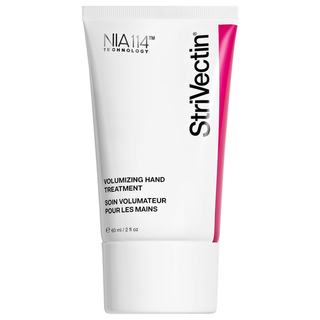
Works for
3 of 3 advertised claims delivered
MoisturizingLinoleic acid, Panthenol + 23 moreStrong evidence
“The ultra-moisturising cream combats signs of ageing on the hands, relieving you of tired, dry and discoloured skin to restore vitality for youthful-looking hands.”
This product can help improve hydration of the skin with the two types of ingredients.
The first type is called “humectants”:
these ingredients help attract water.
When humectants are on the surface of the skin, they “pull in” the moisture from the outside environment, or from
within deeper layers of the skin. The following ingredients in this product do the job:
glycerin, hyaluronic acid.
This product also contains ingredients called “occlusives”. They help reduce the speed with which our skin loses moisture to the outside environment. These ingredients also help soften the upper layer of the skin, so it feels less tight and nicer to the touch. The following ingredients in this product do the job: butyrospermum parkii butter, dimethicone.
The following ingredients in this product are especially good for supporting the skin barrier and helping with the hydration level: linoleic acid, panthenol
Anti-agingResveratrol, Butyrospermum parkii butter + 3 moreModerate evidence
“The ultra-moisturising cream combats signs of ageing on the hands, relieving you of tired, dry and discoloured skin to restore vitality for youthful-looking hands.”
This product contains resveratrol. This ingredient might be able to help reduce and prevent fine lines and wrinkles, improve skin elasticity and firmness, but there is not enough evidence that it actually works.
Evens skin toneArbutin, ResveratrolModerate evidence
“The ultra-moisturising cream combats signs of ageing on the hands, relieving you of tired, dry and discoloured skin to restore vitality for youthful-looking hands.”
The following ingredient (ingredients) in this product might be helpful, but there is no evidence to confirm that it actually works: arbutin, resveratrol.
Anti-oxidationNot advertised by the brand · Resveratrol, Ubiquinone + 5 moreStrong evidence
This product contains antioxidants (resveratrol, ubiquinone) that can help neutralize free radicals in skin. By doing so, they can lessen the damage the skin gets from the UV light (sun).
The following ingredients - arbutin also can have an antioxidant effect, but there is less evidence to confirm their effectiveness in skin.
Can it cause trouble?
Irritancy1 strong irritant: ParfumMedium risk
Comedogenic2 ingredients rated 2 or more on the 0–5 pore-clogging scale2 flagged

User reviews
Be the first — your take helps the next person decide.
Ingredients
Filter by role to see what each ingredient is doing.
Water~45–55%
Glycerin~5.2–6.4%
- Irritation risk
- Low
One of the best moisturizing ingredients. Naturally present in skin. It attracts water to the upper layer of the skin working as a humectant
More about GlycerinMyristyl nicotinate~4.1–5%
- Irritation risk
- Low
Butylene glycol~3–3.7%
- Irritation risk
- Low
Used to create a nice product texture and help delivery of other ingredients. Might be somewhat helpful in attracting water to the upper layer of the skin
More about Butylene glycolButyrospermum parkii butter~2.4–2.9%
- Irritation risk
- Low
- Comedogenicity
- 3/5
A great moisturising ingredient that softens the skin and reduces water loss from its upper layer. It also can be helpful in protecting skin from free radicals
More about Butyrospermum parkii butterCetyl esters~1.9–2.3%
- Irritation risk
- Low
Helps soften upper layer of the skin and can enhance penetration of other ingredients into the upper layer of the skin
More about Cetyl estersHyaluronic acid~1.5–1.8%
- Irritation risk
- Low
One of the best moisturizing ingredients. Attracts water into the upper layer of the skin. Naturally present in skin. Typically has large molecule size unless advertised otherwise on the product label. Helps support skin's barrier function and may help to reduce inflammation
More about Hyaluronic acidDimethicone~1.5–1.8%
- Irritation risk
- Low
A silicone that helps to reduce water loss from the surface of the skin. Can temporarily "fill in" lines and wrinkles, absorb oil, and create a nice product finish
More about DimethiconePersea gratissima oil~1.2–1.5%
- Irritation risk
- Medium
An emollient that helps soften the skin and could be helpful in repairing its barrier function
More about Persea gratissima oilGlyceryl stearate~0.95–1.2%
- Irritation risk
- Low
An emollient that softens the skin and forms a protective layer on its surface. Helps water and oil mix together
More about Glyceryl stearateHydrogenated polyisobutene~0.7–1.05%
- Irritation risk
- Low
Used to improve the product consistency and soften the upper layer of the skin
More about Hydrogenated polyisobutenePeg-100 stearate~0.6–0.95%
- Irritation risk
- Low
Helps oil and water mix togehter and creates a nice product texture
More about Peg-100 stearateSteareth-2~0.5–0.75%
Cetyl alcohol~0.55–0.8%
- Irritation risk
- Low
A non-drying alcohol that works to soften the skin and stabilize product formulations helping oil and water mix together
More about Cetyl alcoholHelianthus annuus seed oil~0.45–0.65%
- Irritation risk
- Low
A great emollient due to its high linoleic acid content. One of the most effective plant oils in helping skin hydration and repairing skin barrier function
More about Helianthus annuus seed oilHydrogenated vegetable oil~0.45–0.65%
- Irritation risk
- Low
- Comedogenicity
- 2/5
An oil from a mixture of different vegetables. Helps soften the upper layer of the skin
More about Hydrogenated vegetable oilPanthenol~0.35–0.65%
- Irritation risk
- Low
Helps attract water to the upper layer of the skin and can help improve skin barrier function
More about PanthenolSilica~0.5–0.7%
Stearyl alcohol~0.35–0.6%
- Irritation risk
- Low
An emollient that helps soften the skin
More about Stearyl alcoholTocopheryl acetate~0.25–0.5%
- Irritation risk
- Medium
A more stable but less bio-available form of vitamin E compared to Tocopherol. Might help moisturize and protect the skin from free radicals, but mostly used in low concentrations to stabilize other ingredients.
More about Tocopheryl acetateLinoleic acid~0.35–0.65%
- Irritation risk
- Low
An excellent emollient. Helps soften the skin, restore its barrier function, and can help to calm down inflammation. It can be helpful to prevent blemishes and clogged pores
More about Linoleic acidLinolenic acid~0.3–0.55%
- Irritation risk
- Medium
An emollient that helps soften the skin and calm down inflammation
More about Linolenic acidOlea europaea fruit oil~0.2–0.4%
- Irritation risk
- Medium
An emollient that helps soften the skin but is not effective for restoring its barrier function. Might be helpful to calm down inflammation
More about Olea europaea fruit oilPhospholipids~0.2–0.4%
- Irritation risk
- Low
Emollients that are naturaly present in skin. In addition, they help water and oil mix together in the product
More about PhospholipidsSqualane~0.25–0.45%
- Irritation risk
- Low
An oil naturally present in skin. Works as an emollient to soften the skin and form a protective layer on its surface without a greasy feeling.
More about SqualaneArbutin~0.2–0.35%
- Irritation risk
- Medium
Beta-arbutin. Can help to reduce hyperpigmentation and has an anti-oxidant effect when used in high enough concentration. Is less effective compared to alpha-arbutin
More about ArbutinAscorbyl palmitate~0.2–0.35%
- Irritation risk
- Medium
Being a lipid soluble form of vitamin C, it is more stable and can penetrate the skin better than L-Ascorbic acid. It is effective in protecting the skin from free radicals, as well as evening the skin tone, but is less effective in stimulating collagen production compared to L-Ascorbic acid.
More about Ascorbyl palmitateLecithin~0.25–0.45%
- Irritation risk
- Low
Used mostly for creating emulsions - helping oil and water mix together. Helps soften the upper layer of the skin
More about LecithinMel~0.25–0.4%
- Irritation risk
- Low
Helps to soften the upper layer of the skin and attract water to it
More about MelSphingolipids~0.2–0.4%
- Irritation risk
- Low
Sphingolipids are a group of lipids with a common chemical structure. Some of them are naturally present in skin and can be converted to ceramides
More about SphingolipidsResveratrol~0.2–0.4%
- Irritation risk
- Medium
Helps neutralize free radicals in skin and might help reduce fine lines and wrinkles, as well as even out the skin tone
More about ResveratrolRutin~0.2–0.35%
- Irritation risk
- Low
An antioxidant that might help neutralize free radicals in skin
More about RutinUbiquinone~0.2–0.4%
- Irritation risk
- Low
Coenzyme Q10. It helps neutralize free radicals in skin, improves skin hydration and might be helpful agains fine lines and wrinkles. It can be an allergen
More about UbiquinoneBehenyl alcohol~0.25–0.45%
- Irritation risk
- Low
Non-drying alcohol that helps water and oil mix together. Also serves as an emollient
More about Behenyl alcoholPeg-40 stearate~0.2–0.4%
Caprylyl glycol~0.2–0.4%
- Irritation risk
- Medium
Helps preserve products and creates a nice product texture
More about Caprylyl glycolAcrylates/c10-30 alkyl acrylate crosspolymer~0.2–0.35%
- Irritation risk
- Medium
Maintains the texture of skincare products. Allows the product to spread evenly. Helps oil and water mix together
More about Acrylates/c10-30 alkyl acrylate crosspolymerCellulose gum~0.15–0.3%
- Irritation risk
- Low
Used to create thicker product consistency and stabilize emulsions
More about Cellulose gumPhenyl trimethicone~0.2–0.35%
- Irritation risk
- Low
A type of silicone that can decrease loss of moisture from the skin surface. It helps create a nice product texture
More about Phenyl trimethiconePhenoxyethanol~0.15–0.25%
- Irritation risk
- Low
A preservative. It helps prevent bacterial growth in cosmetic products
More about PhenoxyethanolChlorphenesin~0.15–0.25%
Disodium edta~0.15–0.25%
Potassium hydroxide~0.1–0.2%
Parfum~0.05–0.15%
- Irritation risk
- High
An aromatic blend of unspecified and possibly irritating ingredients
More about ParfumIngredient list view
Water, Glycerin, Myristyl nicotinate, Butylene glycol, Butyrospermum parkii butter, Cetyl esters, Hyaluronic acid, Dimethicone, Persea gratissima oil, Glyceryl stearate, Hydrogenated polyisobutene, Peg-100 stearate, Steareth-2, Cetyl alcohol, Helianthus annuus seed oil, Hydrogenated vegetable oil, Panthenol, Silica, Stearyl alcohol, Tocopheryl acetate, Linoleic acid, Linolenic acid, Olea europaea fruit oil, Phospholipids, Squalane, Arbutin, Ascorbyl palmitate, Lecithin, Mel, Sphingolipids, Resveratrol, Rutin, Ubiquinone, Behenyl alcohol, Peg-40 stearate, Caprylyl glycol, Acrylates/c10-30 alkyl acrylate crosspolymer, Cellulose gum, Phenyl trimethicone, Phenoxyethanol, Chlorphenesin, Disodium edta, Potassium hydroxide, Parfum
Compare prices
Retailers ranked by price — lowest first.
Affiliate links · prices updated regularly · As an Amazon Associate, WIMJ earns from qualifying purchases.
Worth comparing, line by line.
Match % combines shared ingredients, the first five ingredients, shared actives and hero ingredients, irritancy (lower counts in the alternative's favour), texture and body area. Only products in the same routine step are compared.
| StriVectinSD™ Hand CreamYOUR PRODUCT | It CosmeticsConfidence in a Cream Barrier Boost Skin Barrier Repair Moisturizer | |
|---|---|---|
| Match | — | 51% |
| Price | $34.65 | $39.20+$4.55 |
| Shared key ingredients | — | 7 of 15 |
| Key difference | — | Acetyl Dipeptide-1 Cetyl Ester |
| Irritancy | Medium | Low |
| Drying alcohol | — | — |
| View product | Shop |
Product summary
"StriVectin - SD™ Hand Cream" is a well-rounded moisturizing product. This moisturizer uses a good combo of humectants and emollients. These both types of ingredients are essentials for improving the skin hydration and keeping the skin barrier healthy. Panthenol, glycerin, hyaluronic acid, honey and mel in this product (humectants) attract water molecules to the upper layer of the skin (the water comes from the outside air or from the deeper layers of the skin if the air is dry). Emollients in this formulation (linolenic acid, persea gratissima oil, sphingolipids, butyrospermum parkii butter and dimethicone) help to reduce the moisture loss from the skin. They also soften the skin surface and relieve the feeling of dryness and tightness.
Irritation risk
This moisturizer contains some common irritants, including those without a benefit for the skin. We assess the overall irritancy of this moisturizer to be medium. For a detailed overview of all potential irritants: click here
You can see the detailed formula review with the breakdown of all actives in the product and the full ingredient list with estimated concentrations in the tables below.
Price
The product retails from 21.75$ up to 29.00$ in the United States and for 26.00£ in the United Kingdom.
For a detailed price comparison: click here.
Sources cited in this review
Every concentration estimate and effectiveness label is anchored to one of these 27 studies and safety reviews.
- 1
- 2
- 3
- 4Efficacy of a New Topical Nano-hyaluronic Acid in Humansncbi.nlm.nih.gov
- 5Physiochemical properties and application of hyaluronic acid: a systematic reviewonlinelibrary.wiley.com
- 6

Affiliate links · As an Amazon Associate, WIMJ earns from qualifying purchases.