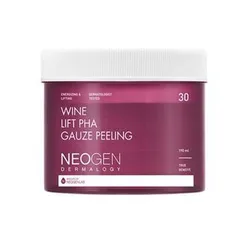
Works for:
based on ingredients and %- Anti-aging
- Exfoliation
- Moisturizing
- Anti-oxidation
Can it cause trouble?
- Irritation risk: high
- Comedogenic risk ingredients: 1
Key actives


Product Summary
"Neogen - Dermalogy Wine Lift PHA Gauze Peeling" is effective for: Anti-aging, Exfoliation, Moisturizing and Evens skin tone
Ingredient callouts
- This product contains acids (gluconolactone 1.30% - 1.60%, lactic acid 0.05% - 0.15% and glycolic acid 0.10% - 0.15%). Their concentration is low, and they will not have a strong exfoliating effect. Instead, they work to support the skin natural acid mantle and to attract water (as humectants). PHAs (gluconolactone) especially are great for improving skin hydration. They might be even able to stimulate the production of skin's natural humectants and support the healthy skin microbiome.
- Ceramides (ceramide np 0.15% - 0.30%, ceramide ap 0.15% - 0.25%, ceramide eop 0.15% - 0.30%, ceramide as 0.15% - 0.25% and ceramide ns 0.15% - 0.30%). Ceramides are an important part of our natural skin barrier. The Ceramides used in skincare are synthetic or come from plants. They help soften the skin and can help "fill the gaps" in the skin barrier, keeping the skin hydrated and resilient for longer.
- Peptides (palmitoyl tripeptide-5 0.15% - 0.25%, oligopeptide-1 0.15% - 0.25% and acetyl hexapeptide-8 0.15% - 0.25%). Peptides are a very big group of ingredients. They all consist of a different combination of aminoacids. Our skin produces Peptides naturally. Some of them work as natural antibiotics, promote wound-healing and production of collagen. The scientists are still studying how effective the topical application of Peptides is, but it is very likely that theynare helpful. Peptides might be able to support skin barrier restoration and even have an anti-aging benefit. At the very least, they certainly help attract water to the skin and support the hydration in this way.
- Adenosine 0.15% - 0.30%. It is a chemical present inside our skin cells. A clinical trial confirmed that topical application of Adenosine in a low concentration can reduce dynamic wrinkles (these are the wrinkles that appear with age in a places where our mimic is the most active, for example, in the corners of the eyes or on the forehead).
- Humectants (sodium hyaluronate crosspolymer 0.15% - 0.30%, sodium hyaluronate 0.15% - 0.25%, sodium acetylated hyaluronate 0.15% - 0.30%, polyglycerin-3 1.60% - 1.90%, hyaluronic acid 0.15% - 0.25%, glycerin 3.70% - 4.60%, diglycerin 2.90% - 3.60%, hydrolyzed hyaluronic acid 0.15% - 0.30%, arginine 0.15% - 0.25% and acetyl hexapeptide-8 0.15% - 0.25%). These ingredients help attract water to the upper layer of the skin and improve the skin hydration.
Price
The product retails for 25.81£ in the United Kingdom and for 25.00$ in the United States.
For a detailed price comparison: click here.
Anti-aging
What does the product description say?
Pads are also enriched with wine extracts, polyphenol, collagen and adenosine to improve skin elasticity.
Source: Yesstyle
This product can help reduce and prevent fine lines and wrinkles, improve skin elasticity and firmness because it contains adenosine, gluconolactone, glycolic acid.
These ingredients in the product can also be helpful, even though there is less evidence for their effectiveness: acetyl hexapeptide-8, oligopeptide-1, palmitoyl tripeptide-5, resveratrol, vitis vinifera seed extract.
Keep in mind that it typically takes at least 6 weeks to notice any results because the changes that are needed to improve fine lines and elasticity happen in the deeper layers of the skin. No topical anti-aging product can “erase” wrinkles or fully reverse signs of aging.
Might help improve cell turnover and reduce inflammation in skin. One study shows that the ingredients might be able to help reduce dynamic wrinkles (for example, in the corners of the eyes or on the forehead)
A polyhydroxy acid (PHA) that helps shed the dead cells from the skin surface revealing smoother skin. Is believed to be genter than AHAs. It helps attract water to the upper layer of the skin and can stimulate production of skin's own hyaluronic acid resulting in improved hydration levels. It has been shown to be helpful against acne and clogged pores if used consistently (e.g over a period of 12 weeks) in high enough concentration. It can help reduce fine lines and wrinkles and improve skin tone with long-term application. Can help neutralize free radicals
An alpha-hydroxy acid (AHA) that helps to remove the dead skin cells on the surface of the skin reveling a more even, smoother complexation. It is also able to stimulate collagen production with long-term use. Could help to reduce pore congestion. It can be irritating to the skin. Apply sunscreen daily if using products with glycolic acid
A type of peptide. Peptides are excellent moisturizers and might be able support collagen production reducing fine lines and wrinkles
Helps neutralize free radicals in skin and might help reduce fine lines and wrinkles, as well as even out the skin tone
A plant extract that contains resveratrol and other anti-oxidant compounds that can help neutralize free radicals, reduce inflammation in skin and even out its tone. Can be also used to stabilize the product formulation
A type of peptide. Peptides are excellent moisturizers and might be able support collagen production reducing fine lines and wrinkles
A type of peptide. Peptides are excellent moisturizers and might be able support collagen production reducing fine lines and wrinkles
One of the best moisturizing ingredients. Attracts water into the upper layer of the skin. Naturally present in skin. Typically has large molecule size unless advertised otherwise on the product label. Helps support skin's barrier function and may help to reduce inflammation
An exfoliating and moisturizing alpha-hydroxy acid (AHA). Typically causes less irritation than other AHAs, for example, glycolic acid. At high concentrations (about 15%), lactic acid can help reduce lines and wrinkles. Recent studies show that lactic acid can support the "good" bacteria living on skin's surface (healthy skin microbiome)
Anti-oxidation
This product contains antioxidants (resveratrol, vitis vinifera seed extract) that can help neutralize free radicals in skin. By doing so, they can lessen the damage the skin gets from the UV light (sun).
The following ingredients - cornus officinalis fruit extract, gluconolactone, tartaric acid also can have an antioxidant effect, but there is less evidence to confirm their effectiveness in skin.
A plant extract that contains resveratrol and other anti-oxidant compounds that can help neutralize free radicals, reduce inflammation in skin and even out its tone. Can be also used to stabilize the product formulation
Helps neutralize free radicals in skin and might help reduce fine lines and wrinkles, as well as even out the skin tone
A plant extract that contains anti-oxidants. It might help to neutralize free radicals in skin. Can be used to help preserve the product formulation
An AHA (alpha-hydroxy acid). It oxidizes quickly which makes it less effective in skincare formulations. It can support skin's barrier and moisture levels
A polyhydroxy acid (PHA) that helps shed the dead cells from the skin surface revealing smoother skin. Is believed to be genter than AHAs. It helps attract water to the upper layer of the skin and can stimulate production of skin's own hyaluronic acid resulting in improved hydration levels. It has been shown to be helpful against acne and clogged pores if used consistently (e.g over a period of 12 weeks) in high enough concentration. It can help reduce fine lines and wrinkles and improve skin tone with long-term application. Can help neutralize free radicals
A plant extract tha can have anti-oxidant properties, but evidence of effectiveness in skin is lacking
A berry extract that might help neutralize free radicals on the surface of the skin
A plant extract that may contain a small amount of essential oils. Might be helpful in neutralizing free radicals in skin
Flower oil that is used as a fragrance
Used as a fragrance for its mint-like smell
A plant extract that can have some anti-oxidant effect in skin
Might help improve cell turnover and reduce inflammation in skin. One study shows that the ingredients might be able to help reduce dynamic wrinkles (for example, in the corners of the eyes or on the forehead)
A plant extract that might help neutralize free radicals in skin, but research on its efficacy in skin is lacking
An essential oil. Can be irritating. Can become an allergen with oxidation
A plant extract that helps attract water to the upper layer of the skin. It might be helpful in neutralizing free radicals in skin, but is less potent than the extract from the seeds
A plant extract that can be irritating. It might contain a compound anthocyanin that could be helpful in neutralizing free radicals
A berry extract. Might have some anti-oxidant properties
A fruit extract that might have some anti-oxidant properties but evidence of effectiveness in skin is lacking
Consists of remains of dead yeast bacteria cells. Helps to hydrate the skin and reduce irritation. Might has some anti-oxidant effect
A more stable but less bio-available form of vitamin E compared to Tocopherol. Might help moisturize and protect the skin from free radicals, but mostly used in low concentrations to stabilize other ingredients.
An essential oil that is used as a fragrance and can be irritating. It might have some anti-oxidant effect in skin
Evens skin tone
This product can help reduce hypepigmentation and even out the skin tone because it contains the following effective ingredients: gluconolactone, glycolic acid
The following ingredient (ingredients) in this product might be helpful, but there is no evidence to confirm that it actually can help even out the skin tone: capryloyl salicylic acid, resveratrol.
Keep in mind that you would need to apply any topical skincare targetted at hypigmentation consistently for a couple of months to get a result. No topical skincare product can help get rid of hyperpigmentation (including post-acne marks and age spots) instantly.
An alpha-hydroxy acid (AHA) that helps to remove the dead skin cells on the surface of the skin reveling a more even, smoother complexation. It is also able to stimulate collagen production with long-term use. Could help to reduce pore congestion. It can be irritating to the skin. Apply sunscreen daily if using products with glycolic acid
A polyhydroxy acid (PHA) that helps shed the dead cells from the skin surface revealing smoother skin. Is believed to be genter than AHAs. It helps attract water to the upper layer of the skin and can stimulate production of skin's own hyaluronic acid resulting in improved hydration levels. It has been shown to be helpful against acne and clogged pores if used consistently (e.g over a period of 12 weeks) in high enough concentration. It can help reduce fine lines and wrinkles and improve skin tone with long-term application. Can help neutralize free radicals
Helps neutralize free radicals in skin and might help reduce fine lines and wrinkles, as well as even out the skin tone
An exfoliating and moisturizing alpha-hydroxy acid (AHA). Typically causes less irritation than other AHAs, for example, glycolic acid. At high concentrations (about 15%), lactic acid can help reduce lines and wrinkles. Recent studies show that lactic acid can support the "good" bacteria living on skin's surface (healthy skin microbiome)
Consists of remains of dead yeast bacteria cells. Helps to hydrate the skin and reduce irritation. Might has some anti-oxidant effect
Used for skin exfoliation. It has an anti-inflammatory and anti-bacterial effect, helps to unclog pores, prevent blemishes and speed up healing of the existing ones. Sometimes referred to as a BHA (beta-hydroxy acid)
Exfoliation
What does the product description say?
Dermalogy Wine Lift PHA Gauze Peeling
Source: From product name
This product can help exfoliate the skin. In other words, it helps break down the bonds between dead cells on the surface of the skin and speed up the skin turnover. Skin often appears softer and brighter after exfoliation, but overdoing it can result in disrupted skin barrier. The following ingredient is doing the exfoliating job in this product: capryloyl salicylic acid, gluconolactone, glycolic acid.
A polyhydroxy acid (PHA) that helps shed the dead cells from the skin surface revealing smoother skin. Is believed to be genter than AHAs. It helps attract water to the upper layer of the skin and can stimulate production of skin's own hyaluronic acid resulting in improved hydration levels. It has been shown to be helpful against acne and clogged pores if used consistently (e.g over a period of 12 weeks) in high enough concentration. It can help reduce fine lines and wrinkles and improve skin tone with long-term application. Can help neutralize free radicals
An alpha-hydroxy acid (AHA) that helps to remove the dead skin cells on the surface of the skin reveling a more even, smoother complexation. It is also able to stimulate collagen production with long-term use. Could help to reduce pore congestion. It can be irritating to the skin. Apply sunscreen daily if using products with glycolic acid
An AHA (alpha-hydroxy acid). It oxidizes quickly which makes it less effective in skincare formulations. It can support skin's barrier and moisture levels
An exfoliating and moisturizing alpha-hydroxy acid (AHA). Typically causes less irritation than other AHAs, for example, glycolic acid. At high concentrations (about 15%), lactic acid can help reduce lines and wrinkles. Recent studies show that lactic acid can support the "good" bacteria living on skin's surface (healthy skin microbiome)
Used for skin exfoliation. It has an anti-inflammatory and anti-bacterial effect, helps to unclog pores, prevent blemishes and speed up healing of the existing ones. Sometimes referred to as a BHA (beta-hydroxy acid)
Moisturizing
This product can help improve hydration of the skin with the two types of ingredients.
The first type is called “humectants”:
these ingredients help attract water.
When humectants are on the surface of the skin, they “pull in” the moisture from the outside environment, or from
within deeper layers of the skin. The following ingredients in this product do the job:
arginine, diglycerin.
This product also contains ingredients called “occlusives”. They help reduce the speed with which our skin loses moisture to the outside environment. These ingredients also help soften the upper layer of the skin, so it feels less tight and nicer to the touch. The following ingredients in this product do the job: arginine, chondrus crispus extract.
The following ingredients in this product are especially good for supporting the skin barrier and helping with the hydration level: acetyl hexapeptide-8, ceramide ap, ceramide as, ceramide eop, ceramide np, ceramide ns, oligopeptide-1, palmitoyl tripeptide-5
A type of peptide. Peptides are excellent moisturizers and might be able support collagen production reducing fine lines and wrinkles
One of the best moisturizing ingredients. Attracts water into the upper layer of the skin. Naturally present in skin. Typically has large molecule size unless advertised otherwise on the product label. Helps support skin's barrier function and may help to reduce inflammation
One of the best moisturizing ingredients. Attracts water into the upper layer of the skin. A version of it is naturally present in skin
Attracts water into the upper layer of the skin
Lipids that work as an emollient and can be helpful in repairing skin barrier function
Helps to attract water to the upper layer of the skin
A type of hyaluronic acid that works as an excellent moisturizer by attracting water into the upper layer of the skin. Is typically feels less sticky on the skin compared to the usual hyaluronic acid
One of the best moisturizing ingredients. Attracts water into the upper layer of the skin
Attracts water into the upper layer of the skin
One of the best moisturizing ingredients. Naturally present in skin. It attracts water to the upper layer of the skin working as a humectant
A polyhydroxy acid (PHA) that helps shed the dead cells from the skin surface revealing smoother skin. Is believed to be genter than AHAs. It helps attract water to the upper layer of the skin and can stimulate production of skin's own hyaluronic acid resulting in improved hydration levels. It has been shown to be helpful against acne and clogged pores if used consistently (e.g over a period of 12 weeks) in high enough concentration. It can help reduce fine lines and wrinkles and improve skin tone with long-term application. Can help neutralize free radicals
Helps attract water to the upper layer of the skin
Red algae extract that helps attract water to the upper layer of the skin and create a nicer product consistency
An emollient that is naturally found in skin
A type of lipid similar to ceramides naturally present in skin. Helps to soften the upper layer of the skin and supports the skin barrier function to keep it hydrated. Can help to prevent inflammation in skin
A type of lipid similar to ceramides naturally present in skin. Helps to soften the upper layer of the skin and supports the skin barrier function to keep it hydrated. Can help to prevent inflammation in skin
A type of lipid similar to ceramides naturally present in skin. Helps to soften the upper layer of the skin and supports the skin barrier function to keep it hydrated. Can help to prevent inflammation in skin
A type of lipid similar to ceramides naturally present in skin. Helps to soften the upper layer of the skin and supports the skin barrier function to keep it hydrated. Can help to prevent inflammation in skin
A type of lipid similar to ceramides naturally present in skin. Helps to soften the upper layer of the skin and supports the skin barrier function to keep it hydrated. Can help to prevent inflammation in skin
An amino acid that is naturally present in skin and helps keep it hydrated. When used together with AHAs, it can reduce their irritating effect on the skin
A type of peptide. Peptides are excellent moisturizers and might be able support collagen production reducing fine lines and wrinkles
A type of peptide. Peptides are excellent moisturizers and might be able support collagen production reducing fine lines and wrinkles
A plant extract that helps attract water to the upper layer of the skin. It might be helpful in neutralizing free radicals in skin, but is less potent than the extract from the seeds
Helps attract water to the upper layer of the skin. Could be helpful in restoring the skin barrier function
Might help improve cell turnover and reduce inflammation in skin. One study shows that the ingredients might be able to help reduce dynamic wrinkles (for example, in the corners of the eyes or on the forehead)
Helps soften the upper layer of the skin
Emollients that are naturaly present in skin. In addition, they help water and oil mix together in the product
Cannot penetrate the skin barrier so is not particularly useful in skincare products
A "broth" with parts of dead cells of lactobacteria. Might be helpful supporting diverse microbiome in skin, but evidence is lacking
An AHA (alpha-hydroxy acid). It oxidizes quickly which makes it less effective in skincare formulations. It can support skin's barrier and moisture levels
An emollient that can also help water and oil mix together, as well as prevent bacteria growth in products
A sugar that is used to stabilize the product formulation. Can help attract water to the upper layer of the skin
Used to create a nice product texture and help delivery of other ingredients. Might be somewhat helpful in attracting water to the upper layer of the skin
A plant oil that helps soften the upper layer of the skin. Is unlikely to be helpful in restoring skin barrier function due to the low content of linoleic acid
Helps preserve products and creates a nice product texture
A good mix of fatty acids that forms a protective layer on the skin. Improves the shelf life of products. Derived from coconut and glycerin
An exfoliating and moisturizing alpha-hydroxy acid (AHA). Typically causes less irritation than other AHAs, for example, glycolic acid. At high concentrations (about 15%), lactic acid can help reduce lines and wrinkles. Recent studies show that lactic acid can support the "good" bacteria living on skin's surface (healthy skin microbiome)
Consists of remains of dead yeast bacteria cells. Helps to hydrate the skin and reduce irritation. Might has some anti-oxidant effect
How honest is this product?
| Promise | Can it deliver? |
|---|---|
| Anti-aging | |
| Exfoliation |
Total Promises Fulfilled score: 100/100.
We receive a small commission for purchases made through these links at no cost for you. Thank you for your support! Learn more
Potential irritants
Comedogenic ingredients
User reviews (0)
Averages from community submissions.
No reviews yet for this product.
Be the first to share your experience!
Tried this product?
Help capture what the ingredient list can't—texture, finish, pilling, scent, and more. Answer what you can, skip the rest.
Takes ~30 seconds.
Reviews are shown in aggregate. No personal details.
| Product | Similarity | Price | Irritancy |
|---|---|---|---|
 NEOGEN X SUR.MEDIC Dermalogy Wine Lift PHA Gauze Peeling | Current | $25.00 | |
Zombie Beauty Bloody Peel | 69% | ≈ $18.49 | |
CeraVe Blemish Control Gel Moisturiser with 2% Salicylic Acid & Niacinamide for Blemish-Prone Skin | 67% | ≈ $14.54 | |
Skin Control Peel Pads | 67% | ≈ $6.35 | |
 BeautyBio The Peel | 67% | $45.00 | |
 AcneFree Dermatology Inspired Care Blackhead Removing Scrub With Charcoal | 66% | - |
Key Actives
A polyhydroxy acid (PHA) that helps shed the dead cells from the skin surface revealing smoother skin. Is believed to be genter than AHAs. It helps attract water to the upper layer of the skin and can stimulate production of skin's own hyaluronic acid resulting in improved hydration levels. It has been shown to be helpful against acne and clogged pores if used consistently (e.g over a period of 12 weeks) in high enough concentration. It can help reduce fine lines and wrinkles and improve skin tone with long-term application. Can help neutralize free radicals
Used for skin exfoliation. It has an anti-inflammatory and anti-bacterial effect, helps to unclog pores, prevent blemishes and speed up healing of the existing ones. Sometimes referred to as a BHA (beta-hydroxy acid)
An alpha-hydroxy acid (AHA) that helps to remove the dead skin cells on the surface of the skin reveling a more even, smoother complexation. It is also able to stimulate collagen production with long-term use. Could help to reduce pore congestion. It can be irritating to the skin. Apply sunscreen daily if using products with glycolic acid
A plant extract that contains resveratrol and other anti-oxidant compounds that can help neutralize free radicals, reduce inflammation in skin and even out its tone. Can be also used to stabilize the product formulation
Might help improve cell turnover and reduce inflammation in skin. One study shows that the ingredients might be able to help reduce dynamic wrinkles (for example, in the corners of the eyes or on the forehead)
An AHA (alpha-hydroxy acid). It oxidizes quickly which makes it less effective in skincare formulations. It can support skin's barrier and moisture levels
A type of lipid similar to ceramides naturally present in skin. Helps to soften the upper layer of the skin and supports the skin barrier function to keep it hydrated. Can help to prevent inflammation in skin
Helps neutralize free radicals in skin and might help reduce fine lines and wrinkles, as well as even out the skin tone
A type of lipid similar to ceramides naturally present in skin. Helps to soften the upper layer of the skin and supports the skin barrier function to keep it hydrated. Can help to prevent inflammation in skin
A type of lipid similar to ceramides naturally present in skin. Helps to soften the upper layer of the skin and supports the skin barrier function to keep it hydrated. Can help to prevent inflammation in skin
A type of lipid similar to ceramides naturally present in skin. Helps to soften the upper layer of the skin and supports the skin barrier function to keep it hydrated. Can help to prevent inflammation in skin
One of the best moisturizing ingredients. Attracts water into the upper layer of the skin. Naturally present in skin. Typically has large molecule size unless advertised otherwise on the product label. Helps support skin's barrier function and may help to reduce inflammation
A type of peptide. Peptides are excellent moisturizers and might be able support collagen production reducing fine lines and wrinkles
An emollient that is naturally found in skin
A type of lipid similar to ceramides naturally present in skin. Helps to soften the upper layer of the skin and supports the skin barrier function to keep it hydrated. Can help to prevent inflammation in skin
A type of peptide. Peptides are excellent moisturizers and might be able support collagen production reducing fine lines and wrinkles
A type of peptide. Peptides are excellent moisturizers and might be able support collagen production reducing fine lines and wrinkles
One of the best moisturizing ingredients. Naturally present in skin. It attracts water to the upper layer of the skin working as a humectant
Helps attract water to the upper layer of the skin
Helps to attract water to the upper layer of the skin
A good mix of fatty acids that forms a protective layer on the skin. Improves the shelf life of products. Derived from coconut and glycerin
A plant extract that contains anti-oxidants. It might help to neutralize free radicals in skin. Can be used to help preserve the product formulation
One of the best moisturizing ingredients. Attracts water into the upper layer of the skin
An amino acid that is naturally present in skin and helps keep it hydrated. When used together with AHAs, it can reduce their irritating effect on the skin
Red algae extract that helps attract water to the upper layer of the skin and create a nicer product consistency
Lipids that work as an emollient and can be helpful in repairing skin barrier function
One of the best moisturizing ingredients. Attracts water into the upper layer of the skin. A version of it is naturally present in skin
A type of hyaluronic acid that works as an excellent moisturizer by attracting water into the upper layer of the skin. Is typically feels less sticky on the skin compared to the usual hyaluronic acid
Attracts water into the upper layer of the skin
Attracts water into the upper layer of the skin
Potential irritants
A plant oil with a high content of volatile compounds that can irritate the skin and lead to allergic reactions. Can lead to photosensitivity
Used for skin exfoliation. It has an anti-inflammatory and anti-bacterial effect, helps to unclog pores, prevent blemishes and speed up healing of the existing ones. Sometimes referred to as a BHA (beta-hydroxy acid)
An essential oil. Potential allergen and can be irritating. It has some anti-bacterial properties
An essential oil that is used as a fragrance and can be irritating. It might have some anti-oxidant effect in skin
An essential oil. Can be irritating. Can become an allergen with oxidation
An alpha-hydroxy acid (AHA) that helps to remove the dead skin cells on the surface of the skin reveling a more even, smoother complexation. It is also able to stimulate collagen production with long-term use. Could help to reduce pore congestion. It can be irritating to the skin. Apply sunscreen daily if using products with glycolic acid
Used as a fragrance for its mint-like smell
A berry extract. Might have some anti-oxidant properties
A plant extract that contains anti-oxidants. It might help to neutralize free radicals in skin. Can be used to help preserve the product formulation
A plant extract that may contain a small amount of essential oils. Might be helpful in neutralizing free radicals in skin
A plant extract that can be irritating. It might contain a compound anthocyanin that could be helpful in neutralizing free radicals
A common frangrance that can easily irritate skin, especially if exposed to air, light or heat
A polyhydroxy acid (PHA) that helps shed the dead cells from the skin surface revealing smoother skin. Is believed to be genter than AHAs. It helps attract water to the upper layer of the skin and can stimulate production of skin's own hyaluronic acid resulting in improved hydration levels. It has been shown to be helpful against acne and clogged pores if used consistently (e.g over a period of 12 weeks) in high enough concentration. It can help reduce fine lines and wrinkles and improve skin tone with long-term application. Can help neutralize free radicals
A plant extract that helps attract water to the upper layer of the skin. It might be helpful in neutralizing free radicals in skin, but is less potent than the extract from the seeds
A plant oil that helps soften the upper layer of the skin. Is unlikely to be helpful in restoring skin barrier function due to the low content of linoleic acid
An AHA (alpha-hydroxy acid). It oxidizes quickly which makes it less effective in skincare formulations. It can support skin's barrier and moisture levels
An exfoliating and moisturizing alpha-hydroxy acid (AHA). Typically causes less irritation than other AHAs, for example, glycolic acid. At high concentrations (about 15%), lactic acid can help reduce lines and wrinkles. Recent studies show that lactic acid can support the "good" bacteria living on skin's surface (healthy skin microbiome)
A good mix of fatty acids that forms a protective layer on the skin. Improves the shelf life of products. Derived from coconut and glycerin
A fruit extract that might have some anti-oxidant properties but evidence of effectiveness in skin is lacking
A plant extract tha can have anti-oxidant properties, but evidence of effectiveness in skin is lacking
A plant extract that can have some anti-oxidant effect in skin
A berry extract that might help neutralize free radicals on the surface of the skin
A plant extract that might help neutralize free radicals in skin, but research on its efficacy in skin is lacking
Helps preserve products and creates a nice product texture
Helps neutralize free radicals in skin and might help reduce fine lines and wrinkles, as well as even out the skin tone
A more stable but less bio-available form of vitamin E compared to Tocopherol. Might help moisturize and protect the skin from free radicals, but mostly used in low concentrations to stabilize other ingredients.
Lipids that work as an emollient and can be helpful in repairing skin barrier function
Attracts water into the upper layer of the skin
Comedogenic ingredients
Red algae extract that helps attract water to the upper layer of the skin and create a nicer product consistency
All ingredients
Helps to dissolve other ingredients in a formulation. Slows down the rate of product drying
One of the best moisturizing ingredients. Naturally present in skin. It attracts water to the upper layer of the skin working as a humectant
A polyhydroxy acid (PHA) that helps shed the dead cells from the skin surface revealing smoother skin. Is believed to be genter than AHAs. It helps attract water to the upper layer of the skin and can stimulate production of skin's own hyaluronic acid resulting in improved hydration levels. It has been shown to be helpful against acne and clogged pores if used consistently (e.g over a period of 12 weeks) in high enough concentration. It can help reduce fine lines and wrinkles and improve skin tone with long-term application. Can help neutralize free radicals
An emollient that can also help water and oil mix together, as well as prevent bacteria growth in products
A plant extract that helps attract water to the upper layer of the skin. It might be helpful in neutralizing free radicals in skin, but is less potent than the extract from the seeds
Helps create a thicker or gel-like product texture. It is not a surfactant but can be used in gentle cleansing formulations
Might help improve cell turnover and reduce inflammation in skin. One study shows that the ingredients might be able to help reduce dynamic wrinkles (for example, in the corners of the eyes or on the forehead)
A plant oil with a high content of volatile compounds that can irritate the skin and lead to allergic reactions. Can lead to photosensitivity
Used for skin exfoliation. It has an anti-inflammatory and anti-bacterial effect, helps to unclog pores, prevent blemishes and speed up healing of the existing ones. Sometimes referred to as a BHA (beta-hydroxy acid)
An essential oil. Potential allergen and can be irritating. It has some anti-bacterial properties
An essential oil that is used as a fragrance and can be irritating. It might have some anti-oxidant effect in skin
A sugar that is used to stabilize the product formulation. Can help attract water to the upper layer of the skin
Used to create a nice product texture and help delivery of other ingredients. Might be somewhat helpful in attracting water to the upper layer of the skin
An essential oil. Can be irritating. Can become an allergen with oxidation
A plant oil that helps soften the upper layer of the skin. Is unlikely to be helpful in restoring skin barrier function due to the low content of linoleic acid
Helps attract water to the upper layer of the skin and repair the skin barrier function
An AHA (alpha-hydroxy acid). It oxidizes quickly which makes it less effective in skincare formulations. It can support skin's barrier and moisture levels
An exfoliating and moisturizing alpha-hydroxy acid (AHA). Typically causes less irritation than other AHAs, for example, glycolic acid. At high concentrations (about 15%), lactic acid can help reduce lines and wrinkles. Recent studies show that lactic acid can support the "good" bacteria living on skin's surface (healthy skin microbiome)
A "broth" with parts of dead cells of lactobacteria. Might be helpful supporting diverse microbiome in skin, but evidence is lacking
An alpha-hydroxy acid (AHA) that helps to remove the dead skin cells on the surface of the skin reveling a more even, smoother complexation. It is also able to stimulate collagen production with long-term use. Could help to reduce pore congestion. It can be irritating to the skin. Apply sunscreen daily if using products with glycolic acid
Used as a fragrance for its mint-like smell
A good mix of fatty acids that forms a protective layer on the skin. Improves the shelf life of products. Derived from coconut and glycerin
A berry extract. Might have some anti-oxidant properties
A fruit extract that might have some anti-oxidant properties but evidence of effectiveness in skin is lacking
A plant extract tha can have anti-oxidant properties, but evidence of effectiveness in skin is lacking
A plant extract that contains anti-oxidants. It might help to neutralize free radicals in skin. Can be used to help preserve the product formulation
A plant extract that can have some anti-oxidant effect in skin
A plant extract that may contain a small amount of essential oils. Might be helpful in neutralizing free radicals in skin
A berry extract that might help neutralize free radicals on the surface of the skin
A plant extract that might help neutralize free radicals in skin, but research on its efficacy in skin is lacking
A plant extract that can be irritating. It might contain a compound anthocyanin that could be helpful in neutralizing free radicals
A type of lipid similar to ceramides naturally present in skin. Helps to soften the upper layer of the skin and supports the skin barrier function to keep it hydrated. Can help to prevent inflammation in skin
Helps to retain moisture by creating a protective barrier on the skin. Rich in fatty acids. Improves product texture and helps with the penetration of other ingredients.
Emollients that are naturaly present in skin. In addition, they help water and oil mix together in the product
Used to stabilize the product formulation and can help absorb oil
Helps preserve products and creates a nice product texture
Cannot penetrate the skin barrier so is not particularly useful in skincare products
A type of peptide. Peptides are excellent moisturizers and might be able support collagen production reducing fine lines and wrinkles
Helps neutralize free radicals in skin and might help reduce fine lines and wrinkles, as well as even out the skin tone
A more stable but less bio-available form of vitamin E compared to Tocopherol. Might help moisturize and protect the skin from free radicals, but mostly used in low concentrations to stabilize other ingredients.
A plant extract that contains resveratrol and other anti-oxidant compounds that can help neutralize free radicals, reduce inflammation in skin and even out its tone. Can be also used to stabilize the product formulation
A type of lipid similar to ceramides naturally present in skin. Helps to soften the upper layer of the skin and supports the skin barrier function to keep it hydrated. Can help to prevent inflammation in skin
A type of lipid similar to ceramides naturally present in skin. Helps to soften the upper layer of the skin and supports the skin barrier function to keep it hydrated. Can help to prevent inflammation in skin
Acts as a solvent for other ingredients. Speeds up the absorption of other ingredients into the skin
A type of peptide. Peptides are excellent moisturizers and might be able support collagen production reducing fine lines and wrinkles
A type of lipid similar to ceramides naturally present in skin. Helps to soften the upper layer of the skin and supports the skin barrier function to keep it hydrated. Can help to prevent inflammation in skin
A type of lipid similar to ceramides naturally present in skin. Helps to soften the upper layer of the skin and supports the skin barrier function to keep it hydrated. Can help to prevent inflammation in skin
Helps attract water to the upper layer of the skin. Could be helpful in restoring the skin barrier function
One of the best moisturizing ingredients. Attracts water into the upper layer of the skin
An amino acid that is naturally present in skin and helps keep it hydrated. When used together with AHAs, it can reduce their irritating effect on the skin
One of the best moisturizing ingredients. Attracts water into the upper layer of the skin. Naturally present in skin. Typically has large molecule size unless advertised otherwise on the product label. Helps support skin's barrier function and may help to reduce inflammation
Red algae extract that helps attract water to the upper layer of the skin and create a nicer product consistency
A type of peptide. Peptides are excellent moisturizers and might be able support collagen production reducing fine lines and wrinkles
Lipids that work as an emollient and can be helpful in repairing skin barrier function
Consists of remains of dead yeast bacteria cells. Helps to hydrate the skin and reduce irritation. Might has some anti-oxidant effect
One of the best moisturizing ingredients. Attracts water into the upper layer of the skin. A version of it is naturally present in skin
A type of hyaluronic acid that works as an excellent moisturizer by attracting water into the upper layer of the skin. Is typically feels less sticky on the skin compared to the usual hyaluronic acid
Attracts water into the upper layer of the skin
Attracts water into the upper layer of the skin
A common frangrance that can easily irritate skin, especially if exposed to air, light or heat
Ingredient list view
Water, Dipropylene glycol, Glycerin, Diglycerin, 1,2-hexanediol, Polyglyceryl-10 laurate, Polyglycerin-3, Gluconolactone, Glyceryl caprylate, Tromethamine, Vitis vinifera fruit extract, Ethylhexylglycerin, Carbomer, Adenosine, Citrus aurantium bergamia fruit oil, Salicylic acid, Wine extract, Lavandula angustifolia oil, Gardenia florida fruit extract, Anthemis nobilis flower oil, Dextrin, Butylene glycol, Pelargonium graveolens flower oil, Moringa oleifera seed oil, Xylitol, Tartaric acid, Capryloyl salicylic acid, Vitis vinifera fruit water, Lactic acid, Lactobacillus ferment lysate, Glycolic acid, Mentha viridis leaf oil, Perilla frutescens leaf extract, Rose flower oil, Caprylic/capric triglyceride, Isopentyldiol, Vaccinium macrocarpon fruit extract, Panax ginseng berry extract, Fragaria chiloensis fruit extract, Rubus idaeus fruit extract, Vaccinium angustifolium fruit extract, Cornus officinalis fruit extract, Euterpe oleracea fruit extract, Sambucus nigra fruit extract, Schisandra chinensis fruit extract, Vaccinium myrtillus fruit extract, Adansonia digitata seed oil, Hibiscus sabdariffa flower extract, Ceramide np, Hydrogenated lecithin, Phospholipids, Maltodextrin, Xanthan gum, Caprylyl glycol, Collagen, Soluble proteoglycan, Palmitoyl tripeptide-5, Resveratrol, Cholesterol, Tocopheryl acetate, Vitis vinifera seed extract, Ceramide ns, Ceramide as, Propanediol, Acetyl hexapeptide-8, Ceramide eop, Ceramide ap, Glucose, Sodium hyaluronate, Arginine, Hyaluronic acid, Chondrus crispus extract, Oligopeptide-1, Phytosterols, Bifida ferment lysate, Hydroxypropyltrimonium hyaluronate, Streptococcus thermophilus ferment, Crocus sativus flower extract, Hydrolyzed hyaluronic acid, Sodium acetylated hyaluronate, Sodium hyaluronate crosspolymer, Hydrolyzed sodium hyaluronate, Potassium hyaluronate, Limonene, Linalool
- Glycerol and the skin: holistic approach to its origin and functions
- The influence of alkane chain length on the skin irritation potential of 1,2-alkanediols
- In Vitro Assessment of Skin Irritation Potential of Surfactant-based Formulations by Using a 3-D Skin Reconstructed Tissue Model and Cytokine Response
- A comparative study of gluconolactone versus benzoyl peroxide in the treatment of acne
- The Polyhydroxy Acid Gluconolactone Protects Against Ultraviolet Radiation in an In Vitro Model of Cutaneous Photoaging
- Applications of hydroxy acids: classification, mechanisms, and photoactivity
- The efficacy of glycolic acid, salicylic acid, gluconolactone, and licochalcone A combined with 0.1% adapalene vs adapalene monotherapy in mild-to-moderate acne vulgaris: a double-blinded within-person comparative study
- A polyhydroxy acid skin care regimen provides antiaging effects comparable to an alpha-hydroxyacid regimen
- The use of polyhydroxy acids (PHAs) in photoaged skin
- Blackwell Publishing, Ltd. Alpha-hydroxyacids and carboxylic acids
- An evaluation of a polyhydroxy acid skin care regimen in combination with azelaic acid 15% gel in rosacea patients
- Aging Skin: Causes, Treatments, and Prevention
- Clinical and cosmeceutical uses of hydroxyacids
- Polyhydroxy Acids (PHAs) Provide Conditioning Effects to Skin Without Increasing Sensitivity to UV Light
- Safety Assessment of Tromethamine as Used in Cosmetics
- Safety Assessment of Vitis Vinifera (Grape)-Derived Ingredients as Used in Cosmetics
- Evaluation of anti-wrinkle efficacy of adenosine-containing products using the FOITS technique
- Safety Assessment of Citrus-Derived Peel Oils as Used in Cosmetics
- Oxidized citrus oil (R-limonene): A frequent skin sensitizer in Europe
- Air oxidation increases skin irritation from fragrance terpenes
- Salicylic acid as a peeling agent: a comprehensive review
- Beta Hydroxy Acids
- A review of toxicity from topical salicylic acid preparations
- Glycolic Acid Peels Versus Salicylic–Mandelic Acid Peels in Active Acne Vulgaris and Post‐Acne Scarring and Hyperpigmentation: A Comparative Study
- Allergic contact dermatitis from gardenia fruit
- VOLATILE CONSTITUENTS AND BIOLOGICAL ACTIVITIES OF GARDENIA JASMINOIDES
- Safety Assessment of Anthemis nobilis– Derived Ingredients as Used in Cosmetics
- Fragrance Compound Geraniol Forms Contact Allergens on Air Exposure. Identification and Quantification of Oxidation Products and Effect on Skin Sensitization
- Moringa oleifera seed oil: Composition, nutritional aspects and health attributes
- Moringa oleifera Seeds and Oil: Characteristics and Uses for Human Health
- Control of keratinization with á-hydroxy acids and related compounds: I. Topical treatment of ichthyotic disorders
- Dual Effects of Alpha-Hydroxy Acids on the Skin
- Method of treating wrinkles using tartaric acid
- Impact of the condition of storage of tartaric acid solutions on the production and stability of glyoxylic acid
- Epidermal and dermal effects of topical lactic acid
- Dual Effects of Alpha-Hydroxy Acids on the Skin
- Photoprotective and antiinflammatory effects of topical glycolic acid
- Glycolic acid peel therapy – a current review
- Anti-Inflammatory and Neuroactive Properties of Selected Fruit Extracts
- Chemoprevention Against Hepatocellular Carcinoma of Cornus officinalis in vitro
- Total Oxidant Scavenging Capacity of Euterpe oleracea Mart. (Açaí) Seeds and Identification of Their Polyphenolic Compounds
- Euterpe oleracea, Matricaria chamomilla, and Camellia sinensis as promising ingredients for development of skin care formulations
- Assessment report on Sambucus nigra L., fructus
- SKIN PROTECTION AGAINST SOLAR UV RADIATION BY NATURAL PLANT PRODUCTS: EXTRACTS FROM ELDER FRUIT (SAMBUCUS NIGRA L.)
- Lonicera caerulea and Vaccinium myrtillus fruit polyphenols protect HaCaT keratinocytes against UVB-induced phototoxic stress and DNA damage
- Herbal Medicine: Biomolecular and Clinical Aspects. 2nd edition.
- Anthocyanin-rich extract from Hibiscus sabdariffa calyx counteracts UVC-caused impairments in rats
- Hibiscus sabdariffa L. – A phytochemical and pharmacological review
- Liposome-containing Hibiscus sabdariffa calyx extract formulations with increased antioxidant activity, improved dermal penetration and reduced dermal toxicity
- Skin hydration is significantly increased by a cream formulated to mimic the skin’s own natural moisturizing systems
- Topically Applied Ceramides Interact with the Stratum Corneum Lipid Matrix in Compromised Ex Vivo Skin
- Skin permeation and antioxidant efficacy of topically applied resveratrol
- Chemoprevention of skin cancer by grape constituent resveratrol: relevance to human disease?
- Evaluation of efficacy and tolerance of a nighttime topical antioxidant containing resveratrol, baicalin, and vitamin e for treatment of mild to moderately photodamaged skin
- Resveratrol as a Multifunctional Topical Hypopigmenting Agent
- Anti-aging properties of resveratrol: review and report of a potent new antioxidant skin care formulation
- Resveratrol: A Unique Antioxidant Offering a Multi-Mechanistic Approach for Treating Aging Skin
- The Topical Effect of Grape Seed Extract 2% Cream on Surgery Wound Healing
- Review of the Pharmacological Effects of Vitis vinifera (Grape) and its Bioactive Constituents: An Update
- Topical emulsions containing ceramides: Effects on the skin barrier function and anti‐inflammatory properties
- Topical Glucose Induces Claudin-1 and Filaggrin Expression in a Mouse Model of Atopic Dermatitis and in Keratinocyte Culture, Exerting Anti-inflammatory Effects by Repairing Skin Barrier Function
- Hyaluronic acid: A key molecule in skin aging
- Hyaluronan (Hyaluronic Acid): a natural moisturizer for skin care
- Efficacy of a New Topical Nano-hyaluronic Acid in Humans
- Physiochemical properties and application of hyaluronic acid: a systematic review
- Bifidobacterium longumlysate, a new ingredient forreactive skin
- Use of Probiotics for Dermal Applications
- Acetylated Hyaluronic Acid: Enhanced Bioavailability and Biological Studies