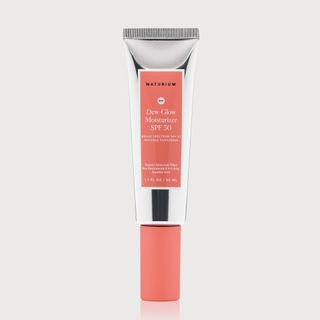
Naturium Dew-Glow Moisturizer SPF 50
Works for
2 of 2 advertised claims delivered
Sun protectionSPF 50 · 4 UV filtersBroad spectrum
This product offers a good level of protection against both UVB and UVA rays.
This sunscreen uses organic (so-called "chemical") sunscreen filters. Organic, or "chemical" filters usually provide reliable sun protection and rarely leave a white cast. Sunscreens with organic filters can sting eyes.
This product can be considered "reef safe" because it does not contain the UV filters (oxybenzone and octinoxate) that can be harmful to coral reefs when present in the water in high concentrations.
Evens skin tone2 ingredients credited for this claimStrong support
“Formulated with niacinamide and antioxidant ethyl ascorbic acid to help visibly improve brightness and texture.”
This product offers broad spectrum sun protection. It means that it can prevent hyperpigmentation and help keep the skin tone even (sun damage is the main factor causing age spots, darkening of post-acne marks and other discolorations).
Anti-agingNot advertised by the brand · 3 ingredients credited for this claimStrong support
This product can help prevent early signs of skin aging because it offers a good level of broad spectrum sun protection. Sun damage is the main cause of premature skin aging, and protecting your skin from the sun is the best anti-aging strategy.
Anti-oxidationNot advertised by the brand · 5 ingredients credited for this claimModerate support
This product contains antioxidants (3-o-ethyl ascorbic acid) that might be able to help neutralize free radicals in skin to lessen the damage it gets from the UV light (sun). There is not enough evidence to confirm their effectiveness in skin though.
MoisturizingNot advertised by the brand · 9 ingredients credited for this claimGood support
This product can help improve hydration of the skin with the two types of ingredients.
The first type is called “humectants”:
these ingredients help attract water.
When humectants are on the surface of the skin, they “pull in” the moisture from the outside environment, or from
within deeper layers of the skin. The following ingredients in this product do the job:
glycerin, sodium hyaluronate.
This product also contains ingredients called “occlusives”. They help reduce the speed with which our skin loses moisture to the outside environment. These ingredients also help soften the upper layer of the skin, so it feels less tight and nicer to the touch. The following ingredients in this product do the job: squalane, argania spinosa kernel oil.
Can it cause trouble?
Irritancy16 flagged ingredientsLow risk
Comedogenic1 ingredient rated 2 or more on the 0–5 pore-clogging scale1 flagged


User reviews
Ingredients
Filter by role to see what each ingredient is doing.
Homosalate10%
- Irritation risk
- Medium
A weak sunscreen that offers some protection against the sun rays that cause sunburn (UVB), but does not offer meaningful protection against protect against the most aging sun rays (UVA). It loses its effectiveness quickly when exposed to sunlight. It is an organic, or so called "chemical" sunscreen. When used in low concentrations, helps to stabilize the product formulation
More about HomosalateEthylhexyl salicylate5%
- Irritation risk
- Low
Octisalate. A UV filter. It offers some protection against the sun rays that cause sunburn (UVB), but does not protect against the most aging sun rays (UVA). It loses its effectiveness quickly when exposed to sunlight. It is an organic, or so called "chemical" sunscreen
More about Ethylhexyl salicylateButyl methoxydibenzoylmethane3%
- Irritation risk
- Medium
Avobenzone. An organic, or so-called "chemical" UV filter. Protects against both UVA and UVB rays. Needs to be combined with other filters in a formulation to be stable.
More about Butyl methoxydibenzoylmethaneWater~45–55%
Butyloctyl salicylate~6.4–7.8%
- Irritation risk
- Medium
A synthetic ester of salicylic acid that is used to help disperse pigments and boost effectiveness of sunscreen ingredients. It is able to absorb UV light (working as an organic, or chemical filter), but is not approved as a sunscreen ingredient on its own
More about Butyloctyl salicylateC12-15 alkyl benzoate~4.9–6%
- Irritation risk
- Low
Enhances the product texture and makes it more spreadable. Helps reduce water loss from the outer layer of skin. Extands the shelf life by preventing bacteria growth
More about C12-15 alkyl benzoateCalcium sodium borosilicate~3.9–4.7%
Glycerin~2.8–3.5%
- Irritation risk
- Low
One of the best moisturizing ingredients. Naturally present in skin. It attracts water to the upper layer of the skin working as a humectant
More about GlycerinGlyceryl stearate~2.1–2.6%
- Irritation risk
- Low
An emollient that softens the skin and forms a protective layer on its surface. Helps water and oil mix together
More about Glyceryl stearateEthylhexyl methoxycrylene~1.5–1.8%
- Irritation risk
- Medium
Helps improve stability of sunscreen filters and boost their effectiveness
More about Ethylhexyl methoxycryleneVp/eicosene copolymer~1.3–1.6%
- Irritation risk
- Medium
Used to improve the product adherence to the skin, for example, to pro-long the protective effect of sunscreens. Can be irritating to very sensitive skin
More about Vp/eicosene copolymerStearyl dimethicone~1.1–1.4%
- Irritation risk
- Low
Helps soften the upper layer of the skin
More about Stearyl dimethiconeArgania spinosa kernel oil~0.8–1.2%
- Irritation risk
- Medium
An emollient that helps soften the upper layer of the skin. Might have some weak anti-oxidant properties
More about Argania spinosa kernel oilTocopheryl acetate~0.6–0.9%
- Irritation risk
- Medium
A more stable but less bio-available form of vitamin E compared to Tocopherol. Might help moisturize and protect the skin from free radicals, but mostly used in low concentrations to stabilize other ingredients.
More about Tocopheryl acetate1,2-hexanediol~0.5–0.75%
Niacinamide~0.45–0.7%
- Irritation risk
- Low
Is proven to be effective in reducing blemishes, evening out skin tone and helping to improve lines and wrinkles. It helps the skin to repair sun damage, calm down inflammation and keep maintain good levels of moisture. The concentration of about 2% is effective for supporting the skin barrier and evening out the skin tone. Concentration of 4-6% is better for helping with acne and balancing the sebum production
More about NiacinamideTocopherol~0.35–0.65%
- Irritation risk
- Low
Pure form of vitamin E. Can help moisturise and protect the skin from free radicals. Often used to help stabilise other ingredients or the formula itself
More about TocopherolCetearyl olivate~0.35–0.65%
Bisabolol~0.25–0.5%
- Irritation risk
- Low
An active component of chamomile plant that historically has been used to calm down irritated skin. A recent study shows that bisabolol indeed can have some anti-inflammatory effect on skin, even though conclusive data is lacking. Bisabolol has a sweet floral scent and can be added to products for its aromatic properties
More about Bisabolol3-o-ethyl ascorbic acid~0.35–0.6%
- Irritation risk
- High
A vitamin C derivative that is more stable but less potent than pure form of vitamin C. Can help neutralize free radicals and help reduce hyperpigmentation, but the required concentration is likely to be much higher than for the pure form of vitamin C, limiting the ingredient's effectiveness in products
More about 3-o-ethyl ascorbic acidSodium hyaluronate~0.3–0.55%
- Irritation risk
- Low
One of the best moisturizing ingredients. Attracts water into the upper layer of the skin
More about Sodium hyaluronateSqualane~0.4–0.6%
- Irritation risk
- Low
An oil naturally present in skin. Works as an emollient to soften the skin and form a protective layer on its surface without a greasy feeling.
More about SqualaneAmmonium acryloyldimethyltaurate/vp copolymer~0.25–0.5%
- Irritation risk
- Low
Increases thickness of a product. Texture enhancer for oil-in-water emulsions
More about Ammonium acryloyldimethyltaurate/vp copolymerHydroxyacetophenone~0.25–0.45%
Silica~0.4–0.6%
Sodium stearoyl glutamate~0.45–0.65%
- Irritation risk
- Medium
Helps oil and water mix together
More about Sodium stearoyl glutamateOctadecene~0.25–0.45%
- Irritation risk
- Low
Sorbitan olivate~0.25–0.45%
Sorbitan oleate~0.2–0.35%
- Irritation risk
- Medium
- Comedogenicity
- 2/5
Helps oil and water mix together
More about Sorbitan oleateCaprylyl/capryl glucoside~0.25–0.5%
- Irritation risk
- Medium
Helps oil and water mix together. Can be used as a cleansing agent
More about Caprylyl/capryl glucosideXanthan gum~0.1–0.2%
- Irritation risk
- Low
Used to create a thicker product consistency
More about Xanthan gumSodium acrylate/sodium acryloyldimethyl taurate copolymer~0.2–0.4%
- Irritation risk
- Low
Used to create a thicker product consistency
More about Sodium acrylate/sodium acryloyldimethyl taurate copolymerTrisodium ethylenediamine disuccinate~0.1–0.2%
- Irritation risk
- Medium
Used to improve stability of the formulation
More about Trisodium ethylenediamine disuccinatePolyisobutene~0.1–0.15%
Citric acid~0.05%
- Irritation risk
- Medium
Can work as an exfoliant but is typically used to adjust the product pH
More about Citric acidSodium hydroxide~0.05–0.1%
Ingredient list view
Homosalate, Ethylhexyl salicylate, Butyl methoxydibenzoylmethane, Water, Butyloctyl salicylate, C12-15 alkyl benzoate, Calcium sodium borosilicate, Glycerin, Glyceryl stearate, Ethylhexyl methoxycrylene, Vp/eicosene copolymer, Stearyl dimethicone, Argania spinosa kernel oil, Tocopheryl acetate, 1,2-hexanediol, Niacinamide, Tocopherol, Cetearyl olivate, Bisabolol, 3-o-ethyl ascorbic acid, Sodium hyaluronate, Squalane, Ammonium acryloyldimethyltaurate/vp copolymer, Hydroxyacetophenone, Silica, Sodium stearoyl glutamate, Octadecene, Sorbitan olivate, Sorbitan oleate, Caprylyl/capryl glucoside, Xanthan gum, Sodium acrylate/sodium acryloyldimethyl taurate copolymer, Trisodium ethylenediamine disuccinate, Polyisobutene, Citric acid, Sodium hydroxide
Compare prices
Retailers ranked by price — lowest first.


Worth comparing, line by line.
Match % combines shared ingredients, the first five ingredients, shared actives and hero ingredients, irritancy (lower counts in the alternative's favour), texture and body area. Only products in the same routine step are compared.
| NaturiumDew-Glow Moisturizer SPF 50YOUR PRODUCT | Supergoop!Daily Dose Vitamin C + SPF 40 Serum | Beauty of JoseonDayscreen Moisturizer SPF 30 | OlayComplete+ Moisturizer with SPF 40 Sensitive | |
|---|---|---|---|---|
| Match | — | 80% | 78% | 76% |
| Price | $13.00 | $46.00+$33.00 | $3500.00+$3487.00 | $19.94+$6.94 |
| Shared key ingredients | — | 6 of 12 | 5 of 12 | 4 of 12 |
| Key difference | — | Hydrolyzed Sodium Hyaluronate | Ceramide Np | Panthenol |
| Irritancy | Low | High | Low | Low |
| SPF | SPF 50 | SPF 40 | SPF 30 | SPF 40 |
| Drying alcohol | — | — | — | — |
| View product | Shop | Shop | Shop |



Product summary
"Naturium - Dew-Glow Moisturizer SPF 50" does not provide enough UVA protection. UVA rays do not cause sunburn, but still damage the skin, leading to early signs of aging and pigmentation issues.
Its formula is also hydrating, so you might not need an additional moistruizer during the day.
Sunscreen filters
This sunscreen uses so-called "chemical", or organic UV filters (organic simply means that their molecules contain atoms of carbon). These filters typically give good sun protection and rarely leave a white cast, but they can be irritating for sensitive skin. Here are the exact UV filters in this sunscreen: butyloctyl salicylate 6.80% - 8.30%.
Irritation risk
This moisturizer contains actives that can be irritating. We assess the overall irritancy of this moisturizer to be low. For a detailed overview of all potential irritants: click here
You can see the detailed formula review with the breakdown of all actives in the product and the full ingredient list with estimated concentrations in the tables below.
What our users say
Based on 1 review 100% recommend this product- When it comes to comedogenicity, the reviewer found that it does not clog pores.
- As for the white cast, it did not leave a noticeable white residue for the reviewer.
- When it comes to using this sunscreen under makeup, the user found that it pills under a foundation.
- As for using this sunscreen in the eye area, the reviewer reported that it stings eyes.
Price
The product retails for 22.00$ in the United States.
For a detailed price comparison: click here.
Sources cited in this review
Every concentration estimate and effectiveness label is anchored to one of these 16 studies and safety reviews.
- 1
- 2
- 3
- 4
- 5
- 6

Affiliate links · As an Amazon Associate, WIMJ earns from qualifying purchases.