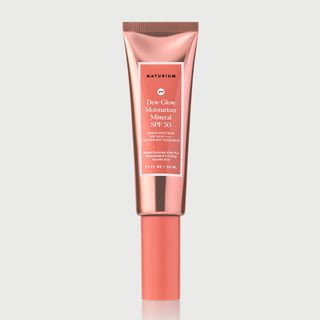
Naturium Dew-Glow Moisturizer Mineral SPF 50
Works for
1 of 1 advertised claim delivered
Sun protectionSPF 50 · 2 UV filtersBroad spectrum
This product offers a good level of protection against both UVB and UVA rays.
This sunscreen uses organic (so-called "chemical") sunscreen filters. Organic, or "chemical" filters usually provide reliable sun protection and rarely leave a white cast. Sunscreens with organic filters can sting eyes.
This product can be considered "reef safe" because it does not contain the UV filters (oxybenzone and octinoxate) that can be harmful to coral reefs when present in the water in high concentrations.
Anti-agingNot advertised by the brand · 2 ingredients credited for this claimStrong support
This product can help prevent early signs of skin aging because it offers a good level of broad spectrum sun protection. Sun damage is the main cause of premature skin aging, and protecting your skin from the sun is the best anti-aging strategy.
Evens skin toneNot advertised by the brand · 2 ingredients credited for this claimStrong support
This product offers broad spectrum sun protection. It means that it can prevent hyperpigmentation and help keep the skin tone even (sun damage is the main factor causing age spots, darkening of post-acne marks and other discolorations).
MoisturizingNot advertised by the brand · 9 ingredients credited for this claimGood support
This product can help improve hydration of the skin with the two types of ingredients.
The first type is called “humectants”:
these ingredients help attract water.
When humectants are on the surface of the skin, they “pull in” the moisture from the outside environment, or from
within deeper layers of the skin. The following ingredients in this product do the job:
galactoarabinan, glycerin.
This product also contains ingredients called “occlusives”. They help reduce the speed with which our skin loses moisture to the outside environment. These ingredients also help soften the upper layer of the skin, so it feels less tight and nicer to the touch. The following ingredients in this product do the job: dimethicone, squalane.
Can it cause trouble?
Irritancy13 flagged ingredientsLow risk
ComedogenicClean of flagged comedogenic ingredientsNone flagged


User reviews
Be the first — your take helps the next person decide.
Ingredients
Filter by role to see what each ingredient is doing.
Zinc oxide10%
- Irritation risk
- Low
A broad spectrum sunblock (protects from both UVA and UVB rays). Is suitable for most sensitive skins. In small concentrations, can be used as a colorant
More about Zinc oxideWater~45–55%
Glycerin~7.1–8.7%
- Irritation risk
- Low
One of the best moisturizing ingredients. Naturally present in skin. It attracts water to the upper layer of the skin working as a humectant
More about GlycerinC13-15 alkane~5–6.1%
Butyloctyl salicylate~3.2–3.9%
- Irritation risk
- Medium
A synthetic ester of salicylic acid that is used to help disperse pigments and boost effectiveness of sunscreen ingredients. It is able to absorb UV light (working as an organic, or chemical filter), but is not approved as a sunscreen ingredient on its own
More about Butyloctyl salicylateTridecyl salicylate~2.2–2.7%
- Irritation risk
- Low
Diethylhexyl 2,6-naphthalate~1.9–2.4%
- Irritation risk
- Low
Calcium sodium borosilicate~1.7–2.1%
Ethylhexyl methoxycrylene~1.5–1.8%
- Irritation risk
- Medium
Helps improve stability of sunscreen filters and boost their effectiveness
More about Ethylhexyl methoxycryleneMica~1.4–1.7%
- Irritation risk
- Low
Creates an illusion of smoother and more radiant skin tone. Adds shimmer to the skin by reflecting light
More about MicaPropanediol~1.1–1.3%
- Irritation risk
- Low
Acts as a solvent for other ingredients. Speeds up the absorption of other ingredients into the skin
More about PropanediolGalactoarabinan~0.8–1.2%
- Irritation risk
- Medium
Helps attract water to the upper layer of the skin
More about GalactoarabinanHydroxyethyl acrylate/sodium acryloyldimethyl taurate copolymer~0.65–0.95%
- Irritation risk
- Medium
A gelling agent that thickens the product consistency and leaves the skin with a velvety finish
More about Hydroxyethyl acrylate/sodium acryloyldimethyl taurate copolymerPolyricinoleic acid~0.6–0.9%
- Irritation risk
- Low
Niacinamide~0.55–0.8%
- Irritation risk
- Low
Is proven to be effective in reducing blemishes, evening out skin tone and helping to improve lines and wrinkles. It helps the skin to repair sun damage, calm down inflammation and keep maintain good levels of moisture. The concentration of about 2% is effective for supporting the skin barrier and evening out the skin tone. Concentration of 4-6% is better for helping with acne and balancing the sebum production
More about NiacinamideDimethicone~0.55–0.85%
- Irritation risk
- Low
A silicone that helps to reduce water loss from the surface of the skin. Can temporarily "fill in" lines and wrinkles, absorb oil, and create a nice product finish
More about DimethiconeSodium cocoyl glutamate~0.6–0.9%
- Irritation risk
- Medium
Helps oil and water mix together
More about Sodium cocoyl glutamatePhenoxyethanol~0.5–0.75%
- Irritation risk
- Low
A preservative. It helps prevent bacterial growth in cosmetic products
More about PhenoxyethanolC15-23 alkane~0.45–0.65%
Polyglyceryl-3 polyricinoleate~0.4–0.65%
- Irritation risk
- Medium
Helps oil and water mix together
More about Polyglyceryl-3 polyricinoleateSorbitan isostearate~0.35–0.6%
- Irritation risk
- Low
Helps oil and water mix together
More about Sorbitan isostearateHydrogenated castor oil/sebacic acid copolymer~0.3–0.6%
- Irritation risk
- Low
Hydroxyacetophenone~0.3–0.55%
Lauryl laurate~0.25–0.45%
- Irritation risk
- Medium
Helps soften the upper layer of the skin
More about Lauryl laurateOryzanol~0.25–0.45%
- Irritation risk
- Low
An anti-oxidant that helps stabilize product formulations. Might help neutralise free radicals in skin
More about OryzanolCoconut oil ethyl ferulate esters~0.25–0.4%
- Irritation risk
- Low
C13-14 alkane~0.2–0.4%
- Irritation risk
- Low
Helps soften the upper layer of the skin
More about C13-14 alkaneDecyl glucoside~0.3–0.55%
- Irritation risk
- High
Helps oil and water mix together. Can be irritating
More about Decyl glucosideBisabolol~0.15–0.3%
- Irritation risk
- Low
An active component of chamomile plant that historically has been used to calm down irritated skin. A recent study shows that bisabolol indeed can have some anti-inflammatory effect on skin, even though conclusive data is lacking. Bisabolol has a sweet floral scent and can be added to products for its aromatic properties
More about BisabololSqualane~0.25–0.45%
- Irritation risk
- Low
An oil naturally present in skin. Works as an emollient to soften the skin and form a protective layer on its surface without a greasy feeling.
More about SqualaneSodium phytate~0.15–0.3%
3-o-ethyl ascorbic acid~0.15–0.25%
- Irritation risk
- High
A vitamin C derivative that is more stable but less potent than pure form of vitamin C. Can help neutralize free radicals and help reduce hyperpigmentation, but the required concentration is likely to be much higher than for the pure form of vitamin C, limiting the ingredient's effectiveness in products
More about 3-o-ethyl ascorbic acidHippophae rhamnoides fruit oil~0.1–0.25%
- Irritation risk
- High
A plant oil that might somewhat help to neutralize free radicals. It could be irritating
More about Hippophae rhamnoides fruit oilTocopheryl acetate~0.1–0.2%
- Irritation risk
- Medium
A more stable but less bio-available form of vitamin E compared to Tocopherol. Might help moisturize and protect the skin from free radicals, but mostly used in low concentrations to stabilize other ingredients.
More about Tocopheryl acetateSodium hyaluronate~0.1–0.15%
- Irritation risk
- Low
One of the best moisturizing ingredients. Attracts water into the upper layer of the skin
More about Sodium hyaluronateIngredient list view
Zinc oxide, Water, Glycerin, C13-15 alkane, Butyloctyl salicylate, Tridecyl salicylate, Diethylhexyl 2,6-naphthalate, Calcium sodium borosilicate, Ethylhexyl methoxycrylene, Mica, Propanediol, Galactoarabinan, Hydroxyethyl acrylate/sodium acryloyldimethyl taurate copolymer, Polyricinoleic acid, Niacinamide, Dimethicone, Sodium cocoyl glutamate, Phenoxyethanol, C15-23 alkane, Polyglyceryl-3 polyricinoleate, Sorbitan isostearate, Hydrogenated castor oil/sebacic acid copolymer, Hydroxyacetophenone, Lauryl laurate, Oryzanol, Coconut oil ethyl ferulate esters, C13-14 alkane, Decyl glucoside, Bisabolol, Squalane, Sodium phytate, 3-o-ethyl ascorbic acid, Hippophae rhamnoides fruit oil, Tocopheryl acetate, Sodium hyaluronate
Compare prices
Retailers ranked by price — lowest first.

Worth comparing, line by line.
Match % combines shared ingredients, the first five ingredients, shared actives and hero ingredients, irritancy (lower counts in the alternative's favour), texture and body area. Only products in the same routine step are compared.
| NaturiumDew-Glow Moisturizer Mineral SPF 50YOUR PRODUCT | CeraVeHydrating Mineral Face Sunscreen Lotion SPF 50 with Zinc Oxide | Skincare by Dr VInZincable SPF 50 | KnoursKoolsol Ultra Light Invisible Mineral Sunscreen Broad Spectrum SPF 50 | |
|---|---|---|---|---|
| Match | — | 79% | 77% | 76% |
| Price | $18.08 | $18.99+$0.91 | $33.32+$15.24 | $25.00+$6.92 |
| Shared key ingredients | — | 6 of 10 | 6 of 10 | 4 of 10 |
| Key difference | — | Panthenol | Copernicia Cerifera Wax | Madecassoside |
| Irritancy | Low | Low | Low | Low |
| SPF | SPF 50 | SPF 50 | SPF 50 | SPF 50 |
| Drying alcohol | — | — | — | — |
| View product | Shop | Shop | Shop |


Sources cited in this review
Every concentration estimate and effectiveness label is anchored to one of these 20 studies and safety reviews.
- 1A review of inorganic UV filters zinc oxide and titanium dioxideonlinelibrary.wiley.com
- 2
- 3
- 4
- 5
- 6

Affiliate links · As an Amazon Associate, WIMJ earns from qualifying purchases.