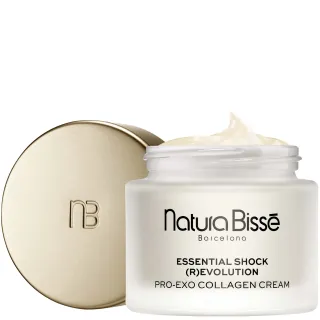
Natura Bissé Essential Shock Evolution Pro-Exo Collagen Cream
Works for
MoisturizingPalmitoyl tetrapeptide-7, Palmitoyl tripeptide-1 + 28 moreWorks well
“Featuring collagen, elastin, antioxidants, wrinkle-targeting ingredients, and pro-vitamin D prebiotics, this pro-firmness moisturizer helps reduce the appearance of wrinkles and loss of elasticity, while providing the extra support your skin needs before, during, and after hormonal changes such as menopause.”
This product can help improve hydration of the skin with the two types of ingredients.
The first type is called “humectants”:
these ingredients help attract water.
When humectants are on the surface of the skin, they “pull in” the moisture from the outside environment, or from
within deeper layers of the skin. The following ingredients in this product do the job:
alanine, arginine.
This product also contains ingredients called “occlusives”. They help reduce the speed with which our skin loses moisture to the outside environment. These ingredients also help soften the upper layer of the skin, so it feels less tight and nicer to the touch. The following ingredients in this product do the job: arginine, butyrospermum parkii butter.
The following ingredients in this product are especially good for supporting the skin barrier and helping with the hydration level: palmitoyl tetrapeptide-7, palmitoyl tripeptide-1
Anti-agingThreonine, Palmitoyl tripeptide-1 + 6 moreMay help
“Featuring collagen, elastin, antioxidants, wrinkle-targeting ingredients, and pro-vitamin D prebiotics, this pro-firmness moisturizer helps reduce the appearance of wrinkles and loss of elasticity, while providing the extra support your skin needs before, during, and after hormonal changes such as menopause.”
This product contains aspartic acid, palmitoyl tetrapeptide-7, palmitoyl tripeptide-1, serine, threonine. There is some human evidence that these ingredients help reduce and prevent fine lines and wrinkles and improve skin elasticity and firmness, though it is smaller or less consistent than the evidence for the best anti-aging ingredients.
Can it cause trouble?
Irritancy11 strong irritants: Withania somnifera root extract, Parfum + 9 more — patch-test recommendedHigh risk
Comedogenic1 ingredient rated 2 or more on the 0–5 pore-clogging scale1 flagged


User reviews
Be the first — your take helps the next person decide.
Ingredients
Filter by role to see what each ingredient is doing.
Water~45–55%
Caprylic/capric triglyceride~5.5–6.7%
- Irritation risk
- Medium
A good mix of fatty acids that forms a protective layer on the skin. Improves the shelf life of products. Derived from coconut and glycerin
More about Caprylic/capric triglycerideCetearyl ethylhexanoate~4.4–5.4%
- Irritation risk
- Low
An emollient that helps soften the skin
More about Cetearyl ethylhexanoateGlyceryl stearate~2.8–3.5%
- Irritation risk
- Low
An emollient that softens the skin and forms a protective layer on its surface. Helps water and oil mix together
More about Glyceryl stearateGlycerin~2.4–3%
- Irritation risk
- Low
One of the best moisturizing ingredients. Naturally present in skin. It attracts water to the upper layer of the skin working as a humectant
More about GlycerinC15-19 alkane~1.9–2.3%
- Irritation risk
- Low
Helps soften the upper layer of the skin and create a nice product texture
More about C15-19 alkanePropanediol~1.6–2%
- Irritation risk
- Low
Acts as a solvent for other ingredients. Speeds up the absorption of other ingredients into the skin
More about PropanediolCetyl alcohol~1.4–1.8%
- Irritation risk
- Low
A non-drying alcohol that works to soften the skin and stabilize product formulations helping oil and water mix together
More about Cetyl alcoholButyrospermum parkii butter~1.2–1.5%
- Irritation risk
- Low
- Comedogenicity
- 3/5
A great moisturising ingredient that softens the skin and reduces water loss from its upper layer. It also can be helpful in protecting skin from free radicals
More about Butyrospermum parkii butterTribehenin~0.9–1.1%
- Irritation risk
- Low
Used to create a thicker product consistency and soften the upper layer of the skin
More about TribeheninNiacinamide~0.6–0.95%
- Irritation risk
- Low
Is proven to be effective in reducing blemishes, evening out skin tone and helping to improve lines and wrinkles. It helps the skin to repair sun damage, calm down inflammation and keep maintain good levels of moisture. The concentration of about 2% is effective for supporting the skin barrier and evening out the skin tone. Concentration of 4-6% is better for helping with acne and balancing the sebum production
More about NiacinamideBeta vulgaris root extract~0.5–0.75%
- Irritation risk
- Medium
A plant extract that might have some antioxidant properties, but mostly used in cosmetics for its color
More about Beta vulgaris root extractFructooligosaccharides~0.45–0.65%
- Irritation risk
- Low
Help attract water to the upper layer of the skin
More about FructooligosaccharidesPotassium lactate~0.35–0.65%
- Irritation risk
- Low
Sh-polypeptide-69~0.3–0.6%
- Irritation risk
- Low
Withania somnifera root extract~0.3–0.55%
- Irritation risk
- High
Alanine~0.3–0.55%
- Irritation risk
- Low
An amino-acid that helps to attract water to the upper layer of the skin and might help to lighten the skin, but solid evidence is lacking
More about AlanineArginine~0.25–0.5%
- Irritation risk
- Low
An amino acid that is naturally present in skin and helps keep it hydrated. When used together with AHAs, it can reduce their irritating effect on the skin
More about ArginineAspartic acid~0.25–0.45%
- Irritation risk
- Low
An amino-acid that helps increase skin hydration and might help to slightly improve skin firmness, potentially reducing lines and wrinkles
More about Aspartic acidGlyceryl linoleate~0.3–0.5%
- Irritation risk
- Medium
Helps oil and water mix together
More about Glyceryl linoleateGlyceryl linolenate~0.25–0.45%
- Irritation risk
- Low
Helps soften the upper layer of the skin
More about Glyceryl linolenateGlycine~0.2–0.35%
- Irritation risk
- Low
Helps to attract water to the upper layer of the skin and can help restore the skin barrier function
More about GlycineHistidine~0.2–0.35%
Hydrolyzed collagen~0.25–0.45%
- Irritation risk
- Low
A typically plant-derived compound that is supposed mimic human collagen. Cannot penetrate the skin barrier so is not particularly useful in skincare products beyond attracting water to the upper layer of the skin
More about Hydrolyzed collagenHydrolyzed elastin~0.25–0.45%
- Irritation risk
- Low
Isoleucine~0.2–0.4%
- Irritation risk
- Low
An amino acid that can help attract water to the upper layer of the skin and support skin's barrier function
More about IsoleucineLactic acid~0.2–0.4%
- Irritation risk
- Medium
An exfoliating and moisturizing alpha-hydroxy acid (AHA). Typically causes less irritation than other AHAs, for example, glycolic acid. At high concentrations (about 15%), lactic acid can help reduce lines and wrinkles. Recent studies show that lactic acid can support the "good" bacteria living on skin's surface (healthy skin microbiome)
More about Lactic acidPalmitoyl tetrapeptide-7~0.25–0.5%
- Irritation risk
- Low
A type of peptide. Peptides are excellent moisturizers and might be able support collagen production reducing fine lines and wrinkles
More about Palmitoyl tetrapeptide-7Palmitoyl tripeptide-1~0.25–0.5%
- Irritation risk
- Low
A type of peptide. Peptides are excellent moisturizers and might be able support collagen production reducing fine lines and wrinkles
More about Palmitoyl tripeptide-1Pca~0.2–0.4%
- Irritation risk
- Low
Naturally present in skin and helps to attract water to its upper layer
More about PcaPhenylalanine~0.25–0.45%
- Irritation risk
- Low
Proline~0.25–0.45%
Serine~0.2–0.4%
- Irritation risk
- Low
An amino-acid that helps to attract water to the upper layer of the skin. In combination with other amino-acids, might help to reduce fine lines and wrinkles
More about SerineSodium lactate~0.25–0.45%
- Irritation risk
- Medium
Helps attract water to the upper layer of the skin. Is often used to adjust the pH level of the product
More about Sodium lactateSodium pca~0.25–0.45%
- Irritation risk
- Low
Naturally present in skin and helps to attract water to its upper layer
More about Sodium pcaSoluble proteoglycan~0.2–0.4%
- Irritation risk
- Low
Threonine~0.25–0.45%
- Irritation risk
- Low
An amino-acid that helps to attract water to the upper layer of the skin. In combination with other amino-acids, might help to reduce fine lines and wrinkles
More about ThreonineTocopheryl acetate~0.25–0.45%
- Irritation risk
- Medium
A more stable but less bio-available form of vitamin E compared to Tocopherol. Might help moisturize and protect the skin from free radicals, but mostly used in low concentrations to stabilize other ingredients.
More about Tocopheryl acetateValine~0.2–0.4%
- Irritation risk
- Low
1,2-hexanediol~0.25–0.45%
Butylene glycol~0.25–0.45%
- Irritation risk
- Low
Used to create a nice product texture and help delivery of other ingredients. Might be somewhat helpful in attracting water to the upper layer of the skin
More about Butylene glycolCaprylyl glycol~0.25–0.5%
- Irritation risk
- Medium
Helps preserve products and creates a nice product texture
More about Caprylyl glycolEthylhexylglycerin~0.25–0.45%
Dimethicone~0.3–0.55%
- Irritation risk
- Low
A silicone that helps to reduce water loss from the surface of the skin. Can temporarily "fill in" lines and wrinkles, absorb oil, and create a nice product finish
More about DimethiconeCarbomer~0.25–0.45%
- Irritation risk
- Low
Helps create a thicker or gel-like product texture. It is not a surfactant but can be used in gentle cleansing formulations
More about CarbomerCeteth-20~0.35–0.65%
Peg-75 stearate~0.25–0.45%
Polysorbate 20~0.25–0.5%
Steareth-20~0.3–0.6%
Disodium edta~0.25–0.45%
Phenoxyethanol~0.25–0.45%
- Irritation risk
- Low
A preservative. It helps prevent bacterial growth in cosmetic products
More about PhenoxyethanolParfum~0.2–0.4%
- Irritation risk
- High
An aromatic blend of unspecified and possibly irritating ingredients
More about ParfumBenzyl benzoate~0.2–0.4%
- Irritation risk
- High
Fragrance with sweet balsamic smell. Help to preserve products and dissolve other ingredients. Could trigger allergic reactions and be irritating
More about Benzyl benzoateBeta-caryophyllene~0.2–0.35%
- Irritation risk
- Low
Camphor~0.25–0.45%
- Irritation risk
- High
Cananga odorata oil/extract~0.2–0.35%
- Irritation risk
- Low
Cinnamyl alcohol~0.2–0.4%
- Irritation risk
- High
Citral~0.2–0.4%
Citronellol~0.2–0.4%
Citrus aurantium peel oil~0.2–0.35%
- Irritation risk
- Low
Citrus limon peel oil~0.2–0.4%
Geraniol~0.2–0.35%
Geranyl acetate~0.2–0.35%
- Irritation risk
- Low
Hexamethylindanopyran~0.2–0.4%
- Irritation risk
- Low
Juniperus virginiana oil~0.2–0.4%
- Irritation risk
- Medium
Cedarwood oil. Used as a fragrance. Can be irritating
More about Juniperus virginiana oilLavandula oil/extract~0.15–0.3%
- Irritation risk
- Low
Limonene~0.2–0.35%
- Irritation risk
- High
A common frangrance that can easily irritate skin, especially if exposed to air, light or heat
More about LimoneneLinalool~0.15–0.3%
Linalyl acetate~0.15–0.3%
- Irritation risk
- Low
Pinene~0.15–0.3%
- Irritation risk
- Low
Terpineol~0.15–0.3%
- Irritation risk
- Low
Vanillin~0.15–0.3%
- Irritation risk
- Low
Caramel~0.1–0.2%
- Irritation risk
- Low
Ci 19140~0.1–0.2%
Ingredient list view
Water, Caprylic/capric triglyceride, Cetearyl ethylhexanoate, Glyceryl stearate, Glycerin, C15-19 alkane, Propanediol, Cetyl alcohol, Butyrospermum parkii butter, Tribehenin, Niacinamide, Beta vulgaris root extract, Fructooligosaccharides, Potassium lactate, Sh-polypeptide-69, Withania somnifera root extract, Alanine, Arginine, Aspartic acid, Glyceryl linoleate, Glyceryl linolenate, Glycine, Histidine, Hydrolyzed collagen, Hydrolyzed elastin, Isoleucine, Lactic acid, Palmitoyl tetrapeptide-7, Palmitoyl tripeptide-1, Pca, Phenylalanine, Proline, Serine, Sodium lactate, Sodium pca, Soluble proteoglycan, Threonine, Tocopheryl acetate, Valine, 1,2-hexanediol, Butylene glycol, Caprylyl glycol, Ethylhexylglycerin, Dimethicone, Carbomer, Ceteth-20, Peg-75 stearate, Polysorbate 20, Steareth-20, Disodium edta, Phenoxyethanol, Parfum, Benzyl benzoate, Beta-caryophyllene, Camphor, Cananga odorata oil/extract, Cinnamyl alcohol, Citral, Citronellol, Citrus aurantium peel oil, Citrus limon peel oil, Geraniol, Geranyl acetate, Hexamethylindanopyran, Juniperus virginiana oil, Lavandula oil/extract, Limonene, Linalool, Linalyl acetate, Pinene, Terpineol, Vanillin, Caramel, Ci 19140
Compare prices
Retailers ranked by price — lowest first.

Worth comparing, line by line.
Match % combines shared ingredients, the first five ingredients, shared actives and hero ingredients, irritancy (lower counts in the alternative's favour), texture and body area. Only products in the same routine step are compared.
| Natura BisséEssential Shock Evolution Pro-Exo Collagen CreamYOUR PRODUCT | NEOGEN X SUR.MEDICProbiotics Youth Repair Cream | KLAVUURejuve Pearlsation Multi Pearl Peptide Cream | Transparent LabNiacinamide Glow Cream | |
|---|---|---|---|---|
| Match | — | 94% | 94% | 92% |
| Price | $165.00 | $25.33−$139.67 | $29.10−$135.90 | — |
| Shared key ingredients | — | 19 of 20 | 15 of 20 | 13 of 20 |
| Key difference | — | Hexapeptide-11 | Acetyl Dipeptide-1 Cetyl Ester | Gluconolactone |
| Irritancy | High | Medium | Medium | Medium |
| Drying alcohol | — | — | — | — |
| View product | Shop | Shop | Shop |

More alternatives: MEDI-PEEL Peptide 9 Volume and Tension Tox Cream ProEight Saints Up the Anti Night Cream
Sources cited in this review
Every concentration estimate and effectiveness label is anchored to one of these 19 studies and safety reviews.
- 1
- 2
- 3
- 4
- 5
- 6

Affiliate links · As an Amazon Associate, WIMJ earns from qualifying purchases.