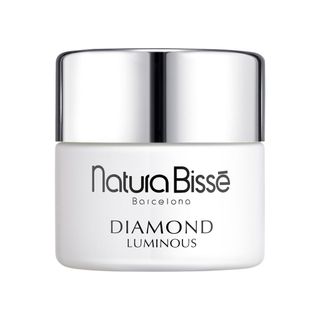
Natura Bissé Diamond Luminous Perfecting Cream
Works for
3 of 3 advertised claims delivered
Moisturizing19 ingredients credited for this claimStrong evidence
“Helping to firm the skin, this daily cream also works to address signs of ageing.Formulated with four different molecular weights of hyaluronic acid and organic aloe vera, this daily cream works to deeply moisturise the skin.”
This product can help improve hydration of the skin with the two types of ingredients.
The first type is called “humectants”:
these ingredients help attract water.
When humectants are on the surface of the skin, they “pull in” the moisture from the outside environment, or from
within deeper layers of the skin. The following ingredients in this product do the job:
carnosine, sodium acetylated hyaluronate.
This product also contains ingredients called “occlusives”. They help reduce the speed with which our skin loses moisture to the outside environment. These ingredients also help soften the upper layer of the skin, so it feels less tight and nicer to the touch. The following ingredients in this product do the job: dimethicone, cetyl palmitate.
The following ingredients in this product are especially good for supporting the skin barrier and helping with the hydration level: niacinamide
Anti-aging4 ingredients credited for this claimStrong evidence
“Helping to firm the skin, this daily cream also works to address signs of ageing.Formulated with four different molecular weights of hyaluronic acid and organic aloe vera, this daily cream works to deeply moisturise the skin.”
This product can help reduce and prevent fine lines and wrinkles, improve skin elasticity and firmness because it contains niacinamide.
These ingredients in the product can also be helpful, even though there is less evidence for their effectiveness: carnosine.
Keep in mind that it typically takes at least 6 weeks to notice any results because the changes that are needed to improve fine lines and elasticity happen in the deeper layers of the skin. No topical anti-aging product can “erase” wrinkles or fully reverse signs of aging.
Evens skin tone4 ingredients credited for this claimStrong evidence
“Improve the appearance of dull, uneven skin tone with the help of Natura Bissé Diamond Luminous Perfecting Cream, a daily cream that works to enhance the complexion’s radiance and helps to fade the appearance of dark spots.”
This product can help reduce hypepigmentation and even out the skin tone because it contains the following effective ingredients: alpha-arbutin, niacinamide
The following ingredient (ingredients) in this product might be helpful, but there is no evidence to confirm that it actually can help even out the skin tone: glycyrrhiza glabra root extract.
Keep in mind that you would need to apply any topical skincare targetted at hypigmentation consistently for a couple of months to get a result. No topical skincare product can help get rid of hyperpigmentation (including post-acne marks and age spots) instantly.
Anti-blemishNot advertised by the brand · 1 ingredient credited for this claimStrong evidence
This product can help reduce breakouts and clogged pores because it contains the following ingredient: niacinamide. This ingredient is used for treating acne and can have a noticeable effect.
Anti-oxidationNot advertised by the brand · 4 ingredients credited for this claimStrong evidence
This product contains antioxidants (carnosine) that can help neutralize free radicals in skin. By doing so, they can lessen the damage the skin gets from the UV light (sun).
Can it cause trouble?
Irritancy6 strong irritants: Alcohol, Parfum + 4 more — patch-test recommendedHigh risk
Comedogenic1 ingredient rated 2 or more on the 0–5 pore-clogging scale1 flagged


User reviews
Be the first — your take helps the next person decide.
Ingredients
Filter by role to see what each ingredient is doing.
Water~45–55%
Niacinamide~4.5–5.5%
- Irritation risk
- Low
Is proven to be effective in reducing blemishes, evening out skin tone and helping to improve lines and wrinkles. It helps the skin to repair sun damage, calm down inflammation and keep maintain good levels of moisture. The concentration of about 2% is effective for supporting the skin barrier and evening out the skin tone. Concentration of 4-6% is better for helping with acne and balancing the sebum production
More about NiacinamidePropanediol~3.9–4.8%
- Irritation risk
- Low
Acts as a solvent for other ingredients. Speeds up the absorption of other ingredients into the skin
More about PropanediolCaprylyl methicone~3.1–3.7%
- Irritation risk
- Low
A type of silicone that helps to soften the upper layer of the skin and create a nice product finish on the skin
More about Caprylyl methiconePropylheptyl caprylate~2.4–2.9%
- Irritation risk
- Low
Helps soften the upper layer of the skin
More about Propylheptyl caprylateSodium acrylates copolymer~1.7–2.1%
- Irritation risk
- Medium
Used to create a thicker product consistency
More about Sodium acrylates copolymerSilica~1.8–2.2%
Brassica campestris seed oil~1.4–1.7%
- Irritation risk
- Low
Helps soften the upper layer of the skin
More about Brassica campestris seed oilCarnosine~1.1–1.4%
- Irritation risk
- Low
A type of peptide. It attracts water to the upper layer of the skin. It can help neutralize free radicals in skin combatting the sun damage
More about CarnosineGlycyrrhiza glabra root extract~0.7–1.1%
- Irritation risk
- Medium
A plant extract that can help lighten the skin and calm down inflammation. Might be helpful in neutralizing free radicals
More about Glycyrrhiza glabra root extractAloe barbadensis leaf juice powder~0.7–1.05%
- Irritation risk
- Medium
Traditionally used to treat sunburns, dermatitis and inflammation, but evidence for its effectiveness is lacking. The extract can contain humectants that help attract water into the skin
More about Aloe barbadensis leaf juice powderAlpha-arbutin~0.6–0.9%
- Irritation risk
- Medium
Might help reduce hyperpigmentation when used regularly over a long period of time. Is more effective than beta-arbutin
More about Alpha-arbutinSodium phytate~0.55–0.85%
Althaea officinalis root extract~0.5–0.75%
- Irritation risk
- High
A plant extract that can help attract water to the upper layer of the skin and might help to reduce inflammation
More about Althaea officinalis root extractOryza sativa bran extract~0.5–0.7%
Sodium acetylated hyaluronate~0.5–0.75%
- Irritation risk
- Low
A type of hyaluronic acid that works as an excellent moisturizer by attracting water into the upper layer of the skin. Is typically feels less sticky on the skin compared to the usual hyaluronic acid
More about Sodium acetylated hyaluronateSodium hyaluronate~0.45–0.7%
- Irritation risk
- Low
One of the best moisturizing ingredients. Attracts water into the upper layer of the skin
More about Sodium hyaluronateSodium hyaluronate crosspolymer~0.45–0.65%
- Irritation risk
- Medium
Attracts water into the upper layer of the skin
More about Sodium hyaluronate crosspolymerHydrolyzed sodium hyaluronate~0.4–0.6%
- Irritation risk
- Low
Attracts water into the upper layer of the skin
More about Hydrolyzed sodium hyaluronatePalmitoyl tetrapeptide-10~0.35–0.6%
- Irritation risk
- Low
Curcuma longa root extract~0.3–0.55%
- Irritation risk
- High
A plant extract that can contain an active compound curcumin, that may have some anti-inflammatory properties when applied to the skin, but solid research is lacking and the typical concentration used in skincare products is too low. Can be an irritant
More about Curcuma longa root extractCaprylic/capric triglyceride~0.4–0.65%
- Irritation risk
- Medium
A good mix of fatty acids that forms a protective layer on the skin. Improves the shelf life of products. Derived from coconut and glycerin
More about Caprylic/capric triglycerideC15-19 alkane~0.3–0.55%
- Irritation risk
- Low
Helps soften the upper layer of the skin and create a nice product texture
More about C15-19 alkaneDimethicone~0.4–0.6%
- Irritation risk
- Low
A silicone that helps to reduce water loss from the surface of the skin. Can temporarily "fill in" lines and wrinkles, absorb oil, and create a nice product finish
More about DimethiconePeg-12 dimethicone/ppg-20 crosspolymer~0.35–0.6%
- Irritation risk
- Low
Helps water and oil mix together
More about Peg-12 dimethicone/ppg-20 crosspolymerLecithin~0.35–0.65%
- Irritation risk
- Low
Used mostly for creating emulsions - helping oil and water mix together. Helps soften the upper layer of the skin
More about LecithinSynthetic fluorphlogopite~0.35–0.6%
- Irritation risk
- Low
A mineral that is used as an optical filter (makes the skin looks nicer through light reflection) and to improve the texture of cosmetic products
More about Synthetic fluorphlogopitePotassium cetyl phosphate~0.35–0.6%
- Irritation risk
- Medium
Helps oil and water mix together
More about Potassium cetyl phosphatePolyglyceryl-3 diisostearate~0.35–0.6%
- Irritation risk
- Medium
- Comedogenicity
- 3/5
Helps oil and water mix together
More about Polyglyceryl-3 diisostearateCetyl palmitate~0.35–0.6%
- Irritation risk
- Low
An emollient that helps soften the skin and is used to improve product texture and stability
More about Cetyl palmitateEthylhexylglycerin~0.3–0.55%
Sorbitan stearate~0.3–0.6%
Polysorbate 80~0.35–0.6%
Octadecyl di-t-butyl-4-hydroxyhydrocinnamate~0.3–0.6%
- Irritation risk
- Low
Lactic acid~0.3–0.55%
- Irritation risk
- Medium
An exfoliating and moisturizing alpha-hydroxy acid (AHA). Typically causes less irritation than other AHAs, for example, glycolic acid. At high concentrations (about 15%), lactic acid can help reduce lines and wrinkles. Recent studies show that lactic acid can support the "good" bacteria living on skin's surface (healthy skin microbiome)
More about Lactic acidPentylene glycol~0.35–0.65%
- Irritation risk
- Medium
Used to preserve products, dissolve other ingredients and create a nice product texture
More about Pentylene glycolHydrogenated lecithin~0.3–0.6%
- Irritation risk
- Low
Helps to retain moisture by creating a protective barrier on the skin. Rich in fatty acids. Improves product texture and helps with the penetration of other ingredients.
More about Hydrogenated lecithinCitric acid~0.3–0.55%
- Irritation risk
- Medium
Can work as an exfoliant but is typically used to adjust the product pH
More about Citric acidTocopherol~0.3–0.55%
- Irritation risk
- Low
Pure form of vitamin E. Can help moisturise and protect the skin from free radicals. Often used to help stabilise other ingredients or the formula itself
More about TocopherolAlcohol~0.3–0.55%
- Irritation risk
- High
Can be drying and contribute to skin irritation. Used in formulars to dissolve other ingredients, create a thinner product consistency or for its antibacterial properties
More about AlcoholPhenoxyethanol~0.3–0.55%
- Irritation risk
- Low
A preservative. It helps prevent bacterial growth in cosmetic products
More about PhenoxyethanolSodium benzoate~0.25–0.5%
Parfum~0.25–0.45%
- Irritation risk
- High
An aromatic blend of unspecified and possibly irritating ingredients
More about ParfumLinalool~0.25–0.45%
Coumarin~0.2–0.4%
Amyl cinnamal~0.2–0.35%
- Irritation risk
- High
Limonene~0.15–0.3%
- Irritation risk
- High
A common frangrance that can easily irritate skin, especially if exposed to air, light or heat
More about LimoneneTitanium dioxide~0.25–0.5%
- Irritation risk
- Low
Works as a UV filter when used in high concentrations. It is photostable and is effective mostly against the UVB light, with some protection in the UVA range. In small concentrations, used for its ability to improve the color of cosmetic products. Is usually well tolerated by the skin
More about Titanium dioxideCi 77891~0.15–0.25%
- Irritation risk
- Low
Tin oxide~0.25–0.45%
- Irritation risk
- Low
A colorant that can add a pearl-like appearance to the formulation
More about Tin oxideCi 14700~0.15–0.25%
Datem~0.1–0.25%
Ingredient list view
Water, Niacinamide, Propanediol, Caprylyl methicone, Propylheptyl caprylate, Sodium acrylates copolymer, Silica, Brassica campestris seed oil, Carnosine, Glycyrrhiza glabra root extract, Aloe barbadensis leaf juice powder, Alpha-arbutin, Sodium phytate, Althaea officinalis root extract, Oryza sativa bran extract, Sodium acetylated hyaluronate, Sodium hyaluronate, Sodium hyaluronate crosspolymer, Hydrolyzed sodium hyaluronate, Palmitoyl tetrapeptide-10, Curcuma longa root extract, Caprylic/capric triglyceride, C15-19 alkane, Dimethicone, Peg-12 dimethicone/ppg-20 crosspolymer, Lecithin, Synthetic fluorphlogopite, Potassium cetyl phosphate, Polyglyceryl-3 diisostearate, Cetyl palmitate, Ethylhexylglycerin, Sorbitan stearate, Polysorbate 80, Octadecyl di-t-butyl-4-hydroxyhydrocinnamate, Lactic acid, Pentylene glycol, Hydrogenated lecithin, Citric acid, Tocopherol, Alcohol, Phenoxyethanol, Sodium benzoate, Parfum, Linalool, Coumarin, Amyl cinnamal, Limonene, Titanium dioxide, Ci 77891, Tin oxide, Ci 14700, Datem
Compare prices
Retailers ranked by price — lowest first.


Worth comparing, line by line.
Match % combines shared ingredients, the first five ingredients, shared actives and hero ingredients, irritancy (lower counts in the alternative's favour), texture and body area. Only products in the same routine step are compared.
| Natura BisséDiamond Luminous Perfecting CreamYOUR PRODUCT | MedicubeTXA + Niacinamide Capsule Cream | MEDI-PEELMelanon X Cream 30ml | ElsheSkinRadiant Glow Brightening Moisturiser | |
|---|---|---|---|---|
| Match | — | 85% | 78% | 77% |
| Price | $240.00 | $15.90−$224.10 | $12.50−$227.50 | — |
| Shared key ingredients | — | 7 of 13 | 5 of 13 | 6 of 13 |
| Key difference | — | 3-O-Ethyl Ascorbic Acid | Adenosine | Hexapeptide-2 |
| Irritancy | High | Medium | Medium | Medium |
| Drying alcohol | Contains drying alcohol | — | — | — |
| View product | Shop | Shop | Shop |
Product summary
"Natura Bissé - Diamond Luminous Perfecting Cream" has a good moisturizing formula. This moisturizer uses a good combo of humectants and emollients. These both types of ingredients are essentials for improving the skin hydration and keeping the skin barrier healthy. Humectants in this product (carnosine, sodium acetylated hyaluronate, sodium hyaluronate and sodium hyaluronate crosspolymer) help to increase the water content in the upper layer of the skin. (These ingredients do so by "capturing" water molecules from the outside air or from within the deeper layers of the skin). Dimethicone, cetyl palmitate, propylheptyl caprylate and pentylene glycol in this product help decrease the water evoporation from the skin, so that it stays hydrated for longer. These ingredients also soften the skin and take away the feeling of tightness and dryness.
Ingredient callouts
- We love that this moisturizer contains a good concentration of niacinamide 4.50% - 5.50%. Niacinamide is a perfect active in a moistruizer because it helps calm down inflamation in skin and support the skin barrier. More than that, it is helpful for most common skin concerns: it helps regulat oil production, help reduce acne and clogged pores, improve skin tone and prevent pigmentation marks. It also helps fight photodamage.
Irritation risk
There are quite a few common irritants in this product, including ingredients without particular skin benefits. We would not recommend it for sensitive skin. We assess the overall irritancy of this moisturizer to be high. For a detailed overview of all potential irritants: click here
You can see the detailed formula review with the breakdown of all actives in the product and the full ingredient list with estimated concentrations in the tables below.
Price
The product retails from 240.00$ up to 267.00$ in the United States and from 185.00£ up to 1511.00£ in the United Kingdom.
For a detailed price comparison: click here.
Sources cited in this review
Every concentration estimate and effectiveness label is anchored to one of these 15 studies and safety reviews.
- 1
- 2
- 3
- 4
- 5
- 6Hyaluronic acid: A key molecule in skin agingncbi.nlm.nih.gov

Affiliate links · As an Amazon Associate, WIMJ earns from qualifying purchases.