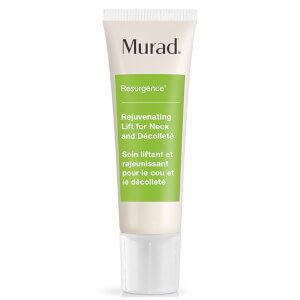
Murad Rejuvenating Lift for Neck and Decollete
Works for
3 of 3 advertised claims delivered
Evens skin tone8 ingredients credited for this claimStrong support
“Bearberry and liquorice root extracts lighten, brighten and even skin tone to reduce the appearance of age spots and discolouration whilst a natural botanical blend helps to improve the skin's elasticity and suppleness.”
This product can help reduce hypepigmentation and even out the skin tone because it contains the following effective ingredients: glycolic acid
The following ingredient (ingredients) in this product might be helpful, but there is no evidence to confirm that it actually can help even out the skin tone: glycine soja protein, punica granatum extract.
Keep in mind that you would need to apply any topical skincare targetted at hypigmentation consistently for a couple of months to get a result. No topical skincare product can help get rid of hyperpigmentation (including post-acne marks and age spots) instantly.
Anti-aging7 ingredients credited for this claimStrong support
“Murad Rejuvenating Lift for Neck and Décolleté (50ml) An anti-ageing neck and décolleté cream to nourish, firm and smooth the skin.”
This product can help reduce and prevent fine lines and wrinkles, improve skin elasticity and firmness because it contains glycolic acid.
These ingredients in the product can also be helpful, even though there is less evidence for their effectiveness: tripeptide-10 citrulline.
Keep in mind that it typically takes at least 6 weeks to notice any results because the changes that are needed to improve fine lines and elasticity happen in the deeper layers of the skin. No topical anti-aging product can “erase” wrinkles or fully reverse signs of aging.
Moisturizing19 ingredients credited for this claimStrong support
“Murad Rejuvenating Lift for Neck and Décolleté (50ml) An anti-ageing neck and décolleté cream to nourish, firm and smooth the skin.”
This product can help improve hydration of the skin with the two types of ingredients.
The first type is called “humectants”:
these ingredients help attract water.
When humectants are on the surface of the skin, they “pull in” the moisture from the outside environment, or from
within deeper layers of the skin. The following ingredients in this product do the job:
avena sativa kernel flour, glycerin.
This product also contains ingredients called “occlusives”. They help reduce the speed with which our skin loses moisture to the outside environment. These ingredients also help soften the upper layer of the skin, so it feels less tight and nicer to the touch. The following ingredients in this product do the job: avena sativa kernel flour, cetearyl alcohol.
The following ingredients in this product are especially good for supporting the skin barrier and helping with the hydration level: tripeptide-10 citrulline
ExfoliationNot advertised by the brand · 3 ingredients credited for this claimStrong support
This product can help exfoliate the skin. In other words, it helps break down the bonds between dead cells on the surface of the skin and speed up the skin turnover. Skin often appears softer and brighter after exfoliation, but overdoing it can result in disrupted skin barrier. The following ingredient is doing the exfoliating job in this product: glycolic acid.
Anti-oxidationNot advertised by the brand · 7 ingredients credited for this claimModerate support
This product contains antioxidants (chitosan, punica granatum extract) that might be able to help neutralize free radicals in skin to lessen the damage it gets from the UV light (sun). There is not enough evidence to confirm their effectiveness in skin though.
Anti-blemishNot advertised by the brand · 4 ingredients credited for this claimGood support
This product might be able to help reduce blemishes and clogged pores because it contains chitosan.
The following ingredient (ingredients) in this product might be helpful, but there is no evidence to confirm that it actually works: glycolic acid
Can it cause trouble?
Irritancy4 strong irritants: Retinyl palmitate, Limonene + 2 more — patch-test recommendedHigh risk
Comedogenic4 ingredients rated 2 or more on the 0–5 pore-clogging scale4 flagged
User reviews
Be the first — your take helps the next person decide.
Ingredients
Filter by role to see what each ingredient is doing.
Water~45–55%
Glycolic acid~4.4–5.4%
- Irritation risk
- High
An alpha-hydroxy acid (AHA) that helps to remove the dead skin cells on the surface of the skin reveling a more even, smoother complexation. It is also able to stimulate collagen production with long-term use. Could help to reduce pore congestion. It can be irritating to the skin. Apply sunscreen daily if using products with glycolic acid
More about Glycolic acidSodium hydroxide~4.1–5%
Ppg-12/smdi copolymer~3.1–3.8%
Sclerotium gum~2.2–2.7%
- Irritation risk
- Low
Used to create gel-like formulas and stabilize emulsions
More about Sclerotium gumAvena sativa kernel flour~1.9–2.3%
- Irritation risk
- Low
A type of colloidal oatmeal. Can contain potent antioxidants and anti-inflammatory compounds. Is effective in supporting skin barrier
More about Avena sativa kernel flourDicaprylyl maleate~1.6–1.9%
- Irritation risk
- Medium
Used to dissolve other ingredients, create a nice product texture and soften the upper layer of the skin. Can be an allergen
More about Dicaprylyl maleatePollen extract~1.4–1.7%
- Irritation risk
- Low
Glycine soja oil unsaponifiables~1.1–1.4%
- Irritation risk
- Low
- Comedogenicity
- 2/5
Olea europaea oil unsaponifiables~0.8–1.2%
- Irritation risk
- Low
Help soften the upper layer of the skin
More about Olea europaea oil unsaponifiablesTriticum vulgare germ oil unsaponifiables~0.65–1%
- Irritation risk
- Low
- Comedogenicity
- 2/5
Glycine soja protein~0.55–0.85%
- Irritation risk
- Low
A plant extract that helps to attract water to the upper layer of the skin and soften it. It might be helpful in neutralizing free radicals. It might be somewhat helpful for evening out the skin tone. It might be able to support elastin production but solid research is lacking
More about Glycine soja proteinLysine hcl~0.45–0.7%
Lecithin~0.5–0.7%
- Irritation risk
- Low
Used mostly for creating emulsions - helping oil and water mix together. Helps soften the upper layer of the skin
More about LecithinCaprylyl glycol~0.45–0.65%
- Irritation risk
- Medium
Helps preserve products and creates a nice product texture
More about Caprylyl glycolTripeptide-10 citrulline~0.4–0.6%
- Irritation risk
- Low
A type of peptide. Peptides are excellent moisturizers and might be able support collagen production reducing fine lines and wrinkles
More about Tripeptide-10 citrullineRetinyl palmitate~0.3–0.6%
- Irritation risk
- High
Three steps removed from the active form of vitamin A - retinoic acid. To have an effect in the skin, it first needs to be converted twice to become the retinoic acid. This means it is less potent than retinol, but could also be less irritating. Once converted to the retinoic acid in the skin, it helps against all signs of aging, improves skin cell turnover and helps fight blemishes and clogged pores. However, in many cosmetic formulations, it is used in a concentration that is too low to have the full effect
More about Retinyl palmitateTocopheryl acetate~0.35–0.6%
- Irritation risk
- Medium
A more stable but less bio-available form of vitamin E compared to Tocopherol. Might help moisturize and protect the skin from free radicals, but mostly used in low concentrations to stabilize other ingredients.
More about Tocopheryl acetateArctostaphylos uva-ursi leaf extract~0.3–0.55%
- Irritation risk
- Low
Magnesium ascorbyl phosphate~0.25–0.5%
- Irritation risk
- Medium
A derivative of vitamin C that is more stable, but less bioavailable than the pure form of vitamin C. It does not penetrate the skin well, but has been shown to convert to pure vitamin C once in skin. It can be helpful in stimulating collagen production and lightening the skin tone, but the required concentration is likely to be very high
More about Magnesium ascorbyl phosphateGlycerin~0.3–0.55%
- Irritation risk
- Low
One of the best moisturizing ingredients. Naturally present in skin. It attracts water to the upper layer of the skin working as a humectant
More about GlycerinSpondias mombin pulp extract~0.25–0.45%
- Irritation risk
- Low
Mangifera indica pulp extract~0.25–0.4%
- Irritation risk
- Low
Musa sapientum pulp extract~0.25–0.4%
- Irritation risk
- Low
Ascorbic acid~0.25–0.45%
- Irritation risk
- High
The most well-researched antioxidant that works in skin. Helps neutralize free radicals supporting collagen production, helping to even out the skin tone and preventing early signs of aging
More about Ascorbic acidChitosan~0.25–0.45%
- Irritation risk
- Medium
Inhibits acne-causing bacteria on the surface of the skin. Can help to reduce inflammation caused by bacteria. Helps neutralize free radicals in skin. Helps to attract water to the upper layer of the skin
More about ChitosanPropyl gallate~0.25–0.45%
- Irritation risk
- Medium
Helps preserve product formulations and can mask the smell of other ingredients in a product
More about Propyl gallateZinc gluconate~0.2–0.4%
- Irritation risk
- Medium
Typically used to stabilize the product formulations. It is a salt of a polyhydroxy acid (PHA) and in larger concentrations, can help shed the dead cells from the skin surface revealing smoother skin. It can help attract water to the upper layer of the skin. Might to be helpful against acne and clogged pores. Could be helpful in neutralizing free radicals, but solid research is missing. Due to the zinc content, might help calm down inflammation in skin
More about Zinc gluconateSodium pca~0.25–0.45%
- Irritation risk
- Low
Naturally present in skin and helps to attract water to its upper layer
More about Sodium pcaProline~0.25–0.45%
Sodium lactate~0.25–0.45%
- Irritation risk
- Medium
Helps attract water to the upper layer of the skin. Is often used to adjust the pH level of the product
More about Sodium lactateSorbitol~0.25–0.45%
- Irritation risk
- Low
Helps attract water to the upper layer of the skin and improves the product texture
More about SorbitolPunica granatum extract~0.25–0.45%
- Irritation risk
- Medium
A plant extract that can help neutralize free radicals in skin and even out the skin tone, but is typically used in products in a concentration that is too low to be effective
More about Punica granatum extractDipotassium glycyrrhizate~0.25–0.45%
- Irritation risk
- Low
A salt derived from licorice. Works as an emollient to soften the upper layer of the skin and can help calm down inflammation. Might be helpful for skin lightening
More about Dipotassium glycyrrhizateButylene glycol~0.2–0.4%
- Irritation risk
- Low
Used to create a nice product texture and help delivery of other ingredients. Might be somewhat helpful in attracting water to the upper layer of the skin
More about Butylene glycolCetearyl alcohol~0.25–0.5%
- Irritation risk
- Low
- Comedogenicity
- 2/5
A non-drying alcohol. Works as an emollient. Helps water and oil mix together and creates a nice product texture
More about Cetearyl alcoholCeteareth-20~0.3–0.55%
- Irritation risk
- Medium
- Comedogenicity
- 2/5
Helps oil and water mix together. Has some emollient properties
More about Ceteareth-20Peg-100 stearate~0.3–0.5%
- Irritation risk
- Low
Helps oil and water mix togehter and creates a nice product texture
More about Peg-100 stearateGlyceryl stearate~0.25–0.45%
- Irritation risk
- Low
An emollient that softens the skin and forms a protective layer on its surface. Helps water and oil mix together
More about Glyceryl stearateCarbomer~0.2–0.35%
- Irritation risk
- Low
Helps create a thicker or gel-like product texture. It is not a surfactant but can be used in gentle cleansing formulations
More about CarbomerDisodium edta~0.15–0.3%
Phenoxyethanol~0.1–0.25%
- Irritation risk
- Low
A preservative. It helps prevent bacterial growth in cosmetic products
More about PhenoxyethanolCaprylyl glycol~0.15–0.3%
- Irritation risk
- Medium
Helps preserve products and creates a nice product texture
More about Caprylyl glycolChlorphenesin~0.1–0.2%
Limonene~0.1–0.2%
- Irritation risk
- High
A common frangrance that can easily irritate skin, especially if exposed to air, light or heat
More about LimoneneLinalool~0.05–0.1%
Parfum~0.05–0.1%
- Irritation risk
- High
An aromatic blend of unspecified and possibly irritating ingredients
More about ParfumIngredient list view
Water, Glycolic acid, Sodium hydroxide, Ppg-12/smdi copolymer, Sclerotium gum, Avena sativa kernel flour, Dicaprylyl maleate, Pollen extract, Glycine soja oil unsaponifiables, Olea europaea oil unsaponifiables, Triticum vulgare germ oil unsaponifiables, Glycine soja protein, Lysine hcl, Lecithin, Caprylyl glycol, Tripeptide-10 citrulline, Retinyl palmitate, Tocopheryl acetate, Arctostaphylos uva-ursi leaf extract, Magnesium ascorbyl phosphate, Glycerin, Spondias mombin pulp extract, Mangifera indica pulp extract, Musa sapientum pulp extract, Ascorbic acid, Chitosan, Propyl gallate, Zinc gluconate, Sodium pca, Proline, Sodium lactate, Sorbitol, Punica granatum extract, Dipotassium glycyrrhizate, Butylene glycol, Cetearyl alcohol, Ceteareth-20, Peg-100 stearate, Glyceryl stearate, Carbomer, Disodium edta, Phenoxyethanol, Caprylyl glycol, Chlorphenesin, Limonene, Linalool, Parfum
Compare prices
Retailers ranked by price — lowest first.
.png)
Product summary
Based on the ingredient list, "Murad - Rejuvenating Lift for Neck and Decollete" can work well for skin moisturization. This moisturizer uses a good combo of humectants and emollients. These both types of ingredients are essentials for improving the skin hydration and keeping the skin barrier healthy. Humectants in this product (avena sativa kernel flour, glycerin, sodium lactate, sodium pca and chitosan) help to increase the water content in the upper layer of the skin. (These ingredients do so by "capturing" water molecules from the outside air or from within the deeper layers of the skin). Emollients in this formulation (avena sativa kernel flour, cetearyl alcohol, glycine soja protein, caprylyl glycol and dicaprylyl maleate) help to reduce the moisture loss from the skin. They also soften the skin surface and relieve the feeling of dryness and tightness.
Ingredient callouts
- Exfoliating acids (glycolic acid 4.40% - 5.40%). In this concentration, they will have a noticeable exfoliating effect. They can also have an anti-aging effect and stimulate collagen production in a long-run.
- This product also contains Vitamin C (Ascorbic Acid). It can be an effective active for anti-aging and evening out the skin tone, but in this moisturizer it is used for stabilizing other ingredients in the formulation. In this concentration (0.25% - 0.45%) it cannot have a noticeable benefit for the skin.
- This moisturizer includes a form of Retinoids (vitamin A) - retinyl palmitate 0.30% - 0.60%, but this type of vitamin A is not very effective. It could in theory help with fine lines and wrinkles, but the effect is most likely minimal.
- This moisturizer also contains Peptides (tripeptide-10 citrulline 0.40% - 0.60%). Peptides are a very big group of ingredients. They all consist of a different combination of aminoacids. Our skin produces Peptides naturally. Some of them work as natural antibiotics, promote wound-healing and production of collagen. The scientists are still studying how effective the topical application of Peptides is, but it is very likely that they are helpful. Peptides might be able to support skin barrier restoration and even have an anti-aging benefit. At the very least, they certainly help attract water to the skin and support the hydration in this way.
Irritation risk
There are some common irritants in this product, including ingredients that do not have benefits for the skin. We assess the overall irritancy of this moisturizer to be high. For a detailed overview of all potential irritants: click here
You can see the detailed formula review with the breakdown of all actives in the product and the full ingredient list with estimated concentrations in the tables below.
About the brand
According to Cruelty-Free Kitty "Murad" is cruelty free, but its parent company is not.
Price
The product retails for 68.00£ in the United Kingdom and for 60.00$ in the United States.
For a detailed price comparison: click here.
Sources cited in this review
Every concentration estimate and effectiveness label is anchored to one of these 25 studies and safety reviews.
- 1
- 2Glycolic acid peel therapy – a current reviewncbi.nlm.nih.gov
- 3
- 4Allergic contact dermatitis from medium-chain triglyceridesonlinelibrary.wiley.com
- 5Dicaprylyl maleate--an emerging cosmetic allergenncbi.nlm.nih.gov
- 6

Affiliate links · As an Amazon Associate, WIMJ earns from qualifying purchases.