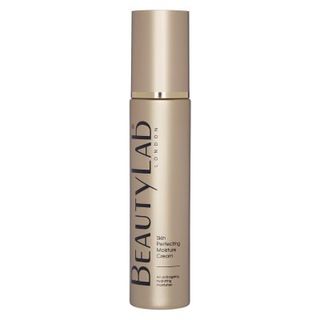
BeautyLab Anti-Ageing Skin Perfecting Moisture Cream
Works for
3 of 3 advertised claims delivered
Moisturizing42 ingredients credited for this claimStrong support
“Anti-Ageing Skin Perfecting Moisture Cream”
This product can help improve hydration of the skin with the two types of ingredients.
The first type is called “humectants”:
these ingredients help attract water.
When humectants are on the surface of the skin, they “pull in” the moisture from the outside environment, or from
within deeper layers of the skin. The following ingredients in this product do the job:
cyclomethicone, glycerin.
This product also contains ingredients called “occlusives”. They help reduce the speed with which our skin loses moisture to the outside environment. These ingredients also help soften the upper layer of the skin, so it feels less tight and nicer to the touch. The following ingredients in this product do the job: beeswax, caprylic/capric triglyceride.
The following ingredients in this product are especially good for supporting the skin barrier and helping with the hydration level: palmitoyl tripeptide-5, tripeptide-1, tripeptide-10 citrulline
Anti-aging12 ingredients credited for this claimStrong support
“Anti-Ageing Skin Perfecting Moisture Cream”
This product can help reduce and prevent fine lines and wrinkles, improve skin elasticity and firmness because it contains glycolic acid.
These ingredients in the product can also be helpful, even though there is less evidence for their effectiveness: palmitoyl tripeptide-5, tripeptide-1, tripeptide-10 citrulline.
Keep in mind that it typically takes at least 6 weeks to notice any results because the changes that are needed to improve fine lines and elasticity happen in the deeper layers of the skin. No topical anti-aging product can “erase” wrinkles or fully reverse signs of aging.
Evens skin tone7 ingredients credited for this claimStrong support
“Hard-working vitamin A helps to optimise cellular function and improves skin texture, firmness and smoothness, while it simultaneously minimises the appearance of wrinkles and pigmentation.”
This product can help reduce hypepigmentation and even out the skin tone because it contains the following effective ingredients: glycolic acid
The following ingredient (ingredients) in this product might be helpful, but there is no evidence to confirm that it actually can help even out the skin tone: phenylethyl resorcinol.
Keep in mind that you would need to apply any topical skincare targetted at hypigmentation consistently for a couple of months to get a result. No topical skincare product can help get rid of hyperpigmentation (including post-acne marks and age spots) instantly.
ExfoliationNot advertised by the brand · 3 ingredients credited for this claimStrong support
This product can help exfoliate the skin. In other words, it helps break down the bonds between dead cells on the surface of the skin and speed up the skin turnover. Skin often appears softer and brighter after exfoliation, but overdoing it can result in disrupted skin barrier. The following ingredient is doing the exfoliating job in this product: glycolic acid.
Can it cause trouble?
Irritancy16 strong irritants: Benzophenone-3, Carica papaya fruit extract + 14 more — patch-test recommendedHigh risk
Comedogenic6 ingredients rated 2 or more on the 0–5 pore-clogging scale6 flagged
User reviews
Be the first — your take helps the next person decide.
Ingredients
Filter by role to see what each ingredient is doing.
Water~45–55%
Caprylic/capric triglyceride~5.6–6.8%
- Irritation risk
- Medium
A good mix of fatty acids that forms a protective layer on the skin. Improves the shelf life of products. Derived from coconut and glycerin
More about Caprylic/capric triglycerideEthylhexyl methoxycinnamate~4.5–5.4%
- Irritation risk
- High
Octinoxate. When used in higher concentrations, works as a sunscreen protecting the skin from UVB rays. When used in lower concentration, helps to preserve the product formulation. Is shown to be harmful to coral reefs - consider avoiding bathing in coral reef areas when wearing a product with this ingredient. It can be irritating
More about Ethylhexyl methoxycinnamateGlyceryl stearate se~2.9–3.5%
- Irritation risk
- Low
- Comedogenicity
- 2/5
Used to stabilize the product formulations and works as an emollient
More about Glyceryl stearate seCetyl alcohol~2.4–2.9%
- Irritation risk
- Low
A non-drying alcohol that works to soften the skin and stabilize product formulations helping oil and water mix together
More about Cetyl alcoholGlycerin~2–2.5%
- Irritation risk
- Low
One of the best moisturizing ingredients. Naturally present in skin. It attracts water to the upper layer of the skin working as a humectant
More about GlycerinCyclomethicone~1.6–2%
- Irritation risk
- Low
A type of silicone that leaves a nice silky finish on the skin and can help soften its upper layer
More about CyclomethiconeBenzophenone-3~1.9–2.4%
- Irritation risk
- High
Same as oxybenzone. Protects in the UVB and short UVA range. In small concentrations, used to stabilize product formulation. Can be irritating. Is shown to be harmful to coral reefs - consider avoiding bathing in coral reef areas when wearing a product with this ingredient. It can penetrate the skin and get absorbed into bloodstream faster than other popular filters available in the US. The study that produced this finding did not address any potential health effects of the absorption
More about Benzophenone-3Ethylhexyl salicylate~1.6–2%
- Irritation risk
- Low
Octisalate. A UV filter. It offers some protection against the sun rays that cause sunburn (UVB), but does not protect against the most aging sun rays (UVA). It loses its effectiveness quickly when exposed to sunlight. It is an organic, or so called "chemical" sunscreen
More about Ethylhexyl salicylateSodium hyaluronate~0.9–1.1%
- Irritation risk
- Low
One of the best moisturizing ingredients. Attracts water into the upper layer of the skin
More about Sodium hyaluronatePeg-100 stearate~0.75–1.1%
- Irritation risk
- Low
Helps oil and water mix togehter and creates a nice product texture
More about Peg-100 stearatePropylene glycol~0.5–0.75%
- Irritation risk
- High
Helps oil and water mix together and can enhance the penetration of other ingredients into the skin. It can be irritating
More about Propylene glycolAloe barbadensis leaf juice~0.45–0.7%
- Irritation risk
- Medium
Traditionally used to treat sunburns, dermatitis and inflammation, but evidence for its effectiveness is lacking. The extract can contain humectants that help attract water into the skin
More about Aloe barbadensis leaf juiceFaex extract~0.4–0.65%
- Irritation risk
- Low
Yeast extract. Helps attract water to the upper layer of the skin
More about Faex extractYeast extract~0.35–0.65%
- Irritation risk
- Low
Helps attract water to the upper layer of the skin and might have some anti-oxidant and skin lightening properties. It can help calm down inflammation in skin
More about Yeast extractSimmondsia chinensis seed oil~0.45–0.65%
- Irritation risk
- Medium
Softens the upper layer of skin and helps restore the healthy skin barrier. Has shown to help calm down inflammation in skin. It is a stable oil, meaning that it retains its properties even when exposed to air.
More about Simmondsia chinensis seed oilHydrolyzed corn starch~0.3–0.6%
- Irritation risk
- Low
Helps improve the product texture
More about Hydrolyzed corn starchButyrospermum parkii butter extract~0.35–0.65%
- Irritation risk
- Low
- Comedogenicity
- 3/5
A great moisturising ingredient that softens the skin and reduces water loss from its upper layer. It also can be helpful in protecting skin from free radicals
More about Butyrospermum parkii butter extractButyrospermum parkii butter~0.3–0.6%
- Irritation risk
- Low
- Comedogenicity
- 3/5
A great moisturising ingredient that softens the skin and reduces water loss from its upper layer. It also can be helpful in protecting skin from free radicals
More about Butyrospermum parkii butterCocamidopropyl dimethylamine~0.25–0.5%
- Irritation risk
- High
Helps oil and water mix together. Can work as a cleansing agent. Can be irritating
More about Cocamidopropyl dimethylamineHydrated silica~0.35–0.65%
Phenylethyl resorcinol~0.25–0.45%
- Irritation risk
- High
Might help reduce hyperpigmentation in skin and help neutralize free radicals
More about Phenylethyl resorcinolCera alba~0.3–0.55%
- Irritation risk
- Medium
Forms a protective barrier that holds water and keeps dry skin hydrated. Keeps an emulsion from separating into its oil and liquid components, and increases the thickness of a product. Can be an allergen
More about Cera albaBeeswax~0.25–0.5%
- Irritation risk
- Low
Forms a protective barrier that holds water and keeps dry skin hydrated. Keeps an emulsion from separating into its oil and liquid components, and increases the thickness of a product. Can be an allergen
More about BeeswaxDimethicone~0.25–0.5%
- Irritation risk
- Low
A silicone that helps to reduce water loss from the surface of the skin. Can temporarily "fill in" lines and wrinkles, absorb oil, and create a nice product finish
More about DimethiconeCyclopentasiloxane~0.25–0.45%
- Irritation risk
- Low
A silicone that helps improve the product texture and spreadability. Can absorb oil creating a short-term mattifying effect on the skin
More about CyclopentasiloxanePolymethylsilsesquioxane~0.2–0.4%
- Irritation risk
- Low
A silicone that improves product texture and helps dissolve other ingredients. Can form a non-greasy film on the skin to prevent moisture loss
More about PolymethylsilsesquioxanePolysilicone-11~0.25–0.45%
- Irritation risk
- Low
A silicone that forms a light film on the skin surface helping to bind water and temporarily absorb oils creating a matt and powdery feel
More about Polysilicone-11Dimethicone/divinyldimethicone/silsesquioxane crosspolymer~0.2–0.35%
- Irritation risk
- Low
Hydrogenated coco-glycerides~0.2–0.4%
- Irritation risk
- Medium
Helps oil and water mix together while creating a nice finish on the skin
More about Hydrogenated coco-glyceridesIsohexadecane~0.3–0.55%
- Irritation risk
- Low
Improves the texture of the product and helps soften the skin. Helps oil and water mix together and can be used as a cleansing agent
More about IsohexadecaneGlyceryl stearate~0.25–0.45%
- Irritation risk
- Low
An emollient that softens the skin and forms a protective layer on its surface. Helps water and oil mix together
More about Glyceryl stearateCetearyl alcohol~0.25–0.45%
- Irritation risk
- Low
- Comedogenicity
- 2/5
A non-drying alcohol. Works as an emollient. Helps water and oil mix together and creates a nice product texture
More about Cetearyl alcoholStearyl alcohol~0.25–0.45%
- Irritation risk
- Low
An emollient that helps soften the skin
More about Stearyl alcoholBehenyl alcohol~0.25–0.5%
- Irritation risk
- Low
Non-drying alcohol that helps water and oil mix together. Also serves as an emollient
More about Behenyl alcoholPalmitic acid~0.25–0.45%
- Irritation risk
- Low
An emollient that is naturally present in skin and helps soften it
More about Palmitic acidStearic acid~0.3–0.55%
- Irritation risk
- Low
Helps oil and water mix together and works as an emollient
More about Stearic acidAmmonium polyacryloyldimethyl taurate~0.2–0.4%
- Irritation risk
- Low
Used to create a thicker product consistency
More about Ammonium polyacryloyldimethyl tauratePolysorbate 20~0.25–0.4%
Polysorbate 80~0.25–0.4%
Tocopheryl acetate~0.2–0.4%
- Irritation risk
- Medium
A more stable but less bio-available form of vitamin E compared to Tocopherol. Might help moisturize and protect the skin from free radicals, but mostly used in low concentrations to stabilize other ingredients.
More about Tocopheryl acetateIsopropyl palmitate~0.2–0.4%
- Irritation risk
- Medium
- Comedogenicity
- 3/5
Helps soften the upper layer of the skin and create a thicker product consistency
More about Isopropyl palmitatePrunus amygdalus dulcis oil~0.25–0.45%
- Irritation risk
- Low
An emollient that softens the skin
More about Prunus amygdalus dulcis oilPanthenol~0.2–0.35%
- Irritation risk
- Low
Helps attract water to the upper layer of the skin and can help improve skin barrier function
More about PanthenolSodium cocoyl isethionate~0.3–0.5%
- Irritation risk
- Medium
Helps water and oil mix together. Can be used as a cleansing agent
More about Sodium cocoyl isethionatePseudoalteromonas ferment extract~0.25–0.45%
- Irritation risk
- Low
Hydrolyzed wheat protein~0.2–0.4%
- Irritation risk
- Medium
Can help attract water to the upper layer of the skin. Avoid if sensitive to gluten
More about Hydrolyzed wheat proteinHydrolyzed soy protein~0.25–0.45%
- Irritation risk
- Low
Helps attract water to the upper layer of the skin. Might have some anti-aging, anti-oxidant, and skin lightening properties, but solid evidence is missing
More about Hydrolyzed soy proteinTripeptide-10 citrulline~0.2–0.4%
- Irritation risk
- Low
A type of peptide. Peptides are excellent moisturizers and might be able support collagen production reducing fine lines and wrinkles
More about Tripeptide-10 citrullineTripeptide-1~0.25–0.45%
- Irritation risk
- Low
A type of peptide. Peptides are excellent moisturizers and might be able support collagen production reducing fine lines and wrinkles
More about Tripeptide-1Lecithin~0.25–0.5%
- Irritation risk
- Low
Used mostly for creating emulsions - helping oil and water mix together. Helps soften the upper layer of the skin
More about LecithinXanthan gum~0.25–0.45%
- Irritation risk
- Low
Used to create a thicker product consistency
More about Xanthan gumCarbomer~0.25–0.45%
- Irritation risk
- Low
Helps create a thicker or gel-like product texture. It is not a surfactant but can be used in gentle cleansing formulations
More about CarbomerTriethanolamine~0.25–0.5%
- Irritation risk
- Medium
Used to adjust pH of the product and can help improve the product's smell
More about TriethanolamineTocopherol~0.25–0.45%
- Irritation risk
- Low
Pure form of vitamin E. Can help moisturise and protect the skin from free radicals. Often used to help stabilise other ingredients or the formula itself
More about TocopherolFucus vesiculosus extract~0.25–0.45%
- Irritation risk
- Low
- Comedogenicity
- 3/5
Camellia sinensis leaf extract~0.25–0.5%
- Irritation risk
- Low
Can contain potent anti-oxidant compounds (abbreviated ECG, GCG, EGC, and EGCG) that might help protect the skin from free radicals. Can help calm down inflammation and has some anti-bacterial properties. Unfortunately, these antioxidants are unstable and lose their effectiveness very quickly in products. The concentration of the antioxidant compounds in the extract also tends to be low to be effective in topical formulation
More about Camellia sinensis leaf extractCarica papaya fruit extract~0.25–0.45%
- Irritation risk
- High
Dipropylene glycol~0.25–0.4%
- Irritation risk
- Low
Helps to dissolve other ingredients in a formulation. Slows down the rate of product drying
More about Dipropylene glycolAnthemis nobilis flower oil~0.2–0.4%
- Irritation risk
- High
An essential oil that is used as a fragrance and can be irritating. It might have some anti-oxidant effect in skin
More about Anthemis nobilis flower oilMel~0.25–0.5%
- Irritation risk
- Low
Helps to soften the upper layer of the skin and attract water to it
More about MelAnthemis nobilis flower oil~0.2–0.4%
- Irritation risk
- High
An essential oil that is used as a fragrance and can be irritating. It might have some anti-oxidant effect in skin
More about Anthemis nobilis flower oilGlycolic acid~0.25–0.45%
- Irritation risk
- High
An alpha-hydroxy acid (AHA) that helps to remove the dead skin cells on the surface of the skin reveling a more even, smoother complexation. It is also able to stimulate collagen production with long-term use. Could help to reduce pore congestion. It can be irritating to the skin. Apply sunscreen daily if using products with glycolic acid
More about Glycolic acidChenopodium quinoa seed extract~0.25–0.45%
- Irritation risk
- Low
Helps soften the upper layer of the skin
More about Chenopodium quinoa seed extractSodium ascorbyl phosphate~0.25–0.45%
- Irritation risk
- Medium
A stable derivative of vitamin C. It is oil-soluble which means it is more likely to penetrate the skin compared to the pure form of vitamin C (which is water-soluble), but it is less bio-available and is way less effective in stimulating collagen and reducing wrinkles compared to the pure form of vitamin C (L-ascorbic acid) and its other derivatives (for example, magnesium ascorbyl phosphate). At the same time, this vitamin C derivative has been shown in studies to be effective in reducing acne, blemishes and clogged pores. It is less irritating then the pure form of vitamin C
More about Sodium ascorbyl phosphateCitrus sinensis peel oil expressed~0.25–0.4%
- Irritation risk
- High
Citrus aurantium dulcis peel oil~0.25–0.45%
- Irritation risk
- High
An essentil oil from orange peel. Potential allergen and can be irritating
More about Citrus aurantium dulcis peel oilSodium hydroxide~0.25–0.45%
Palmitoyl tripeptide-5~0.25–0.45%
- Irritation risk
- Low
A type of peptide. Peptides are excellent moisturizers and might be able support collagen production reducing fine lines and wrinkles
More about Palmitoyl tripeptide-5Phenoxyethanol~0.25–0.5%
- Irritation risk
- Low
A preservative. It helps prevent bacterial growth in cosmetic products
More about PhenoxyethanolDecylene glycol~0.25–0.45%
- Irritation risk
- Low
Used to creat a nice product texture and support penetration of other ingredients
More about Decylene glycolCaprylyl glycol~0.25–0.5%
- Irritation risk
- Medium
Helps preserve products and creates a nice product texture
More about Caprylyl glycolPotassium sorbate~0.25–0.5%
Sodium benzoate~0.25–0.45%
Diamond powder~0.3–0.6%
- Irritation risk
- Low
Does not have known skin benefits. Might help create an optical illusion of smoother skin
More about Diamond powderRuby extract~0.25–0.45%
- Irritation risk
- Low
Ruby powder~0.25–0.45%
- Irritation risk
- Low
Leuconostoc/radish root ferment filtrate~0.25–0.45%
- Irritation risk
- Medium
A preservative that comes from radishes fermented by a bacteria. New research suggests that the preservation properties in the ingredient come from an ammonium salt that is not present naturally in radish root but used in its cultivation. Is problematic because the exact amount of the preservative agents is difficult to determine
More about Leuconostoc/radish root ferment filtrateHydrolyzed silk~0.25–0.45%
- Irritation risk
- Medium
Can help attract water to the upper layer of the skin
More about Hydrolyzed silkCitrus aurantifolia oil~0.25–0.45%
- Irritation risk
- High
Boswellia carterii oil~0.25–0.45%
Olibanum~0.25–0.45%
Citrus aurantium flower oil~0.2–0.4%
- Irritation risk
- High
Retinyl palmitate~0.2–0.4%
- Irritation risk
- High
Three steps removed from the active form of vitamin A - retinoic acid. To have an effect in the skin, it first needs to be converted twice to become the retinoic acid. This means it is less potent than retinol, but could also be less irritating. Once converted to the retinoic acid in the skin, it helps against all signs of aging, improves skin cell turnover and helps fight blemishes and clogged pores. However, in many cosmetic formulations, it is used in a concentration that is too low to have the full effect
More about Retinyl palmitateCitric acid~0.2–0.4%
- Irritation risk
- Medium
Can work as an exfoliant but is typically used to adjust the product pH
More about Citric acidLactic acid~0.2–0.4%
- Irritation risk
- Medium
An exfoliating and moisturizing alpha-hydroxy acid (AHA). Typically causes less irritation than other AHAs, for example, glycolic acid. At high concentrations (about 15%), lactic acid can help reduce lines and wrinkles. Recent studies show that lactic acid can support the "good" bacteria living on skin's surface (healthy skin microbiome)
More about Lactic acidParfum~0.15–0.3%
- Irritation risk
- High
An aromatic blend of unspecified and possibly irritating ingredients
More about ParfumCitral~0.15–0.3%
Hydroxycitronellal~0.15–0.25%
- Irritation risk
- High
A fragrance. A likely allergen and can be irritating
More about HydroxycitronellalGeraniol~0.15–0.3%
Butylphenyl methylpropional~0.15–0.25%
- Irritation risk
- High
A fragrance. Can trigger allergic reactions and be irritating
More about Butylphenyl methylpropionalCitronellol~0.1–0.15%
Limonene~0.1–0.15%
- Irritation risk
- High
A common frangrance that can easily irritate skin, especially if exposed to air, light or heat
More about LimoneneIngredient list view
Water, Caprylic/capric triglyceride, Ethylhexyl methoxycinnamate, Glyceryl stearate se, Cetyl alcohol, Glycerin, Cyclomethicone, Benzophenone-3, Ethylhexyl salicylate, Sodium hyaluronate, Peg-100 stearate, Propylene glycol, Aloe barbadensis leaf juice, Faex extract, Yeast extract, Simmondsia chinensis seed oil, Hydrolyzed corn starch, Butyrospermum parkii butter extract, Butyrospermum parkii butter, Cocamidopropyl dimethylamine, Hydrated silica, Phenylethyl resorcinol, Cera alba, Beeswax, Dimethicone, Cyclopentasiloxane, Polymethylsilsesquioxane, Polysilicone-11, Dimethicone/divinyldimethicone/silsesquioxane crosspolymer, Hydrogenated coco-glycerides, Isohexadecane, Glyceryl stearate, Cetearyl alcohol, Stearyl alcohol, Behenyl alcohol, Palmitic acid, Stearic acid, Ammonium polyacryloyldimethyl taurate, Polysorbate 20, Polysorbate 80, Tocopheryl acetate, Isopropyl palmitate, Prunus amygdalus dulcis oil, Panthenol, Sodium cocoyl isethionate, Pseudoalteromonas ferment extract, Hydrolyzed wheat protein, Hydrolyzed soy protein, Tripeptide-10 citrulline, Tripeptide-1, Lecithin, Xanthan gum, Carbomer, Triethanolamine, Tocopherol, Fucus vesiculosus extract, Camellia sinensis leaf extract, Carica papaya fruit extract, Dipropylene glycol, Anthemis nobilis flower oil, Mel, Unknown, Anthemis nobilis flower oil, Glycolic acid, Chenopodium quinoa seed extract, Sodium ascorbyl phosphate, Citrus sinensis peel oil expressed, Citrus aurantium dulcis peel oil, Sodium hydroxide, Palmitoyl tripeptide-5, Phenoxyethanol, Decylene glycol, Caprylyl glycol, Potassium sorbate, Sodium benzoate, Diamond powder, Ruby extract, Ruby powder, Leuconostoc/radish root ferment filtrate, Hydrolyzed silk, Citrus aurantifolia oil, Boswellia carterii oil, Olibanum, Unknown, Citrus aurantium flower oil, Retinyl palmitate, Citric acid, Lactic acid, Parfum, Citral, Hydroxycitronellal, Geraniol, Butylphenyl methylpropional, Citronellol, Limonene
Compare prices
Retailers ranked by price — lowest first.
Affiliate links · prices updated regularly · As an Amazon Associate, WIMJ earns from qualifying purchases.
Product summary
"BeautyLab - Anti-Ageing Skin Perfecting Moisture Cream" is a well-rounded moisturizing product. The formulation is based on a combination of good humectants and emollients. Both are needed to increase the skin hydration level. Humectants in this product (cyclomethicone, glycerin, sodium hyaluronate, hydrolyzed silk and hydrolyzed soy protein) help to increase the water content in the upper layer of the skin. (These ingredients do so by "capturing" water molecules from the outside air or from within the deeper layers of the skin). Tripeptide-1, cyclomethicone, beeswax, caprylic/capric triglyceride and cera alba in this product help decrease the water evoporation from the skin, so that it stays hydrated for longer. These ingredients also soften the skin and take away the feeling of tightness and dryness.
Ingredient callouts
- this moisturizer includes a form of Retinoids (vitamin A) - retinyl palmitate 0.20% - 0.40%, but this type of vitamin A is not very effective. It could in theory help with fine lines and wrinkles, but the effect is most likely minimal.
- We like that this moisturizer contains peptides (tripeptide-1 0.25% - 0.45%, tripeptide-10 citrulline 0.20% - 0.40% and palmitoyl tripeptide-5 0.25% - 0.45%). There are many different kind of Peptides and they are naturally present in our skin. They all are a combination of aminoacids. Some of them work as natural antibiotics, promote wound-healing and production of collagen. The science is still not settled on how effective Peptides are in skincare, but it is very likely that they have a benefit. Peptides might help restore the skin barrier and fight the signs of aging. At the very least, Peptides work as humectants: they attract water to the upper layer of the skin and improve its hydration.
Irritation risk
This moisturizer contains a bunch of common irritants, including ingredients that do not provide any known benefit for the skin. It might not be the best choice if your skin is sensitive. We assess the overall irritancy of this moisturizer to be high. For a detailed overview of all potential irritants: click here
You can see the detailed formula review with the breakdown of all actives in the product and the full ingredient list with estimated concentrations in the tables below.
Price
The product retails for 45.00£ in the United Kingdom.
For a detailed price comparison: click here.
Sources cited in this review
Every concentration estimate and effectiveness label is anchored to one of these 42 studies and safety reviews.
- 1
- 2
- 3
- 4On Photostability of Oxybenzonecore.ac.uk
- 5Hyaluronic acid: A key molecule in skin agingncbi.nlm.nih.gov
- 6

Affiliate links · As an Amazon Associate, WIMJ earns from qualifying purchases.