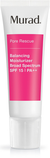
Murad Pore Rescue Balancing Moisturizer Broad Spectrum SPF 15 / PA++

Murad Pore Rescue Balancing Moisturizer Broad Spectrum SPF 15 / PA++

SPF 15Efficacy50/100IrritancyHigh·3 UV filters
Edit

Works for

1 of 3 advertised claims delivered

Sun protection
SPF 15 · 3 UV filters · Broad spectrum
Weak protectionSPF under 30
SPF 15Broad spectrumMineral + chemical filtersNo white cast

This product offers broad spectrum sun protection, but it is weak. We recommend to use a broad spectrum sunscreen with at least SPF 30.

UV spectrum
UVB290–320 nmUVA II320–340 nmUVA I340–400 nm
Octinoxate
Oxybenzone
Avobenzone
FilterCoverageWhat it doesEst. amount
OctinoxateEthylhexyl MethoxycinnamateUVBOctinoxate. When used in higher concentrations, works as a sunscreen protecting the skin from UVB rays. When used in lower concentration, helps to preserve the product formulation. Is shown to be harmful to coral reefs - consider avoiding bathing in coral reef areas when wearing a product with this ingredient. It can be irritating7.5%
OxybenzoneBenzophenone-3UVBUVA2Same as oxybenzone. Protects in the UVB and short UVA range. In small concentrations, used to stabilize product formulation. Can be irritating. Is shown to be harmful to coral reefs - consider avoiding bathing in coral reef areas when wearing a product with this ingredient. It can penetrate the skin and get absorbed into bloodstream faster than other popular filters available in the US. The study that produced this finding did not address any potential health effects of the absorption2%
AvobenzoneButyl MethoxydibenzoylmethaneUVA1Avobenzone. An organic, or so-called "chemical" UV filter. Protects against both UVA and UVB rays. Needs to be combined with other filters in a formulation to be stable.2.5%
Moisturizing
19 ingredients credited for this claim
Strong support
What the product description says
“Pore Rescue Balancing Moisturizer Broad Spectrum SPF 15 / PA++”
Source: Ulta

This product can help improve hydration of the skin with the two types of ingredients.

The first type is called “humectants”:
these ingredients help attract water. When humectants are on the surface of the skin, they “pull in” the moisture from the outside environment, or from within deeper layers of the skin. The following ingredients in this product do the job: artemia extract, betaine.

This product also contains ingredients called “occlusives”. They help reduce the speed with which our skin loses moisture to the outside environment. These ingredients also help soften the upper layer of the skin, so it feels less tight and nicer to the touch. The following ingredients in this product do the job: dimethicone, cetearyl alcohol.

The following ingredients in this product are especially good for supporting the skin barrier and helping with the hydration level: urea

InositolKey active· HumectantEffect: High~0.2–0.4%
TrehaloseKey active· HumectantEffect: HighA sugar that attracts water to the upper layer of the skin~0.25–0.5%
UreaHero· HumectantEffect: HighNaturally present in skin (urea makes up about 7% of natural moisturizing factors in skin). Attracts water to the upper layer of the skin. Also has a positive effect on the skin barrier beyond the humectant action. Can enhance penetration of other ingredients. Is an exfoliating ingredient when used in high concentrations~0.4–0.6%
Artemia extractKey active· HumectantEffect: HighZooplankton extract that can attract water to the upper level of the skin and might have some anti-oxidant effect~0.1–0.2%
BetaineKey active· HumectantEffect: HighHelps attract water to the upper layer of the skin and improves the product texture~0.2–0.4%
DimethiconeKey active· Emollient, OcclusiveEffect: HighA silicone that helps to reduce water loss from the surface of the skin. Can temporarily "fill in" lines and wrinkles, absorb oil, and create a nice product finish~0.2–0.35%
PhospholipidsKey activeEffect: MediumEmollients that are naturaly present in skin. In addition, they help water and oil mix together in the product~0.2–0.4%
Magnesium aspartateKey activeEffect: MediumMight be helpful in restoring skin barrier function and calm down inflammation in skin~0.1–0.2%
Cetearyl alcoholKey active· EmollientEffect: MediumA non-drying alcohol. Works as an emollient. Helps water and oil mix together and creates a nice product texture~1.2–1.5%
Butylene glycol· HumectantEffect: LowUsed to create a nice product texture and help delivery of other ingredients. Might be somewhat helpful in attracting water to the upper layer of the skin~4.6–5.6%
Pentylene glycol· EmollientEffect: LowUsed to preserve products, dissolve other ingredients and create a nice product texture~4.6–5.6%
Dicaprylyl ether· EmollientEffect: LowHelps soften the upper layer of the skin while creating a non-greasy feel on the skin. Helps to dissolve other ingredients~1.6–1.9%
Glyceryl stearate· EmollientEffect: LowAn emollient that softens the skin and forms a protective layer on its surface. Helps water and oil mix together~0.8–1.15%
Isononyl isononanoate· Emollient, OcclusiveEffect: LowForms a protective film on the surface of the skin to prevent moisture loss. Gives a velvety feel to products while reducing tackiness~4.1–5%
Copper gluconateUnder-dosedEffect: HighTypically used to stabilize the product formulations. It is a salt of polyhydroxy acid (PHA) and in larger concentrations, can help shed the dead cells from the skin surface revealing smoother skin. It can help attract water to the upper layer of the skin. Might to be helpful against acne and clogged pores. Could be helpful in neutralizing free radicals, but solid research is missing~0.1–0.2%
Lactic acidUnder-dosedEffect: HighAn exfoliating and moisturizing alpha-hydroxy acid (AHA). Typically causes less irritation than other AHAs, for example, glycolic acid. At high concentrations (about 15%), lactic acid can help reduce lines and wrinkles. Recent studies show that lactic acid can support the "good" bacteria living on skin's surface (healthy skin microbiome)~0.1–0.2%
Zinc gluconateUnder-dosedEffect: HighTypically used to stabilize the product formulations. It is a salt of a polyhydroxy acid (PHA) and in larger concentrations, can help shed the dead cells from the skin surface revealing smoother skin. It can help attract water to the upper layer of the skin. Might to be helpful against acne and clogged pores. Could be helpful in neutralizing free radicals, but solid research is missing. Due to the zinc content, might help calm down inflammation in skin~0.1–0.2%
PanthenolUnder-dosedEffect: HighHelps attract water to the upper layer of the skin and can help improve skin barrier function~0.15–0.25%
Caprylic/capric triglycerideUnder-dosedEffect: HighA good mix of fatty acids that forms a protective layer on the skin. Improves the shelf life of products. Derived from coconut and glycerin~0.25–0.45%
Anti-blemish
5 ingredients credited for this claim
Weak support
What the product description says
“Japanese Alder Flower helps prevent blackhead formation.”
Source: Skinstore

Effective ingredients missing or their concentration is too low.

TaurineEffect: LowCould be helpful in reducing inflammation in skin, evening out the skin tone and neutralizing free radicals, but more research is needed to confirm its effectiveness~0.2–0.4%
Sodium ascorbyl phosphateUnder-dosedEffect: HighA stable derivative of vitamin C. It is oil-soluble which means it is more likely to penetrate the skin compared to the pure form of vitamin C (which is water-soluble), but it is less bio-available and is way less effective in stimulating collagen and reducing wrinkles compared to the pure form of vitamin C (L-ascorbic acid) and its other derivatives (for example, magnesium ascorbyl phosphate). At the same time, this vitamin C derivative has been shown in studies to be effective in reducing acne, blemishes and clogged pores. It is less irritating then the pure form of vitamin C~0.1–0.2%
Retinyl palmitateUnder-dosedEffect: MediumThree steps removed from the active form of vitamin A - retinoic acid. To have an effect in the skin, it first needs to be converted twice to become the retinoic acid. This means it is less potent than retinol, but could also be less irritating. Once converted to the retinoic acid in the skin, it helps against all signs of aging, improves skin cell turnover and helps fight blemishes and clogged pores. However, in many cosmetic formulations, it is used in a concentration that is too low to have the full effect~0.15–0.3%
Zinc gluconateEffect: Low, below effective doseTypically used to stabilize the product formulations. It is a salt of a polyhydroxy acid (PHA) and in larger concentrations, can help shed the dead cells from the skin surface revealing smoother skin. It can help attract water to the upper layer of the skin. Might to be helpful against acne and clogged pores. Could be helpful in neutralizing free radicals, but solid research is missing. Due to the zinc content, might help calm down inflammation in skin~0.1–0.2%
Copper gluconateEffect: Low, below effective doseTypically used to stabilize the product formulations. It is a salt of polyhydroxy acid (PHA) and in larger concentrations, can help shed the dead cells from the skin surface revealing smoother skin. It can help attract water to the upper layer of the skin. Might to be helpful against acne and clogged pores. Could be helpful in neutralizing free radicals, but solid research is missing~0.1–0.2%

Can it cause trouble?

Irritancy
5 strong irritants: Benzophenone-3, Retinyl palmitate + 3 more — patch-test recommended
High risk
We flagged 20 ingredients with irritancy potential. Severity depends on your sensitivity threshold; the table lists the worst offenders first.
IngredientFunctionIrritationEst. amount
Ethylhexyl methoxycinnamateOctinoxate. When used in higher concentrations, works as a sunscreen protecting the skin from UVB rays. When used in lower concentration, helps to preserve the product formulation. Is shown to be harmful to coral reefs - consider avoiding bathing in coral reef areas when wearing a product with this ingredient. It can be irritatingHigh7.5%
Benzophenone-3Same as oxybenzone. Protects in the UVB and short UVA range. In small concentrations, used to stabilize product formulation. Can be irritating. Is shown to be harmful to coral reefs - consider avoiding bathing in coral reef areas when wearing a product with this ingredient. It can penetrate the skin and get absorbed into bloodstream faster than other popular filters available in the US. The study that produced this finding did not address any potential health effects of the absorptionHigh2%
Retinyl palmitateThree steps removed from the active form of vitamin A - retinoic acid. To have an effect in the skin, it first needs to be converted twice to become the retinoic acid. This means it is less potent than retinol, but could also be less irritating. Once converted to the retinoic acid in the skin, it helps against all signs of aging, improves skin cell turnover and helps fight blemishes and clogged pores. However, in many cosmetic formulations, it is used in a concentration that is too low to have the full effectHigh~0.15–0.3%est.
Epilobium angustifolium flower/leaf/stem extractA plant extract that might contain antioxidantsHigh~0.1–0.2%est.
Benzyl salicylateA fragrance. Is a likely irritantHigh~0.1–0.15%est.
LinaloolA fragrance. Can be irritatingHigh~0.05–0.1%est.
ParfumAn aromatic blend of unspecified and possibly irritating ingredientsHigh~0.05–0.1%est.
Butyl methoxydibenzoylmethaneAvobenzone. An organic, or so-called "chemical" UV filter. Protects against both UVA and UVB rays. Needs to be combined with other filters in a formulation to be stable.Medium2.5%
Pentylene glycolUsed to preserve products, dissolve other ingredients and create a nice product textureMedium~4.6–5.6%est.
TaurineCould be helpful in reducing inflammation in skin, evening out the skin tone and neutralizing free radicals, but more research is needed to confirm its effectivenessMedium~0.2–0.4%est.
Tocopheryl acetateA more stable but less bio-available form of vitamin E compared to Tocopherol. Might help moisturize and protect the skin from free radicals, but mostly used in low concentrations to stabilize other ingredients.Medium~0.15–0.3%est.
Ascorbyl palmitateBeing a lipid soluble form of vitamin C, it is more stable and can penetrate the skin better than L-Ascorbic acid. It is effective in protecting the skin from free radicals, as well as evening the skin tone, but is less effective in stimulating collagen production compared to L-Ascorbic acid.Medium~0.15–0.25%est.
Caprylic/capric triglycerideA good mix of fatty acids that forms a protective layer on the skin. Improves the shelf life of products. Derived from coconut and glycerinMedium~0.25–0.45%est.
Zinc gluconateTypically used to stabilize the product formulations. It is a salt of a polyhydroxy acid (PHA) and in larger concentrations, can help shed the dead cells from the skin surface revealing smoother skin. It can help attract water to the upper layer of the skin. Might to be helpful against acne and clogged pores. Could be helpful in neutralizing free radicals, but solid research is missing. Due to the zinc content, might help calm down inflammation in skinMedium~0.1–0.2%est.
Copper gluconateTypically used to stabilize the product formulations. It is a salt of polyhydroxy acid (PHA) and in larger concentrations, can help shed the dead cells from the skin surface revealing smoother skin. It can help attract water to the upper layer of the skin. Might to be helpful against acne and clogged pores. Could be helpful in neutralizing free radicals, but solid research is missingMedium~0.1–0.2%est.
Punica granatum extractA plant extract that can help neutralize free radicals in skin and even out the skin tone, but is typically used in products in a concentration that is too low to be effectiveMedium~0.1–0.25%est.
Sodium ascorbyl phosphateA stable derivative of vitamin C. It is oil-soluble which means it is more likely to penetrate the skin compared to the pure form of vitamin C (which is water-soluble), but it is less bio-available and is way less effective in stimulating collagen and reducing wrinkles compared to the pure form of vitamin C (L-ascorbic acid) and its other derivatives (for example, magnesium ascorbyl phosphate). At the same time, this vitamin C derivative has been shown in studies to be effective in reducing acne, blemishes and clogged pores. It is less irritating then the pure form of vitamin CMedium~0.1–0.2%est.
Lactic acidAn exfoliating and moisturizing alpha-hydroxy acid (AHA). Typically causes less irritation than other AHAs, for example, glycolic acid. At high concentrations (about 15%), lactic acid can help reduce lines and wrinkles. Recent studies show that lactic acid can support the "good" bacteria living on skin's surface (healthy skin microbiome)Medium~0.1–0.2%est.
Acrylates/c10-30 alkyl acrylate crosspolymerMaintains the texture of skincare products. Allows the product to spread evenly. Helps oil and water mix togetherMedium~0.25–0.45%est.
Disodium edtaStabilizes the product formulationMedium~0.2–0.35%est.
Comedogenic
1 ingredient rated 2 or more on the 0–5 pore-clogging scale
1 flagged
These ingredients have a comedogenic rating of 2 or more on a 0–5 scale; the table shows each one's rating. In leave-on products they can clog pores in acne-prone skin.
IngredientFunctionRatingEst. amount
Cetearyl alcoholA non-drying alcohol. Works as an emollient. Helps water and oil mix together and creates a nice product texture2/5~1.2–1.5%est.
Edit

User reviews

Would you recommend?
No community reviews yet.

Be the first — your take helps the next person decide.

Write a review · ~30s

Ingredients

Filter by role to see what each ingredient is doing.

Ethylhexyl methoxycinnamate7.5%
UV filterKey activeIrritant · high
Irritation risk
High
Works for
Sun protection

Octinoxate. When used in higher concentrations, works as a sunscreen protecting the skin from UVB rays. When used in lower concentration, helps to preserve the product formulation. Is shown to be harmful to coral reefs - consider avoiding bathing in coral reef areas when wearing a product with this ingredient. It can be irritating

More about Ethylhexyl methoxycinnamate
Butyl methoxydibenzoylmethane2.5%
UV filterKey activeIrritant · medium
Irritation risk
Medium
Works for
Sun protection

Avobenzone. An organic, or so-called "chemical" UV filter. Protects against both UVA and UVB rays. Needs to be combined with other filters in a formulation to be stable.

More about Butyl methoxydibenzoylmethane
Benzophenone-32%
UV filterKey activeIrritant · high
Irritation risk
High
Works for
Sun protection

Same as oxybenzone. Protects in the UVB and short UVA range. In small concentrations, used to stabilize product formulation. Can be irritating. Is shown to be harmful to coral reefs - consider avoiding bathing in coral reef areas when wearing a product with this ingredient. It can penetrate the skin and get absorbed into bloodstream faster than other popular filters available in the US. The study that produced this finding did not address any potential health effects of the absorption

More about Benzophenone-3
Water~45–55%
Formula
Irritation risk
Low

Plain old water

More about Water
Butylene glycol~4.6–5.6%
Formula
Irritation risk
Low
Works for
Moisturizing

Used to create a nice product texture and help delivery of other ingredients. Might be somewhat helpful in attracting water to the upper layer of the skin

More about Butylene glycol
Pentylene glycol~4.6–5.6%
Irritant · medium
Irritation risk
Medium
Works for
Moisturizing

Used to preserve products, dissolve other ingredients and create a nice product texture

More about Pentylene glycol
Isononyl isononanoate~4.1–5%
Formula
Irritation risk
Low
Works for
Moisturizing

Forms a protective film on the surface of the skin to prevent moisture loss. Gives a velvety feel to products while reducing tackiness

More about Isononyl isononanoate
Neopentyl glycol diethylhexanoate~2.9–3.5%
Formula
Bis-peg/ppg-16/16 peg/ppg-16/16 dimethicone~2.1–2.6%
Formula
Dicaprylyl ether~1.6–1.9%
Formula
Irritation risk
Low
Works for
Moisturizing

Helps soften the upper layer of the skin while creating a non-greasy feel on the skin. Helps to dissolve other ingredients

More about Dicaprylyl ether
Cetearyl alcohol~1.2–1.5%
Key activeComedogenic 2/5
Irritation risk
Low
Comedogenicity
2/5
Works for
CleansingMoisturizing

A non-drying alcohol. Works as an emollient. Helps water and oil mix together and creates a nice product texture

More about Cetearyl alcohol
Glyceryl stearate~0.8–1.15%
Formula
Irritation risk
Low
Works for
CleansingMoisturizing

An emollient that softens the skin and forms a protective layer on its surface. Helps water and oil mix together

More about Glyceryl stearate
Peg-100 stearate~0.65–1%
Formula
Irritation risk
Low
Works for
Cleansing

Helps oil and water mix togehter and creates a nice product texture

More about Peg-100 stearate
Urea~0.4–0.6%
Hero · Moisturizing
Irritation risk
Low
Works for
MoisturizingExfoliation

Naturally present in skin (urea makes up about 7% of natural moisturizing factors in skin). Attracts water to the upper layer of the skin. Also has a positive effect on the skin barrier beyond the humectant action. Can enhance penetration of other ingredients. Is an exfoliating ingredient when used in high concentrations

More about Urea
Yeast amino acids~0.3–0.55%
Formula
Trehalose~0.25–0.5%
Key active
Irritation risk
Low
Works for
Moisturizing

A sugar that attracts water to the upper layer of the skin

More about Trehalose
Inositol~0.2–0.4%
Key active
Irritation risk
Low
Works for
Moisturizing
More about Inositol
Taurine~0.2–0.4%
Irritant · medium
Irritation risk
Medium
Works for
Anti-blemishAnti-oxidationAnti-inflammatoryEvens skin tone

Could be helpful in reducing inflammation in skin, evening out the skin tone and neutralizing free radicals, but more research is needed to confirm its effectiveness

More about Taurine
Betaine~0.2–0.4%
Key active
Irritation risk
Low
Works for
Moisturizing

Helps attract water to the upper layer of the skin and improves the product texture

More about Betaine
Phospholipids~0.2–0.4%
Key active
Irritation risk
Low
Works for
Moisturizing

Emollients that are naturaly present in skin. In addition, they help water and oil mix together in the product

More about Phospholipids
Retinyl palmitate~0.15–0.3%
Under-dosedIrritant · high
Irritation risk
High
Works for
Evens skin toneAnti-blemishAnti-agingExfoliation

Three steps removed from the active form of vitamin A - retinoic acid. To have an effect in the skin, it first needs to be converted twice to become the retinoic acid. This means it is less potent than retinol, but could also be less irritating. Once converted to the retinoic acid in the skin, it helps against all signs of aging, improves skin cell turnover and helps fight blemishes and clogged pores. However, in many cosmetic formulations, it is used in a concentration that is too low to have the full effect

More about Retinyl palmitate
Tocopheryl acetate~0.15–0.3%
Irritant · medium
Irritation risk
Medium
Works for
Anti-oxidation

A more stable but less bio-available form of vitamin E compared to Tocopherol. Might help moisturize and protect the skin from free radicals, but mostly used in low concentrations to stabilize other ingredients.

More about Tocopheryl acetate
Ascorbyl palmitate~0.15–0.25%
Irritant · medium
Irritation risk
Medium
Works for
Anti-agingAnti-oxidation

Being a lipid soluble form of vitamin C, it is more stable and can penetrate the skin better than L-Ascorbic acid. It is effective in protecting the skin from free radicals, as well as evening the skin tone, but is less effective in stimulating collagen production compared to L-Ascorbic acid.

More about Ascorbyl palmitate
Caprylic/capric triglyceride~0.25–0.45%
Under-dosedIrritant · medium
Irritation risk
Medium
Works for
Moisturizing

A good mix of fatty acids that forms a protective layer on the skin. Improves the shelf life of products. Derived from coconut and glycerin

More about Caprylic/capric triglyceride
Panthenol~0.15–0.25%
Under-dosed
Irritation risk
Low
Works for
Reduces rednessMoisturizingReduces irritation

Helps attract water to the upper layer of the skin and can help improve skin barrier function

More about Panthenol
Dimethicone~0.2–0.35%
Key active
Irritation risk
Low
Works for
MoisturizingMattifying

A silicone that helps to reduce water loss from the surface of the skin. Can temporarily "fill in" lines and wrinkles, absorb oil, and create a nice product finish

More about Dimethicone
Magnesium aspartate~0.1–0.2%
Key active
Irritation risk
Low
Works for
Anti-inflammatoryMoisturizing

Might be helpful in restoring skin barrier function and calm down inflammation in skin

More about Magnesium aspartate
Zinc gluconate~0.1–0.2%
Under-dosedIrritant · medium
Irritation risk
Medium
Works for
MoisturizingAnti-inflammatoryAnti-agingAnti-blemishAnti-oxidationExfoliationEvens skin tone

Typically used to stabilize the product formulations. It is a salt of a polyhydroxy acid (PHA) and in larger concentrations, can help shed the dead cells from the skin surface revealing smoother skin. It can help attract water to the upper layer of the skin. Might to be helpful against acne and clogged pores. Could be helpful in neutralizing free radicals, but solid research is missing. Due to the zinc content, might help calm down inflammation in skin

More about Zinc gluconate
Copper gluconate~0.1–0.2%
Under-dosedIrritant · medium
Irritation risk
Medium
Works for
MoisturizingAnti-agingEvens skin toneAnti-blemishExfoliationAnti-oxidation

Typically used to stabilize the product formulations. It is a salt of polyhydroxy acid (PHA) and in larger concentrations, can help shed the dead cells from the skin surface revealing smoother skin. It can help attract water to the upper layer of the skin. Might to be helpful against acne and clogged pores. Could be helpful in neutralizing free radicals, but solid research is missing

More about Copper gluconate
Punica granatum extract~0.1–0.25%
Irritant · medium
Irritation risk
Medium
Works for
Anti-oxidationEvens skin tone

A plant extract that can help neutralize free radicals in skin and even out the skin tone, but is typically used in products in a concentration that is too low to be effective

More about Punica granatum extract
Sodium ascorbyl phosphate~0.1–0.2%
Under-dosedIrritant · medium
Irritation risk
Medium
Works for
Anti-blemishAnti-oxidationAnti-aging

A stable derivative of vitamin C. It is oil-soluble which means it is more likely to penetrate the skin compared to the pure form of vitamin C (which is water-soluble), but it is less bio-available and is way less effective in stimulating collagen and reducing wrinkles compared to the pure form of vitamin C (L-ascorbic acid) and its other derivatives (for example, magnesium ascorbyl phosphate). At the same time, this vitamin C derivative has been shown in studies to be effective in reducing acne, blemishes and clogged pores. It is less irritating then the pure form of vitamin C

More about Sodium ascorbyl phosphate
Alnus firmifolia fruit extract~0.1–0.2%
Formula
Artemia extract~0.1–0.2%
Key active
Irritation risk
Low
Works for
MoisturizingAnti-oxidation

Zooplankton extract that can attract water to the upper level of the skin and might have some anti-oxidant effect

More about Artemia extract
Lactic acid~0.1–0.2%
Under-dosedIrritant · medium
Irritation risk
Medium
Works for
Evens skin toneMoisturizingExfoliationAnti-aging

An exfoliating and moisturizing alpha-hydroxy acid (AHA). Typically causes less irritation than other AHAs, for example, glycolic acid. At high concentrations (about 15%), lactic acid can help reduce lines and wrinkles. Recent studies show that lactic acid can support the "good" bacteria living on skin's surface (healthy skin microbiome)

More about Lactic acid
Epilobium angustifolium flower/leaf/stem extract~0.1–0.2%
Irritant · high
Irritation risk
High
Works for
Anti-oxidation

A plant extract that might contain antioxidants

More about Epilobium angustifolium flower/leaf/stem extract
Neopentyl glycol diisostearate~0.15–0.25%
Formula
Irritation risk
Low
Works for
Cleansing
More about Neopentyl glycol diisostearate
Polysorbate 80~0.15–0.25%
Formula
Irritation risk
Low
Works for
Cleansing

Helps water and oil mix together

More about Polysorbate 80
Acrylates/c10-30 alkyl acrylate crosspolymer~0.25–0.45%
Irritant · medium
Irritation risk
Medium

Maintains the texture of skincare products. Allows the product to spread evenly. Helps oil and water mix together

More about Acrylates/c10-30 alkyl acrylate crosspolymer
Disodium edta~0.2–0.35%
Irritant · medium
Irritation risk
Medium

Stabilizes the product formulation

More about Disodium edta
Aminomethyl propanol~0.2–0.4%
Formula
Irritation risk
Low

Used to adjust the pH in formulations

More about Aminomethyl propanol
Phenoxyethanol~0.2–0.4%
Formula
Irritation risk
Low

A preservative. It helps prevent bacterial growth in cosmetic products

More about Phenoxyethanol
Methylparaben~0.15–0.25%
Formula
Irritation risk
Low

A preservative

More about Methylparaben
Ethylparaben~0.1–0.25%
Formula
Irritation risk
Low

A preservative

More about Ethylparaben
Propylparaben~0.05–0.15%
Formula
Irritation risk
Low

A preservative

More about Propylparaben
Butylparaben~0.05–0.1%
Formula
Irritation risk
Low

A preservative

More about Butylparaben
Isobutylparaben~0.1–0.2%
Formula
Irritation risk
Low

A preservative

More about Isobutylparaben
Benzyl salicylate~0.1–0.15%
Irritant · high
Irritation risk
High

A fragrance. Is a likely irritant

More about Benzyl salicylate
Linalool~0.05–0.1%
Irritant · high
Irritation risk
High

A fragrance. Can be irritating

More about Linalool
Parfum~0.05–0.1%
Irritant · high
Irritation risk
High

An aromatic blend of unspecified and possibly irritating ingredients

More about Parfum
Ingredient list view

Ethylhexyl methoxycinnamate, Butyl methoxydibenzoylmethane, Benzophenone-3, Water, Butylene glycol, Pentylene glycol, Isononyl isononanoate, Neopentyl glycol diethylhexanoate, Bis-peg/ppg-16/16 peg/ppg-16/16 dimethicone, Dicaprylyl ether, Cetearyl alcohol, Glyceryl stearate, Peg-100 stearate, Urea, Yeast amino acids, Trehalose, Inositol, Taurine, Betaine, Phospholipids, Retinyl palmitate, Tocopheryl acetate, Ascorbyl palmitate, Caprylic/capric triglyceride, Panthenol, Dimethicone, Magnesium aspartate, Zinc gluconate, Copper gluconate, Punica granatum extract, Sodium ascorbyl phosphate, Alnus firmifolia fruit extract, Artemia extract, Lactic acid, Epilobium angustifolium flower/leaf/stem extract, Neopentyl glycol diisostearate, Polysorbate 80, Acrylates/c10-30 alkyl acrylate crosspolymer, Disodium edta, Aminomethyl propanol, Phenoxyethanol, Methylparaben, Ethylparaben, Propylparaben, Butylparaben, Isobutylparaben, Benzyl salicylate, Linalool, Parfum

Compare prices

Retailers ranked by price — lowest first.

No pricing data available yet for this product.

Worth comparing, line by line.

Match % combines shared ingredients, the first five ingredients, shared actives and hero ingredients, irritancy (lower counts in the alternative's favour), texture and body area. Only products in the same routine step are compared.

Side-by-side comparison of this product against its closest alternatives
MuradPore Rescue Balancing Moisturizer Broad Spectrum SPF 15 / PA++YOUR PRODUCTMalibuHigh Protection SPF50 LotionM-61Hydraboost Moisturizer SPF 30MineraliumMoisturizing Protector SPF 15 For Normal And Dry Skin
Match—54%51%50%
Price$40.00$5.27−$34.73$78.00+$38.00$196.98+$156.98
Shared key ingredients—5 of 154 of 158 of 15
Key difference—GlycerinLinoleic AcidNiacinamide
Irritancy High High Medium High
SPFSPF 15SPF 50SPF 30SPF 15
Drying alcohol————
View product Shop Shop Shop
Cheaper alternatives? See how this stacks up against similar formulas.
We compare ingredient profiles across our catalog — pick the closest match for your budget.
Open dupe finder

Product summary

"Murad - Pore Rescue Balancing Moisturizer Broad Spectrum SPF 15 / PA++" "is a broad spectrum sunscreen meaning that it protects both from UVB rays (" burning "- they cause sunburn) and UVA rays (" aging "- they don't cause sunburn but lead to premature aging and pigmentation issues). However, this moisturizer does not offer enough sun protection. We recommend to use a sunscreen with at least SPF 30 daily.

Its formula is also hydrating, so you might not need an additional moistruizer during the day.

Sunscreen filters

This is a so-called" chemical "sunscreen. It means that it uses organic UV filters. They typically offer good sun protection and rarely leave a white cast, but they can be irritating for some people with sensitive skin. Here are the exact UV filters in this sunscreen: oxybenzone 2.00% (declared), avobenzone 2.50% (declared) and octinoxate 7.50% (declared).

Irritation risk

This moisturizer contains some common irritants, including those without a benefit for the skin. We assess the overall irritancy of this moisturizer to be high. For a detailed overview of all potential irritants: click here

You can see the detailed formula review with the breakdown of all actives in the product and the full ingredient list with estimated concentrations in the tables below.

About the brand

According to Cruelty-Free Kitty" Murad "is cruelty free, but its parent company is not.

Price

The product retails for 40.00$ in the United States.

For a detailed price comparison: click here.

Sources cited in this review

Every concentration estimate and effectiveness label is anchored to one of these 31 studies and safety reviews.

  1. 1
  2. 2
  3. 3
  4. 4
    Topical urea in skincare: A reviewpubmed.ncbi.nlm.nih.gov
  5. 5
  6. 6
Murad Pore Rescue Balancing Moisturizer Broad Spectrum SPF 15 / PA++
MuradPore Rescue Balancing Moisturizer Broad Spectrum SPF 15 / PA++

Affiliate links · As an Amazon Associate, WIMJ earns from qualifying purchases.

As an Amazon Associate, WIMJ earns from qualifying purchases.