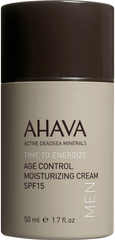
Ahava Mens Age Control Moisturizer SPF 15
Works for
2 of 3 advertised claims delivered
Sun protectionSPF 15 · 4 UV filters · Broad spectrumWeak protectionSPF under 30
This product offers broad spectrum sun protection, but it is weak. We recommend to use a broad spectrum sunscreen with at least SPF 30.
This product can be considered "reef safe" because it does not contain the UV filters (oxybenzone and octinoxate) that can be harmful to coral reefs when present in the water in high concentrations.
Moisturizing29 ingredients credited for this claimStrong support
“Mens Age Control Moisturizer SPF 15”
This product can help improve hydration of the skin with the two types of ingredients.
The first type is called “humectants”:
these ingredients help attract water.
When humectants are on the surface of the skin, they “pull in” the moisture from the outside environment, or from
within deeper layers of the skin. The following ingredients in this product do the job:
alanine, glycerin.
This product also contains ingredients called “occlusives”. They help reduce the speed with which our skin loses moisture to the outside environment. These ingredients also help soften the upper layer of the skin, so it feels less tight and nicer to the touch. The following ingredients in this product do the job: dimethicone, squalene.
The following ingredients in this product are especially good for supporting the skin barrier and helping with the hydration level: panthenol, urea
Anti-aging6 ingredients credited for this claimModerate support
“Mens Age Control Moisturizer SPF 15”
This product contains creatine. This ingredient might be able to help reduce and prevent fine lines and wrinkles, improve skin elasticity and firmness, but there is not enough evidence that it actually works. The biggest anti-aging effect in this product comes from sun protection. Sun damage is the main factor causing early signs of skin aging. We, however, do not recommend using this product as a sunscreen because the protection it offers is not strong enough).
Anti-oxidationNot advertised by the brand · 12 ingredients credited for this claimModerate support
This product contains antioxidants (creatine, ginkgo biloba leaf extract, squalene) that might be able to help neutralize free radicals in skin to lessen the damage it gets from the UV light (sun). There is not enough evidence to confirm their effectiveness in skin though.
Can it cause trouble?
Irritancy11 strong irritants: Parfum, Alpha-isomethyl ionone + 9 more — patch-test recommendedHigh risk
Comedogenic4 ingredients rated 2 or more on the 0–5 pore-clogging scale4 flagged


User reviews
Be the first — your take helps the next person decide.
Ingredients
Filter by role to see what each ingredient is doing.
Water~45–55%
Butyloctyl salicylate~5.8–7.1%
- Irritation risk
- Medium
A synthetic ester of salicylic acid that is used to help disperse pigments and boost effectiveness of sunscreen ingredients. It is able to absorb UV light (working as an organic, or chemical filter), but is not approved as a sunscreen ingredient on its own
More about Butyloctyl salicylateC12-15 alkyl benzoate~4.5–5.5%
- Irritation risk
- Low
Enhances the product texture and makes it more spreadable. Helps reduce water loss from the outer layer of skin. Extands the shelf life by preventing bacteria growth
More about C12-15 alkyl benzoateEthylhexyl salicylate~3.7–4.5%
- Irritation risk
- Low
Octisalate. A UV filter. It offers some protection against the sun rays that cause sunburn (UVB), but does not protect against the most aging sun rays (UVA). It loses its effectiveness quickly when exposed to sunlight. It is an organic, or so called "chemical" sunscreen
More about Ethylhexyl salicylateGlycerin~2.5–3%
- Irritation risk
- Low
One of the best moisturizing ingredients. Naturally present in skin. It attracts water to the upper layer of the skin working as a humectant
More about GlycerinButyl methoxydibenzoylmethane~2.5–3.1%
- Irritation risk
- Medium
Avobenzone. An organic, or so-called "chemical" UV filter. Protects against both UVA and UVB rays. Needs to be combined with other filters in a formulation to be stable.
More about Butyl methoxydibenzoylmethanePeg-40 stearate~1.7–2.1%
Octocrylene~1.8–2.2%
- Irritation risk
- Medium
A weak sunscreen that protects against the sun rays that cause sunburn (UVB) and is somewhat effective against the UVA rays. It is quite stable and can help stabilize other, more vulnerable, sunscreen ingredients like Avobenzone. It is an organic, or so called "chemical" sunscreen
More about OctocryleneSorbitan tristearate~1.1–1.4%
- Irritation risk
- Medium
Helps oil and water mix together
More about Sorbitan tristearateDimethicone~0.95–1.15%
- Irritation risk
- Low
A silicone that helps to reduce water loss from the surface of the skin. Can temporarily "fill in" lines and wrinkles, absorb oil, and create a nice product finish
More about DimethiconeNylon-6/12~0.75–1.1%
- Irritation risk
- Low
Octyldodecyl neopentanoate~0.55–0.8%
- Irritation risk
- Low
An emollient that helps soften the skin. Often used to stabilize other ingredients, for example, sunscreen
More about Octyldodecyl neopentanoateCetearyl olivate~0.45–0.7%
Sorbitan olivate~0.4–0.6%
Cyclopentasiloxane~0.4–0.6%
- Irritation risk
- Low
A silicone that helps improve the product texture and spreadability. Can absorb oil creating a short-term mattifying effect on the skin
More about CyclopentasiloxanePhenoxyethanol~0.35–0.6%
- Irritation risk
- Low
A preservative. It helps prevent bacterial growth in cosmetic products
More about PhenoxyethanolCetyl palmitate~0.35–0.65%
- Irritation risk
- Low
An emollient that helps soften the skin and is used to improve product texture and stability
More about Cetyl palmitatePotassium cetyl phosphate~0.3–0.55%
- Irritation risk
- Medium
Helps oil and water mix together
More about Potassium cetyl phosphateSorbitan palmitate~0.25–0.5%
- Irritation risk
- Medium
Helps water and oil mix together and stabilize the product formulation
More about Sorbitan palmitateIsostearyl isostearate~0.25–0.45%
- Irritation risk
- Medium
- Comedogenicity
- 3/5
Helps soften the upper layer of the skin and improve the product texture. It can be comedogenic
More about Isostearyl isostearateXanthan gum~0.25–0.4%
- Irritation risk
- Low
Used to create a thicker product consistency
More about Xanthan gumUrea~0.2–0.4%
- Irritation risk
- Low
Naturally present in skin (urea makes up about 7% of natural moisturizing factors in skin). Attracts water to the upper layer of the skin. Also has a positive effect on the skin barrier beyond the humectant action. Can enhance penetration of other ingredients. Is an exfoliating ingredient when used in high concentrations
More about UreaAllantoin~0.15–0.3%
- Irritation risk
- Low
Helps calm down inflammation in skin and can help reduce itching. Helps to repair the skin barrier and keep skin hydrated
More about AllantoinParfum~0.15–0.3%
- Irritation risk
- High
An aromatic blend of unspecified and possibly irritating ingredients
More about ParfumAcetyl cedrene~0.15–0.25%
- Irritation risk
- Low
Alpha-isomethyl ionone~0.15–0.3%
- Irritation risk
- High
A fragrance. Potential allergen and can be irritating
More about Alpha-isomethyl iononeBenzyl salicylate~0.15–0.3%
Citrus limon peel oil~0.15–0.3%
Coumarin~0.15–0.3%
Eugenol~0.15–0.3%
Hexamethylindanopyran~0.15–0.3%
- Irritation risk
- Low
Lavandula oil/extract~0.15–0.25%
- Irritation risk
- Low
Limonene~0.15–0.3%
- Irritation risk
- High
A common frangrance that can easily irritate skin, especially if exposed to air, light or heat
More about LimoneneLinalool~0.15–0.3%
Linalyl acetate~0.2–0.35%
- Irritation risk
- Low
Pinene~0.25–0.45%
- Irritation risk
- Low
Pogostemon cablin oil~0.15–0.3%
- Irritation risk
- Low
Tetramethyl acetyloctahydronaphthalenes~0.2–0.35%
- Irritation risk
- Low
Propanediol~0.25–0.45%
- Irritation risk
- Low
Acts as a solvent for other ingredients. Speeds up the absorption of other ingredients into the skin
More about PropanediolSaccharide hydrolysate~0.2–0.4%
Disteardimonium hectorite~0.25–0.4%
- Irritation risk
- Low
A type of clay that is used to thicken the product consistency
More about Disteardimonium hectoriteDisodium lauriminodipropionate tocopheryl phosphates~0.3–0.6%
- Irritation risk
- Low
A form of Vitamin E. In concentrations 1-3%, it can help neutralize free radicals in skin and support photodamage repair
More about Disodium lauriminodipropionate tocopheryl phosphatesPanthenol~0.25–0.45%
- Irritation risk
- Low
Helps attract water to the upper layer of the skin and can help improve skin barrier function
More about PanthenolPvp~0.25–0.45%
- Irritation risk
- Medium
Helps evenly disperse other ingredients in a formulation and create an even layer on the surface of the skin
More about PvpAlanine~0.25–0.4%
- Irritation risk
- Low
An amino-acid that helps to attract water to the upper layer of the skin and might help to lighten the skin, but solid evidence is lacking
More about AlanineGlycine~0.25–0.4%
- Irritation risk
- Low
Helps to attract water to the upper layer of the skin and can help restore the skin barrier function
More about GlycineMagnesium aspartate~0.25–0.4%
- Irritation risk
- Low
Might be helpful in restoring skin barrier function and calm down inflammation in skin
More about Magnesium aspartateEthylhexylglycerin~0.25–0.45%
Lactic acid~0.25–0.4%
- Irritation risk
- Medium
An exfoliating and moisturizing alpha-hydroxy acid (AHA). Typically causes less irritation than other AHAs, for example, glycolic acid. At high concentrations (about 15%), lactic acid can help reduce lines and wrinkles. Recent studies show that lactic acid can support the "good" bacteria living on skin's surface (healthy skin microbiome)
More about Lactic acidPropylene carbonate~0.25–0.5%
- Irritation risk
- Low
Is used to dissolve other ingredients and create nice product texture
More about Propylene carbonateCreatine~0.25–0.4%
- Irritation risk
- Low
Can support skin's ability to neutralize free radicals and produce collagen, though further research is needed to confirm effectiveness
More about CreatineGlycine soja oil~0.25–0.45%
- Irritation risk
- Medium
- Comedogenicity
- 2/5
A good emollient that helps soften the skin and helps repair its barrier function. It can clog pores if used in high concentrations.
More about Glycine soja oilSodium benzoate~0.25–0.45%
Potassium sorbate~0.25–0.45%
1,2-hexanediol~0.25–0.45%
Caprylyl glycol~0.25–0.5%
- Irritation risk
- Medium
Helps preserve products and creates a nice product texture
More about Caprylyl glycolCitric acid~0.25–0.45%
- Irritation risk
- Medium
Can work as an exfoliant but is typically used to adjust the product pH
More about Citric acidAscorbyl palmitate~0.25–0.45%
- Irritation risk
- Medium
Being a lipid soluble form of vitamin C, it is more stable and can penetrate the skin better than L-Ascorbic acid. It is effective in protecting the skin from free radicals, as well as evening the skin tone, but is less effective in stimulating collagen production compared to L-Ascorbic acid.
More about Ascorbyl palmitateHydrogenated vegetable glycerides citrate~0.25–0.5%
Lecithin~0.25–0.5%
- Irritation risk
- Low
Used mostly for creating emulsions - helping oil and water mix together. Helps soften the upper layer of the skin
More about LecithinPropylene glycol~0.2–0.4%
- Irritation risk
- High
Helps oil and water mix together and can enhance the penetration of other ingredients into the skin. It can be irritating
More about Propylene glycolOpuntia ficus-indica fruit extract~0.25–0.4%
- Irritation risk
- Low
Porphyra umbilicalis extract~0.25–0.45%
- Irritation risk
- Low
- Comedogenicity
- 3/5
An algae extract that can help attract water to the upper layer of the skin. Might have an anti-oxidant effect in skin but evidence is lacking
More about Porphyra umbilicalis extractBenzoic acid~0.25–0.5%
Beta-sitosterol~0.25–0.5%
- Irritation risk
- Low
A phytosterol that can support skin's barrier function and help the skin stay hydrated
More about Beta-sitosterolDehydroacetic acid~0.25–0.45%
Squalene~0.25–0.5%
- Irritation risk
- Low
- Comedogenicity
- 2/5
An oil that is naturally part of skin sebum that helps to soften its upper layer, reduce water loss and neutralize free radicals. It might be comedogenic. Avoid applying large concentrations (or pure oil) before sun exposure as oxidized squalene can clog pores and lead to skin irritation. Today squalene is mostly derived from vegetable oils or synthetized by yeast
More about SqualeneSalicylic acid~0.2–0.4%
- Irritation risk
- High
Used for skin exfoliation. It has an anti-inflammatory and anti-bacterial effect, helps to unclog pores, prevent blemishes and speed up healing of the existing ones. Sometimes referred to as a BHA (beta-hydroxy acid)
More about Salicylic acidSodium lactate~0.25–0.45%
- Irritation risk
- Medium
Helps attract water to the upper layer of the skin. Is often used to adjust the pH level of the product
More about Sodium lactateCommiphora abyssinica resin extract~0.25–0.4%
- Irritation risk
- Low
Sodium hydroxide~0.25–0.45%
Helianthus annuus sprout extract~0.25–0.4%
- Irritation risk
- Low
Helps soften the upper layer of the skin and can help support the skin barrier
More about Helianthus annuus sprout extractTocopherol~0.25–0.45%
- Irritation risk
- Low
Pure form of vitamin E. Can help moisturise and protect the skin from free radicals. Often used to help stabilise other ingredients or the formula itself
More about TocopherolSanguisorba officinalis root extract~0.25–0.5%
- Irritation risk
- Low
Cinnamomum cassia bark extract~0.25–0.5%
Pseudoalteromonas ferment extract~0.25–0.45%
- Irritation risk
- Low
Ginkgo biloba leaf extract~0.25–0.45%
- Irritation risk
- High
A plant extract that might help neutralize free radicals and reduce inflammation in skin. It can be irritating
More about Ginkgo biloba leaf extractSodium hyaluronate~0.25–0.4%
- Irritation risk
- Low
One of the best moisturizing ingredients. Attracts water into the upper layer of the skin
More about Sodium hyaluronateCamellia sinensis leaf extract~0.25–0.45%
- Irritation risk
- Low
Can contain potent anti-oxidant compounds (abbreviated ECG, GCG, EGC, and EGCG) that might help protect the skin from free radicals. Can help calm down inflammation and has some anti-bacterial properties. Unfortunately, these antioxidants are unstable and lose their effectiveness very quickly in products. The concentration of the antioxidant compounds in the extract also tends to be low to be effective in topical formulation
More about Camellia sinensis leaf extractPanax ginseng root extract~0.25–0.45%
- Irritation risk
- High
A plant extract that might have some anti-inflammatory properties, but solid evidence is lacking. It can be irritating
More about Panax ginseng root extractZingiber officinale root extract~0.15–0.25%
- Irritation risk
- High
A plant extract that can contain an irritating essential oil. Might have some anti-oxidant effect, but evidence is lacking
More about Zingiber officinale root extractCucumis sativus fruit extract~0.15–0.3%
- Irritation risk
- Medium
Might be somewhat helpful in reducing hyperpigmentation and neutralizing free radicals but its typical concentration in a product is too low for having an effect
More about Cucumis sativus fruit extractHamamelis virginiana leaf water~0.15–0.3%
- Irritation risk
- High
Bisabolol~0.2–0.4%
- Irritation risk
- Low
An active component of chamomile plant that historically has been used to calm down irritated skin. A recent study shows that bisabolol indeed can have some anti-inflammatory effect on skin, even though conclusive data is lacking. Bisabolol has a sweet floral scent and can be added to products for its aromatic properties
More about BisabololAloe barbadensis leaf juice~0.1–0.2%
- Irritation risk
- Medium
Traditionally used to treat sunburns, dermatitis and inflammation, but evidence for its effectiveness is lacking. The extract can contain humectants that help attract water into the skin
More about Aloe barbadensis leaf juiceMaris aqua~0.1–0.2%
Ingredient list view
Water, Butyloctyl salicylate, C12-15 alkyl benzoate, Ethylhexyl salicylate, Glycerin, Butyl methoxydibenzoylmethane, Peg-40 stearate, Octocrylene, Sorbitan tristearate, Dimethicone, Nylon-6/12, Octyldodecyl neopentanoate, Cetearyl olivate, Sorbitan olivate, Cyclopentasiloxane, Phenoxyethanol, Cetyl palmitate, Potassium cetyl phosphate, Sorbitan palmitate, Isostearyl isostearate, Xanthan gum, Urea, Allantoin, Parfum, Acetyl cedrene, Alpha-isomethyl ionone, Benzyl salicylate, Citrus limon peel oil, Coumarin, Eugenol, Hexamethylindanopyran, Lavandula oil/extract, Limonene, Linalool, Linalyl acetate, Pinene, Pogostemon cablin oil, Tetramethyl acetyloctahydronaphthalenes, Propanediol, Saccharide hydrolysate, Disteardimonium hectorite, Disodium lauriminodipropionate tocopheryl phosphates, Panthenol, Pvp, Alanine, Glycine, Magnesium aspartate, Ethylhexylglycerin, Lactic acid, Propylene carbonate, Creatine, Glycine soja oil, Sodium benzoate, Potassium sorbate, 1,2-hexanediol, Caprylyl glycol, Citric acid, Ascorbyl palmitate, Hydrogenated vegetable glycerides citrate, Lecithin, Propylene glycol, Opuntia ficus-indica fruit extract, Porphyra umbilicalis extract, Benzoic acid, Beta-sitosterol, Dehydroacetic acid, Squalene, Salicylic acid, Sodium lactate, Commiphora abyssinica resin extract, Sodium hydroxide, Helianthus annuus sprout extract, Tocopherol, Sanguisorba officinalis root extract, Cinnamomum cassia bark extract, Pseudoalteromonas ferment extract, Ginkgo biloba leaf extract, Sodium hyaluronate, Camellia sinensis leaf extract, Panax ginseng root extract, Zingiber officinale root extract, Cucumis sativus fruit extract, Hamamelis virginiana leaf water, Bisabolol, Aloe barbadensis leaf juice, Maris aqua
Compare prices
Retailers ranked by price — lowest first.

Affiliate links · prices updated regularly
Worth comparing, line by line.
Match % combines shared ingredients, the first five ingredients, shared actives and hero ingredients, irritancy (lower counts in the alternative's favour), texture and body area. Only products in the same routine step are compared.
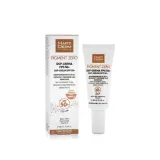
| AhavaMens Age Control Moisturizer SPF 15YOUR PRODUCT | CliniqueNEW UV Solutions Mattifying Sunscreen SPF 50 | MartidermPigment Zero DSP-Cream SPF 50+ | Paula's choiceDaytime Protect | |
|---|---|---|---|---|
| Match | — | 69% | 68% | 67% |
| Price | $26.25 | $39.66+$13.41 | $63.03+$36.78 | $64.78+$38.53 |
| Shared key ingredients | — | 7 of 28 | 5 of 28 | 7 of 28 |
| Key difference | — | Algae Extract | Niacinamide | Colloidal Oatmeal |
| Irritancy | High | Low | Medium | Medium |
| SPF | SPF 15 | SPF 50 | SPF 50 | SPF 15 |
| Drying alcohol | — | — | — | — |
| View product | Shop | Shop | Shop |



Product summary
"Ahava - Mens Age Control Moisturizer SPF 15" offers broad spectrum protection. It means that it protects from both UVA and UVB rays (you can remember UVB as "burning" sunlight - they cause sunburn. You can remember UVA rays as "aging" - they do not lead to sunburn, but they cause photodamage and contribute to early signs of skin aging and hyperpigmentation). On the negative side, the SPF of this moisturizer is not high enough. We recommend to use a sunscreen with at least SPF 30 daily.
This moisturizer should also be hydrating enough to use without an additional moisturizer during the day.
Sunscreen filters
This is a so-called "chemical" sunscreen. It means that it uses organic UV filters. They typically offer good sun protection and rarely leave a white cast, but they can be irritating for some people with sensitive skin. These are the sun protection ingredients in this sunscreen: avobenzone 3.00% - 4.50%, octisalate 4.90% - 7.40% and octocrylene 1.50% - 2.20%.
Irritation risk
This moisturizer contains a bunch of common irritants, including ingredients that do not provide any known benefit for the skin. It might not be the best choice if your skin is sensitive. We assess the overall irritancy of this moisturizer to be high. For a detailed overview of all potential irritants: click here
You can see the detailed formula review with the breakdown of all actives in the product and the full ingredient list with estimated concentrations in the tables below.
Sources cited in this review
Every concentration estimate and effectiveness label is anchored to one of these 45 studies and safety reviews.
- 1
- 2
- 3
- 4
- 5Final Report on the Safety Assessment of Dimethicone Copolyoljournals.sagepub.com
- 6

Affiliate links · As an Amazon Associate, WIMJ earns from qualifying purchases.