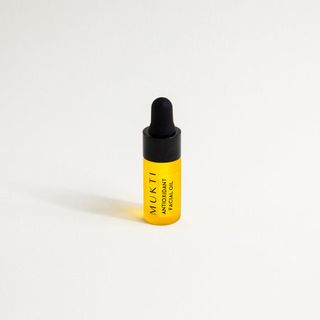
mukti-au Antioxidant Facial Oil Omega 3-6-9
Works for
2 of 2 advertised claims delivered
MoisturizingAcetyl hexapeptide-8, Pentapeptide-18 + 14 moreStrong evidence
“Contains a curated infusion of 16 superfood oils that work to restore youthful radiance and impart an extra surge of moisture, leaving your complexion with a visible dewy glow.”
This product can help improve hydration of the skin with the two types of ingredients.
The first type is called “humectants”:
these ingredients help attract water.
When humectants are on the surface of the skin, they “pull in” the moisture from the outside environment, or from
within deeper layers of the skin. The following ingredients in this product do the job:
acetyl hexapeptide-8, mel.
This product also contains ingredients called “occlusives”. They help reduce the speed with which our skin loses moisture to the outside environment. These ingredients also help soften the upper layer of the skin, so it feels less tight and nicer to the touch. The following ingredients in this product do the job: squalane, carthamus tinctorius seed oil.
The following ingredients in this product are especially good for supporting the skin barrier and helping with the hydration level: acetyl hexapeptide-8, pentapeptide-18
Anti-agingPentapeptide-18, Acetyl hexapeptide-8 + 5 moreModerate evidence
“Contains a curated infusion of 16 superfood oils that work to restore youthful radiance and impart an extra surge of moisture, leaving your complexion with a visible dewy glow.”
This product contains acetyl hexapeptide-8, pentapeptide-18. These ingredients might be able to help reduce and prevent fine lines and wrinkles, improve skin elasticity and firmness, but there is not enough evidence that it actually works.
Anti-oxidationNot advertised by the brand · Ubiquinone, Punica granatum extract + 5 moreStrong evidence
This product contains antioxidants (ubiquinone) that can help neutralize free radicals in skin. By doing so, they can lessen the damage the skin gets from the UV light (sun).
The following ingredients - punica granatum extract also can have an antioxidant effect, but there is less evidence to confirm their effectiveness in skin.
Can it cause trouble?
Irritancy3 strong irritants: Rosa damascena extract, Boswellia carterii oil + 1 more — patch-test recommendedHigh risk
Comedogenic1 ingredient rated 2 or more on the 0–5 pore-clogging scale1 flagged

User reviews
Be the first — your take helps the next person decide.
Ingredients
Filter by role to see what each ingredient is doing.
Aloe barbadensis leaf juice~23–34%
- Irritation risk
- Medium
Traditionally used to treat sunburns, dermatitis and inflammation, but evidence for its effectiveness is lacking. The extract can contain humectants that help attract water into the skin
More about Aloe barbadensis leaf juicePrunus amygdalus dulcis oleosomes~3.2–4.7%
- Irritation risk
- Low
Pseudoalteromonas exopolysaccharides~4.3–6.4%
- Irritation risk
- Low
Pseudoalteromonas ferment extract~3.2–4.7%
- Irritation risk
- Low
Pentapeptide-18~2.5–3.8%
- Irritation risk
- Low
A type of peptide. Peptides are excellent moisturizers and might be able support collagen production reducing fine lines and wrinkles
More about Pentapeptide-18Acetyl hexapeptide-8~1.7–2.6%
- Irritation risk
- Low
A type of peptide. Peptides are excellent moisturizers and might be able support collagen production reducing fine lines and wrinkles
More about Acetyl hexapeptide-8Phospholipids~1.3–1.9%
- Irritation risk
- Low
Emollients that are naturaly present in skin. In addition, they help water and oil mix together in the product
More about PhospholipidsGlycine soja extract~1–1.5%
- Irritation risk
- Low
Glycine soja oil~0.95–1.4%
- Irritation risk
- Medium
- Comedogenicity
- 2/5
A good emollient that helps soften the skin and helps repair its barrier function. It can clog pores if used in high concentrations.
More about Glycine soja oilGlycolipids~0.6–1.4%
- Irritation risk
- Low
Rosa damascena extract~0.5–1.15%
- Irritation risk
- High
Oil of a very fragrant pink rose used as fragrance in cosmetics. Extensive research has shown it has mixed benefits. In the pro column, inhaling this flower’s scent seems to have relaxing properties and the plant’s petals contain skin-soothing and antioxidant compounds that can benefit skin. On the flipside, the numerous chemicals that create this rose’s distinctive fragrance pose a risk of causing skin aggravation.
More about Rosa damascena extractTasmannia lanceolata leaf extract~0.4–1%
- Irritation risk
- Low
Mel~0.45–1%
- Irritation risk
- Low
Helps to soften the upper layer of the skin and attract water to it
More about MelCi 42090~0.35–0.85%
Rosa damascena extract~0.35–0.75%
- Irritation risk
- High
Oil of a very fragrant pink rose used as fragrance in cosmetics. Extensive research has shown it has mixed benefits. In the pro column, inhaling this flower’s scent seems to have relaxing properties and the plant’s petals contain skin-soothing and antioxidant compounds that can benefit skin. On the flipside, the numerous chemicals that create this rose’s distinctive fragrance pose a risk of causing skin aggravation.
More about Rosa damascena extractMagnesium ascorbyl phosphate~0.4–0.95%
- Irritation risk
- Medium
A derivative of vitamin C that is more stable, but less bioavailable than the pure form of vitamin C. It does not penetrate the skin well, but has been shown to convert to pure vitamin C once in skin. It can be helpful in stimulating collagen production and lightening the skin tone, but the required concentration is likely to be very high
More about Magnesium ascorbyl phosphatePolyglyceryl-2 dipolyhydroxystearate~0.35–0.8%
- Irritation risk
- Low
Helps to soften the upper layer of the skin
More about Polyglyceryl-2 dipolyhydroxystearateCarthamus tinctorius seed oil~0.35–0.85%
- Irritation risk
- Low
An emollient that helps soften the skin and might help calm down inflammation
More about Carthamus tinctorius seed oilMel~0.35–0.75%
- Irritation risk
- Low
Helps to soften the upper layer of the skin and attract water to it
More about MelRosa damascena extract~0.2–0.7%
- Irritation risk
- High
Oil of a very fragrant pink rose used as fragrance in cosmetics. Extensive research has shown it has mixed benefits. In the pro column, inhaling this flower’s scent seems to have relaxing properties and the plant’s petals contain skin-soothing and antioxidant compounds that can benefit skin. On the flipside, the numerous chemicals that create this rose’s distinctive fragrance pose a risk of causing skin aggravation.
More about Rosa damascena extractAstragalus membranaceus root extract~0.3–0.75%
- Irritation risk
- Low
Ubiquinone~0.35–0.75%
- Irritation risk
- Low
Coenzyme Q10. It helps neutralize free radicals in skin, improves skin hydration and might be helpful agains fine lines and wrinkles. It can be an allergen
More about UbiquinoneTocopherol~0.3–0.75%
- Irritation risk
- Low
Pure form of vitamin E. Can help moisturise and protect the skin from free radicals. Often used to help stabilise other ingredients or the formula itself
More about TocopherolSqualane~0.3–0.75%
- Irritation risk
- Low
An oil naturally present in skin. Works as an emollient to soften the skin and form a protective layer on its surface without a greasy feeling.
More about SqualanePunica granatum extract~0.2–0.75%
- Irritation risk
- Medium
A plant extract that can help neutralize free radicals in skin and even out the skin tone, but is typically used in products in a concentration that is too low to be effective
More about Punica granatum extractPunica granatum seed oil~0.35–0.8%
- Irritation risk
- Low
Helps soften the upper layer of the skin
More about Punica granatum seed oilHippophae rhamnoides fruit oil~0.2–0.7%
- Irritation risk
- High
A plant oil that might somewhat help to neutralize free radicals. It could be irritating
More about Hippophae rhamnoides fruit oilGlyceryl caprylate~0.35–0.75%
- Irritation risk
- Low
An emollient that can also help water and oil mix together, as well as prevent bacteria growth in products
More about Glyceryl caprylateBoswellia carterii oil~0.15–0.6%
Rosmarinus officinalis extract~0.15–0.55%
- Irritation risk
- High
Lysolecithin~0.15–0.5%
- Irritation risk
- Low
Lecithin derivative. It helps oil and water mix together and can enhance penetration of other ingredients. It helps soften the upper layer of the skin
More about LysolecithinSclerotium gum~0.1–0.45%
- Irritation risk
- Low
Used to create gel-like formulas and stabilize emulsions
More about Sclerotium gumXanthan gum~0.1–0.4%
- Irritation risk
- Low
Used to create a thicker product consistency
More about Xanthan gumPullulan~0.1–0.45%
- Irritation risk
- High
Creates a thin drying film on the skin resulting in a short-term tightening effect
More about PullulanP-anisic acid~0.05–0.3%
- Irritation risk
- High
Helps preserve products. Can mask unpleasant smell. Could be irritating
More about P-anisic acidCentella asiatica extract~0.1–0.45%
- Irritation risk
- Medium
A plant extract that has been shown to be able to reduce inflammation in skin, support restoration of skin barrier function, as well as support collagen production. Contains active compounds called centelloids: asiaticoside, madecasosside, asiatic acid and madecassic acid. Might be helpful in preventing stretch marks. It can be itself be irritating though.
More about Centella asiatica extractIngredient list view
Aloe barbadensis leaf juice, Prunus amygdalus dulcis oleosomes, Pseudoalteromonas exopolysaccharides, Pseudoalteromonas ferment extract, Pentapeptide-18, Acetyl hexapeptide-8, Phospholipids, Glycine soja extract, Glycine soja oil, Glycolipids, Rosa damascena extract, Tasmannia lanceolata leaf extract, Mel, Ci 42090, Rosa damascena extract, Magnesium ascorbyl phosphate, Polyglyceryl-2 dipolyhydroxystearate, Carthamus tinctorius seed oil, Mel, Rosa damascena extract, Astragalus membranaceus root extract, Ubiquinone, Tocopherol, Squalane, Punica granatum extract, Punica granatum seed oil, Hippophae rhamnoides fruit oil, Glyceryl caprylate, Boswellia carterii oil, Rosmarinus officinalis extract, Lysolecithin, Sclerotium gum, Xanthan gum, Pullulan, P-anisic acid, Centella asiatica extract
Compare prices
Retailers ranked by price — lowest first.

Affiliate links · prices updated regularly
Worth comparing, line by line.
Match % combines shared ingredients, the first five ingredients, shared actives and hero ingredients, irritancy (lower counts in the alternative's favour), texture and body area. Only products in the same routine step are compared.
| mukti-auAntioxidant Facial Oil Omega 3-6-9YOUR PRODUCT | 3LABAnti-Aging Oil | |
|---|---|---|
| Match | — | 51% |
| Price | $9.19 | $325.00+$315.81 |
| Shared key ingredients | — | 2 of 11 |
| Key difference | — | Urea |
| Irritancy | High | Medium |
| Drying alcohol | — | — |
| View product | Shop |
Product summary
"mukti-au - Antioxidant Facial Oil Omega 3-6-9" is a well-rounded moisturizing product. The formulation is based on a combination of good humectants and emollients. Both are needed to increase the skin hydration level. Humectants in this product (acetyl hexapeptide-8, mel and aloe barbadensis leaf juice) help to increase the water content in the upper layer of the skin. (These ingredients do so by "capturing" water molecules from the outside air or from within the deeper layers of the skin). Emollients in this formulation (carthamus tinctorius seed oil, glycine soja oil, squalane, mel and punica granatum seed oil) help to reduce the moisture loss from the skin. They also soften the skin surface and relieve the feeling of dryness and tightness.
Ingredient callouts
- This moistruizer also contains peptides (acetyl hexapeptide-8 1.70% - 2.60% and pentapeptide-18 2.50% - 3.80%). Peptides is a very big group of ingredients. They all consist of a different combination of amino-acids. Our skin produces peptides naturally. Some of them work as natural anti-biotics, promote wound-healing and production of collagen. The scientists are still studying how effective the topical application of peptides is, but it is very likely that peptides in skincare are helpful. They might be able to support skin barrier restoration and even have an anti-aging benefit. At the very least, they certainly help attract water to the skin and support the hydration in this way.
Irritation risk
There are quite a few common irritants in this product, including ingredients without particular skin benefits. We would not recommend it for sensitive skin. We assess the overall irritancy of this moisturizer to be high. For a detailed overview of all potential irritants: click here
You can see the detailed formula review with the breakdown of all actives in the product and the full ingredient list with estimated concentrations in the tables below.
Price
The product retails for 6.95A$ in Australia.
For a detailed price comparison: click here.
Sources cited in this review
Every concentration estimate and effectiveness label is anchored to one of these 15 studies and safety reviews.
- 1
- 2Topical L-ascorbic acid: percutaneous absorption studiesncbi.nlm.nih.gov
- 3Vitamin E in dermatologyncbi.nlm.nih.gov
- 4Vitamin E and Skin Healthlpi.oregonstate.edu
- 5
- 6

Affiliate links · As an Amazon Associate, WIMJ earns from qualifying purchases.