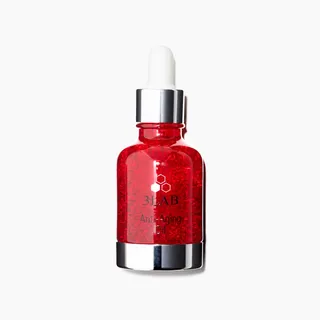
3LAB Anti-Aging Oil

3LAB Anti-Aging Oil

Efficacy83/100IrritancyHigh

Works for

Anti-aging
Bakuchiol, Tocopherol + 1 more
Works well
What the product description says
“Anti-Aging Oil”
Source: 3lab

This product can help reduce and prevent fine lines and wrinkles, improve skin elasticity and firmness because it contains bakuchiol.

Keep in mind that it typically takes at least 6 weeks to notice any results because the changes that are needed to improve fine lines and elasticity happen in the deeper layers of the skin. No topical anti-aging product can “erase” wrinkles or fully reverse signs of aging.

BakuchiolKey activeEffect: HighA plant extract that is, though different in chemical structure, acts similar to retinoids. First studies show that it can help reduce fine lines and wrinkles, improve skin tone, reduce clogged pores and blemishes, and reduce inflammation. There is no conclusive evidence that bakuchiol is as effective as retinol however. The study that directly compared retinol with bakuchiol used bakuchiol applied twice daily compared to once per day for the retinol. According to this study, bakuchiol is less irritating than retinol. Bakuchiol is extracted from seeds of Babchi plant. Other parts of the plant contain coumarins that could cause allergic and irritant reactions. These compounds should be removed in the extraction process when bakuchiol is produced, but it is a good idea to be cautious and stay away from products that include the Babchi plant extracts other than purified bakuchiol to avoid irritation~0.6–1.4%
TocopherolEffect: Low, below effective dosePure form of vitamin E. Can help moisturise and protect the skin from free radicals. Often used to help stabilise other ingredients or the formula itself~0.1–0.45%
Tetrahexyldecyl ascorbateUnder-dosedBeing a lipid soluble form of vitamin C, it is more stable than ascorbic acid, but still degrades quickly and needs to be stabilized in a formulation with another ingredient. It is claimed to penetrate skin better than pure vitamin C and have the the similar benefits, but solid studies of its effectiveness are lacking. Is likely to require a higher concentration in a product than pure vitamin C to be effective. It might be able to help reduce pore clogging.~1.9–2.8%
Moisturizing
Hydrogenated ethylhexyl olivate, Rosa canina fruit oil + 7 more
Works
What the product description says
“A unique blend designed to repair, hydrate, and smooth out your skin’s texture.”
Source: 3lab

This product can help soften the skin and reduce its moisture loss with emollients and occlusives: caprylic/capric triglyceride, rosa canina fruit oil.

Keep in mind that this product does not contain effective ingredients to attract water to the upper layer of the skin. This is why an additional product with humectants like glycerin or hyaluronic acid can be helpful (apply it before this product for the best results).

Hydrogenated ethylhexyl olivateKey active· EmollientEffect: MediumHelps soften the upper layer of the skin~22–33%
Rosa canina fruit oilKey active· EmollientEffect: HighA great emollient. Contains vitamin E (tocopherol) which may give it some anti-oxidant properties. Can contain volatile compounds and can be irritating~4.6–6.8%
Ethylhexyl palmitateKey active· EmollientEffect: MediumAn emollient that helps soften the skin and create a nice product texture~3–4.5%
Hydrogenated olive oil unsaponifiablesKey active· EmollientEffect: MediumHelp soften the upper layer of the skin~1.6–2.4%
Caprylic/capric triglycerideKey active· Emollient, OcclusiveEffect: HighA good mix of fatty acids that forms a protective layer on the skin. Improves the shelf life of products. Derived from coconut and glycerin~1.2–1.9%
Mauritia flexuosa fruit oilKey activeEffect: HighHelps soften the upper layer of the skin~0.85–1.25%
Sesamum indicum seed extractKey activeEffect: HighPlant oil that due to its high content of linoleic acid can help support skin's barrier function improving its hydration~0.35–0.8%
Tridecyl trimellitate· EmollientEffect: LowUsed to create a thicker product consistency and soften the upper layer of the skin~5.5–8.3%
TocopherolEffect: Low, below effective dosePure form of vitamin E. Can help moisturise and protect the skin from free radicals. Often used to help stabilise other ingredients or the formula itself~0.1–0.45%
Anti-blemish
Bakuchiol
May help
What the product description says
“Addresses multiple skin concerns from breakouts to extreme dryness.”
Source: 3lab

This product might be able to help reduce blemishes and clogged pores because it contains bakuchiol.

BakuchiolKey activeEffect: HighA plant extract that is, though different in chemical structure, acts similar to retinoids. First studies show that it can help reduce fine lines and wrinkles, improve skin tone, reduce clogged pores and blemishes, and reduce inflammation. There is no conclusive evidence that bakuchiol is as effective as retinol however. The study that directly compared retinol with bakuchiol used bakuchiol applied twice daily compared to once per day for the retinol. According to this study, bakuchiol is less irritating than retinol. Bakuchiol is extracted from seeds of Babchi plant. Other parts of the plant contain coumarins that could cause allergic and irritant reactions. These compounds should be removed in the extraction process when bakuchiol is produced, but it is a good idea to be cautious and stay away from products that include the Babchi plant extracts other than purified bakuchiol to avoid irritation~0.6–1.4%
Anti-oxidation
Side benefit · Bakuchiol, Rosa canina fruit oil + 5 more
Works well

This product contains antioxidants (bakuchiol) that can help neutralize free radicals in skin. By doing so, they can lessen the damage the skin gets from the UV light (sun).

BakuchiolKey activeEffect: HighA plant extract that is, though different in chemical structure, acts similar to retinoids. First studies show that it can help reduce fine lines and wrinkles, improve skin tone, reduce clogged pores and blemishes, and reduce inflammation. There is no conclusive evidence that bakuchiol is as effective as retinol however. The study that directly compared retinol with bakuchiol used bakuchiol applied twice daily compared to once per day for the retinol. According to this study, bakuchiol is less irritating than retinol. Bakuchiol is extracted from seeds of Babchi plant. Other parts of the plant contain coumarins that could cause allergic and irritant reactions. These compounds should be removed in the extraction process when bakuchiol is produced, but it is a good idea to be cautious and stay away from products that include the Babchi plant extracts other than purified bakuchiol to avoid irritation~0.6–1.4%
Rosa canina fruit oilEffect: LowA great emollient. Contains vitamin E (tocopherol) which may give it some anti-oxidant properties. Can contain volatile compounds and can be irritating~4.6–6.8%
BisabololEffect: LowAn active component of chamomile plant that historically has been used to calm down irritated skin. A recent study shows that bisabolol indeed can have some anti-inflammatory effect on skin, even though conclusive data is lacking. Bisabolol has a sweet floral scent and can be added to products for its aromatic properties~0.55–1.3%
Tocopheryl acetateEffect: LowA more stable but less bio-available form of vitamin E compared to Tocopherol. Might help moisturize and protect the skin from free radicals, but mostly used in low concentrations to stabilize other ingredients.~0.5–1.15%
Zingiber officinale root extractEffect: LowA plant extract that can contain an irritating essential oil. Might have some anti-oxidant effect, but evidence is lacking~0.1–0.35%
Tetrahexyldecyl ascorbateUnder-dosedBeing a lipid soluble form of vitamin C, it is more stable than ascorbic acid, but still degrades quickly and needs to be stabilized in a formulation with another ingredient. It is claimed to penetrate skin better than pure vitamin C and have the the similar benefits, but solid studies of its effectiveness are lacking. Is likely to require a higher concentration in a product than pure vitamin C to be effective. It might be able to help reduce pore clogging.~1.9–2.8%
TocopherolUnder-dosedPure form of vitamin E. Can help moisturise and protect the skin from free radicals. Often used to help stabilise other ingredients or the formula itself~0.1–0.45%
Evens skin tone
Side benefit · Bakuchiol, Tetrahexyldecyl ascorbate
Works well

This product can help reduce hypepigmentation and even out the skin tone because it contains the following effective ingredients: bakuchiol

Keep in mind that you would need to apply any topical skincare targetted at hypigmentation consistently for a couple of months to get a result. No topical skincare product can help get rid of hyperpigmentation (including post-acne marks and age spots) instantly.

BakuchiolKey activeEffect: HighA plant extract that is, though different in chemical structure, acts similar to retinoids. First studies show that it can help reduce fine lines and wrinkles, improve skin tone, reduce clogged pores and blemishes, and reduce inflammation. There is no conclusive evidence that bakuchiol is as effective as retinol however. The study that directly compared retinol with bakuchiol used bakuchiol applied twice daily compared to once per day for the retinol. According to this study, bakuchiol is less irritating than retinol. Bakuchiol is extracted from seeds of Babchi plant. Other parts of the plant contain coumarins that could cause allergic and irritant reactions. These compounds should be removed in the extraction process when bakuchiol is produced, but it is a good idea to be cautious and stay away from products that include the Babchi plant extracts other than purified bakuchiol to avoid irritation~0.6–1.4%
Tetrahexyldecyl ascorbateUnder-dosedBeing a lipid soluble form of vitamin C, it is more stable than ascorbic acid, but still degrades quickly and needs to be stabilized in a formulation with another ingredient. It is claimed to penetrate skin better than pure vitamin C and have the the similar benefits, but solid studies of its effectiveness are lacking. Is likely to require a higher concentration in a product than pure vitamin C to be effective. It might be able to help reduce pore clogging.~1.9–2.8%

Can it cause trouble?

Irritancy
3 strong irritants: Citrus aurantium dulcis peel oil, Lavandula angustifolia oil + 1 more — patch-test recommended
High risk
We flagged 14 ingredients with irritancy potential. Severity depends on your sensitivity threshold; the table lists the worst offenders first.
IngredientFunctionIrritationEst. amount
Citrus aurantium dulcis peel oilAn essentil oil from orange peel. Potential allergen and can be irritatingHigh~0.4–0.95%est.
Lavandula angustifolia oilAn essential oil. Potential allergen and can be irritating. It has some anti-bacterial propertiesHigh~0.15–0.6%est.
Zingiber officinale root extractA plant extract that can contain an irritating essential oil. Might have some anti-oxidant effect, but evidence is lackingHigh~0.1–0.35%est.
Tridecyl trimellitateUsed to create a thicker product consistency and soften the upper layer of the skinMedium~5.5–8.3%est.
Rosa canina fruit oilA great emollient. Contains vitamin E (tocopherol) which may give it some anti-oxidant properties. Can contain volatile compounds and can be irritatingMedium~4.6–6.8%est.
Ethyl macadamiateHelps water and oil mix togetherMedium~3.6–5.5%est.
Tetrahexyldecyl ascorbateBeing a lipid soluble form of vitamin C, it is more stable than ascorbic acid, but still degrades quickly and needs to be stabilized in a formulation with another ingredient. It is claimed to penetrate skin better than pure vitamin C and have the the similar benefits, but solid studies of its effectiveness are lacking. Is likely to require a higher concentration in a product than pure vitamin C to be effective. It might be able to help reduce pore clogging.Medium~1.9–2.8%est.
Caprylic/capric triglycerideA good mix of fatty acids that forms a protective layer on the skin. Improves the shelf life of products. Derived from coconut and glycerinMedium~1.2–1.9%est.
Mauritia flexuosa fruit oilHelps soften the upper layer of the skinMedium~0.85–1.25%est.
BakuchiolA plant extract that is, though different in chemical structure, acts similar to retinoids. First studies show that it can help reduce fine lines and wrinkles, improve skin tone, reduce clogged pores and blemishes, and reduce inflammation. There is no conclusive evidence that bakuchiol is as effective as retinol however. The study that directly compared retinol with bakuchiol used bakuchiol applied twice daily compared to once per day for the retinol. According to this study, bakuchiol is less irritating than retinol. Bakuchiol is extracted from seeds of Babchi plant. Other parts of the plant contain coumarins that could cause allergic and irritant reactions. These compounds should be removed in the extraction process when bakuchiol is produced, but it is a good idea to be cautious and stay away from products that include the Babchi plant extracts other than purified bakuchiol to avoid irritationMedium~0.6–1.4%est.
Tocopheryl acetateA more stable but less bio-available form of vitamin E compared to Tocopherol. Might help moisturize and protect the skin from free radicals, but mostly used in low concentrations to stabilize other ingredients.Medium~0.5–1.15%est.
Sorbitan oleateHelps oil and water mix togetherMedium~0.4–1%est.
Sorbitan laurateHelps water and oil mix togetherMedium~0.3–0.75%est.
GoldA colorant. Does not have any proven benefits in skinMedium~0.15–0.5%est.
Comedogenic
2 ingredients rated 2 or more on the 0–5 pore-clogging scale
2 flagged
These ingredients have a comedogenic rating of 2 or more on a 0–5 scale; the table shows each one's rating. In leave-on products they can clog pores in acne-prone skin.
IngredientFunctionRatingEst. amount
Ethylhexyl palmitateAn emollient that helps soften the skin and create a nice product texture3/5~3–4.5%est.
Sorbitan oleateHelps oil and water mix together2/5~0.4–1%est.
Did this help you decide?

User reviews

Would you recommend?
No community reviews yet.

Be the first — your take helps the next person decide.

Ingredients

Filter by role to see what each ingredient is doing.

Hydrogenated ethylhexyl olivate~22–33%
Key active
Irritation risk
Low
Works for
Moisturizing

Helps soften the upper layer of the skin

More about Hydrogenated ethylhexyl olivate
Carapa guianensis seed oil~10–16%
Formula
Tridecyl trimellitate~5.5–8.3%
Irritant · medium
Irritation risk
Medium
Works for
Moisturizing

Used to create a thicker product consistency and soften the upper layer of the skin

More about Tridecyl trimellitate
Rosa canina fruit oil~4.6–6.8%
Key activeIrritant · medium
Irritation risk
Medium
Works for
MoisturizingAnti-oxidation

A great emollient. Contains vitamin E (tocopherol) which may give it some anti-oxidant properties. Can contain volatile compounds and can be irritating

More about Rosa canina fruit oil
Ethyl macadamiate~3.6–5.5%
Irritant · medium
Irritation risk
Medium

Helps water and oil mix together

More about Ethyl macadamiate
Ethylhexyl palmitate~3–4.5%
Key activeComedogenic 3/5
Irritation risk
Low
Comedogenicity
3/5
Works for
Moisturizing

An emollient that helps soften the skin and create a nice product texture

More about Ethylhexyl palmitate
Camellia japonica seed oil~2.5–3.8%
Formula
Irritation risk
Low

A plant oil that helps to soften the upper layer of the skin and can help restore skin's barrier function. Might have an anti-oxidant effect

More about Camellia japonica seed oil
Tetrahexyldecyl ascorbate~1.9–2.8%
Under-dosedIrritant · medium
Irritation risk
Medium
Works for
Anti-oxidationEvens skin toneAnti-aging

Being a lipid soluble form of vitamin C, it is more stable than ascorbic acid, but still degrades quickly and needs to be stabilized in a formulation with another ingredient. It is claimed to penetrate skin better than pure vitamin C and have the the similar benefits, but solid studies of its effectiveness are lacking. Is likely to require a higher concentration in a product than pure vitamin C to be effective. It might be able to help reduce pore clogging.

More about Tetrahexyldecyl ascorbate
Hydrogenated olive oil unsaponifiables~1.6–2.4%
Key active
Irritation risk
Low
Works for
Moisturizing

Help soften the upper layer of the skin

More about Hydrogenated olive oil unsaponifiables
Caprylic/capric triglyceride~1.2–1.9%
Key activeIrritant · medium
Irritation risk
Medium
Works for
Moisturizing

A good mix of fatty acids that forms a protective layer on the skin. Improves the shelf life of products. Derived from coconut and glycerin

More about Caprylic/capric triglyceride
Isosorbide disunflowerseedate~0.95–1.4%
Formula
Mauritia flexuosa fruit oil~0.85–1.25%
Key activeIrritant · medium
Irritation risk
Medium
Works for
Moisturizing

Helps soften the upper layer of the skin

More about Mauritia flexuosa fruit oil
Dimethyl isosorbide~0.8–1.25%
Formula
Irritation risk
Low

Used to dissolve other ingredients in a product and can enhance their ability to penetrate the skin

More about Dimethyl isosorbide
Bisabolol~0.55–1.3%
Formula
Irritation risk
Low
Works for
Anti-inflammatoryReduces irritationAnti-oxidation

An active component of chamomile plant that historically has been used to calm down irritated skin. A recent study shows that bisabolol indeed can have some anti-inflammatory effect on skin, even though conclusive data is lacking. Bisabolol has a sweet floral scent and can be added to products for its aromatic properties

More about Bisabolol
Bakuchiol~0.6–1.4%
Key activeIrritant · medium
Irritation risk
Medium
Works for
Anti-inflammatoryAnti-blemishEvens skin toneAnti-oxidationAnti-aging

A plant extract that is, though different in chemical structure, acts similar to retinoids. First studies show that it can help reduce fine lines and wrinkles, improve skin tone, reduce clogged pores and blemishes, and reduce inflammation. There is no conclusive evidence that bakuchiol is as effective as retinol however. The study that directly compared retinol with bakuchiol used bakuchiol applied twice daily compared to once per day for the retinol. According to this study, bakuchiol is less irritating than retinol. Bakuchiol is extracted from seeds of Babchi plant. Other parts of the plant contain coumarins that could cause allergic and irritant reactions. These compounds should be removed in the extraction process when bakuchiol is produced, but it is a good idea to be cautious and stay away from products that include the Babchi plant extracts other than purified bakuchiol to avoid irritation

More about Bakuchiol
Tocopheryl acetate~0.5–1.15%
Irritant · medium
Irritation risk
Medium
Works for
Anti-oxidation

A more stable but less bio-available form of vitamin E compared to Tocopherol. Might help moisturize and protect the skin from free radicals, but mostly used in low concentrations to stabilize other ingredients.

More about Tocopheryl acetate
Citrus aurantium dulcis peel oil~0.4–0.95%
Irritant · high
Irritation risk
High

An essentil oil from orange peel. Potential allergen and can be irritating

More about Citrus aurantium dulcis peel oil
Sorbitan oleate~0.4–1%
Comedogenic 2/5Irritant · medium
Irritation risk
Medium
Comedogenicity
2/5
Works for
Cleansing

Helps oil and water mix together

More about Sorbitan oleate
Sesamum indicum seed extract~0.35–0.8%
Key active
Irritation risk
Low
Works for
Moisturizing

Plant oil that due to its high content of linoleic acid can help support skin's barrier function improving its hydration

More about Sesamum indicum seed extract
Sorbitan laurate~0.3–0.75%
Irritant · medium
Irritation risk
Medium
Works for
Cleansing

Helps water and oil mix together

More about Sorbitan laurate
Lavandula angustifolia oil~0.15–0.6%
Irritant · high
Irritation risk
High

An essential oil. Potential allergen and can be irritating. It has some anti-bacterial properties

More about Lavandula angustifolia oil
Gold~0.15–0.5%
Irritant · medium
Irritation risk
Medium

A colorant. Does not have any proven benefits in skin

More about Gold
Tocopherol~0.1–0.45%
Under-dosed
Irritation risk
Low
Works for
Anti-oxidationMoisturizingAnti-inflammatoryAnti-aging

Pure form of vitamin E. Can help moisturise and protect the skin from free radicals. Often used to help stabilise other ingredients or the formula itself

More about Tocopherol
Zingiber officinale root extract~0.1–0.35%
Irritant · high
Irritation risk
High
Works for
Anti-oxidation

A plant extract that can contain an irritating essential oil. Might have some anti-oxidant effect, but evidence is lacking

More about Zingiber officinale root extract
Myristyl malate phosphonic acid~0.1–0.4%
Formula
Ingredient list view

Hydrogenated ethylhexyl olivate, Carapa guianensis seed oil, Tridecyl trimellitate, Rosa canina fruit oil, Ethyl macadamiate, Ethylhexyl palmitate, Camellia japonica seed oil, Tetrahexyldecyl ascorbate, Hydrogenated olive oil unsaponifiables, Caprylic/capric triglyceride, Isosorbide disunflowerseedate, Mauritia flexuosa fruit oil, Dimethyl isosorbide, Bisabolol, Bakuchiol, Tocopheryl acetate, Citrus aurantium dulcis peel oil, Sorbitan oleate, Sesamum indicum seed extract, Sorbitan laurate, Lavandula angustifolia oil, Gold, Tocopherol, Zingiber officinale root extract, Myristyl malate phosphonic acid

Compare prices

Retailers ranked by price — lowest first.

3lab
$345.00
Buy

Affiliate links

Worth comparing, line by line.

Match % combines shared ingredients, the first five ingredients, shared actives and hero ingredients, irritancy (lower counts in the alternative's favour), texture and body area. Only products in the same routine step are compared.

Side-by-side comparison of this product against its closest alternatives
3LABAnti-Aging OilYOUR PRODUCTOlverumRadiance Oil - GWPInvityYouth Activating Cream ConcentrateSoft & CoBacuchiol + Q10 Multifunctional Oil
Match—73%70%66%
Price$345.00———
Shared key ingredients—2 of 72 of 71 of 7
Key difference—Caryodendron Orinocense Seed OilTripeptide-29Sunflower Seed Oil
Irritancy High Medium Medium High
Drying alcohol————
View product Shop Shop Shop

More alternatives: CosMedix Alt-A Daily Rejuvenating MoisturizerHeritage Store Brightening Citrus Aura Glow Gel Cream

Cheaper alternatives? See how this stacks up against similar formulas.
We compare ingredient profiles across our catalog — pick the closest match for your budget.
Open dupe finder

Product summary

"3LAB - Anti-Aging Oil" is effective for: Moisturizing

This moisturizer could be helpful for: Anti-aging, but its actives are not the most effective or are not well-studied.

Ingredient callouts

  • We like that this moisturizer contains peptides (dipeptide diaminobutyroyl benzylamide diacetate 1.10% - 1.30%, palmitoyl tripeptide-38 1.30% - 1.60%, palmitoyl tetrapeptide-7 1.50% - 1.90%, palmitoyl tripeptide-1 1.90% - 2.30%, pentapeptide-18 2.20% - 2.70% and acetyl hexapeptide-8 3.00% - 3.60%). There are many different kind of Peptides and they are naturally present in our skin. They all are a combination of aminoacids. Some of them work as natural antibiotics, promote wound-healing and production of collagen. The science is still not settled on how effective Peptides are in skincare, but it is very likely that they have a benefit. Peptides might help restore the skin barrier and fight the signs of aging. At the very least, Peptides work as humectants: they attract water to the upper layer of the skin and improve its hydration.

Price

The product retails for 325.00$ in the United States and from 240.00£ up to 500.00£ in the United Kingdom.

For a detailed price comparison: click here.

3LAB Anti-Aging Oil
3LABAnti-Aging Oil

Affiliate links · As an Amazon Associate, WIMJ earns from qualifying purchases.

As an Amazon Associate, WIMJ earns from qualifying purchases.