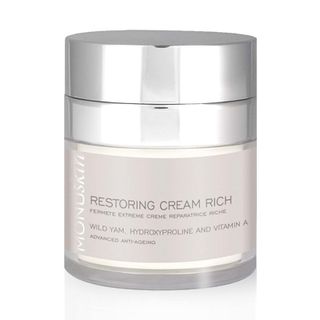
MONU Professional Skincare RENUSKIN Restoring Cream Rich
Works for
1 of 2 advertised claims delivered
Moisturizing16 ingredients credited for this claimGood support
“RENUSKIN Restoring Cream Rich”
This product can help improve hydration of the skin with the two types of ingredients.
The first type is called “humectants”:
these ingredients help attract water.
When humectants are on the surface of the skin, they “pull in” the moisture from the outside environment, or from
within deeper layers of the skin. The following ingredients in this product do the job:
glycerin, sodium hyaluronate.
This product also contains ingredients called “occlusives”. They help reduce the speed with which our skin loses moisture to the outside environment. These ingredients also help soften the upper layer of the skin, so it feels less tight and nicer to the touch. The following ingredients in this product do the job: butyrospermum parkii butter, dimethicone.
Anti-aging5 ingredients credited for this claimLimited support
“It promises to lift and tone slackening skin whilst firming fine lines and plumping deep wrinkles to leave you looking and feeling more radiant and youthful. . An uplifting blend of fresh, floral essential oils is sure to leave you smelling deliciously feminine. . A blend of Evening Primrose and Rosehip Oils along with Wild Yam extract and Vitamin C provides skin with the help it needs to maintain suppleness and elasticity whilst intensively hydrating.”
This product does not contain ingredients that are able to reduce fine lines and wrinkles or help with skin elasticity, but it can improve the look of the skin temporarily through moisturization. Well-moisturized skin might also be able to repair the sun damage better.These ingredients - butyrospermum parkii butter, dipalmitoyl hydroxyproline - could be helpful for preventing or repairing signs of aging in theory, but there is no evidence that it actually works.
Can it cause trouble?
Irritancy8 strong irritants: Parfum, Linalool + 6 more — patch-test recommendedHigh risk
Comedogenic4 ingredients rated 2 or more on the 0–5 pore-clogging scale4 flagged


User reviews
Be the first — your take helps the next person decide.
Ingredients
Filter by role to see what each ingredient is doing.
Water~45–55%
Simmondsia chinensis seed oil~5.6–6.8%
- Irritation risk
- Medium
Softens the upper layer of skin and helps restore the healthy skin barrier. Has shown to help calm down inflammation in skin. It is a stable oil, meaning that it retains its properties even when exposed to air.
More about Simmondsia chinensis seed oilCetearyl alcohol~3.6–4.4%
- Irritation risk
- Low
- Comedogenicity
- 2/5
A non-drying alcohol. Works as an emollient. Helps water and oil mix together and creates a nice product texture
More about Cetearyl alcoholButyrospermum parkii butter~3.1–3.8%
- Irritation risk
- Low
- Comedogenicity
- 3/5
A great moisturising ingredient that softens the skin and reduces water loss from its upper layer. It also can be helpful in protecting skin from free radicals
More about Butyrospermum parkii butterDicaprylyl maleate~2.4–2.9%
- Irritation risk
- Medium
Used to dissolve other ingredients, create a nice product texture and soften the upper layer of the skin. Can be an allergen
More about Dicaprylyl maleateGlycerin~2–2.4%
- Irritation risk
- Low
One of the best moisturizing ingredients. Naturally present in skin. It attracts water to the upper layer of the skin working as a humectant
More about GlycerinEthylhexyl palmitate~1.7–2%
- Irritation risk
- Low
- Comedogenicity
- 3/5
An emollient that helps soften the skin and create a nice product texture
More about Ethylhexyl palmitateCyclotetrasiloxane~1.4–1.8%
- Irritation risk
- Low
Cyclopentasiloxane~1.2–1.5%
- Irritation risk
- Low
A silicone that helps improve the product texture and spreadability. Can absorb oil creating a short-term mattifying effect on the skin
More about CyclopentasiloxaneGlyceryl stearate~1–1.2%
- Irritation risk
- Low
An emollient that softens the skin and forms a protective layer on its surface. Helps water and oil mix together
More about Glyceryl stearatePeg-100 stearate~0.8–1.15%
- Irritation risk
- Low
Helps oil and water mix togehter and creates a nice product texture
More about Peg-100 stearateOleyl alcohol~0.6–0.9%
Dimethicone~0.6–0.9%
- Irritation risk
- Low
A silicone that helps to reduce water loss from the surface of the skin. Can temporarily "fill in" lines and wrinkles, absorb oil, and create a nice product finish
More about DimethiconePhenoxyethanol~0.5–0.75%
- Irritation risk
- Low
A preservative. It helps prevent bacterial growth in cosmetic products
More about PhenoxyethanolCoconut alcohol~0.5–0.8%
Polyacrylamide~0.5–0.75%
- Irritation risk
- Medium
Used to improve product texture and help oil and water mix together
More about PolyacrylamideDioscorea villosa root extract~0.45–0.65%
- Irritation risk
- Low
Glycine soja extract~0.4–0.6%
- Irritation risk
- Low
Glycine soja lipids~0.35–0.6%
- Irritation risk
- Low
Oenothera biennis oil~0.4–0.6%
- Irritation risk
- Medium
Helps soften the upper layer of the skin and can support skin barrier function
More about Oenothera biennis oilCoco-glucoside~0.45–0.65%
- Irritation risk
- High
Used as a cleansing agent (surfactant) in cleansers. Helps water and oil mix together in lotions. Can be irritating
More about Coco-glucosideRosa canina fruit oil~0.35–0.6%
- Irritation risk
- Medium
A great emollient. Contains vitamin E (tocopherol) which may give it some anti-oxidant properties. Can contain volatile compounds and can be irritating
More about Rosa canina fruit oilDipalmitoyl hydroxyproline~0.25–0.5%
- Irritation risk
- Low
Is claimed to stimulate collagen and elastin production, as well as work as an anti-oxidant. There is however not enough evidence for its effectiveness
More about Dipalmitoyl hydroxyprolineParfum~0.25–0.5%
- Irritation risk
- High
An aromatic blend of unspecified and possibly irritating ingredients
More about ParfumLinalool~0.25–0.5%
Limonene~0.25–0.5%
- Irritation risk
- High
A common frangrance that can easily irritate skin, especially if exposed to air, light or heat
More about LimoneneBenzyl benzoate~0.25–0.45%
- Irritation risk
- High
Fragrance with sweet balsamic smell. Help to preserve products and dissolve other ingredients. Could trigger allergic reactions and be irritating
More about Benzyl benzoateFarnesol~0.25–0.45%
Geraniol~0.25–0.45%
Benzyl salicylate~0.25–0.4%
Panthenol~0.25–0.5%
- Irritation risk
- Low
Helps attract water to the upper layer of the skin and can help improve skin barrier function
More about PanthenolCassia alata leaf extract~0.25–0.45%
- Irritation risk
- Medium
Might have some anti-oxidant properties. Can be used as a fragrance. Can be irritating
More about Cassia alata leaf extractSodium ascorbyl phosphate~0.25–0.45%
- Irritation risk
- Medium
A stable derivative of vitamin C. It is oil-soluble which means it is more likely to penetrate the skin compared to the pure form of vitamin C (which is water-soluble), but it is less bio-available and is way less effective in stimulating collagen and reducing wrinkles compared to the pure form of vitamin C (L-ascorbic acid) and its other derivatives (for example, magnesium ascorbyl phosphate). At the same time, this vitamin C derivative has been shown in studies to be effective in reducing acne, blemishes and clogged pores. It is less irritating then the pure form of vitamin C
More about Sodium ascorbyl phosphateRetinyl palmitate~0.2–0.35%
- Irritation risk
- High
Three steps removed from the active form of vitamin A - retinoic acid. To have an effect in the skin, it first needs to be converted twice to become the retinoic acid. This means it is less potent than retinol, but could also be less irritating. Once converted to the retinoic acid in the skin, it helps against all signs of aging, improves skin cell turnover and helps fight blemishes and clogged pores. However, in many cosmetic formulations, it is used in a concentration that is too low to have the full effect
More about Retinyl palmitateTocopherol~0.2–0.35%
- Irritation risk
- Low
Pure form of vitamin E. Can help moisturise and protect the skin from free radicals. Often used to help stabilise other ingredients or the formula itself
More about TocopherolSodium hyaluronate~0.15–0.3%
- Irritation risk
- Low
One of the best moisturizing ingredients. Attracts water into the upper layer of the skin
More about Sodium hyaluronateXanthan gum~0.15–0.25%
- Irritation risk
- Low
Used to create a thicker product consistency
More about Xanthan gumC13-14 isoparaffin~0.15–0.3%
- Irritation risk
- Low
Helps soften the upper layer of the skin, dissolve other ingredients and create a thicker product consistency
More about C13-14 isoparaffinDisodium edta~0.1–0.15%
Laureth-7~0.1–0.15%
Ethylhexylglycerin~0.1–0.15%
Ingredient list view
Water, Simmondsia chinensis seed oil, Cetearyl alcohol, Butyrospermum parkii butter, Dicaprylyl maleate, Glycerin, Ethylhexyl palmitate, Cyclotetrasiloxane, Cyclopentasiloxane, Glyceryl stearate, Peg-100 stearate, Oleyl alcohol, Dimethicone, Phenoxyethanol, Coconut alcohol, Polyacrylamide, Dioscorea villosa root extract, Glycine soja extract, Glycine soja lipids, Oenothera biennis oil, Coco-glucoside, Rosa canina fruit oil, Dipalmitoyl hydroxyproline, Parfum, Linalool, Limonene, Benzyl benzoate, Farnesol, Geraniol, Benzyl salicylate, Panthenol, Cassia alata leaf extract, Sodium ascorbyl phosphate, Retinyl palmitate, Tocopherol, Sodium hyaluronate, Xanthan gum, C13-14 isoparaffin, Disodium edta, Laureth-7, Ethylhexylglycerin
Compare prices
Retailers ranked by price — lowest first.
Worth comparing, line by line.
Match % combines shared ingredients, the first five ingredients, shared actives and hero ingredients, irritancy (lower counts in the alternative's favour), texture and body area. Only products in the same routine step are compared.
| MONU Professional SkincareRENUSKIN Restoring Cream RichYOUR PRODUCT | MONURENU Restoring Cream Light | Elizabeth GrantCollagen Re-Inforce 3D Advanced 24HR Face Cream | 3LABAnti-Aging Cream | |
|---|---|---|---|---|
| Match | — | 67% | 62% | 61% |
| Price | $73.97 | $42.00−$31.97 | $70.00−$3.97 | $544.68+$470.71 |
| Shared key ingredients | — | 11 of 11 | 6 of 11 | 7 of 11 |
| Key difference | — | — | Palmitoyl Tetrapeptide-7 | Acetyl Tetrapeptide-2 |
| Irritancy | High | High | Medium | High |
| Drying alcohol | — | — | — | — |
| View product | Shop | Shop | Shop |


Sources cited in this review
Every concentration estimate and effectiveness label is anchored to one of these 22 studies and safety reviews.
- 1Allergic contact dermatitis from medium-chain triglyceridesonlinelibrary.wiley.com
- 2Dicaprylyl maleate--an emerging cosmetic allergenncbi.nlm.nih.gov
- 3
- 4
- 5Final Report on the Safety Assessment of Dimethicone Copolyoljournals.sagepub.com
- 6

Affiliate links · As an Amazon Associate, WIMJ earns from qualifying purchases.