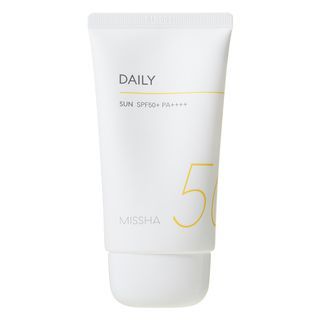
MISSHA All-Around Safe Block Daily Sun SPF50+ PA++++
Works for
1 of 1 advertised claim delivered
Sun protectionSPF 50 · 5 UV filtersBroad spectrum
This product offers a good level of protection against both UVB and UVA rays.
This sunscreen uses organic (so-called "chemical") sunscreen filters. Organic, or "chemical" filters usually provide reliable sun protection and rarely leave a white cast. Sunscreens with organic filters can sting eyes.
This product can be considered "reef safe" because it does not contain the UV filters (oxybenzone and octinoxate) that can be harmful to coral reefs when present in the water in high concentrations.
Evens skin toneNot advertised by the brand · 1 ingredient credited for this claimStrong support
This product offers broad spectrum sun protection. It means that it can prevent hyperpigmentation and help keep the skin tone even (sun damage is the main factor causing age spots, darkening of post-acne marks and other discolorations).
Anti-agingNot advertised by the brand · 1 ingredient credited for this claimStrong support
This product can help prevent early signs of skin aging because it offers a good level of broad spectrum sun protection. Sun damage is the main cause of premature skin aging, and protecting your skin from the sun is the best anti-aging strategy.
MoisturizingNot advertised by the brand · 12 ingredients credited for this claimGood support
This product can help soften the skin and reduce its moisture loss with emollients and occlusives: dimethicone, c12-15 alkyl benzoate.
Keep in mind that this product does not contain effective ingredients to attract water to the upper layer of the skin. This is why an additional product with humectants like glycerin or hyaluronic acid can be helpful (apply it before this product for the best results).
Can it cause trouble?
Irritancy7 strong irritants: Parfum, Calendula officinalis flower extract + 5 more — patch-test recommendedHigh risk
Comedogenic3 ingredients rated 2 or more on the 0–5 pore-clogging scale3 flagged
User reviews
Ingredients
Filter by role to see what each ingredient is doing.
Water~45–55%
Homosalate~4.7–5.7%
- Irritation risk
- Medium
A weak sunscreen that offers some protection against the sun rays that cause sunburn (UVB), but does not offer meaningful protection against protect against the most aging sun rays (UVA). It loses its effectiveness quickly when exposed to sunlight. It is an organic, or so called "chemical" sunscreen. When used in low concentrations, helps to stabilize the product formulation
More about HomosalateSilica~4.3–5.2%
Propanediol~3–3.7%
- Irritation risk
- Low
Acts as a solvent for other ingredients. Speeds up the absorption of other ingredients into the skin
More about PropanediolEthylhexyl salicylate~3.2–3.9%
- Irritation risk
- Low
Octisalate. A UV filter. It offers some protection against the sun rays that cause sunburn (UVB), but does not protect against the most aging sun rays (UVA). It loses its effectiveness quickly when exposed to sunlight. It is an organic, or so called "chemical" sunscreen
More about Ethylhexyl salicylateTitanium dioxide~2.5–3%
- Irritation risk
- Low
Works as a UV filter when used in high concentrations. It is photostable and is effective mostly against the UVB light, with some protection in the UVA range. In small concentrations, used for its ability to improve the color of cosmetic products. Is usually well tolerated by the skin
More about Titanium dioxideCi 77891~1.8–2.2%
- Irritation risk
- Low
Dipropylene glycol~1.3–1.6%
- Irritation risk
- Low
Helps to dissolve other ingredients in a formulation. Slows down the rate of product drying
More about Dipropylene glycolC12-15 alkyl benzoate~1.2–1.4%
- Irritation risk
- Low
Enhances the product texture and makes it more spreadable. Helps reduce water loss from the outer layer of skin. Extands the shelf life by preventing bacteria growth
More about C12-15 alkyl benzoateDiethylamino hydroxybenzoyl hexyl benzoate~1.3–1.6%
- Irritation risk
- Medium
Uvinul A Plus. A new generation broad spectrum sunscreen that offers an effective protection especially in the UVA range. It is stable in formulations. Unfortunately, is not approved by the FDA (US) yet
More about Diethylamino hydroxybenzoyl hexyl benzoateDimethicone~0.75–1.1%
- Irritation risk
- Low
A silicone that helps to reduce water loss from the surface of the skin. Can temporarily "fill in" lines and wrinkles, absorb oil, and create a nice product finish
More about DimethiconeAlcohol denat.~0.55–0.85%
- Irritation risk
- High
Produces temporary toning effect. Can help dissolve other ingredients or preserve products
More about Alcohol denat.Polysorbate 60~0.55–0.8%
Potassium cetyl phosphate~0.5–0.75%
- Irritation risk
- Medium
Helps oil and water mix together
More about Potassium cetyl phosphateButylene glycol~0.45–0.65%
- Irritation risk
- Low
Used to create a nice product texture and help delivery of other ingredients. Might be somewhat helpful in attracting water to the upper layer of the skin
More about Butylene glycolBis-ethylhexyloxyphenol methoxyphenyl triazine~0.6–0.9%
- Irritation risk
- Medium
Tinosorb S. One of the most effective broad spectrum sunscreen ingredients. Protects from both UVA and UVB rays. It is photostable. Unfortunately, not approved by FDA (US) yet.
More about Bis-ethylhexyloxyphenol methoxyphenyl triazineGlyceryl stearate~0.5–0.7%
- Irritation risk
- Low
An emollient that softens the skin and forms a protective layer on its surface. Helps water and oil mix together
More about Glyceryl stearateSodium acrylate/sodium acryloyldimethyl taurate copolymer~0.35–0.6%
- Irritation risk
- Low
Used to create a thicker product consistency
More about Sodium acrylate/sodium acryloyldimethyl taurate copolymerCetearyl olivate~0.35–0.6%
Stearic acid~0.45–0.7%
- Irritation risk
- Low
Helps oil and water mix together and works as an emollient
More about Stearic acidSorbitan olivate~0.3–0.55%
Aluminum hydroxide~0.3–0.55%
- Irritation risk
- Low
Is used to add opaque (non-transparent) appearance to formulations. Can be used to coat other ingredients for even dispersion. This is a different ingredient compared to the ones used in antipersperants (aluminium chloride and aluminium chlorohydrate)
More about Aluminum hydroxideIsohexadecane~0.35–0.65%
- Irritation risk
- Low
Improves the texture of the product and helps soften the skin. Helps oil and water mix together and can be used as a cleansing agent
More about IsohexadecaneSorbitan stearate~0.25–0.5%
Cetearyl alcohol~0.3–0.55%
- Irritation risk
- Low
- Comedogenicity
- 2/5
A non-drying alcohol. Works as an emollient. Helps water and oil mix together and creates a nice product texture
More about Cetearyl alcoholCaprylyl glycol~0.3–0.5%
- Irritation risk
- Medium
Helps preserve products and creates a nice product texture
More about Caprylyl glycolParfum~0.25–0.45%
- Irritation risk
- High
An aromatic blend of unspecified and possibly irritating ingredients
More about ParfumEthylhexylglycerin~0.25–0.45%
Carbomer~0.25–0.45%
- Irritation risk
- Low
Helps create a thicker or gel-like product texture. It is not a surfactant but can be used in gentle cleansing formulations
More about CarbomerPolysorbate 80~0.3–0.5%
Palmitic acid~0.3–0.55%
- Irritation risk
- Low
An emollient that is naturally present in skin and helps soften it
More about Palmitic acidTromethamine~0.25–0.45%
Tocopheryl acetate~0.25–0.5%
- Irritation risk
- Medium
A more stable but less bio-available form of vitamin E compared to Tocopherol. Might help moisturize and protect the skin from free radicals, but mostly used in low concentrations to stabilize other ingredients.
More about Tocopheryl acetateXanthan gum~0.25–0.5%
- Irritation risk
- Low
Used to create a thicker product consistency
More about Xanthan gum1,2-hexanediol~0.25–0.45%
Sorbitan oleate~0.25–0.5%
- Irritation risk
- Medium
- Comedogenicity
- 2/5
Helps oil and water mix together
More about Sorbitan oleateDisodium edta~0.25–0.45%
Potassium hydroxide~0.25–0.5%
Leontopodium alpinum flower/leaf extract~0.25–0.45%
- Irritation risk
- Low
Myristic acid~0.3–0.55%
- Irritation risk
- Medium
- Comedogenicity
- 3/5
Helps oil and water mix together. Could be comedogenic
More about Myristic acidVp/hexadecene copolymer~0.25–0.5%
- Irritation risk
- Low
Creates a nice product texture and can support water-resistance of sunscreens
More about Vp/hexadecene copolymerCyclopentasiloxane~0.3–0.55%
- Irritation risk
- Low
A silicone that helps improve the product texture and spreadability. Can absorb oil creating a short-term mattifying effect on the skin
More about CyclopentasiloxaneAnthemis nobilis flower extract~0.2–0.4%
- Irritation risk
- High
A plant extract that one one hand, can contain compounds that can help calm down skin irritation, but, on the other hand, its other compounds (especially fragrant ones) can themselves be irritating
More about Anthemis nobilis flower extractHelianthus annuus seed extract~0.25–0.45%
- Irritation risk
- Low
Acrylates/dimethicone copolymer~0.25–0.5%
- Irritation risk
- Medium
Used to stabilize product formulation, help create an even product layer over skin (for example, in sunscreen), evenly disperse pigements and create a nice product consistency
More about Acrylates/dimethicone copolymerPhenoxyethanol~0.25–0.5%
- Irritation risk
- Low
A preservative. It helps prevent bacterial growth in cosmetic products
More about PhenoxyethanolCalendula officinalis flower extract~0.2–0.4%
- Irritation risk
- High
A plant extract that has some anti-oxidant and anti-bacterial properties. Can be irritating
More about Calendula officinalis flower extractAloe barbadensis leaf extract~0.3–0.55%
- Irritation risk
- Medium
Traditionally used to treat sunburns, dermatitis and inflammation, but evidence for its effectiveness is lacking. The extract can contain humectants that help attract water into the skin
More about Aloe barbadensis leaf extractMorus alba fruit extract~0.25–0.5%
- Irritation risk
- Low
Pueraria lobata root extract~0.25–0.45%
- Irritation risk
- Low
Camellia sinensis leaf extract~0.25–0.45%
- Irritation risk
- Low
Can contain potent anti-oxidant compounds (abbreviated ECG, GCG, EGC, and EGCG) that might help protect the skin from free radicals. Can help calm down inflammation and has some anti-bacterial properties. Unfortunately, these antioxidants are unstable and lose their effectiveness very quickly in products. The concentration of the antioxidant compounds in the extract also tends to be low to be effective in topical formulation
More about Camellia sinensis leaf extractChrysanthemum indicum flower extract~0.25–0.45%
- Irritation risk
- Low
Sodium benzoate~0.25–0.4%
Artemisia princeps leaf extract~0.2–0.4%
- Irritation risk
- Low
Cinnamomum cassia bark extract~0.25–0.45%
Diospyros kaki leaf extract~0.2–0.35%
- Irritation risk
- Low
Citric acid~0.2–0.35%
- Irritation risk
- Medium
Can work as an exfoliant but is typically used to adjust the product pH
More about Citric acidCentaurea cyanus flower water~0.15–0.3%
- Irritation risk
- High
Cornflower water. Might have an anti-oxidant effect and can help reduce inflammation in skin. However, it can be irritating on its own
More about Centaurea cyanus flower waterHelichrysum italicum flower water~0.15–0.25%
- Irritation risk
- Low
Thymus vulgaris leaf water~0.15–0.3%
- Irritation risk
- High
Benzyl benzoate~0.1–0.25%
- Irritation risk
- High
Fragrance with sweet balsamic smell. Help to preserve products and dissolve other ingredients. Could trigger allergic reactions and be irritating
More about Benzyl benzoateButylphenyl methylpropional~0.05–0.15%
- Irritation risk
- High
A fragrance. Can trigger allergic reactions and be irritating
More about Butylphenyl methylpropionalLimonene~0.05–0.15%
- Irritation risk
- High
A common frangrance that can easily irritate skin, especially if exposed to air, light or heat
More about LimoneneIngredient list view
Water, Homosalate, Silica, Propanediol, Ethylhexyl salicylate, Titanium dioxide, Ci 77891, Dipropylene glycol, C12-15 alkyl benzoate, Diethylamino hydroxybenzoyl hexyl benzoate, Dimethicone, Alcohol denat., Polysorbate 60, Potassium cetyl phosphate, Butylene glycol, Bis-ethylhexyloxyphenol methoxyphenyl triazine, Glyceryl stearate, Sodium acrylate/sodium acryloyldimethyl taurate copolymer, Cetearyl olivate, Stearic acid, Sorbitan olivate, Aluminum hydroxide, Isohexadecane, Sorbitan stearate, Cetearyl alcohol, Caprylyl glycol, Parfum, Ethylhexylglycerin, Carbomer, Polysorbate 80, Palmitic acid, Tromethamine, Tocopheryl acetate, Xanthan gum, 1,2-hexanediol, Sorbitan oleate, Disodium edta, Potassium hydroxide, Leontopodium alpinum flower/leaf extract, Myristic acid, Vp/hexadecene copolymer, Cyclopentasiloxane, Anthemis nobilis flower extract, Helianthus annuus seed extract, Acrylates/dimethicone copolymer, Phenoxyethanol, Calendula officinalis flower extract, Aloe barbadensis leaf extract, Morus alba fruit extract, Pueraria lobata root extract, Camellia sinensis leaf extract, Chrysanthemum indicum flower extract, Sodium benzoate, Artemisia princeps leaf extract, Cinnamomum cassia bark extract, Diospyros kaki leaf extract, Citric acid, Centaurea cyanus flower water, Helichrysum italicum flower water, Thymus vulgaris leaf water, Benzyl benzoate, Butylphenyl methylpropional, Limonene
Compare prices
Retailers ranked by price — lowest first.

Affiliate links · prices updated regularly
Product summary
We believe that "MISSHA - All-Around Safe Block Daily Sun SPF50+ PA++++" can provide reliable sun protection based on the ingredients listed. It can protect from both UVA and UVB rays. This is great news because not all sunscreens with SPF ratings give UVA protection. (UVA rays do not cause sunburn, but still damage our skin and lead to early aging).
Because it includes good moisturizing ingredients, it can also work as a hydrating day cream. This product prevents early signs of aging by protecting against sun damage (all broad spectrum sunscreens do that).
Sunscreen filters
This sunscreen uses a mixture of both mineral and organic (so-called "chemical") UV filters. The organic filters in the product are: tinosorb s, uvinul a plus, octisalate and homosalate. As for the mineral filters, this sunscreen uses titanium dioxide.
Irritation risk
There are quite a few common irritants in this product, including ingredients without particular skin benefits. We would not recommend it for sensitive skin. We assess the overall irritancy of this product to be high. For a detailed overview of all potential irritants: click here
You can see the detailed formula review with the breakdown of all actives in the product and the full ingredient list with estimated concentrations in the tables below.
What our users say
Based on 1 review 100% recommend this product- When it comes to comedogenicity, the reviewer found that it does not clog pores.
- As for the white cast, it did not leave a noticeable white residue for the reviewer.
- When it comes to using this sunscreen under makeup, the user found that it pills under a foundation.
- As for using this sunscreen in the eye area, the reviewer reported that it does not sting eyes.
Sources cited in this review
Every concentration estimate and effectiveness label is anchored to one of these 13 studies and safety reviews.
- 1
- 2
- 3Final Report on the Safety Assessment of Dimethicone Copolyoljournals.sagepub.com
- 4
- 5Safety Assessment of Tromethamine as Used in Cosmeticscir-safety.org
- 6

Affiliate links · As an Amazon Associate, WIMJ earns from qualifying purchases.