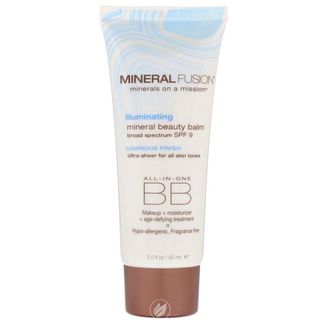
Mineral Fusion All In One Mineral Beauty Balm Illuminating Spf 9
Works for
2 of 4 advertised claims delivered
Sun protectionSPF 9 · 1 UV filter · Partial spectrumNo real protectionSPF too low
This product does not offer sun protection, or it is very low.
This product can be considered "reef safe" because it does not contain the UV filters (oxybenzone and octinoxate) that can be harmful to coral reefs when present in the water in high concentrations.
Moisturizing10 ingredients credited for this claimStrong support
“Hydrating .”
This product can help improve hydration of the skin with the two types of ingredients.
The first type is called “humectants”:
these ingredients help attract water.
When humectants are on the surface of the skin, they “pull in” the moisture from the outside environment, or from
within deeper layers of the skin. The following ingredients in this product do the job:
glycerin.
This product also contains ingredients called “occlusives”. They help reduce the speed with which our skin loses moisture to the outside environment. These ingredients also help soften the upper layer of the skin, so it feels less tight and nicer to the touch. The following ingredients in this product do the job: caprylic/capric triglyceride, dimethicone.
The following ingredients in this product are especially good for supporting the skin barrier and helping with the hydration level: palmitoyl tripeptide-5
Anti-aging6 ingredients credited for this claimModerate support
“Instantly evens and perfects skin tone while minimizing pores and fine lines.”
This product contains palmitoyl tripeptide-5. This ingredient might be able to help reduce and prevent fine lines and wrinkles, improve skin elasticity and firmness, but there is not enough evidence that it actually works.
Evens skin tone6 ingredients credited for this claimLimited support
“Instantly evens and perfects skin tone while minimizing pores and fine lines.”
This product contains ingredients (glycyrrhiza glabra root extract, punica granatum extract) that could help reduce hyperpigmentation (for example, post-acne marks or age spots) in theory, but there is not enough evidence that they actually work.
Anti-oxidationNot advertised by the brand · 7 ingredients credited for this claimModerate support
This product contains antioxidants (punica granatum extract) that might be able to help neutralize free radicals in skin to lessen the damage it gets from the UV light (sun). There is not enough evidence to confirm their effectiveness in skin though.
Can it cause trouble?
Irritancy4 strong irritants: Sorbitan sesquioleate, Rosa damascena extract + 2 more — patch-test recommendedHigh risk
ComedogenicClean of flagged comedogenic ingredientsNone flagged
User reviews
Be the first — your take helps the next person decide.
Ingredients
Filter by role to see what each ingredient is doing.
Titanium dioxide7.38%
- Irritation risk
- Low
Works as a UV filter when used in high concentrations. It is photostable and is effective mostly against the UVB light, with some protection in the UVA range. In small concentrations, used for its ability to improve the color of cosmetic products. Is usually well tolerated by the skin
More about Titanium dioxideWater~45–55%
Caprylic/capric triglyceride~7.5–9.2%
- Irritation risk
- Medium
A good mix of fatty acids that forms a protective layer on the skin. Improves the shelf life of products. Derived from coconut and glycerin
More about Caprylic/capric triglycerideJojoba esters~5.9–7.2%
- Irritation risk
- Medium
An emollient made of jojoba oil. Helps soften the skin and support its barrier function
More about Jojoba estersMica~3.7–4.6%
- Irritation risk
- Low
Creates an illusion of smoother and more radiant skin tone. Adds shimmer to the skin by reflecting light
More about MicaGlycerin~2.6–3.2%
- Irritation risk
- Low
One of the best moisturizing ingredients. Naturally present in skin. It attracts water to the upper layer of the skin working as a humectant
More about GlycerinSorbitan sesquioleate~2.1–2.5%
- Irritation risk
- High
Used to help oil and water mix together. Can be irritating
More about Sorbitan sesquioleateCetearyl olivate~1.8–2.2%
Sorbitan olivate~1.6–1.9%
Potassium cetyl phosphate~1.4–1.7%
- Irritation risk
- Medium
Helps oil and water mix together
More about Potassium cetyl phosphateDimethicone~1.3–1.6%
- Irritation risk
- Low
A silicone that helps to reduce water loss from the surface of the skin. Can temporarily "fill in" lines and wrinkles, absorb oil, and create a nice product finish
More about DimethiconeHydroxyethylcellulose~1–1.3%
- Irritation risk
- Low
Used to thicken product formulations and create gel-like textures
More about HydroxyethylcelluloseCitric acid~0.75–1.1%
- Irritation risk
- Medium
Can work as an exfoliant but is typically used to adjust the product pH
More about Citric acidPunica granatum extract~0.65–1%
- Irritation risk
- Medium
A plant extract that can help neutralize free radicals in skin and even out the skin tone, but is typically used in products in a concentration that is too low to be effective
More about Punica granatum extractTetrahexyldecyl ascorbate~0.65–0.95%
- Irritation risk
- Medium
Being a lipid soluble form of vitamin C, it is more stable than ascorbic acid, but still degrades quickly and needs to be stabilized in a formulation with another ingredient. It is claimed to penetrate skin better than pure vitamin C and have the the similar benefits, but solid studies of its effectiveness are lacking. Is likely to require a higher concentration in a product than pure vitamin C to be effective. It might be able to help reduce pore clogging.
More about Tetrahexyldecyl ascorbateNeral~0.55–0.8%
- Irritation risk
- Low
Magnesium aspartate~0.55–0.8%
- Irritation risk
- Low
Might be helpful in restoring skin barrier function and calm down inflammation in skin
More about Magnesium aspartateZinc gluconate~0.55–0.8%
- Irritation risk
- Medium
Typically used to stabilize the product formulations. It is a salt of a polyhydroxy acid (PHA) and in larger concentrations, can help shed the dead cells from the skin surface revealing smoother skin. It can help attract water to the upper layer of the skin. Might to be helpful against acne and clogged pores. Could be helpful in neutralizing free radicals, but solid research is missing. Due to the zinc content, might help calm down inflammation in skin
More about Zinc gluconateCopper gluconate~0.5–0.75%
- Irritation risk
- Medium
Typically used to stabilize the product formulations. It is a salt of polyhydroxy acid (PHA) and in larger concentrations, can help shed the dead cells from the skin surface revealing smoother skin. It can help attract water to the upper layer of the skin. Might to be helpful against acne and clogged pores. Could be helpful in neutralizing free radicals, but solid research is missing
More about Copper gluconatePalmitoyl tripeptide-5~0.45–0.7%
- Irritation risk
- Low
A type of peptide. Peptides are excellent moisturizers and might be able support collagen production reducing fine lines and wrinkles
More about Palmitoyl tripeptide-5Camellia sinensis leaf extract~0.45–0.7%
- Irritation risk
- Low
Can contain potent anti-oxidant compounds (abbreviated ECG, GCG, EGC, and EGCG) that might help protect the skin from free radicals. Can help calm down inflammation and has some anti-bacterial properties. Unfortunately, these antioxidants are unstable and lose their effectiveness very quickly in products. The concentration of the antioxidant compounds in the extract also tends to be low to be effective in topical formulation
More about Camellia sinensis leaf extractAloe barbadensis leaf juice~0.35–0.6%
- Irritation risk
- Medium
Traditionally used to treat sunburns, dermatitis and inflammation, but evidence for its effectiveness is lacking. The extract can contain humectants that help attract water into the skin
More about Aloe barbadensis leaf juiceGlycyrrhiza glabra root extract~0.35–0.65%
- Irritation risk
- Medium
A plant extract that can help lighten the skin and calm down inflammation. Might be helpful in neutralizing free radicals
More about Glycyrrhiza glabra root extractRosa damascena extract~0.3–0.55%
- Irritation risk
- High
Oil of a very fragrant pink rose used as fragrance in cosmetics. Extensive research has shown it has mixed benefits. In the pro column, inhaling this flower’s scent seems to have relaxing properties and the plant’s petals contain skin-soothing and antioxidant compounds that can benefit skin. On the flipside, the numerous chemicals that create this rose’s distinctive fragrance pose a risk of causing skin aggravation.
More about Rosa damascena extractLavandula angustifolia extract~0.25–0.5%
- Irritation risk
- High
Used for fragrance and contains volatile compounds that can irritate the skin
More about Lavandula angustifolia extractRosa canina flower extract~0.2–0.4%
- Irritation risk
- High
Olea europaea leaf extract~0.15–0.3%
- Irritation risk
- Medium
A plant extract that might have some anti-oxidant and anti-inflammatory properties but evidence for effectiveness in skin is missing
More about Olea europaea leaf extractPotassium sorbate~0.15–0.3%
Sodium dehydroacetate~0.15–0.25%
Sodium benzoate~0.15–0.25%
Iron oxides~0.1–0.2%
- Irritation risk
- Low
An umbrella term for the following three colorants: CI 77491, CI 77492, CI 77499. They might be able to offer some protection against visible light, but the degree of the protection is not clear
More about Iron oxidesIngredient list view
Titanium dioxide, Water, Caprylic/capric triglyceride, Jojoba esters, Mica, Glycerin, Sorbitan sesquioleate, Cetearyl olivate, Sorbitan olivate, Potassium cetyl phosphate, Dimethicone, Hydroxyethylcellulose, Citric acid, Punica granatum extract, Tetrahexyldecyl ascorbate, Neral, Unknown, Magnesium aspartate, Zinc gluconate, Copper gluconate, Palmitoyl tripeptide-5, Camellia sinensis leaf extract, Aloe barbadensis leaf juice, Glycyrrhiza glabra root extract, Rosa damascena extract, Lavandula angustifolia extract, Rosa canina flower extract, Olea europaea leaf extract, Potassium sorbate, Sodium dehydroacetate, Sodium benzoate, Iron oxides
Compare prices
Retailers ranked by price — lowest first.
Affiliate links · prices updated regularly · As an Amazon Associate, WIMJ earns from qualifying purchases.
Product summary
We do not recommend "Mineral Fusion - All In One Mineral Beauty Balm Illuminating Spf 9" because it does not provide good UVA protection. UVA sun rays don't burn the skin, but they still lead to photoaging and hyperpigmentation.
Because it includes good moisturizing ingredients, it can also work as a hydrating day cream.
Sunscreen filters
This moisturizer is a mineral sunscreen. It uses titanium dioxide for sun protection. Titanium dioxide almost never irritates the skin or stings eyes, but it can leave a white cast.
Irritation risk
There are some common irritants in this product, including ingredients that do not have benefits for the skin. We assess the overall irritancy of this moisturizer to be high. For a detailed overview of all potential irritants: click here
You can see the detailed formula review with the breakdown of all actives in the product and the full ingredient list with estimated concentrations in the tables below.
About the brand
According to Cruelty-Free Kitty "Mineral Fusion" is cruelty free and so is its parent company.
Price
The product retails for 53.99A$ in Australia and for 21.98$ in the United States.
For a detailed price comparison: click here.
Sources cited in this review
Every concentration estimate and effectiveness label is anchored to one of these 18 studies and safety reviews.
- 1
- 2
- 3
- 4Final Report on the Safety Assessment of Dimethicone Copolyoljournals.sagepub.com
- 5
- 6

Affiliate links · As an Amazon Associate, WIMJ earns from qualifying purchases.