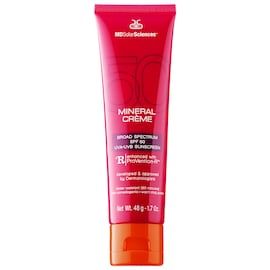
MDSolarSciences Mineral Crme Broad Spectrum SPF 50 UVA-UVB Sunscreen
Works for
0 of 2 advertised claims delivered
Sun protectionSPF 50 · 2 UV filters · Partial spectrumWeak protectionLow filter dose
This product does not offer good protection against UVA rays.
This product can be considered "reef safe" because it does not contain the UV filters (oxybenzone and octinoxate) that can be harmful to coral reefs when present in the water in high concentrations.
Anti-aging1 ingredient credited for this claimLimited support
“Naturally derived and safer Eco-cert zinc oxide helps reduce the risk of photo aging and skin cancer.”
This product does not contain ingredients that are able to reduce fine lines and wrinkles or help with skin elasticity, but it can improve the look of the skin temporarily through moisturization. Well-moisturized skin might also be able to repair the sun damage better.
This ingredient camellia sinensis extract might be able to help neutralize free radicals in skin and help it fight off some of the sun damage.
The biggest anti-aging effect in this product comes from sun protection. Sun damage is the main factor causing early signs of skin aging. We, however, do not recommend using this product as a sunscreen because the protection it offers is not strong enough).
Anti-oxidationNot advertised by the brand · 4 ingredients credited for this claimModerate support
This product contains antioxidants (camellia sinensis extract, punica granatum extract) that might be able to help neutralize free radicals in skin to lessen the damage it gets from the UV light (sun). There is not enough evidence to confirm their effectiveness in skin though.
MoisturizingNot advertised by the brand · 4 ingredients credited for this claimGood support
This product can help soften the skin and reduce its moisture loss with emollients and occlusives: caprylic/capric triglyceride, dimethicone.
Keep in mind that this product does not contain effective ingredients to attract water to the upper layer of the skin. This is why an additional product with humectants like glycerin or hyaluronic acid can be helpful (apply it before this product for the best results).
Can it cause trouble?
Irritancy7 flagged ingredientsLow risk
ComedogenicClean of flagged comedogenic ingredientsNone flagged
User reviews
Be the first — your take helps the next person decide.
Ingredients
Filter by role to see what each ingredient is doing.
Dimethicone~22–34%
- Irritation risk
- Low
A silicone that helps to reduce water loss from the surface of the skin. Can temporarily "fill in" lines and wrinkles, absorb oil, and create a nice product finish
More about DimethiconeDimethicone crosspolymer~5.9–8.9%
- Irritation risk
- Low
Used to create a thicker product texture. Helps soften the upper layer of the skin and might be able to prevent moisture loss from its surface
More about Dimethicone crosspolymerCaprylic/capric triglyceride~4.8–7.1%
- Irritation risk
- Medium
A good mix of fatty acids that forms a protective layer on the skin. Improves the shelf life of products. Derived from coconut and glycerin
More about Caprylic/capric triglycerideGlyceryl isostearate~3.5–5.2%
Polyhydroxystearic acid~2.7–4%
- Irritation risk
- Medium
Used to create a thicker product consistency and stabilize the formulation
More about Polyhydroxystearic acidSilica~2.2–3.3%
Dimethicone/vinyl dimethicone crosspolymer~1.5–2.2%
- Irritation risk
- Low
Used to stabilize product formulations and create a nice product texture
More about Dimethicone/vinyl dimethicone crosspolymerButyloctyl salicylate~1.2–1.8%
- Irritation risk
- Medium
A synthetic ester of salicylic acid that is used to help disperse pigments and boost effectiveness of sunscreen ingredients. It is able to absorb UV light (working as an organic, or chemical filter), but is not approved as a sunscreen ingredient on its own
More about Butyloctyl salicylatePolysilicone-15~1.2–1.8%
- Irritation risk
- Medium
A UV filter. Effective against UVB rays, but does not protect against the most aging UVA light
More about Polysilicone-15Iron oxides~0.55–1.3%
- Irritation risk
- Low
An umbrella term for the following three colorants: CI 77491, CI 77492, CI 77499. They might be able to offer some protection against visible light, but the degree of the protection is not clear
More about Iron oxidesPeg/ppg-18/18 dimethicone~0.45–1.05%
- Irritation risk
- Low
A silicone that mixes with water creating nice light-weight product texture
More about Peg/ppg-18/18 dimethiconeTriethoxycaprylylsilane~0.3–0.7%
- Irritation risk
- Low
A type of silicone that helps oil and water mix well together. Helps to disperse other ingredients, e.g. pigments, evenly in a formulation
More about TriethoxycaprylylsilaneTetrahexyldecyl ascorbate~0.15–0.65%
- Irritation risk
- Medium
Being a lipid soluble form of vitamin C, it is more stable than ascorbic acid, but still degrades quickly and needs to be stabilized in a formulation with another ingredient. It is claimed to penetrate skin better than pure vitamin C and have the the similar benefits, but solid studies of its effectiveness are lacking. Is likely to require a higher concentration in a product than pure vitamin C to be effective. It might be able to help reduce pore clogging.
More about Tetrahexyldecyl ascorbateCamellia sinensis extract~0.1–0.5%
- Irritation risk
- Low
Tea extract. Might be helpful in neutralizing free radicals in skin
More about Camellia sinensis extractVaccinium macrocarpon fruit extract~0.1–0.3%
- Irritation risk
- High
A berry extract. Might have some anti-oxidant properties
More about Vaccinium macrocarpon fruit extractPunica granatum extract~0.05–0.25%
- Irritation risk
- Medium
A plant extract that can help neutralize free radicals in skin and even out the skin tone, but is typically used in products in a concentration that is too low to be effective
More about Punica granatum extractIngredient list view
Dimethicone, Dimethicone crosspolymer, Caprylic/capric triglyceride, Glyceryl isostearate, Polyhydroxystearic acid, Silica, Dimethicone/vinyl dimethicone crosspolymer, Butyloctyl salicylate, Polysilicone-15, Iron oxides, Peg/ppg-18/18 dimethicone, Triethoxycaprylylsilane, Tetrahexyldecyl ascorbate, Camellia sinensis extract, Vaccinium macrocarpon fruit extract, Punica granatum extract
Compare prices
Retailers ranked by price — lowest first.
Product summary
"MDSolarSciences - Mineral Crme Broad Spectrum SPF 50 UVA-UVB Sunscreen" does not provide enough UVA protection. UVA rays do not cause sunburn, but still damage the skin, leading to early signs of aging and pigmentation issues.
It contains good moisturizing ingredients and can double as a hydrating day cream.
Sunscreen filters
This sunscreen uses so-called "chemical", or organic UV filters (organic simply means that their molecules contain atoms of carbon). These filters typically give good sun protection and rarely leave a white cast, but they can be irritating for sensitive skin. Here are the exact UV filters in this sunscreen: butyloctyl salicylate 1.20% - 1.80% and polysilicone-15 1.20% - 1.80%.
Irritation risk
This sunscreen contains some common irritants, including those without a benefit for the skin. We assess the overall irritancy of this product to be low. For a detailed overview of all potential irritants: click here
You can see the detailed formula review with the breakdown of all actives in the product and the full ingredient list with estimated concentrations in the tables below.
Sources cited in this review
Every concentration estimate and effectiveness label is anchored to one of these 8 studies and safety reviews.
- 1
- 2Final Report on the Safety Assessment of Dimethicone Copolyoljournals.sagepub.com
- 3
- 4
- 5
- 6

Affiliate links · As an Amazon Associate, WIMJ earns from qualifying purchases.