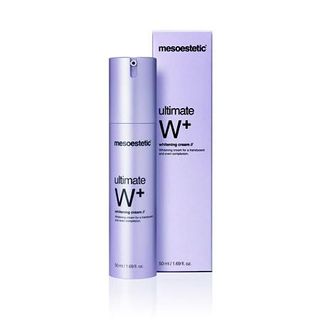
Mesoestetic Ultimate W+ Whitening Cream
Works for
3 of 3 advertised claims delivered
Evens skin tone3 ingredients credited for this claimStrong support
“The tone of the complexion becomes more even, the skin visibly clearer and more radiant.”
This product can help reduce hypepigmentation and even out the skin tone because it contains the following effective ingredients: kojic acid
The following ingredient (ingredients) in this product might be helpful, but there is no evidence to confirm that it actually can help even out the skin tone: ascorbyl glucoside.
Keep in mind that you would need to apply any topical skincare targetted at hypigmentation consistently for a couple of months to get a result. No topical skincare product can help get rid of hyperpigmentation (including post-acne marks and age spots) instantly.
Moisturizing13 ingredients credited for this claimGood support
“Ultimate W+ Whitening Cream”
This product can help improve hydration of the skin with the two types of ingredients.
The first type is called “humectants”:
these ingredients help attract water.
When humectants are on the surface of the skin, they “pull in” the moisture from the outside environment, or from
within deeper layers of the skin. The following ingredients in this product do the job:
cyclomethicone, glycerin.
This product also contains ingredients called “occlusives”. They help reduce the speed with which our skin loses moisture to the outside environment. These ingredients also help soften the upper layer of the skin, so it feels less tight and nicer to the touch. The following ingredients in this product do the job: caprylic/capric triglyceride, dimethicone.
Anti-aging3 ingredients credited for this claimModerate support
“Read More Mesoestetic Ultimate W+ Whitening Cream is formulated to smooth out skin tone and reduce spot coloration while preventing the appearance of expression lines and wrinkles.”
This product contains ascorbyl glucoside. This ingredient might be able to help reduce and prevent fine lines and wrinkles, improve skin elasticity and firmness, but there is not enough evidence that it actually works.
Anti-oxidationNot advertised by the brand · 4 ingredients credited for this claimStrong support
This product contains antioxidants (kojic acid) that can help neutralize free radicals in skin. By doing so, they can lessen the damage the skin gets from the UV light (sun).
The following ingredients - ascorbyl glucoside also can have an antioxidant effect, but there is less evidence to confirm their effectiveness in skin.
Can it cause trouble?
Irritancy1 strong irritant: ParfumMedium risk
Comedogenic3 ingredients rated 2 or more on the 0–5 pore-clogging scale3 flagged


User reviews
Be the first — your take helps the next person decide.
Ingredients
Filter by role to see what each ingredient is doing.
Water~45–55%
Glycerin~4.3–5.3%
- Irritation risk
- Low
One of the best moisturizing ingredients. Naturally present in skin. It attracts water to the upper layer of the skin working as a humectant
More about GlycerinCetyl alcohol~3.5–4.3%
- Irritation risk
- Low
A non-drying alcohol that works to soften the skin and stabilize product formulations helping oil and water mix together
More about Cetyl alcoholCyclomethicone~3–3.7%
- Irritation risk
- Low
A type of silicone that leaves a nice silky finish on the skin and can help soften its upper layer
More about CyclomethiconeEthylhexyl methoxycinnamate~3.2–3.9%
- Irritation risk
- High
Octinoxate. When used in higher concentrations, works as a sunscreen protecting the skin from UVB rays. When used in lower concentration, helps to preserve the product formulation. Is shown to be harmful to coral reefs - consider avoiding bathing in coral reef areas when wearing a product with this ingredient. It can be irritating
More about Ethylhexyl methoxycinnamateCetearyl alcohol~1.9–2.4%
- Irritation risk
- Low
- Comedogenicity
- 2/5
A non-drying alcohol. Works as an emollient. Helps water and oil mix together and creates a nice product texture
More about Cetearyl alcoholCaprylic/capric triglyceride~1.7–2%
- Irritation risk
- Medium
A good mix of fatty acids that forms a protective layer on the skin. Improves the shelf life of products. Derived from coconut and glycerin
More about Caprylic/capric triglycerideIsostearyl isostearate~1.4–1.8%
- Irritation risk
- Medium
- Comedogenicity
- 3/5
Helps soften the upper layer of the skin and improve the product texture. It can be comedogenic
More about Isostearyl isostearateAscorbyl glucoside~1.2–1.5%
- Irritation risk
- Medium
A vitamin C derivative that is more stable but less potent than pure form of vitamin C. Has a potential to boost collagen production, nutralise free radicals and reduce hyperpigmentation, but the required concentration is likely to be much higher than for the pure form of vitamin C, limiting the ingredient's effectiveness in products
More about Ascorbyl glucosideGlyceryl stearate citrate~0.95–1.2%
- Irritation risk
- Low
Helps oil and water mix together while softening the upper layer of the skin
More about Glyceryl stearate citrateKojic acid~0.65–1%
- Irritation risk
- High
Helps to reduce hyperpigmentation and neutralize free radicals. Can be irritating
More about Kojic acidPolymethylsilsesquioxane~0.65–0.95%
- Irritation risk
- Low
A silicone that improves product texture and helps dissolve other ingredients. Can form a non-greasy film on the skin to prevent moisture loss
More about PolymethylsilsesquioxaneAcrylamide/sodium acryloyldimethyltaurate copolymer~0.5–0.75%
- Irritation risk
- Low
Helps water and oil mix together and create gel-like textures
More about Acrylamide/sodium acryloyldimethyltaurate copolymerIsohexadecane~0.55–0.85%
- Irritation risk
- Low
Improves the texture of the product and helps soften the skin. Helps oil and water mix together and can be used as a cleansing agent
More about IsohexadecaneNiacinamide~0.4–0.65%
- Irritation risk
- Low
Is proven to be effective in reducing blemishes, evening out skin tone and helping to improve lines and wrinkles. It helps the skin to repair sun damage, calm down inflammation and keep maintain good levels of moisture. The concentration of about 2% is effective for supporting the skin barrier and evening out the skin tone. Concentration of 4-6% is better for helping with acne and balancing the sebum production
More about NiacinamideTocopheryl acetate~0.4–0.65%
- Irritation risk
- Medium
A more stable but less bio-available form of vitamin E compared to Tocopherol. Might help moisturize and protect the skin from free radicals, but mostly used in low concentrations to stabilize other ingredients.
More about Tocopheryl acetatePeg-40 hydrogenated castor oil~0.4–0.65%
- Irritation risk
- Medium
Helps oil and water mix together
More about Peg-40 hydrogenated castor oilPeg-7 glyceryl cocoate~0.35–0.65%
- Irritation risk
- Medium
Helps oils and water mix together and works as a cleansing agent
More about Peg-7 glyceryl cocoateCitric acid~0.3–0.55%
- Irritation risk
- Medium
Can work as an exfoliant but is typically used to adjust the product pH
More about Citric acidPolysorbate 80~0.3–0.55%
Octocrylene~0.45–0.7%
- Irritation risk
- Medium
A weak sunscreen that protects against the sun rays that cause sunburn (UVB) and is somewhat effective against the UVA rays. It is quite stable and can help stabilize other, more vulnerable, sunscreen ingredients like Avobenzone. It is an organic, or so called "chemical" sunscreen
More about OctocryleneMethylparaben~0.15–0.3%
Bha~0.25–0.4%
Bht~0.2–0.4%
Dimethicone~0.3–0.5%
- Irritation risk
- Low
A silicone that helps to reduce water loss from the surface of the skin. Can temporarily "fill in" lines and wrinkles, absorb oil, and create a nice product finish
More about DimethiconeDisodium edta~0.2–0.4%
Sodium metabisulfite~0.1–0.2%
Homosalate~0.4–0.6%
- Irritation risk
- Medium
A weak sunscreen that offers some protection against the sun rays that cause sunburn (UVB), but does not offer meaningful protection against protect against the most aging sun rays (UVA). It loses its effectiveness quickly when exposed to sunlight. It is an organic, or so called "chemical" sunscreen. When used in low concentrations, helps to stabilize the product formulation
More about HomosalatePropylparaben~0.2–0.35%
Sodium cetearyl sulfate~0.3–0.6%
- Irritation risk
- Medium
Helps water and oil mix together and works as a cleansing agent
More about Sodium cetearyl sulfateSodium lauryl sulfate~0.5–0.75%
- Irritation risk
- High
- Comedogenicity
- 3/5
A cleansing agent (SLS). It can be irritating
More about Sodium lauryl sulfateButyl methoxydibenzoylmethane~0.35–0.65%
- Irritation risk
- Medium
Avobenzone. An organic, or so-called "chemical" UV filter. Protects against both UVA and UVB rays. Needs to be combined with other filters in a formulation to be stable.
More about Butyl methoxydibenzoylmethaneEthylparaben~0.15–0.3%
Tocopherol~0.15–0.3%
- Irritation risk
- Low
Pure form of vitamin E. Can help moisturise and protect the skin from free radicals. Often used to help stabilise other ingredients or the formula itself
More about TocopherolLecithin~0.2–0.35%
- Irritation risk
- Low
Used mostly for creating emulsions - helping oil and water mix together. Helps soften the upper layer of the skin
More about LecithinHelianthus annuus seed oil~0.15–0.3%
- Irritation risk
- Low
A great emollient due to its high linoleic acid content. One of the most effective plant oils in helping skin hydration and repairing skin barrier function
More about Helianthus annuus seed oilLepidium sativum sprout extract~0.1–0.2%
- Irritation risk
- Low
Parfum~0.05–0.1%
- Irritation risk
- High
An aromatic blend of unspecified and possibly irritating ingredients
More about ParfumPhenoxyethanol~0.1–0.2%
- Irritation risk
- Low
A preservative. It helps prevent bacterial growth in cosmetic products
More about PhenoxyethanolIngredient list view
Water, Glycerin, Cetyl alcohol, Cyclomethicone, Ethylhexyl methoxycinnamate, Cetearyl alcohol, Caprylic/capric triglyceride, Isostearyl isostearate, Unknown, Ascorbyl glucoside, Glyceryl stearate citrate, Kojic acid, Polymethylsilsesquioxane, Acrylamide/sodium acryloyldimethyltaurate copolymer, Isohexadecane, Niacinamide, Tocopheryl acetate, Peg-40 hydrogenated castor oil, Peg-7 glyceryl cocoate, Citric acid, Polysorbate 80, Octocrylene, Methylparaben, Bha, Bht, Dimethicone, Disodium edta, Sodium metabisulfite, Homosalate, Propylparaben, Sodium cetearyl sulfate, Sodium lauryl sulfate, Butyl methoxydibenzoylmethane, Ethylparaben, Tocopherol, Lecithin, Helianthus annuus seed oil, Lepidium sativum sprout extract, Parfum, Phenoxyethanol
Compare prices
Retailers ranked by price — lowest first.
Worth comparing, line by line.
Match % combines shared ingredients, the first five ingredients, shared actives and hero ingredients, irritancy (lower counts in the alternative's favour), texture and body area. Only products in the same routine step are compared.
| MesoesteticUltimate W+ Whitening CreamYOUR PRODUCT | CetaphilMoisturising Llotion | OrjenaResponse synergy barrier cream | e.l.f. CosmeticsFragrance Free Holy Hydration! Face Cream | |
|---|---|---|---|---|
| Match | — | 86% | 86% | 86% |
| Price | $79.31 | — | $25.00−$54.31 | $9.10−$70.21 |
| Shared key ingredients | — | 4 of 13 | 4 of 13 | 4 of 13 |
| Key difference | — | Panthenol | Sh-Polypeptide-9 | Palmitoyl Tetrapeptide-7 |
| Irritancy | Medium | Low | Low | Low |
| Drying alcohol | — | — | — | — |
| View product | Shop | Shop | Shop |


Sources cited in this review
Every concentration estimate and effectiveness label is anchored to one of these 19 studies and safety reviews.
- 1
- 2The Roles of Vitamin C in Skin Healthncbi.nlm.nih.gov
- 3
- 4TOPICAL TREATMENT OF MELASMAncbi.nlm.nih.gov
- 5
- 6

Affiliate links · As an Amazon Associate, WIMJ earns from qualifying purchases.