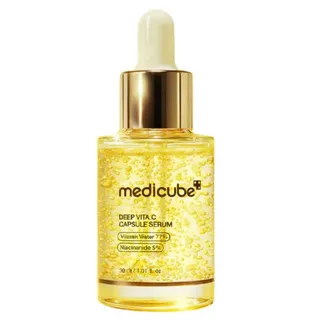
Medicube Deep Vita C Capsule Serum

Medicube Deep Vita C Capsule Serum

Efficacy100/100IrritancyHigh

Works for

Moisturizing
Niacinamide, Glycerin + 20 more
Works well
What the product description says
“Smooths texture and enhances the skin's natural radiance.”
Source: Lila Beauty

This product can help improve hydration of the skin with the two types of ingredients.

The first type is called “humectants”:
these ingredients help attract water. When humectants are on the surface of the skin, they “pull in” the moisture from the outside environment, or from within deeper layers of the skin. The following ingredients in this product do the job: arginine, glycerin.

This product also contains ingredients called “occlusives”. They help reduce the speed with which our skin loses moisture to the outside environment. These ingredients also help soften the upper layer of the skin, so it feels less tight and nicer to the touch. The following ingredients in this product do the job: arginine, caprylic/capric triglyceride.

The following ingredients in this product are especially good for supporting the skin barrier and helping with the hydration level: niacinamide

NiacinamideHeroEffect: HighIs proven to be effective in reducing blemishes, evening out skin tone and helping to improve lines and wrinkles. It helps the skin to repair sun damage, calm down inflammation and keep maintain good levels of moisture. The concentration of about 2% is effective for supporting the skin barrier and evening out the skin tone. Concentration of 4-6% is better for helping with acne and balancing the sebum production~5.1–7.7%
GlycerinKey active· HumectantEffect: HighOne of the best moisturizing ingredients. Naturally present in skin. It attracts water to the upper layer of the skin working as a humectant~3.5–5.2%
Caprylic/capric triglycerideKey active· Emollient, OcclusiveEffect: HighA good mix of fatty acids that forms a protective layer on the skin. Improves the shelf life of products. Derived from coconut and glycerin~1.4–2.1%
ArginineKey active· Humectant, OcclusiveEffect: HighAn amino acid that is naturally present in skin and helps keep it hydrated. When used together with AHAs, it can reduce their irritating effect on the skin~0.45–1.05%
Ricinus communis seed oilKey active· Emollient, OcclusiveEffect: HighA plant oil that can help soften the skin. It might be helpful in calming down inflammation, but solid research is lacking. Is often used in lip products to create the needed product consistency~0.4–0.95%
CholesterolKey active· EmollientEffect: HighAn emollient that is naturally found in skin~0.3–0.75%
Helianthus annuus seed oilKey active· Emollient, OcclusiveEffect: HighA great emollient due to its high linoleic acid content. One of the most effective plant oils in helping skin hydration and repairing skin barrier function~0.2–0.8%
AdenosineKey activeEffect: MediumMight help improve cell turnover and reduce inflammation in skin. One study shows that the ingredients might be able to help reduce dynamic wrinkles (for example, in the corners of the eyes or on the forehead)~0.2–0.7%
Olea europaea fruit oilKey active· EmollientEffect: MediumAn emollient that helps soften the skin but is not effective for restoring its barrier function. Might be helpful to calm down inflammation~0.2–0.75%
GlutathioneKey activeEffect: HighA peptide that can help neutralize free radicals in skin and reduce melanin production resulting in skin lightening effect and reduction in hyperpigmentation. It can also help attract moisture to the upper layer of the skin~0.15–0.65%
Hydrolyzed hyaluronic acidKey active· HumectantEffect: HighOne of the best moisturizing ingredients. Attracts water into the upper layer of the skin. A version of it is naturally present in skin~0.15–0.55%
Sodium hyaluronateKey active· HumectantEffect: HighOne of the best moisturizing ingredients. Attracts water into the upper layer of the skin~0.15–0.65%
GlucoseKey active· HumectantEffect: MediumHelps attract water to the upper layer of the skin. Could be helpful in restoring the skin barrier function~0.15–0.65%
Sodium acetylated hyaluronateKey active· HumectantEffect: HighA type of hyaluronic acid that works as an excellent moisturizer by attracting water into the upper layer of the skin. Is typically feels less sticky on the skin compared to the usual hyaluronic acid~0.1–0.4%
Diphenylsiloxy phenyl trimethiconeEffect: LowHelp improve the product's texture~1.7–2.5%
Isononyl isononanoate· Emollient, OcclusiveEffect: LowForms a protective film on the surface of the skin to prevent moisture loss. Gives a velvety feel to products while reducing tackiness~1–1.5%
Dibutyl ethylhexanoyl glutamideEffect: LowHelps improve the product texture and soften the upper layer of the skin~0.15–0.65%
Ascorbyl tetraisopalmitateEffect: Low, below effective doseA vitamin C derivative. Studies show that is might be effective in reducing hyperpigmentation, but there are no studies confirming that it is effectively converted into the bioavailable form of Vitamin C in skin. It is not clear how this derivative compares in effectiveness to the topical application of bioavailable form of vitamin C (L-ascorbic acid)~0.2–0.75%
TocopherolEffect: Low, below effective dosePure form of vitamin E. Can help moisturise and protect the skin from free radicals. Often used to help stabilise other ingredients or the formula itself~0.15–0.7%
GluconolactoneUnder-dosedA polyhydroxy acid (PHA) that helps shed the dead cells from the skin surface revealing smoother skin. Is believed to be genter than AHAs. It helps attract water to the upper layer of the skin and can stimulate production of skin's own hyaluronic acid resulting in improved hydration levels. It has been shown to be helpful against acne and clogged pores if used consistently (e.g over a period of 12 weeks) in high enough concentration. It can help reduce fine lines and wrinkles and improve skin tone with long-term application. Can help neutralize free radicals~0.35–0.8%
AllantoinUnder-dosedHelps calm down inflammation in skin and can help reduce itching. Helps to repair the skin barrier and keep skin hydrated~0.2–0.75%
PanthenolUnder-dosedHelps attract water to the upper layer of the skin and can help improve skin barrier function~0.15–0.65%
Evens skin tone
Niacinamide, Glutathione + 5 more
Works well
What the product description says
“DESCRIPTION Medicube Deep Vita C Capsule Serum helps brighten and refresh the skin tone with every use.”
Source: Lila Beauty

This product can help reduce hypepigmentation and even out the skin tone because it contains the following effective ingredients: glutathione, niacinamide

Keep in mind that you would need to apply any topical skincare targetted at hypigmentation consistently for a couple of months to get a result. No topical skincare product can help get rid of hyperpigmentation (including post-acne marks and age spots) instantly.

NiacinamideKey activeEffect: HighIs proven to be effective in reducing blemishes, evening out skin tone and helping to improve lines and wrinkles. It helps the skin to repair sun damage, calm down inflammation and keep maintain good levels of moisture. The concentration of about 2% is effective for supporting the skin barrier and evening out the skin tone. Concentration of 4-6% is better for helping with acne and balancing the sebum production~5.1–7.7%
GlutathioneKey activeEffect: HighA peptide that can help neutralize free radicals in skin and reduce melanin production resulting in skin lightening effect and reduction in hyperpigmentation. It can also help attract moisture to the upper layer of the skin~0.15–0.65%
Magnesium ascorbyl phosphateEffect: Low, below effective doseA derivative of vitamin C that is more stable, but less bioavailable than the pure form of vitamin C. It does not penetrate the skin well, but has been shown to convert to pure vitamin C once in skin. It can be helpful in stimulating collagen production and lightening the skin tone, but the required concentration is likely to be very high~0.15–0.7%
GluconolactoneUnder-dosedA polyhydroxy acid (PHA) that helps shed the dead cells from the skin surface revealing smoother skin. Is believed to be genter than AHAs. It helps attract water to the upper layer of the skin and can stimulate production of skin's own hyaluronic acid resulting in improved hydration levels. It has been shown to be helpful against acne and clogged pores if used consistently (e.g over a period of 12 weeks) in high enough concentration. It can help reduce fine lines and wrinkles and improve skin tone with long-term application. Can help neutralize free radicals~0.35–0.8%
Ascorbyl tetraisopalmitateUnder-dosedA vitamin C derivative. Studies show that is might be effective in reducing hyperpigmentation, but there are no studies confirming that it is effectively converted into the bioavailable form of Vitamin C in skin. It is not clear how this derivative compares in effectiveness to the topical application of bioavailable form of vitamin C (L-ascorbic acid)~0.2–0.75%
Ascorbic acidUnder-dosedThe most well-researched antioxidant that works in skin. Helps neutralize free radicals supporting collagen production, helping to even out the skin tone and preventing early signs of aging~0.15–0.65%
3-o-ethyl ascorbic acidUnder-dosedA vitamin C derivative that is more stable but less potent than pure form of vitamin C. Can help neutralize free radicals and help reduce hyperpigmentation, but the required concentration is likely to be much higher than for the pure form of vitamin C, limiting the ingredient's effectiveness in products~0.15–0.65%
Anti-blemish
Side benefit · Niacinamide, Allantoin + 2 more
Works well

This product can help reduce breakouts and clogged pores because it contains the following ingredient: niacinamide. This ingredient is used for treating acne and can have a noticeable effect.

NiacinamideHeroEffect: HighIs proven to be effective in reducing blemishes, evening out skin tone and helping to improve lines and wrinkles. It helps the skin to repair sun damage, calm down inflammation and keep maintain good levels of moisture. The concentration of about 2% is effective for supporting the skin barrier and evening out the skin tone. Concentration of 4-6% is better for helping with acne and balancing the sebum production~5.1–7.7%
AllantoinEffect: Low, below effective doseHelps calm down inflammation in skin and can help reduce itching. Helps to repair the skin barrier and keep skin hydrated~0.2–0.75%
GluconolactoneUnder-dosedA polyhydroxy acid (PHA) that helps shed the dead cells from the skin surface revealing smoother skin. Is believed to be genter than AHAs. It helps attract water to the upper layer of the skin and can stimulate production of skin's own hyaluronic acid resulting in improved hydration levels. It has been shown to be helpful against acne and clogged pores if used consistently (e.g over a period of 12 weeks) in high enough concentration. It can help reduce fine lines and wrinkles and improve skin tone with long-term application. Can help neutralize free radicals~0.35–0.8%
Sodium ascorbyl phosphateUnder-dosedA stable derivative of vitamin C. It is oil-soluble which means it is more likely to penetrate the skin compared to the pure form of vitamin C (which is water-soluble), but it is less bio-available and is way less effective in stimulating collagen and reducing wrinkles compared to the pure form of vitamin C (L-ascorbic acid) and its other derivatives (for example, magnesium ascorbyl phosphate). At the same time, this vitamin C derivative has been shown in studies to be effective in reducing acne, blemishes and clogged pores. It is less irritating then the pure form of vitamin C~0.15–0.7%
Anti-oxidation
Side benefit · Glutathione, Adenosine + 8 more
Works well

This product contains antioxidants (glutathione) that can help neutralize free radicals in skin. By doing so, they can lessen the damage the skin gets from the UV light (sun).

GlutathioneKey activeEffect: HighA peptide that can help neutralize free radicals in skin and reduce melanin production resulting in skin lightening effect and reduction in hyperpigmentation. It can also help attract moisture to the upper layer of the skin~0.15–0.65%
AdenosineEffect: LowMight help improve cell turnover and reduce inflammation in skin. One study shows that the ingredients might be able to help reduce dynamic wrinkles (for example, in the corners of the eyes or on the forehead)~0.2–0.7%
Rosmarinus officinalis leaf oilEffect: Low, below effective doseA plant oil with high content of volatile compounds that can irritate the skin. Can be used as a fragrance. Has anti-bacterial properties and might help neutralize free radicals on the surface of the skin~0.15–0.65%
Magnesium ascorbyl phosphateEffect: Low, below effective doseA derivative of vitamin C that is more stable, but less bioavailable than the pure form of vitamin C. It does not penetrate the skin well, but has been shown to convert to pure vitamin C once in skin. It can be helpful in stimulating collagen production and lightening the skin tone, but the required concentration is likely to be very high~0.15–0.7%
GluconolactoneUnder-dosedA polyhydroxy acid (PHA) that helps shed the dead cells from the skin surface revealing smoother skin. Is believed to be genter than AHAs. It helps attract water to the upper layer of the skin and can stimulate production of skin's own hyaluronic acid resulting in improved hydration levels. It has been shown to be helpful against acne and clogged pores if used consistently (e.g over a period of 12 weeks) in high enough concentration. It can help reduce fine lines and wrinkles and improve skin tone with long-term application. Can help neutralize free radicals~0.35–0.8%
Ascorbyl tetraisopalmitateUnder-dosedA vitamin C derivative. Studies show that is might be effective in reducing hyperpigmentation, but there are no studies confirming that it is effectively converted into the bioavailable form of Vitamin C in skin. It is not clear how this derivative compares in effectiveness to the topical application of bioavailable form of vitamin C (L-ascorbic acid)~0.2–0.75%
TocopherolUnder-dosedPure form of vitamin E. Can help moisturise and protect the skin from free radicals. Often used to help stabilise other ingredients or the formula itself~0.15–0.7%
Ascorbic acidUnder-dosedThe most well-researched antioxidant that works in skin. Helps neutralize free radicals supporting collagen production, helping to even out the skin tone and preventing early signs of aging~0.15–0.65%
Sodium ascorbyl phosphateUnder-dosedA stable derivative of vitamin C. It is oil-soluble which means it is more likely to penetrate the skin compared to the pure form of vitamin C (which is water-soluble), but it is less bio-available and is way less effective in stimulating collagen and reducing wrinkles compared to the pure form of vitamin C (L-ascorbic acid) and its other derivatives (for example, magnesium ascorbyl phosphate). At the same time, this vitamin C derivative has been shown in studies to be effective in reducing acne, blemishes and clogged pores. It is less irritating then the pure form of vitamin C~0.15–0.7%
3-o-ethyl ascorbic acidUnder-dosedA vitamin C derivative that is more stable but less potent than pure form of vitamin C. Can help neutralize free radicals and help reduce hyperpigmentation, but the required concentration is likely to be much higher than for the pure form of vitamin C, limiting the ingredient's effectiveness in products~0.15–0.65%
Anti-aging
Side benefit · Niacinamide, Adenosine + 7 more
Works well

This product can help reduce and prevent fine lines and wrinkles, improve skin elasticity and firmness because it contains adenosine, niacinamide.

Keep in mind that it typically takes at least 6 weeks to notice any results because the changes that are needed to improve fine lines and elasticity happen in the deeper layers of the skin. No topical anti-aging product can “erase” wrinkles or fully reverse signs of aging.

NiacinamideKey activeEffect: HighIs proven to be effective in reducing blemishes, evening out skin tone and helping to improve lines and wrinkles. It helps the skin to repair sun damage, calm down inflammation and keep maintain good levels of moisture. The concentration of about 2% is effective for supporting the skin barrier and evening out the skin tone. Concentration of 4-6% is better for helping with acne and balancing the sebum production~5.1–7.7%
AdenosineKey activeEffect: HighMight help improve cell turnover and reduce inflammation in skin. One study shows that the ingredients might be able to help reduce dynamic wrinkles (for example, in the corners of the eyes or on the forehead)~0.2–0.7%
3-o-ethyl ascorbic acidEffect: Low, below effective doseA vitamin C derivative that is more stable but less potent than pure form of vitamin C. Can help neutralize free radicals and help reduce hyperpigmentation, but the required concentration is likely to be much higher than for the pure form of vitamin C, limiting the ingredient's effectiveness in products~0.15–0.65%
Sodium ascorbyl phosphateEffect: Low, below effective doseA stable derivative of vitamin C. It is oil-soluble which means it is more likely to penetrate the skin compared to the pure form of vitamin C (which is water-soluble), but it is less bio-available and is way less effective in stimulating collagen and reducing wrinkles compared to the pure form of vitamin C (L-ascorbic acid) and its other derivatives (for example, magnesium ascorbyl phosphate). At the same time, this vitamin C derivative has been shown in studies to be effective in reducing acne, blemishes and clogged pores. It is less irritating then the pure form of vitamin C~0.15–0.7%
Magnesium ascorbyl phosphateEffect: Low, below effective doseA derivative of vitamin C that is more stable, but less bioavailable than the pure form of vitamin C. It does not penetrate the skin well, but has been shown to convert to pure vitamin C once in skin. It can be helpful in stimulating collagen production and lightening the skin tone, but the required concentration is likely to be very high~0.15–0.7%
TocopherolEffect: Low, below effective dosePure form of vitamin E. Can help moisturise and protect the skin from free radicals. Often used to help stabilise other ingredients or the formula itself~0.15–0.7%
GluconolactoneUnder-dosedA polyhydroxy acid (PHA) that helps shed the dead cells from the skin surface revealing smoother skin. Is believed to be genter than AHAs. It helps attract water to the upper layer of the skin and can stimulate production of skin's own hyaluronic acid resulting in improved hydration levels. It has been shown to be helpful against acne and clogged pores if used consistently (e.g over a period of 12 weeks) in high enough concentration. It can help reduce fine lines and wrinkles and improve skin tone with long-term application. Can help neutralize free radicals~0.35–0.8%
Ascorbyl tetraisopalmitateUnder-dosedA vitamin C derivative. Studies show that is might be effective in reducing hyperpigmentation, but there are no studies confirming that it is effectively converted into the bioavailable form of Vitamin C in skin. It is not clear how this derivative compares in effectiveness to the topical application of bioavailable form of vitamin C (L-ascorbic acid)~0.2–0.75%
Ascorbic acidUnder-dosedThe most well-researched antioxidant that works in skin. Helps neutralize free radicals supporting collagen production, helping to even out the skin tone and preventing early signs of aging~0.15–0.65%

Can it cause trouble?

Irritancy
6 strong irritants: Citrus medica vulgaris peel oil, Rosmarinus officinalis leaf oil + 4 more — patch-test recommended
High risk
We flagged 28 ingredients with irritancy potential. Severity depends on your sensitivity threshold; the table lists the worst offenders first.
IngredientFunctionIrritationEst. amount
Ascorbic acidThe most well-researched antioxidant that works in skin. Helps neutralize free radicals supporting collagen production, helping to even out the skin tone and preventing early signs of agingHigh~0.15–0.65%est.
Citrus medica vulgaris peel oil—High~0.15–0.65%est.
3-o-ethyl ascorbic acidA vitamin C derivative that is more stable but less potent than pure form of vitamin C. Can help neutralize free radicals and help reduce hyperpigmentation, but the required concentration is likely to be much higher than for the pure form of vitamin C, limiting the ingredient's effectiveness in productsHigh~0.15–0.65%est.
Rosmarinus officinalis leaf oilA plant oil with high content of volatile compounds that can irritate the skin. Can be used as a fragrance. Has anti-bacterial properties and might help neutralize free radicals on the surface of the skinHigh~0.15–0.65%est.
Litsea cubeba fruit oilAn essential oil with a lemon-like smell that is extracted from a fruit grown in Asia. Used as a fragranceHigh~0.15–0.6%est.
Foeniculum vulgare oil—High~0.3–0.7%est.
Coriandrum sativum fruit oilA plant oil that is used as a fragrance. Can be irritatingHigh~0.15–0.6%est.
Mentha arvensis leaf oilUsed as a fragrance and can be irritatingHigh~0.15–0.6%est.
Hippophae rhamnoides waterA plant-infused water. The concentration of compounds with potential skin benefits is unlikely to be effectiveMedium~23–34%est.
1,2-hexanediolA preservativeMedium~0.9–1.35%est.
Benzyl glycolHelps dissolve other ingredients and preserve productsMedium~1.4–2.1%est.
Caprylic/capric triglycerideA good mix of fatty acids that forms a protective layer on the skin. Improves the shelf life of products. Derived from coconut and glycerinMedium~1.4–2.1%est.
Acrylates/c10-30 alkyl acrylate crosspolymerMaintains the texture of skincare products. Allows the product to spread evenly. Helps oil and water mix togetherMedium~0.5–1.15%est.
Ricinus communis seed oilA plant oil that can help soften the skin. It might be helpful in calming down inflammation, but solid research is lacking. Is often used in lip products to create the needed product consistencyMedium~0.4–0.95%est.
GluconolactoneA polyhydroxy acid (PHA) that helps shed the dead cells from the skin surface revealing smoother skin. Is believed to be genter than AHAs. It helps attract water to the upper layer of the skin and can stimulate production of skin's own hyaluronic acid resulting in improved hydration levels. It has been shown to be helpful against acne and clogged pores if used consistently (e.g over a period of 12 weeks) in high enough concentration. It can help reduce fine lines and wrinkles and improve skin tone with long-term application. Can help neutralize free radicalsMedium~0.35–0.8%est.
EthylhexylglycerinA preservativeMedium~0.35–0.75%est.
Disodium edtaStabilizes the product formulationMedium~0.2–0.7%est.
Dextrin palmitateHelps water and oil mix togetherMedium~0.2–0.7%est.
Olea europaea fruit oilAn emollient that helps soften the skin but is not effective for restoring its barrier function. Might be helpful to calm down inflammationMedium~0.2–0.75%est.
Dibutyl ethylhexanoyl glutamideHelps improve the product texture and soften the upper layer of the skinMedium~0.15–0.65%est.
GlutathioneA peptide that can help neutralize free radicals in skin and reduce melanin production resulting in skin lightening effect and reduction in hyperpigmentation. It can also help attract moisture to the upper layer of the skinMedium~0.15–0.65%est.
Dibutyl lauroyl glutamideHelps improve the product texture and soften the upper layer of the skinMedium~0.3–0.75%est.
XanthophyllsA yellow colorantMedium~0.15–0.65%est.
Magnesium ascorbyl phosphateA derivative of vitamin C that is more stable, but less bioavailable than the pure form of vitamin C. It does not penetrate the skin well, but has been shown to convert to pure vitamin C once in skin. It can be helpful in stimulating collagen production and lightening the skin tone, but the required concentration is likely to be very highMedium~0.15–0.7%est.
Sodium ascorbyl phosphateA stable derivative of vitamin C. It is oil-soluble which means it is more likely to penetrate the skin compared to the pure form of vitamin C (which is water-soluble), but it is less bio-available and is way less effective in stimulating collagen and reducing wrinkles compared to the pure form of vitamin C (L-ascorbic acid) and its other derivatives (for example, magnesium ascorbyl phosphate). At the same time, this vitamin C derivative has been shown in studies to be effective in reducing acne, blemishes and clogged pores. It is less irritating then the pure form of vitamin CMedium~0.15–0.7%est.
Ascorbyl tetraisopalmitateA vitamin C derivative. Studies show that is might be effective in reducing hyperpigmentation, but there are no studies confirming that it is effectively converted into the bioavailable form of Vitamin C in skin. It is not clear how this derivative compares in effectiveness to the topical application of bioavailable form of vitamin C (L-ascorbic acid)Medium~0.2–0.75%est.
Polyglyceryl-10 laurateHelps water and oil mix togetherMedium~0.15–0.6%est.
Hydrogenated phosphatidylcholineHelps oil and water mix togetherMedium~0.1–0.45%est.
Comedogenic
Clean of flagged comedogenic ingredients
None flagged

User reviews

Would you recommend?
No community reviews yet.

Be the first — your take helps the next person decide.

Ingredients

Filter by role to see what each ingredient is doing.

Hippophae rhamnoides water~23–34%
Irritant · medium
Irritation risk
Medium

A plant-infused water. The concentration of compounds with potential skin benefits is unlikely to be effective

More about Hippophae rhamnoides water
Glycereth-26~5.4–8.1%
Formula
Irritation risk
Low

Helps create a thicker product consistency

More about Glycereth-26
Niacinamide~5.1–7.7%
Hero · Moisturizing, Anti-blemish
Irritation risk
Low
Works for
Anti-agingAnti-blemishEvens skin toneMoisturizingReduces irritationAntibacterialAnti-inflammatoryReduces redness

Is proven to be effective in reducing blemishes, evening out skin tone and helping to improve lines and wrinkles. It helps the skin to repair sun damage, calm down inflammation and keep maintain good levels of moisture. The concentration of about 2% is effective for supporting the skin barrier and evening out the skin tone. Concentration of 4-6% is better for helping with acne and balancing the sebum production

More about Niacinamide
Glycerin~3.5–5.2%
Key active
Irritation risk
Low
Works for
Moisturizing

One of the best moisturizing ingredients. Naturally present in skin. It attracts water to the upper layer of the skin working as a humectant

More about Glycerin
Water~2.7–4.1%
Formula
Irritation risk
Low

Plain old water

More about Water
1,2-hexanediol~0.9–1.35%
Irritant · medium
Irritation risk
Medium

A preservative

More about 1,2-hexanediol
Diphenylsiloxy phenyl trimethicone~1.7–2.5%
Formula
Irritation risk
Low
Works for
Moisturizing

Help improve the product's texture

More about Diphenylsiloxy phenyl trimethicone
Benzyl glycol~1.4–2.1%
Irritant · medium
Irritation risk
Medium

Helps dissolve other ingredients and preserve products

More about Benzyl glycol
Caprylic/capric triglyceride~1.4–2.1%
Key activeIrritant · medium
Irritation risk
Medium
Works for
Moisturizing

A good mix of fatty acids that forms a protective layer on the skin. Improves the shelf life of products. Derived from coconut and glycerin

More about Caprylic/capric triglyceride
Isononyl isononanoate~1–1.5%
Formula
Irritation risk
Low
Works for
Moisturizing

Forms a protective film on the surface of the skin to prevent moisture loss. Gives a velvety feel to products while reducing tackiness

More about Isononyl isononanoate
Diethoxyethyl succinate~0.55–1.3%
Formula
Irritation risk
Low

Helps dissolve other ingredients in the formulation

More about Diethoxyethyl succinate
Arginine~0.45–1.05%
Key active
Irritation risk
Low
Works for
Moisturizing

An amino acid that is naturally present in skin and helps keep it hydrated. When used together with AHAs, it can reduce their irritating effect on the skin

More about Arginine
Acrylates/c10-30 alkyl acrylate crosspolymer~0.5–1.15%
Irritant · medium
Irritation risk
Medium

Maintains the texture of skincare products. Allows the product to spread evenly. Helps oil and water mix together

More about Acrylates/c10-30 alkyl acrylate crosspolymer
C12-14 alketh-12~0.45–1%
Formula
Octyldodeceth-16~0.35–0.85%
Formula
Irritation risk
Low
Works for
Cleansing
More about Octyldodeceth-16
Ricinus communis seed oil~0.4–0.95%
Key activeIrritant · medium
Irritation risk
Medium
Works for
MoisturizingAnti-inflammatory

A plant oil that can help soften the skin. It might be helpful in calming down inflammation, but solid research is lacking. Is often used in lip products to create the needed product consistency

More about Ricinus communis seed oil
Gluconolactone~0.35–0.8%
Under-dosedIrritant · medium
Irritation risk
Medium
Works for
MoisturizingAnti-agingEvens skin toneExfoliationAnti-oxidationAnti-blemish

A polyhydroxy acid (PHA) that helps shed the dead cells from the skin surface revealing smoother skin. Is believed to be genter than AHAs. It helps attract water to the upper layer of the skin and can stimulate production of skin's own hyaluronic acid resulting in improved hydration levels. It has been shown to be helpful against acne and clogged pores if used consistently (e.g over a period of 12 weeks) in high enough concentration. It can help reduce fine lines and wrinkles and improve skin tone with long-term application. Can help neutralize free radicals

More about Gluconolactone
Ethylhexylglycerin~0.35–0.75%
Irritant · medium
Irritation risk
Medium

A preservative

More about Ethylhexylglycerin
Allantoin~0.2–0.75%
Under-dosed
Irritation risk
Low
Works for
Anti-inflammatoryMoisturizingReduces irritationReduces rednessAnti-blemishExfoliation

Helps calm down inflammation in skin and can help reduce itching. Helps to repair the skin barrier and keep skin hydrated

More about Allantoin
Xanthan gum~0.2–0.8%
Formula
Irritation risk
Low
Works for
Cleansing

Used to create a thicker product consistency

More about Xanthan gum
Adenosine~0.2–0.7%
Key active
Irritation risk
Low
Works for
Anti-agingMoisturizingAnti-oxidation

Might help improve cell turnover and reduce inflammation in skin. One study shows that the ingredients might be able to help reduce dynamic wrinkles (for example, in the corners of the eyes or on the forehead)

More about Adenosine
Disodium edta~0.2–0.7%
Irritant · medium
Irritation risk
Medium

Stabilizes the product formulation

More about Disodium edta
Panthenol~0.15–0.65%
Under-dosed
Irritation risk
Low
Works for
MoisturizingReduces rednessReduces irritation

Helps attract water to the upper layer of the skin and can help improve skin barrier function

More about Panthenol
Dextrin palmitate~0.2–0.7%
Irritant · medium
Irritation risk
Medium
Works for
Cleansing

Helps water and oil mix together

More about Dextrin palmitate
Hydrogenated lecithin~0.2–0.7%
Formula
Irritation risk
Low
Works for
Cleansing

Helps to retain moisture by creating a protective barrier on the skin. Rich in fatty acids. Improves product texture and helps with the penetration of other ingredients.

More about Hydrogenated lecithin
Olea europaea fruit oil~0.2–0.75%
Key activeIrritant · medium
Irritation risk
Medium
Works for
Moisturizing

An emollient that helps soften the skin but is not effective for restoring its barrier function. Might be helpful to calm down inflammation

More about Olea europaea fruit oil
Cholesterol~0.3–0.75%
Key active
Irritation risk
Low
Works for
CleansingMoisturizing

An emollient that is naturally found in skin

More about Cholesterol
Dibutyl ethylhexanoyl glutamide~0.15–0.65%
Irritant · medium
Irritation risk
Medium
Works for
Moisturizing

Helps improve the product texture and soften the upper layer of the skin

More about Dibutyl ethylhexanoyl glutamide
Carbomer~0.15–0.65%
Formula
Irritation risk
Low
Works for
Cleansing

Helps create a thicker or gel-like product texture. It is not a surfactant but can be used in gentle cleansing formulations

More about Carbomer
Helianthus annuus seed oil~0.2–0.8%
Key active
Irritation risk
Low
Works for
Moisturizing

A great emollient due to its high linoleic acid content. One of the most effective plant oils in helping skin hydration and repairing skin barrier function

More about Helianthus annuus seed oil
Glutathione~0.15–0.65%
Key activeIrritant · medium
Irritation risk
Medium
Works for
Anti-oxidationMoisturizingEvens skin tone

A peptide that can help neutralize free radicals in skin and reduce melanin production resulting in skin lightening effect and reduction in hyperpigmentation. It can also help attract moisture to the upper layer of the skin

More about Glutathione
Ascorbic acid~0.15–0.65%
Under-dosedIrritant · high
Irritation risk
High
Works for
Anti-agingEvens skin toneAnti-oxidation

The most well-researched antioxidant that works in skin. Helps neutralize free radicals supporting collagen production, helping to even out the skin tone and preventing early signs of aging

More about Ascorbic acid
Dibutyl lauroyl glutamide~0.3–0.75%
Irritant · medium
Irritation risk
Medium

Helps improve the product texture and soften the upper layer of the skin

More about Dibutyl lauroyl glutamide
Citrus medica vulgaris peel oil~0.15–0.65%
Irritant · high
3-o-ethyl ascorbic acid~0.15–0.65%
Under-dosedIrritant · high
Irritation risk
High
Works for
Anti-oxidationEvens skin toneAnti-aging

A vitamin C derivative that is more stable but less potent than pure form of vitamin C. Can help neutralize free radicals and help reduce hyperpigmentation, but the required concentration is likely to be much higher than for the pure form of vitamin C, limiting the ingredient's effectiveness in products

More about 3-o-ethyl ascorbic acid
Glucose~0.15–0.65%
Key active
Irritation risk
Low
Works for
Moisturizing

Helps attract water to the upper layer of the skin. Could be helpful in restoring the skin barrier function

More about Glucose
Xanthophylls~0.15–0.65%
Irritant · medium
Irritation risk
Medium

A yellow colorant

More about Xanthophylls
Propanediol~0.15–0.7%
Formula
Irritation risk
Low

Acts as a solvent for other ingredients. Speeds up the absorption of other ingredients into the skin

More about Propanediol
Rosmarinus officinalis leaf oil~0.15–0.65%
Irritant · high
Irritation risk
High
Works for
AntibacterialAnti-oxidation

A plant oil with high content of volatile compounds that can irritate the skin. Can be used as a fragrance. Has anti-bacterial properties and might help neutralize free radicals on the surface of the skin

More about Rosmarinus officinalis leaf oil
Litsea cubeba fruit oil~0.15–0.6%
Irritant · high
Irritation risk
High
Works for
Antibacterial

An essential oil with a lemon-like smell that is extracted from a fruit grown in Asia. Used as a fragrance

More about Litsea cubeba fruit oil
Foeniculum vulgare oil~0.3–0.7%
Irritant · high
Magnesium ascorbyl phosphate~0.15–0.7%
Irritant · medium
Irritation risk
Medium
Works for
Anti-agingEvens skin toneAnti-oxidation

A derivative of vitamin C that is more stable, but less bioavailable than the pure form of vitamin C. It does not penetrate the skin well, but has been shown to convert to pure vitamin C once in skin. It can be helpful in stimulating collagen production and lightening the skin tone, but the required concentration is likely to be very high

More about Magnesium ascorbyl phosphate
Sodium ascorbyl phosphate~0.15–0.7%
Under-dosedIrritant · medium
Irritation risk
Medium
Works for
Anti-blemishAnti-oxidationAnti-aging

A stable derivative of vitamin C. It is oil-soluble which means it is more likely to penetrate the skin compared to the pure form of vitamin C (which is water-soluble), but it is less bio-available and is way less effective in stimulating collagen and reducing wrinkles compared to the pure form of vitamin C (L-ascorbic acid) and its other derivatives (for example, magnesium ascorbyl phosphate). At the same time, this vitamin C derivative has been shown in studies to be effective in reducing acne, blemishes and clogged pores. It is less irritating then the pure form of vitamin C

More about Sodium ascorbyl phosphate
Sodium hyaluronate~0.15–0.65%
Key active
Irritation risk
Low
Works for
Moisturizing

One of the best moisturizing ingredients. Attracts water into the upper layer of the skin

More about Sodium hyaluronate
Tocopherol~0.15–0.7%
Under-dosed
Irritation risk
Low
Works for
Anti-oxidationMoisturizingAnti-inflammatoryAnti-aging

Pure form of vitamin E. Can help moisturise and protect the skin from free radicals. Often used to help stabilise other ingredients or the formula itself

More about Tocopherol
Coriandrum sativum fruit oil~0.15–0.6%
Irritant · high
Irritation risk
High

A plant oil that is used as a fragrance. Can be irritating

More about Coriandrum sativum fruit oil
Dipropylene glycol~0.15–0.55%
Formula
Irritation risk
Low

Helps to dissolve other ingredients in a formulation. Slows down the rate of product drying

More about Dipropylene glycol
Mentha arvensis leaf oil~0.15–0.6%
Irritant · high
Irritation risk
High

Used as a fragrance and can be irritating

More about Mentha arvensis leaf oil
Ascorbyl tetraisopalmitate~0.2–0.75%
Under-dosedIrritant · medium
Irritation risk
Medium
Works for
Anti-oxidationAnti-agingEvens skin toneMoisturizing

A vitamin C derivative. Studies show that is might be effective in reducing hyperpigmentation, but there are no studies confirming that it is effectively converted into the bioavailable form of Vitamin C in skin. It is not clear how this derivative compares in effectiveness to the topical application of bioavailable form of vitamin C (L-ascorbic acid)

More about Ascorbyl tetraisopalmitate
Polyglyceryl-10 laurate~0.15–0.6%
Irritant · medium
Irritation risk
Medium
Works for
Cleansing

Helps water and oil mix together

More about Polyglyceryl-10 laurate
Hydrolyzed hyaluronic acid~0.15–0.55%
Key active
Irritation risk
Low
Works for
Moisturizing

One of the best moisturizing ingredients. Attracts water into the upper layer of the skin. A version of it is naturally present in skin

More about Hydrolyzed hyaluronic acid
Glycine max oil~0.2–0.8%
Formula
Hydrogenated phosphatidylcholine~0.1–0.45%
Irritant · medium
Irritation risk
Medium
Works for
Cleansing

Helps oil and water mix together

More about Hydrogenated phosphatidylcholine
Sodium acetylated hyaluronate~0.1–0.4%
Key active
Irritation risk
Low
Works for
Moisturizing

A type of hyaluronic acid that works as an excellent moisturizer by attracting water into the upper layer of the skin. Is typically feels less sticky on the skin compared to the usual hyaluronic acid

More about Sodium acetylated hyaluronate
Ingredient list view

Hippophae rhamnoides water, Glycereth-26, Niacinamide, Glycerin, Water, 1,2-hexanediol, Diphenylsiloxy phenyl trimethicone, Benzyl glycol, Caprylic/capric triglyceride, Isononyl isononanoate, Diethoxyethyl succinate, Arginine, Acrylates/c10-30 alkyl acrylate crosspolymer, C12-14 alketh-12, Octyldodeceth-16, Ricinus communis seed oil, Gluconolactone, Ethylhexylglycerin, Allantoin, Xanthan gum, Adenosine, Disodium edta, Panthenol, Dextrin palmitate, Hydrogenated lecithin, Olea europaea fruit oil, Cholesterol, Dibutyl ethylhexanoyl glutamide, Carbomer, Helianthus annuus seed oil, Glutathione, Ascorbic acid, Dibutyl lauroyl glutamide, Citrus medica vulgaris peel oil, 3-o-ethyl ascorbic acid, Glucose, Xanthophylls, Propanediol, Rosmarinus officinalis leaf oil, Litsea cubeba fruit oil, Foeniculum vulgare oil, Magnesium ascorbyl phosphate, Sodium ascorbyl phosphate, Sodium hyaluronate, Tocopherol, Coriandrum sativum fruit oil, Dipropylene glycol, Mentha arvensis leaf oil, Ascorbyl tetraisopalmitate, Polyglyceryl-10 laurate, Hydrolyzed hyaluronic acid, Glycine max oil, Hydrogenated phosphatidylcholine, Sodium acetylated hyaluronate

Compare prices

Retailers ranked by price — lowest first.

🇦🇺 Lila Beauty (AU)30 ml
≈ $20.32
Buy

Affiliate links · As an Amazon Associate, WIMJ earns from qualifying purchases.

Worth comparing, line by line.

Match % combines shared ingredients, the first five ingredients, shared actives and hero ingredients, irritancy (lower counts in the alternative's favour), texture and body area. Only products in the same routine step are compared.

Side-by-side comparison of this product against its closest alternatives
MedicubeDeep Vita C Capsule SerumYOUR PRODUCTVT CosmeticsVitamin C Astaxanthin SerumSKIN&LABVitamin C Brightening SerumMake P:remGlutamin Antioxidant Radiance Serum
Match—86%86%86%
Price—$18.47$12.69$28.25
Shared key ingredients—11 of 168 of 168 of 16
Key difference—Ferulic AcidRetinolFructooligosaccharides
Irritancy High High Medium Medium
Drying alcohol————
View product Shop Shop Shop

More alternatives: Jin Jung sung Omega Vegan Vita SerumFULLight Re:dence Hyaluron Ectoin Serum

Cheaper alternatives? See how this stacks up against similar formulas.
We compare ingredient profiles across our catalog — pick the closest match for your budget.
Open dupe finder

Product summary

"Medicube - Buy Medicube Deep Vita C Capsule Serum in Australia - Korean Skincare Online Store" is effective for: Anti-blemish, Moisturizing, Evens skin tone and Anti-aging

Ingredient callouts

  • A good concentration of Niacinamide (5.10% - 7.70%). Niacinamide is a well-studied multi-tasking active. It is stable, and can work well in almost any hydrating formulation. There is solid evidence that Niacinamide can help support skin barrier, regulate oil production and reduce acne and clogged pores. It also helps to fight photodamage and improve the skin tone, reducing pigmentation marks.
  • This product also contains Vitamin C (Ascorbic Acid). It can be an effective active for anti-aging and evening out the skin tone, but in this product it is used for stabilizing other ingredients in the formulation. In this concentration (0.15% - 0.65%) it cannot have a noticeable benefit for the skin.
  • Adenosine 0.20% - 0.70%. It is a chemical present inside our skin cells. A clinical trial confirmed that topical application of Adenosine in a low concentration can reduce dynamic wrinkles (these are the wrinkles that appear with age in a places where our mimic is the most active, for example, in the corners of the eyes or on the forehead).
  • Humectants (sodium acetylated hyaluronate 0.10% - 0.40%, hydrolyzed hyaluronic acid 0.15% - 0.55%, sodium hyaluronate 0.15% - 0.65%, arginine 0.45% - 1.05% and glycerin 3.50% - 5.20%). These ingredients help attract water to the upper layer of the skin and improve the skin hydration.

Price

The product retails for 29.95A$ in Australia.

For a detailed price comparison: click here.

Sources cited in this review

Every concentration estimate and effectiveness label is anchored to one of these 63 studies and safety reviews.

  1. 1
  2. 2
  3. 3
  4. 4
  5. 5
  6. 6
Medicube Deep Vita C Capsule Serum
MedicubeDeep Vita C Capsule Serum

Affiliate links · As an Amazon Associate, WIMJ earns from qualifying purchases.

As an Amazon Associate, WIMJ earns from qualifying purchases.