Works for
1 of 1 advertised claim delivered
Moisturizing27 ingredients credited for this claimStrong support
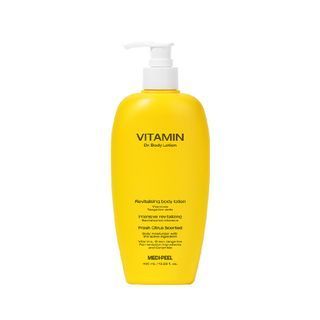
“Vitamin Dr. Body Lotion Body Lotion”
This product can help improve hydration of the skin with the two types of ingredients.
The first type is called “humectants”:
these ingredients help attract water.
When humectants are on the surface of the skin, they “pull in” the moisture from the outside environment, or from
within deeper layers of the skin. The following ingredients in this product do the job:
arginine, glycerin.
This product also contains ingredients called “occlusives”. They help reduce the speed with which our skin loses moisture to the outside environment. These ingredients also help soften the upper layer of the skin, so it feels less tight and nicer to the touch. The following ingredients in this product do the job: arginine, caprylic/capric triglyceride.
The following ingredients in this product are especially good for supporting the skin barrier and helping with the hydration level: ceramide ap, ceramide as, ceramide eop, ceramide np, ceramide ns
Evens skin toneNot advertised by the brand · 4 ingredients credited for this claimModerate support
The following ingredient (ingredients) in this product might be helpful, but there is no evidence to confirm that it actually works: pancratium maritimum extract.
Anti-agingNot advertised by the brand · 6 ingredients credited for this claimModerate support
This product contains folic acid. This ingredient might be able to help reduce and prevent fine lines and wrinkles, improve skin elasticity and firmness, but there is not enough evidence that it actually works.
Anti-oxidationNot advertised by the brand · 7 ingredients credited for this claimModerate support
This product contains antioxidants (pyridoxine, saccharomyces/barley seed ferment filtrate) that might be able to help neutralize free radicals in skin to lessen the damage it gets from the UV light (sun). There is not enough evidence to confirm their effectiveness in skin though.
Can it cause trouble?
Irritancy7 strong irritants: Parfum, Citrus unshiu fruit extract + 5 more — patch-test recommendedHigh risk
Comedogenic2 ingredients rated 2 or more on the 0–5 pore-clogging scale2 flagged


User reviews
Be the first — your take helps the next person decide.
Ingredients
Filter by role to see what each ingredient is doing.
Water~45–55%
Hippophae rhamnoides water~4.3–5.3%
- Irritation risk
- Medium
A plant-infused water. The concentration of compounds with potential skin benefits is unlikely to be effective
More about Hippophae rhamnoides waterCaprylic/capric triglyceride~4.3–5.2%
- Irritation risk
- Medium
A good mix of fatty acids that forms a protective layer on the skin. Improves the shelf life of products. Derived from coconut and glycerin
More about Caprylic/capric triglycerideEthylhexyl stearate~3.1–3.8%
- Irritation risk
- Low
Helps soften the upper layer of the skin
More about Ethylhexyl stearateGlycerin~2.4–2.9%
- Irritation risk
- Low
One of the best moisturizing ingredients. Naturally present in skin. It attracts water to the upper layer of the skin working as a humectant
More about GlycerinPropanediol~1.9–2.3%
- Irritation risk
- Low
Acts as a solvent for other ingredients. Speeds up the absorption of other ingredients into the skin
More about PropanediolDipropylene glycol~1.5–1.9%
- Irritation risk
- Low
Helps to dissolve other ingredients in a formulation. Slows down the rate of product drying
More about Dipropylene glycolHydrogenated poly(c6-14 olefin)~1.5–1.8%
- Irritation risk
- Low
Helps soften the upper layer of the skin and create a nice product texture
More about Hydrogenated poly(c6-14 olefin)Polyglyceryl-6 stearate~1.2–1.5%
- Irritation risk
- Low
Helps soften the upper layer of the skin
More about Polyglyceryl-6 stearateMethyl trimethicone~0.95–1.15%
- Irritation risk
- Low
A type of silicone that helps create a silky product finish and dissolve other ingredients
More about Methyl trimethiconeButyrospermum parkii butter~0.75–1.1%
- Irritation risk
- Low
- Comedogenicity
- 3/5
A great moisturising ingredient that softens the skin and reduces water loss from its upper layer. It also can be helpful in protecting skin from free radicals
More about Butyrospermum parkii butter1,2-hexanediol~0.55–0.8%
Cetearyl alcohol~0.6–0.9%
- Irritation risk
- Low
- Comedogenicity
- 2/5
A non-drying alcohol. Works as an emollient. Helps water and oil mix together and creates a nice product texture
More about Cetearyl alcoholTrehalose~0.45–0.7%
- Irritation risk
- Low
A sugar that attracts water to the upper layer of the skin
More about TrehalosePalmitic acid~0.5–0.75%
- Irritation risk
- Low
An emollient that is naturally present in skin and helps soften it
More about Palmitic acidPolyglyceryl-6 behenate~0.45–0.65%
Stearic acid~0.55–0.8%
- Irritation risk
- Low
Helps oil and water mix together and works as an emollient
More about Stearic acidParfum~0.3–0.6%
- Irritation risk
- High
An aromatic blend of unspecified and possibly irritating ingredients
More about ParfumArginine~0.3–0.55%
- Irritation risk
- Low
An amino acid that is naturally present in skin and helps keep it hydrated. When used together with AHAs, it can reduce their irritating effect on the skin
More about ArginineCarbomer~0.3–0.55%
- Irritation risk
- Low
Helps create a thicker or gel-like product texture. It is not a surfactant but can be used in gentle cleansing formulations
More about CarbomerPanthenol~0.25–0.5%
- Irritation risk
- Low
Helps attract water to the upper layer of the skin and can help improve skin barrier function
More about PanthenolEthylhexylglycerin~0.25–0.5%
Disodium edta~0.25–0.45%
Butylene glycol~0.25–0.45%
- Irritation risk
- Low
Used to create a nice product texture and help delivery of other ingredients. Might be somewhat helpful in attracting water to the upper layer of the skin
More about Butylene glycolHydrogenated lecithin~0.25–0.5%
- Irritation risk
- Low
Helps to retain moisture by creating a protective barrier on the skin. Rich in fatty acids. Improves product texture and helps with the penetration of other ingredients.
More about Hydrogenated lecithinCi 19140~0.25–0.45%
Polyglyceryl-10 stearate~0.25–0.45%
- Irritation risk
- Medium
Helps water and oil mix together and softens the upper layer of the skin
More about Polyglyceryl-10 stearateAscorbic acid~0.25–0.45%
- Irritation risk
- High
The most well-researched antioxidant that works in skin. Helps neutralize free radicals supporting collagen production, helping to even out the skin tone and preventing early signs of aging
More about Ascorbic acidCeramide np~0.3–0.55%
- Irritation risk
- Low
A type of lipid similar to ceramides naturally present in skin. Helps to soften the upper layer of the skin and supports the skin barrier function to keep it hydrated. Can help to prevent inflammation in skin
More about Ceramide npAdansonia digitata seed extract~0.25–0.45%
- Irritation risk
- Low
Sodium ascorbyl phosphate~0.25–0.5%
- Irritation risk
- Medium
A stable derivative of vitamin C. It is oil-soluble which means it is more likely to penetrate the skin compared to the pure form of vitamin C (which is water-soluble), but it is less bio-available and is way less effective in stimulating collagen and reducing wrinkles compared to the pure form of vitamin C (L-ascorbic acid) and its other derivatives (for example, magnesium ascorbyl phosphate). At the same time, this vitamin C derivative has been shown in studies to be effective in reducing acne, blemishes and clogged pores. It is less irritating then the pure form of vitamin C
More about Sodium ascorbyl phosphateLactobacillus/pear juice ferment filtrate~0.25–0.45%
- Irritation risk
- Low
Lactobacillus/punica granatum fruit ferment extract~0.25–0.45%
- Irritation risk
- High
An enzyme-based exfoliant
More about Lactobacillus/punica granatum fruit ferment extractLactobacillus/soybean ferment extract~0.25–0.45%
- Irritation risk
- Low
A fermentation product created by bacteria Lactobacillus out of soybean. The fermented product helps to attract water to the upper layer of the skin and has anti-bacterial properties. It might be helpful in calming down inflammation and could be helpful in evening out skin tone, but studies are lacking
More about Lactobacillus/soybean ferment extractSaccharomyces/barley seed ferment filtrate~0.25–0.45%
- Irritation risk
- Low
A yeast extract that can help neutralize free radicals in skin and can help attract water to its upper layers
More about Saccharomyces/barley seed ferment filtrateNiacinamide~0.25–0.45%
- Irritation risk
- Low
Is proven to be effective in reducing blemishes, evening out skin tone and helping to improve lines and wrinkles. It helps the skin to repair sun damage, calm down inflammation and keep maintain good levels of moisture. The concentration of about 2% is effective for supporting the skin barrier and evening out the skin tone. Concentration of 4-6% is better for helping with acne and balancing the sebum production
More about NiacinamideCitrus unshiu fruit extract~0.25–0.5%
- Irritation risk
- High
Citrus unshiu peel extract~0.25–0.45%
- Irritation risk
- High
Tocopherol~0.25–0.5%
- Irritation risk
- Low
Pure form of vitamin E. Can help moisturise and protect the skin from free radicals. Often used to help stabilise other ingredients or the formula itself
More about TocopherolPancratium maritimum extract~0.25–0.45%
- Irritation risk
- High
A plant extract that might help neutralize free radicals in skin. It might help reduce hyperpigmentation
More about Pancratium maritimum extractCeramide as~0.25–0.45%
- Irritation risk
- Low
A type of lipid similar to ceramides naturally present in skin. Helps to soften the upper layer of the skin and supports the skin barrier function to keep it hydrated. Can help to prevent inflammation in skin
More about Ceramide asCeramide ns~0.25–0.5%
- Irritation risk
- Low
A type of lipid similar to ceramides naturally present in skin. Helps to soften the upper layer of the skin and supports the skin barrier function to keep it hydrated. Can help to prevent inflammation in skin
More about Ceramide nsCi 42090~0.25–0.45%
Biotin~0.25–0.45%
- Irritation risk
- Low
Might have some moisturising properties. Is not effective when applied topically beyond some moisturizing effect
More about BiotinCeramide ap~0.25–0.45%
- Irritation risk
- Low
A type of lipid similar to ceramides naturally present in skin. Helps to soften the upper layer of the skin and supports the skin barrier function to keep it hydrated. Can help to prevent inflammation in skin
More about Ceramide apCeramide eop~0.25–0.5%
- Irritation risk
- Low
A type of lipid similar to ceramides naturally present in skin. Helps to soften the upper layer of the skin and supports the skin barrier function to keep it hydrated. Can help to prevent inflammation in skin
More about Ceramide eopFolic acid~0.25–0.45%
- Irritation risk
- Low
Can help stimulate collagen production in skin. While available studies are promising, more research is needed to confirm the efficacy in skin
More about Folic acidPyridoxine~0.25–0.4%
- Irritation risk
- High
Might help neutralize free radicals in skin, but evidence of effectiveness in skin is lacking. It might be irritating
More about PyridoxineCyanocobalamin~0.2–0.4%
- Irritation risk
- Low
Can support skin barrier function and reduce inflammation in skin
More about CyanocobalaminSodium hyaluronate~0.2–0.4%
- Irritation risk
- Low
One of the best moisturizing ingredients. Attracts water into the upper layer of the skin
More about Sodium hyaluronateLinoleic acid~0.35–0.6%
- Irritation risk
- Low
An excellent emollient. Helps soften the skin, restore its barrier function, and can help to calm down inflammation. It can be helpful to prevent blemishes and clogged pores
More about Linoleic acidRiboflavin~0.2–0.4%
- Irritation risk
- Low
Beta-carotene~0.15–0.3%
Thiamine hcl~0.15–0.3%
- Irritation risk
- Medium
Can help attract water to the upper layer of the skin. Is studied as a mosquito repellent
More about Thiamine hclAlpha-isomethyl ionone~0.15–0.3%
- Irritation risk
- High
A fragrance. Potential allergen and can be irritating
More about Alpha-isomethyl iononeCitral~0.15–0.25%
Limonene~0.1–0.15%
- Irritation risk
- High
A common frangrance that can easily irritate skin, especially if exposed to air, light or heat
More about LimoneneLinalool~0.1–0.15%
Ingredient list view
Water, Hippophae rhamnoides water, Caprylic/capric triglyceride, Ethylhexyl stearate, Glycerin, Propanediol, Dipropylene glycol, Hydrogenated poly(c6-14 olefin), Polyglyceryl-6 stearate, Methyl trimethicone, Butyrospermum parkii butter, 1,2-hexanediol, Cetearyl alcohol, Trehalose, Palmitic acid, Polyglyceryl-6 behenate, Stearic acid, Parfum, Arginine, Carbomer, Panthenol, Ethylhexylglycerin, Disodium edta, Butylene glycol, Hydrogenated lecithin, Ci 19140, Polyglyceryl-10 stearate, Ascorbic acid, Ceramide np, Adansonia digitata seed extract, Sodium ascorbyl phosphate, Lactobacillus/pear juice ferment filtrate, Lactobacillus/punica granatum fruit ferment extract, Lactobacillus/soybean ferment extract, Saccharomyces/barley seed ferment filtrate, Niacinamide, Citrus unshiu fruit extract, Citrus unshiu peel extract, Tocopherol, Pancratium maritimum extract, Ceramide as, Ceramide ns, Ci 42090, Biotin, Ceramide ap, Ceramide eop, Folic acid, Pyridoxine, Cyanocobalamin, Sodium hyaluronate, Linoleic acid, Riboflavin, Beta-carotene, Thiamine hcl, Alpha-isomethyl ionone, Citral, Limonene, Linalool
Compare prices
Retailers ranked by price — lowest first.

Affiliate links · prices updated regularly
Worth comparing, line by line.
Match % combines shared ingredients, the first five ingredients, shared actives and hero ingredients, irritancy (lower counts in the alternative's favour), texture and body area. Only products in the same routine step are compared.
| MEDI-PEELVitamin Dr. Body LotionYOUR PRODUCT | etvosUltimoist Lotion Lavender Scent | Mary&MayIdebenone Blackberry Intense Cream | FEEVHyper-Hydro Cream | |
|---|---|---|---|---|
| Match | — | 76% | 71% | 71% |
| Price | $41.30 | $58.30+$17.00 | $16.33−$24.97 | $18.72−$22.58 |
| Shared key ingredients | — | 8 of 20 | 11 of 20 | 9 of 20 |
| Key difference | — | Ceramide Ng | Adenosine | Phytosphingosine |
| Irritancy | High | Medium | Medium | Medium |
| Drying alcohol | — | — | — | Contains drying alcohol |
| View product | Shop | Shop | Shop |


Product summary
Based on the ingredient list, "MEDI-PEEL - Vitamin Dr. Body Lotion" can work well for skin moisturization. To work well, any moisturizer needs to include a combination of water-binding and emollient ingredients. MEDI-PEEL - Vitamin Dr. Body Lotion ticks this box. Humectants in this product (arginine, glycerin, sodium hyaluronate, trehalose and saccharomyces/barley seed ferment filtrate) help to increase the water content in the upper layer of the skin. (These ingredients do so by "capturing" water molecules from the outside air or from within the deeper layers of the skin). Emollients in this formulation (ceramide eop, ceramide np, ceramide ns, arginine and caprylic/capric triglyceride) help to reduce the moisture loss from the skin. They also soften the skin surface and relieve the feeling of dryness and tightness.
Ingredient callouts
- This product also contains Vitamin C (Ascorbic Acid). It can be an effective active for anti-aging and evening out the skin tone, but in this moisturizer it is used for stabilizing other ingredients in the formulation. In this concentration (0.25% - 0.45%) it cannot have a noticeable benefit for the skin.
- As a plus, this moisturizer also contains Ceramides (ceramide eop 0.25% - 0.50%, ceramide ap 0.25% - 0.45%, ceramide ns 0.25% - 0.50%, ceramide as 0.25% - 0.45% and ceramide np 0.30% - 0.55%). Ceramides are a type of lipids that our skin produces itself. They are a building block of the skin's barrier. Ceramides used in skincare are synthetic or extracted from plants. They work well for softening the skin surface and "patch holes" in the skin's barrier.
Irritation risk
There are quite a few common irritants in this product, including ingredients without particular skin benefits. We would not recommend it for sensitive skin. We assess the overall irritancy of this moisturizer to be high. For a detailed overview of all potential irritants: click here
You can see the detailed formula review with the breakdown of all actives in the product and the full ingredient list with estimated concentrations in the tables below.
Price
The product retails for 41.30$ in the United States.
For a detailed price comparison: click here.
Sources cited in this review
Every concentration estimate and effectiveness label is anchored to one of these 30 studies and safety reviews.
- 1
- 2
- 3Skin moisturizing effects of panthenol-based formulationspdfs.semanticscholar.org
- 4
- 5
- 6

Affiliate links · As an Amazon Associate, WIMJ earns from qualifying purchases.