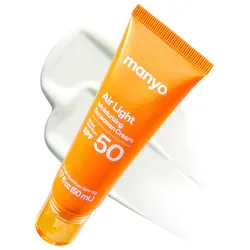
Manyo Air Light Moisturizing Sunscreen SPF 50
Works for
Sun protectionSPF 50 · 4 UV filters · Partial spectrumWeak protection
This product does not offer good protection against UVA rays.
This product can be considered "reef safe" because it does not contain the UV filters (oxybenzone and octinoxate) that can be harmful to coral reefs when present in the water in high concentrations.
Evens skin toneTranexamic acid, NiacinamideWorks well
“TXA (Tranexamic Acid): Prevents dark spots from forming.”
This product can help reduce hypepigmentation and even out the skin tone because it contains the following effective ingredients: tranexamic acid
Keep in mind that you would need to apply any topical skincare targetted at hypigmentation consistently for a couple of months to get a result. No topical skincare product can help get rid of hyperpigmentation (including post-acne marks and age spots) instantly.
This product can also help with skin tone because it offers sun protection. Sun damage is the main factor causing age spots, darkening of post-acne marks and other discolorations. This is why sun protection is the best strategy for maintaining an even skin tone. We, however, do not recommend using this product as a sunscreen because the protection it offers is not strong enough).
MoisturizingSide benefit the brand mentions · Polymethylsilsesquioxane, Hydroxyethyl urea + 13 moreWorks
“Air Light Moisturizing Sunscreen SPF 50”
This product can help improve hydration of the skin with the two types of ingredients.
The first type is called “humectants”:
these ingredients help attract water.
When humectants are on the surface of the skin, they “pull in” the moisture from the outside environment, or from
within deeper layers of the skin. The following ingredients in this product do the job:
biosaccharide gum-1, glycerin.
This product also contains ingredients called “occlusives”. They help reduce the speed with which our skin loses moisture to the outside environment. These ingredients also help soften the upper layer of the skin, so it feels less tight and nicer to the touch. The following ingredients in this product do the job: dimethiconol, isododecane.
Can it cause trouble?
Irritancy2 strong irritants: Rosmarinus officinalis leaf oil, Salvia sclarea oilMedium risk
ComedogenicClean of flagged comedogenic ingredientsNone flagged


User reviews
Be the first — your take helps the next person decide.
Ingredients
Filter by role to see what each ingredient is doing.
Phenylbenzimidazole sulfonic acid2.5%
- Irritation risk
- Medium
Ensulizole. A UV filter that is effective against UVB rays. Does not protect against UVA light. It is photostable and can be used to help stabilize other sunscreen ingredients. It is water-soluble meaning that it can help create lighter sunscreen formulations
More about Phenylbenzimidazole sulfonic acidHomosalate5%
- Irritation risk
- Medium
A weak sunscreen that offers some protection against the sun rays that cause sunburn (UVB), but does not offer meaningful protection against protect against the most aging sun rays (UVA). It loses its effectiveness quickly when exposed to sunlight. It is an organic, or so called "chemical" sunscreen. When used in low concentrations, helps to stabilize the product formulation
More about HomosalateEthylhexyl salicylate4.5%
- Irritation risk
- Low
Octisalate. A UV filter. It offers some protection against the sun rays that cause sunburn (UVB), but does not protect against the most aging sun rays (UVA). It loses its effectiveness quickly when exposed to sunlight. It is an organic, or so called "chemical" sunscreen
More about Ethylhexyl salicylateOctocrylene5%
- Irritation risk
- Medium
A weak sunscreen that protects against the sun rays that cause sunburn (UVB) and is somewhat effective against the UVA rays. It is quite stable and can help stabilize other, more vulnerable, sunscreen ingredients like Avobenzone. It is an organic, or so called "chemical" sunscreen
More about OctocryleneWater~45–55%
Butyloctyl salicylate~6.6–8.1%
- Irritation risk
- Medium
A synthetic ester of salicylic acid that is used to help disperse pigments and boost effectiveness of sunscreen ingredients. It is able to absorb UV light (working as an organic, or chemical filter), but is not approved as a sunscreen ingredient on its own
More about Butyloctyl salicylateEthylhexyl methoxycrylene~5.9–7.2%
- Irritation risk
- Medium
Helps improve stability of sunscreen filters and boost their effectiveness
More about Ethylhexyl methoxycrylenePropanediol~4–4.8%
- Irritation risk
- Low
Acts as a solvent for other ingredients. Speeds up the absorption of other ingredients into the skin
More about PropanediolBenzotriazolyl dodecyl p-cresol~3.2–3.9%
- Irritation risk
- Medium
Used to stabilize the product formulation protecting it from sun light
More about Benzotriazolyl dodecyl p-cresolMethyl methacrylate crosspolymer~2.6–3.2%
- Irritation risk
- Low
Helps thicken the product consistency
More about Methyl methacrylate crosspolymerPentylene glycol~1.9–2.3%
- Irritation risk
- Medium
Used to preserve products, dissolve other ingredients and create a nice product texture
More about Pentylene glycolPolymethylsilsesquioxane~1.6–1.9%
- Irritation risk
- Low
A silicone that improves product texture and helps dissolve other ingredients. Can form a non-greasy film on the skin to prevent moisture loss
More about PolymethylsilsesquioxaneMethylpropanediol~1.2–1.5%
1,2-hexanediol~0.7–1.05%
Aminomethyl propanol~0.65–1%
Hydroxyethyl urea~0.55–0.8%
- Irritation risk
- Low
A synthetic humectant made from urea. It pulls water into the upper layer of the skin about as well as glycerin, but without glycerin's stickiness. Unlike urea, it has not been shown to exfoliate. Lab and animal tests suggest a low risk of irritation at the levels used in products.
More about Hydroxyethyl ureaBehenyl alcohol~0.6–0.85%
- Irritation risk
- Low
Non-drying alcohol that helps water and oil mix together. Also serves as an emollient
More about Behenyl alcoholDimethiconol~0.5–0.8%
- Irritation risk
- Low
A silicone that makes products more spreadable and keeps skin smooth. Helps to add gloss to skin and may visually fill in fine lines/wrinkles for short time
More about DimethiconolButylene glycol~0.35–0.65%
- Irritation risk
- Low
Used to create a nice product texture and help delivery of other ingredients. Might be somewhat helpful in attracting water to the upper layer of the skin
More about Butylene glycolC11-13 isoalkane~0.45–0.65%
- Irritation risk
- Low
Dipropylene glycol~0.3–0.6%
- Irritation risk
- Low
Helps to dissolve other ingredients in a formulation. Slows down the rate of product drying
More about Dipropylene glycolIsododecane~0.35–0.65%
- Irritation risk
- Low
An emollient that helps soften the skin and can decrease moisture loss. Helps create a nice product texture
More about IsododecanePolyglyceryl-3 methylglucose distearate~0.3–0.6%
- Irritation risk
- Medium
Helps water and oil mix together
More about Polyglyceryl-3 methylglucose distearateTromethamine~0.25–0.5%
Polyacrylic acid~0.45–0.65%
- Irritation risk
- Low
Poly c10-30 alkyl acrylate~0.25–0.45%
- Irritation risk
- Low
Cedrus atlantica bark oil~0.2–0.35%
- Irritation risk
- Low
Hydroxyacetophenone~0.25–0.4%
Dimethicone/vinyl dimethicone crosspolymer~0.25–0.4%
- Irritation risk
- Low
Used to stabilize product formulations and create a nice product texture
More about Dimethicone/vinyl dimethicone crosspolymerPolyether-1~0.25–0.45%
- Irritation risk
- Low
Sphingomonas ferment extract~0.2–0.4%
- Irritation risk
- Low
Ethylhexylglycerin~0.2–0.4%
Sodium stearoyl glutamate~0.3–0.55%
- Irritation risk
- Medium
Helps oil and water mix together
More about Sodium stearoyl glutamateRosmarinus officinalis leaf oil~0.2–0.4%
- Irritation risk
- High
A plant oil with high content of volatile compounds that can irritate the skin. Can be used as a fragrance. Has anti-bacterial properties and might help neutralize free radicals on the surface of the skin
More about Rosmarinus officinalis leaf oilSodium hyaluronate~0.2–0.4%
- Irritation risk
- Low
One of the best moisturizing ingredients. Attracts water into the upper layer of the skin
More about Sodium hyaluronateBiosaccharide gum-1~0.2–0.4%
- Irritation risk
- Low
Helps attract water to the upper layer of the skin and is claimed to provide a longer-lasting hydration because of its ability to create a water-binding film on the surface of the skin
More about Biosaccharide gum-1Salvia sclarea oil~0.25–0.4%
- Irritation risk
- High
Tocopherol~0.2–0.4%
- Irritation risk
- Low
Pure form of vitamin E. Can help moisturise and protect the skin from free radicals. Often used to help stabilise other ingredients or the formula itself
More about TocopherolHydrolyzed hyaluronic acid~0.2–0.4%
- Irritation risk
- Low
One of the best moisturizing ingredients. Attracts water into the upper layer of the skin. A version of it is naturally present in skin
More about Hydrolyzed hyaluronic acidGlycerin~0.25–0.45%
- Irritation risk
- Low
One of the best moisturizing ingredients. Naturally present in skin. It attracts water to the upper layer of the skin working as a humectant
More about GlycerinNiacinamide~0.2–0.35%
- Irritation risk
- Low
Is proven to be effective in reducing blemishes, evening out skin tone and helping to improve lines and wrinkles. It helps the skin to repair sun damage, calm down inflammation and keep maintain good levels of moisture. The concentration of about 2% is effective for supporting the skin barrier and evening out the skin tone. Concentration of 4-6% is better for helping with acne and balancing the sebum production
More about NiacinamideCaprylic/capric triglyceride~0.25–0.5%
- Irritation risk
- Medium
A good mix of fatty acids that forms a protective layer on the skin. Improves the shelf life of products. Derived from coconut and glycerin
More about Caprylic/capric triglycerideTranexamic acid~0.15–0.3%
- Irritation risk
- Low
An amino acid that is effective in reducing hyperpigmentation and evening out the skin tone. It can also help in skin barrier recovery. It is used to treat melasma, especially with injections and when taken orally
More about Tranexamic acidHydrogenated lecithin~0.15–0.25%
- Irritation risk
- Low
Helps to retain moisture by creating a protective barrier on the skin. Rich in fatty acids. Improves product texture and helps with the penetration of other ingredients.
More about Hydrogenated lecithinPolyglyceryl-4 caprate~0.1–0.2%
Polyglyceryl-6 caprylate~0.1–0.2%
- Irritation risk
- Medium
Helps oil and water mix together
More about Polyglyceryl-6 caprylateIngredient list view
Phenylbenzimidazole sulfonic acid, Homosalate, Ethylhexyl salicylate, Octocrylene, Water, Butyloctyl salicylate, Ethylhexyl methoxycrylene, Propanediol, Benzotriazolyl dodecyl p-cresol, Methyl methacrylate crosspolymer, Pentylene glycol, Polymethylsilsesquioxane, Methylpropanediol, 1,2-hexanediol, Aminomethyl propanol, Hydroxyethyl urea, Behenyl alcohol, Dimethiconol, Butylene glycol, C11-13 isoalkane, Dipropylene glycol, Isododecane, Polyglyceryl-3 methylglucose distearate, Tromethamine, Polyacrylic acid, Poly c10-30 alkyl acrylate, Cedrus atlantica bark oil, Hydroxyacetophenone, Dimethicone/vinyl dimethicone crosspolymer, Polyether-1, Sphingomonas ferment extract, Ethylhexylglycerin, Sodium stearoyl glutamate, Rosmarinus officinalis leaf oil, Sodium hyaluronate, Biosaccharide gum-1, Salvia sclarea oil, Tocopherol, Hydrolyzed hyaluronic acid, Glycerin, Niacinamide, Caprylic/capric triglyceride, Tranexamic acid, Hydrogenated lecithin, Polyglyceryl-4 caprate, Polyglyceryl-6 caprylate
Compare prices
Retailers ranked by price — lowest first.

Worth comparing, line by line.
Match % combines shared ingredients, the first five ingredients, shared actives and hero ingredients, irritancy (lower counts in the alternative's favour), texture and body area. Only products in the same routine step are compared.
| ManyoAir Light Moisturizing Sunscreen SPF 50YOUR PRODUCT | OlayTotal Effects Anti-Aging Moisturizer With SPF 30 | La Roche-PosayToleriane Sensitive UV Cream SPF 30 | REVOLUTION SKINCAREMoisture SPF30 Cream for Normal/Oily Skin | |
|---|---|---|---|---|
| Match | — | 89% | 89% | 89% |
| Price | $11.90 | $10.76−$1.14 | $18.24+$6.34 | $6.58−$5.32 |
| Shared key ingredients | — | 7 of 15 | 4 of 15 | 3 of 15 |
| Key difference | — | Sodium Ascorbyl Phosphate | Ceramide Np | Urea |
| Irritancy | Medium | High | Low | Low |
| SPF | SPF 50 | SPF 30 | SPF 30 | SPF 30 |
| Drying alcohol | — | — | — | — |
| View product | Shop | Shop | Shop |

More alternatives: Glytone Triple Defense Brightening SPF30 ComplexCeraVe AM Facial Moisturizing Lotion SPF 50
Sources cited in this review
Every concentration estimate and effectiveness label is anchored to one of these 28 studies and safety reviews.
- 1
- 2
- 3
- 4
- 5Glycerin and hydroxyethyl urea: Comparing two skin moisturizers (Cosmetics & Toiletries 2004)cosmeticsandtoiletries.com
- 6Hydrovance technical data sheet (Nouryon, 2021)media.knowde.com

Affiliate links · As an Amazon Associate, WIMJ earns from qualifying purchases.